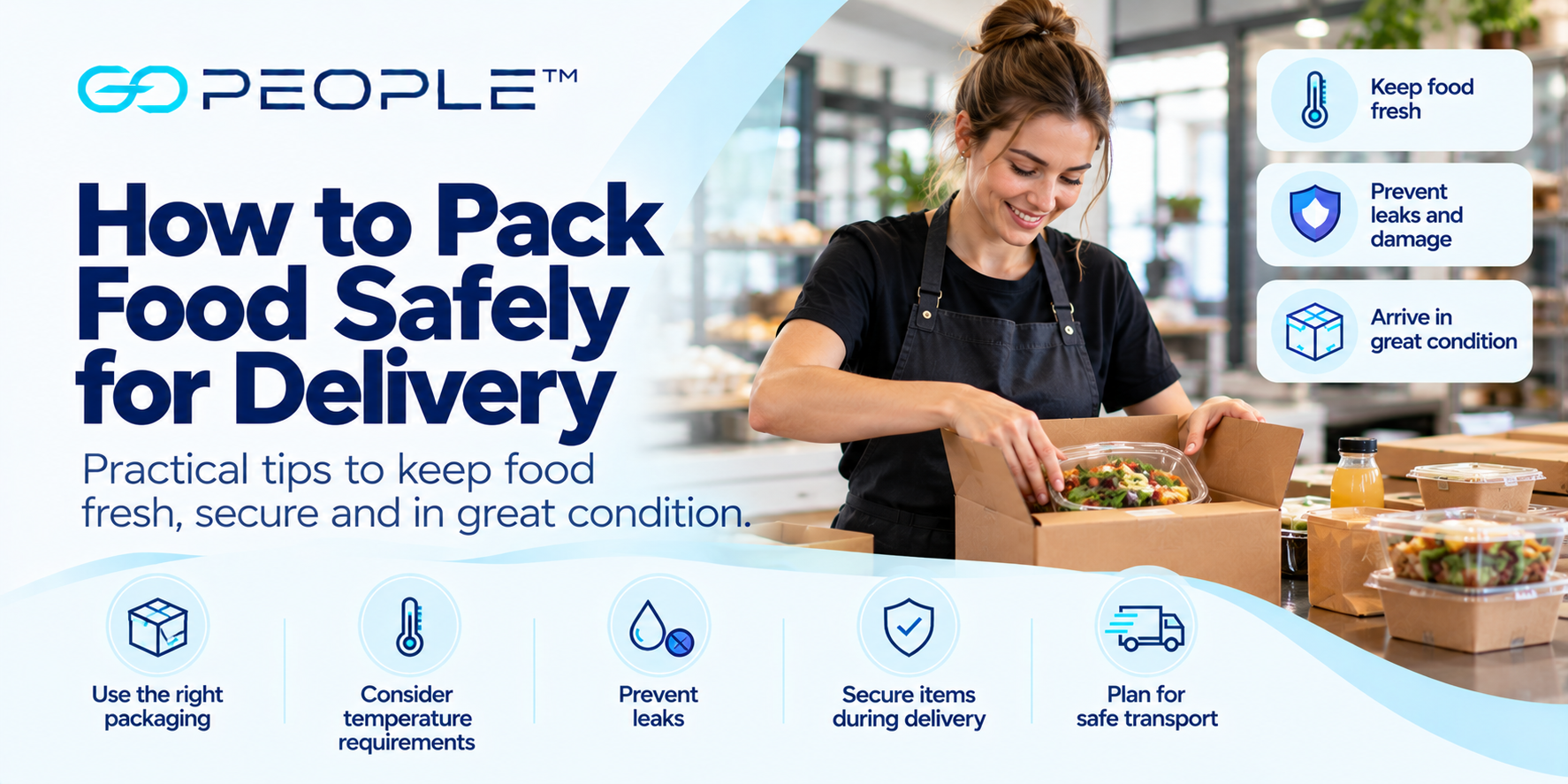
Food delivery creates challenges that ordinary parcel delivery doesn’t always have.
Products may be fragile, temperature-sensitive, prone to leaking or easily damaged if they’re allowed to move around during transport.
For businesses delivering food products, good packaging needs to protect both the product and the customer experience.
Here are practical considerations when preparing food for delivery.
1. Start With the Type of Food You’re Sending
There is no single packaging method that works for every food product.
Before choosing packaging, consider whether the item is:
- hot
- chilled
- frozen
- ambient
- liquid
- fragile
- easily crushed
- likely to leak
- sensitive to movement
A box of chocolates has very different requirements from a cake, bottled product or packaged pantry item.
The packaging and delivery method should reflect those differences.
2. Use Food-Suitable Packaging
Packaging that comes into direct contact with food should be appropriate for its intended use.
Businesses should use packaging supplied and represented as suitable for the particular food product and conditions involved.
This is especially important when packaging may be exposed to:
- heat
- moisture
- oils
- liquids
- refrigeration
- freezing
Don’t assume that a container is suitable simply because it fits the product.
3. Prevent Leaks Before They Happen
Liquids, sauces and products containing moisture require particular attention.
Check that:
- lids close securely
- containers remain sealed when tilted
- liquids cannot escape into the outer package
- different products are appropriately separated
Where appropriate, secondary containment can provide another layer of protection.
A leaking product can damage not only itself but everything else packed with it.
4. Stop Products Moving Around
Movement is one of the biggest risks during delivery.
Containers should fit securely within the outer packaging rather than sliding around every time the package is moved.
Depending on the product, businesses can use:
- dividers
- cardboard inserts
- appropriate cushioning
- fitted trays
- other packaging designed to hold products in position
The objective is to keep the product stable during normal handling and transport.
5. Separate Hot and Cold Products
If an order contains items with different temperature requirements, don’t assume they should all be packed together.
Hot and cold products can affect each other.
Where necessary, separate products so each can be maintained under appropriate conditions during the delivery journey.
6. Consider Temperature Requirements
Some foods need to remain within particular temperature conditions for safety or product quality.
The appropriate controls depend on the food being transported, the length of the journey and applicable food-safety requirements.
Businesses dealing with temperature-sensitive food should establish suitable procedures rather than relying on the delivery driver to solve temperature-control problems after collection.
Depending on the product, this may involve appropriate insulated packaging, cooling materials or specialised temperature-controlled transport.
7. Don’t Overlook the Outer Package
The food container isn’t necessarily the delivery package.
An outer bag, box or other suitable package can provide additional protection and make the order easier to handle.
It should be:
- strong enough for the contents
- appropriately sized
- easy to carry safely
- securely closed
- resistant to normal handling during the journey
Avoid oversized packaging that allows everything inside to move freely.
8. Package Fragile Food Carefully
Cakes, pastries, chocolates and other delicate products can be damaged without the package itself appearing damaged.
They may slide, tip, melt or lose their presentation during transport.
For delicate products:
- use appropriately sized packaging
- secure the product inside the container
- minimise empty space
- keep the package level where required
- clearly communicate relevant handling requirements
- choose a delivery method appropriate to the product
We’ve also prepared separate guides on delivering cakes safely and delivering chocolates without melting.
9. Make Packages Easy to Identify
When several orders are being prepared simultaneously, clear identification helps reduce fulfilment mistakes.
Depending on the operation, packages might include:
- order number
- customer name
- delivery reference
- handling information
- relevant storage instructions
The important thing is that staff can match the correct package to the correct delivery without unnecessary confusion.
10. Check the Delivery Details
Before an order leaves, verify the information required to complete the delivery.
That can include:
- complete address
- unit or suite number
- recipient contact details
- relevant access information
- appropriate delivery instructions
Food products can be particularly sensitive to delays, so avoidable address problems can create larger consequences than they might for a non-perishable parcel.
11. Think About the Delivery Timeframe
Packaging and delivery should be planned together.
Ask:
How long can this product reasonably remain in transit?
Does it need to arrive today?
Does it require specialised temperature control?
Can it safely be left unattended?
What happens if the recipient isn’t available?
These questions should be answered before choosing the delivery service.
12. Test Your Packaging With Real Deliveries
If your business regularly delivers the same products, test the packaging process.
Don’t judge packaging only by how it looks before dispatch.
Review what happens after the delivery.
Look for:
- leaking
- crushing
- movement
- temperature problems
- damaged presentation
- customer complaints
- product replacements
Then adjust the packaging where necessary.
Food Safety Comes First
Delivery speed and presentation matter, but food safety requirements come first.
Australian food businesses need to comply with applicable food-safety requirements for the products they prepare, store and transport.
Businesses handling potentially hazardous or temperature-sensitive food should determine the specific requirements that apply to their operation and use appropriate food-transport procedures.
A standard courier service should not be assumed to provide specialised refrigerated or temperature-controlled transport unless that capability has specifically been confirmed.
Choosing a Delivery Option
For suitable products and supported locations, businesses may have different delivery requirements.
GoBUNDLE can suit businesses making multiple local deliveries from one pickup location.
GoSAMEDAY can suit eligible business deliveries that need to be completed within the same day.
GoVIP provides an on-demand option for urgent individual delivery requirements.
Businesses should confirm that their product, packaging and temperature requirements are suitable for the chosen service before booking.
You can check GoPeople service availability for your pickup location.
Better Packaging Creates Better Deliveries
Good food-delivery packaging isn’t simply about putting an order in a bag.
Businesses need to consider the product, temperature, movement, leakage, delivery timeframe and what happens when the order reaches the customer.
The best approach is to treat packaging and delivery as one connected process.
That can help products arrive in better condition while reducing avoidable damage, replacements and customer complaints.