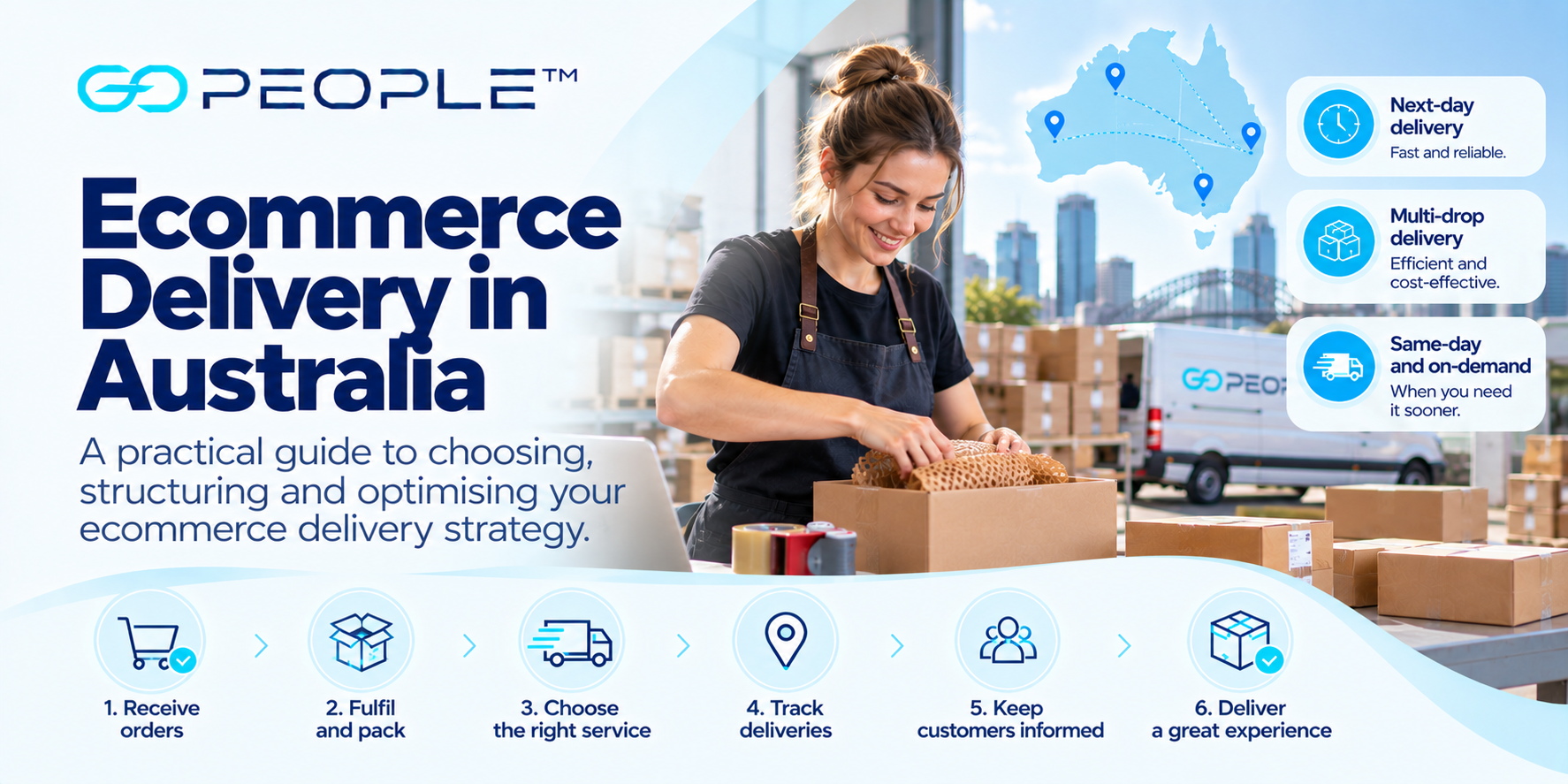
Delivery is one of the most important parts of running an ecommerce business.
A customer might spend only a few minutes placing an order, but the delivery process can continue for hours or days afterwards.
During that time, customers want to know when their order will arrive, where it is and what happens if something goes wrong.
For ecommerce businesses, choosing a delivery strategy therefore involves more than comparing courier prices.
Here are the main factors to consider.
Shipping vs Delivery: What’s the Difference?
The terms shipping and delivery are often used interchangeably in ecommerce.
Broadly:
Shipping describes the process of dispatching an order from the seller.
Delivery describes getting that order to the recipient.
For the customer, however, these processes are usually experienced as one journey:
Order placed → Fulfilment → Dispatch → Tracking → Delivery
That’s why ecommerce businesses should consider the entire process rather than treating delivery as something that happens after fulfilment.
Start With Your Order Profile
Before choosing a delivery provider, understand what you’re actually sending.
Consider:
- average orders per day
- parcel dimensions
- parcel weight
- pickup location
- customer locations
- order value
- fragile or unusual products
- required delivery speed
- seasonal peaks
A business sending 20 local deliveries has different requirements from an ecommerce retailer dispatching hundreds of parcels from a warehouse.
Your delivery model should reflect that.
Where Are Your Customers?
Customer location has a major influence on delivery strategy.
Review your order data and identify where deliveries are concentrated.
You may discover that a significant proportion of customers are located within particular metropolitan areas.
This can help determine whether options such as next-day, same-day or multi-drop metropolitan delivery make sense alongside any broader shipping arrangements your business uses.
How Fast Does Delivery Need to Be?
Faster delivery can be valuable, but not every order needs the fastest possible service.
Businesses should think about what customers actually require.
Next-Day Delivery
Next-day delivery can work well for regular ecommerce parcels where customers want fast delivery but don’t need the product within hours.
For businesses dispatching regular parcel volumes from warehouses in Sydney, Melbourne and Brisbane, GoEXPRESS provides a next-day delivery option.
Same-Day Delivery
Some orders genuinely need to arrive today.
GoSAMEDAY provides same-day delivery within supported areas.
On-Demand Courier
Urgent individual deliveries may require a different approach.
GoVIP is GoPeople’s on-demand courier option for urgent and time-sensitive delivery requirements.
Multi-Drop Delivery
Businesses with many local deliveries leaving from one location may benefit from grouping them into one run.
GoBUNDLE combines multi-drop delivery with route optimisation.
Don’t Make Every Order Urgent
One of the easiest ways to make ecommerce delivery unnecessarily expensive is to treat every parcel as urgent.
A customer who is perfectly happy receiving an order tomorrow doesn’t necessarily need an immediate courier.
Instead, businesses can create a delivery strategy where different services solve different problems.
For example:
Regular ecommerce parcel → Next-day
Needs to arrive today → Same-day
Multiple local orders → Multi-drop
Unexpected urgent requirement → On-demand
This allows businesses to provide speed where it creates value without adding unnecessary urgency everywhere.
Consider the Complete Delivery Cost
The cheapest quoted delivery price isn’t necessarily the lowest-cost option.
Businesses should also consider the cost of:
- failed deliveries
- redeliveries
- customer enquiries
- refunds
- replacements
- damaged products
- manual administration
- poor delivery visibility
A small difference in delivery price can be outweighed by additional operational work if the delivery experience is unreliable.
Tracking Matters
Once an ecommerce order leaves the warehouse, customers lose physical visibility of it.
Tracking helps fill that gap.
Useful delivery visibility can include:
- order status
- delivery progress
- customer notifications
- delivery events
- proof of delivery
Tracking is also valuable internally.
When a customer contacts support, staff can use delivery information to understand what has happened rather than starting an investigation without context.
Customer Notifications Reduce Uncertainty
Good delivery communication doesn’t require sending constant messages.
It means giving customers useful information at important stages of the delivery.
Depending on the service, this can include notifications around dispatch, delivery progress and completion.
The objective is simple:
The customer shouldn’t need to contact the retailer just to understand what is happening with their order.
Proof of Delivery
Proof of delivery provides a record that a delivery has been completed.
This can help businesses:
- confirm completion
- respond to customer enquiries
- investigate disputes
- maintain delivery records
For businesses processing significant order volumes, digital proof of delivery is much easier to manage than relying on individual drivers or manual records.
Packaging and Delivery Should Work Together
Delivery planning starts before the parcel leaves the warehouse.
Packaging should be appropriate for:
- the product
- parcel dimensions
- product weight
- fragility
- expected handling
- delivery journey
Oversized packaging can create unnecessary waste and handling inefficiency.
Insufficient packaging can lead to damage and replacement deliveries.
The goal is to protect the product without unnecessary material.
Plan for Failed Deliveries
Not every delivery will succeed on the first attempt.
Common problems can include:
- incorrect addresses
- missing apartment numbers
- inaccessible buildings
- unavailable recipients
- incomplete delivery instructions
Ecommerce businesses should understand what happens when delivery cannot be completed.
Questions to ask a provider include:
What happens after an unsuccessful delivery attempt?
How will the business know?
What information will the recipient receive?
How is redelivery handled?
What happens to the parcel in the meantime?
Exception handling becomes increasingly important as order volumes grow.
Think About Integrations and Automation
At low volumes, manually booking deliveries may be manageable.
As order volumes increase, repetitive administration becomes a bottleneck.
Businesses may benefit from automating parts of the process, including:
- transferring order information
- creating delivery bookings
- providing tracking information
- receiving delivery status updates
- accessing proof of delivery
The objective is to reduce the amount of manual work required for each additional order.
Review Delivery Performance
Delivery shouldn’t be treated as a set-and-forget supplier relationship.
Monitor how the operation is performing.
Useful measures can include:
- successful delivery rate
- failed deliveries
- redeliveries
- delivery-related customer enquiries
- complaints
- damage
- delivery cost per order
- delivery performance
The right measures depend on the business, but they should tell you more than simply how much you spent on couriers.
Choosing an Ecommerce Delivery Provider
When comparing providers, consider:
Coverage: Can they collect from your fulfilment location and reach your customers?
Service options: Do they provide the delivery timeframes you require?
Tracking: Can your business and customers see useful delivery information?
Proof of delivery: Is completion recorded digitally?
Technology: Can delivery processes integrate with your operation as volumes grow?
Support: What happens when a delivery doesn’t go according to plan?
Pricing: Does the total service make commercial sense for your order profile?
No single delivery provider or service model will necessarily solve every ecommerce delivery requirement.
Building a Better Ecommerce Delivery Strategy
A good ecommerce delivery strategy matches the service to the order.
Rather than asking:
“Which courier is cheapest?”
a better starting point is:
“What delivery experience do our customers need, and how can we provide it efficiently?”
That may involve different delivery services for different order types.
GoPeople provides next-day, multi-drop, same-day and on-demand delivery options for Australian businesses in supported areas.
You can check GoPeople service availability based on your pickup location.
As ecommerce volumes grow, the objective should remain the same: get the right order to the right customer using a delivery process that is reliable, visible and commercially sustainable.
Frequently Asked Questions About Ecommerce Delivery
What is ecommerce delivery?
Ecommerce delivery is the process of getting an online order from the retailer or fulfilment location to the customer.
It can involve several stages, including order fulfilment, collection, sorting, transport, tracking and final delivery. The exact process depends on the delivery service being used.
What is the best delivery option for an ecommerce business?
There isn’t one delivery option that is best for every ecommerce business.
The appropriate service depends on factors such as order volume, pickup location, customer location, parcel size and required delivery speed.
A business might use next-day delivery for regular ecommerce parcels, same-day delivery for time-sensitive orders, multi-drop delivery for batches of local deliveries and an on-demand courier for urgent individual jobs.
What’s the difference between same-day and next-day ecommerce delivery?
Same-day delivery is designed for orders that need to be collected and delivered on the same day.
Next-day delivery allows the parcel to be collected and delivered on the following delivery day.
For many regular ecommerce orders, next-day delivery can provide a useful balance between speed and operational efficiency. Same-day delivery is more appropriate when receiving the order today creates genuine value for the customer.
We’ve covered this in more detail in our same-day vs next-day delivery guide.
How can ecommerce businesses reduce delivery costs?
Businesses can look beyond the individual courier rate and consider the entire delivery process.
Opportunities can include choosing the appropriate service level, consolidating multiple deliveries, optimising routes, improving address accuracy, reducing failed deliveries, using appropriate packaging and automating repetitive delivery administration.
See our guide to reducing business delivery costs for a more detailed explanation.
Why is delivery tracking important for ecommerce?
Once an order leaves the warehouse, the customer no longer has physical visibility of it.
Tracking helps customers understand the progress of their delivery and can reduce uncertainty. It also gives customer-service teams useful information when they need to investigate a delivery enquiry.
Tracking works best when combined with useful status updates, customer notifications and proof of delivery.
What should an ecommerce business do about failed deliveries?
Businesses should establish the failed-delivery process before problems occur.
This includes understanding what happens after an unsuccessful attempt, where the parcel goes, whether another attempt can be arranged, how the recipient is informed and whether additional charges apply.
Businesses can also reduce avoidable failures by collecting accurate addresses, unit numbers, contact details and appropriate delivery instructions before dispatch.
Does GoPeople provide ecommerce delivery in Australia?
Yes. GoPeople provides several delivery services for businesses within supported Australian service areas.
These include GoEXPRESS for next-day delivery, GoBUNDLE for multi-drop delivery, GoSAMEDAY for same-day delivery and GoVIP for on-demand courier requirements.
Service availability depends on the pickup location and service. Businesses can check service availability here.