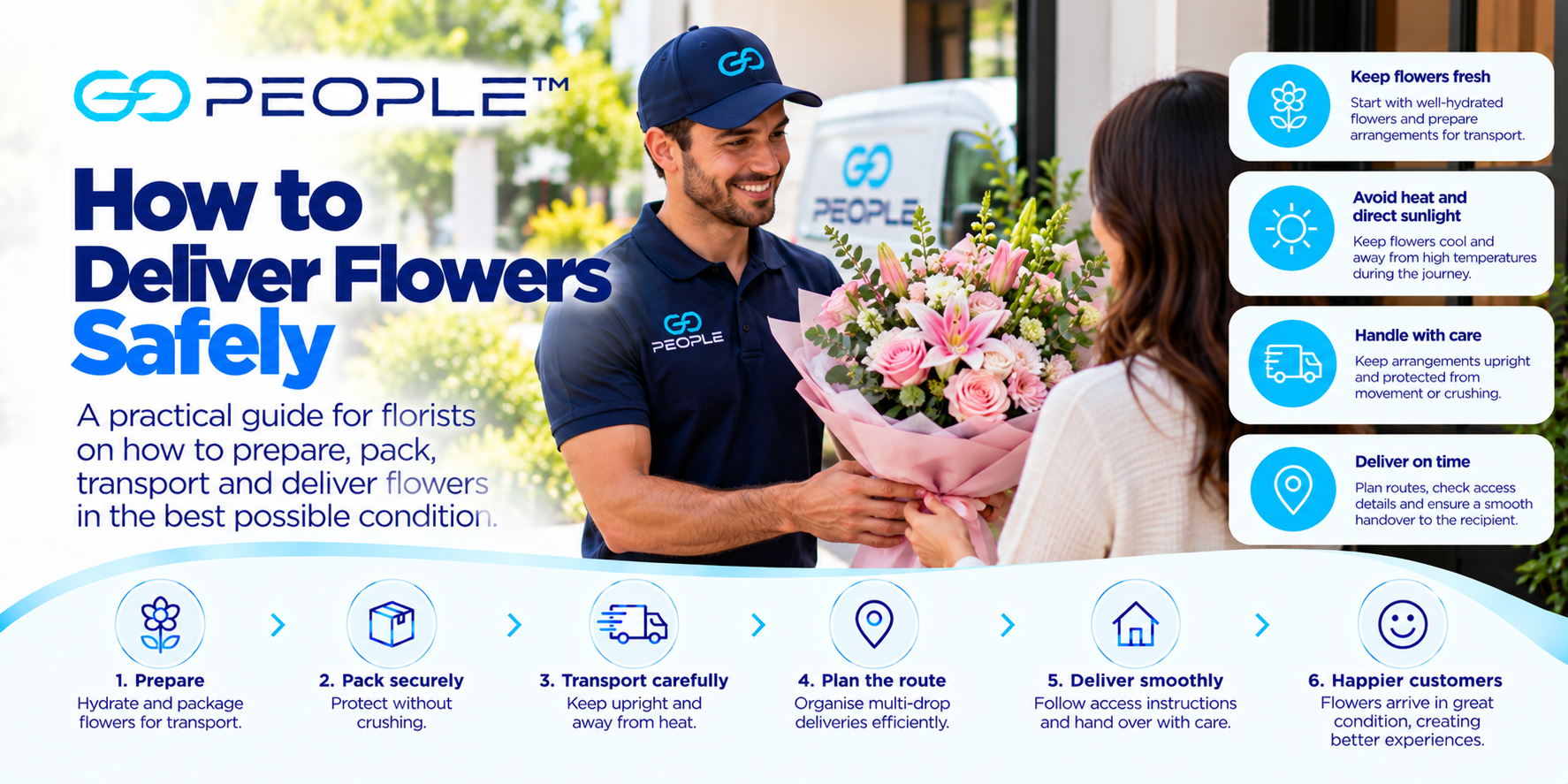
Flowers are delicate products. Unlike many ordinary parcels, they can be affected by heat, direct sunlight, dehydration, movement, crushing and poor handling during transport.
For florists and flower businesses, that makes delivery part of the product experience.
A beautiful arrangement can leave the shop in perfect condition but arrive looking very different if it tips over, sits in a hot vehicle, is squeezed between other items or can’t be handed over successfully.
The objective isn’t simply to move flowers from one address to another.
It is to preserve the presentation the florist created until the customer or recipient receives it.
This guide explains practical ways florists and flower businesses can prepare, load, transport and deliver flowers more safely.
Why Flower Delivery Needs Extra Care
Flowers present several challenges that don’t apply to ordinary boxed products.
They can be:
- easily crushed
- sensitive to heat
- sensitive to direct sunlight
- affected by dehydration
- top-heavy
- difficult to stack
- vulnerable to sudden vehicle movement
- damaged by other parcels
Presentation also matters enormously.
If a cardboard box receives a minor mark during delivery, the product inside may still be completely unaffected.
With flowers, the presentation is part of the product.
Bent stems, damaged petals or a bouquet that has fallen sideways can immediately change the customer’s impression.
Start With the Arrangement
Safe flower delivery begins before the flowers enter the vehicle.
A florist should consider how the arrangement will behave during transport while preparing it.
Ask:
- Is it stable?
- Is it top-heavy?
- Can stems move excessively?
- Could water leak?
- Are delicate flowers exposed?
- Will wrapping protect the arrangement without crushing it?
- Can it stand upright securely?
An arrangement designed only for appearance on a counter may not necessarily be designed for a moving vehicle.
The goal is to protect the presentation without compromising the florist’s design.
Hydrate Flowers Before Dispatch
Flowers should generally begin their delivery journey in appropriate condition.
For fresh-cut flowers, hydration before dispatch can be important because delivery adds time between preparation and receipt.
The appropriate method depends on:
- flower type
- arrangement
- delivery duration
- florist’s preparation method
Florists should follow appropriate handling practices for the specific flowers being transported.
The important principle is simple:
Don’t begin the delivery process with flowers that are already stressed or dehydrated.
Manage Water Carefully
Water helps flowers remain fresh, but it can also create transport problems.
A container that leaks or tips can:
- damage the arrangement
- wet wrapping
- damage cards
- affect other deliveries
- create a slippery vehicle surface
Check water-containing arrangements before dispatch.
Make sure containers are stable and prepared appropriately for transport.
For arrangements using vases, the vase itself also needs protection from movement and breakage.
Protect Delicate Flowers
Some arrangements contain flowers or decorative elements that are particularly vulnerable to contact.
Avoid packaging that presses heavily against:
- petals
- flower heads
- delicate foliage
- decorative elements
At the same time, leaving everything completely exposed can make the arrangement vulnerable to contact with the vehicle, driver or other deliveries.
The right protection should create a buffer around vulnerable areas without flattening the arrangement.
Don’t Over-Wrap the Flowers
More packaging isn’t automatically safer.
Excessive wrapping can:
- compress the arrangement
- trap heat
- damage petals
- distort the shape
- make the arrangement difficult to handle
Packaging should protect the flowers while preserving their presentation.
This is different from shipping a conventional product where filling every empty space inside a box may be desirable.
Flowers need appropriate support without unnecessary pressure.
Keep Bouquets Upright
One of the biggest risks during flower delivery is an arrangement falling sideways.
Once that happens, the flowers can be damaged by:
- their own weight
- contact with the vehicle
- contact with other arrangements
- leaking water
- repeated movement
Where the arrangement is designed to remain upright, the transport setup should support that position.
Possible approaches depend on the arrangement and vehicle, but the objective is to prevent unnecessary tipping and sliding.
Stabilise Vases and Containers
Vase arrangements need particular attention.
A tall arrangement can have a high centre of gravity, making it vulnerable during:
- braking
- acceleration
- cornering
- uneven roads
The vase should not simply be placed on an open vehicle floor and expected to remain upright.
It needs appropriate stabilisation.
The same applies to:
- flower boxes
- baskets
- pots
- decorative containers
Before the vehicle moves, ask:
What happens to this arrangement if the driver needs to brake suddenly?
If the likely answer is that it falls over, it isn’t ready for transport.
Don’t Stack Other Deliveries on Flowers
Flowers generally aren’t suitable as load-bearing items.
Avoid placing:
- boxes
- bags
- parcels
- other heavy items
on top of arrangements.
Even relatively light pressure can affect petals, stems or presentation.
The delivery load should be organised so flowers have appropriate space.
Separate Arrangements Where Necessary
Multiple flower arrangements can damage each other if they’re packed too closely.
During transport, one bouquet can move into another.
Potential problems include:
- petals rubbing together
- stems becoming tangled
- decorative elements catching
- arrangements leaning against each other
Allow sufficient separation or support so arrangements remain stable throughout the journey.
This becomes particularly important during multi-drop flower delivery where many orders may share the same vehicle.
Be Careful With Vehicle Temperature
Temperature can significantly affect flowers.
A parked vehicle can become hot quickly, particularly in direct sunlight.
Avoid leaving flowers unnecessarily in:
- hot vehicles
- direct sunlight
- poorly ventilated areas
The appropriate conditions depend on the flower type and journey.
Florists transporting products with specific temperature requirements should use appropriate handling and transport arrangements.
Standard courier delivery shouldn’t be represented as refrigerated or temperature-controlled transport unless that capability has specifically been provided.
Keep Flowers Out of Direct Sunlight
Even when the vehicle’s overall temperature is reasonable, direct sunlight through a window can create localised heat.
An arrangement sitting beside a sunny window can experience very different conditions from one positioned elsewhere in the vehicle.
Where practical, position flowers away from prolonged direct sunlight.
This is particularly important during warmer weather.
Minimise Unnecessary Time in the Vehicle
Flowers are generally better served by efficient delivery planning than by spending unnecessary time travelling around.
Before dispatch, consider:
- when arrangements will be ready
- when the vehicle will leave
- how many stops are required
- approximate route
- recipient availability
- business opening hours
- difficult-access locations
Good planning can reduce unnecessary waiting and handling.
Plan Multi-Drop Flower Routes Carefully
Flower businesses may have many deliveries leaving from one location.
Examples include:
- Valentine’s Day
- Mother’s Day
- Christmas
- weddings
- corporate events
- ordinary daily florist deliveries
This is where route planning becomes particularly important.
A poorly organised route can increase:
- driving distance
- time in the vehicle
- delivery delays
- handling
- operating costs
Rather than simply delivering orders in the sequence they were received, consider how the stops can be organised efficiently.
GoPeople’s GoBUNDLE is designed for multi-drop deliveries and includes route optimisation.
Our guide to delivery route optimisation explains the concept in more detail.
Load According to the Delivery Route
Route planning and vehicle loading should work together.
Imagine loading 20 flower arrangements.
The first delivery is placed at the very back.
At every stop, the driver has to move other arrangements to reach it.
That creates unnecessary handling and increases the chance of damage.
Where practical, load arrangements so the delivery sequence can be completed with minimal movement of other orders.
The objective is:
Load once → Handle carefully → Deliver
rather than repeatedly rearranging the vehicle throughout the run.
Avoid Overloading the Vehicle
Trying to fit too many arrangements into one vehicle can create problems.
Crowding can lead to:
- crushing
- restricted access
- unstable arrangements
- repeated handling
- poor visibility
- difficulty unloading safely
Capacity should be based on more than whether the flowers technically fit inside the vehicle.
They need enough space to remain appropriately positioned.
This is particularly important during major florist peaks.
Prepare for Peak Flower-Delivery Days
Flower delivery demand isn’t evenly distributed throughout the year.
Certain dates can create unusually high volumes.
A florist that normally dispatches 20 deliveries might suddenly need to manage significantly more.
Plan peak periods in advance.
Consider:
- expected order volume
- delivery areas
- staffing
- vehicle capacity
- packaging materials
- route planning
- order cut-offs
- recipient information
- customer communication
Don’t wait until the morning of a major event to determine how the delivery operation will work.
Use Realistic Order Cut-Offs
It can be tempting to accept same-day flower orders for as long as possible.
But every late order can affect:
- preparation
- route planning
- vehicle loading
- driver departure
- other deliveries
Set cut-offs based on what the business and delivery operation can realistically support.
A sale isn’t successful if accepting it causes several existing orders to be delivered poorly.
Check Addresses Before Dispatch
Address problems are particularly costly when flowers are time-sensitive.
Check for:
- correct street number
- correct suburb
- correct postcode
- apartment or unit number
- business name
- recipient details
- contact number
For business addresses, confirm whether the destination is:
- an office
- reception
- shopping centre
- hospital
- school
- other managed building
A technically correct street address may still be difficult to deliver without enough detail.
Apartment Deliveries Need More Information
Apartment buildings can create additional delivery challenges.
Potential issues include:
- locked entrances
- intercom access
- missing unit numbers
- unavailable recipients
- restricted parking
- concierge arrangements
Where appropriate, collect sufficient information when the order is placed.
Waiting until the driver is outside a locked building is too late to discover that the recipient’s unit number is missing.
Business Deliveries Need Timing Awareness
Flowers sent to businesses may need to arrive while someone is available to receive them.
Consider:
- reception hours
- business closing times
- building access
- recipient work schedule
A delivery arriving after the office closes may not achieve the customer’s intended outcome even if it technically reaches the correct building.
Hospitals and Schools Can Be More Complex
Some destinations have their own delivery and access procedures.
Hospitals, schools and similar facilities may have:
- designated reception points
- restricted access
- limited delivery areas
- recipient-location challenges
Businesses should collect relevant information and set realistic expectations.
Don’t assume a driver can always go directly to a particular room, ward, classroom or individual.
Include the Recipient’s Contact Information
A valid contact number can be useful when delivery access is difficult.
However, businesses shouldn’t assume the driver will always be able to contact the recipient successfully.
The recipient may:
- not answer
- have their phone switched off
- be in a meeting
- not recognise the number
Good delivery information should reduce reliance on last-minute phone calls rather than treating them as the primary delivery plan.
Think Carefully About Surprise Deliveries
Flowers are often intended as surprises.
That creates a unique challenge.
The sender may not want the recipient contacted in advance because doing so could spoil the surprise.
At the same time, lack of communication can make delivery more difficult.
Florists need to balance:
the surprise
with
the practical ability to complete delivery.
Clear terms and appropriate delivery instructions can help manage this.
Give Drivers Useful Instructions
Delivery instructions should be concise and practical.
Useful examples might include:
- reception on Level 2
- use side entrance
- call on arrival
- deliver to concierge
- business closes at 4 pm
Avoid long instructions containing information that doesn’t help complete the delivery.
Important details should be easy for the driver to identify quickly.
Handle Flowers Carefully During Unloading
The final few metres matter.
Flowers that have travelled safely for 20 kilometres can still be damaged while being removed from the vehicle.
Drivers should take care to:
- avoid grabbing delicate areas
- support the arrangement appropriately
- keep it upright where required
- avoid contact with doors or other items
- watch for obstacles
Rushing the final handover can undo the work put into protecting the arrangement during transport.
Use Appropriate Manual Handling
Some arrangements can be larger or heavier than they appear.
Large vases, pots and elaborate arrangements can create manual-handling risks.
Before dispatch, consider:
- weight
- dimensions
- whether the driver can see while carrying it
- whether one person can safely handle it
- stairs or difficult access
If an item requires specialist or two-person handling, use an appropriate service.
Delivery speed should never take priority over safe handling.
Make the Handover Part of the Experience
Flowers are emotional products.
They may represent:
- celebration
- congratulations
- sympathy
- romance
- appreciation
The final handover is therefore part of the customer experience.
The objective should be to deliver the arrangement in a way that preserves the florist’s presentation and the sender’s intention.
That means avoiding careless handling at the final step.
What If the Recipient Isn’t Available?
Florists should have a clear process for unsuccessful delivery attempts.
The correct action can depend on:
- delivery instructions
- authority to leave
- location
- service conditions
- product
- sender instructions
Don’t assume flowers should simply be left somewhere because the recipient isn’t available.
The location may be:
- insecure
- exposed to weather
- in direct sunlight
- inappropriate for the arrangement
Businesses should understand the applicable delivery process before dispatch.
Avoid Leaving Flowers in Unsuitable Locations
Where leaving an item is permitted, consider whether the location is actually appropriate.
Potentially unsuitable locations can include:
- direct sunlight
- exposed pathways
- wet areas
- insecure public areas
- places where the arrangement could fall
- locations where the recipient is unlikely to find it
Authority to leave doesn’t mean every available location is equally suitable.
Communicate Delivery Progress
Customers sending flowers may be particularly interested in knowing whether the delivery has been completed.
This is especially true when the flowers are:
- a gift
- a surprise
- for an event
- sent to someone in another location
Tracking and delivery updates can reduce uncertainty for both the sender and recipient.
Our guide to real-time delivery tracking explains why visibility matters in the broader delivery experience.
Use Proof of Delivery Where Available
Proof of delivery can help confirm that the delivery was completed.
Depending on the delivery service, this may include:
- delivery status
- timestamp
- photo
- signature
- other delivery information
This can be particularly useful when the sender asks:
“Have the flowers arrived?”
It can also help investigate situations where a recipient can’t locate an arrangement shown as delivered.
Photograph Arrangements Before Dispatch
For higher-value or important flower orders, businesses may find it useful to record the arrangement before it leaves.
A simple dispatch photo can help establish:
- condition
- presentation
- arrangement
- packaging
This doesn’t replace delivery proof.
It documents the product at a different point in the journey.
For disputes about damage, having information from both dispatch and delivery can be useful.
Review Damage and Complaint Patterns
If flower arrangements repeatedly arrive damaged, don’t treat each complaint as an isolated incident.
Look for patterns.
For example:
Arrangements frequently tipping?
Review stabilisation.
Petals being crushed?
Review vehicle spacing and packaging.
Flowers arriving stressed during hot weather?
Review exposure and time in the vehicle.
Deliveries failing at apartments?
Review address and access information.
Late deliveries on peak days?
Review capacity and route planning.
Recurring complaints are operational data.
Use them.
Test New Packaging Before Using It at Scale
If you’re changing how arrangements are transported, test the method.
Prepare representative orders and consider:
- stability
- handling
- vehicle movement
- loading
- unloading
- presentation after transport
Something that looks secure while sitting on a workbench may behave very differently in a moving vehicle.
Test before rolling it out across a large number of customer orders.
Choose the Delivery Model That Fits the Order
Different flower-delivery requirements may suit different delivery models.
Multiple Flower Deliveries
For florists with multiple destinations leaving from one pickup location, GoBUNDLE may suit multi-drop delivery requirements.
Route optimisation can be particularly useful when destination addresses change from day to day.
Same-Day Flower Orders
Where an eligible flower order genuinely needs to arrive the same day, GoSAMEDAY may be appropriate within supported service areas.
Urgent Individual Delivery
For an urgent, time-sensitive individual delivery, GoVIP provides an on-demand courier option within supported areas.
Businesses can check GoPeople service availability for their pickup location.
Service suitability still depends on the arrangement, dimensions, handling requirements and applicable service conditions.
A Flower Delivery Checklist
Before an arrangement leaves the florist, check the following.
Flowers
- Are the flowers in appropriate condition?
- Have they been prepared correctly?
- Are delicate areas protected?
- Is the presentation intact?
Container
- Is the vase, box, basket or pot stable?
- Is there any risk of water leaking?
- Can the arrangement remain upright?
Packaging
- Does the packaging protect without crushing?
- Are exposed areas vulnerable?
- Is the arrangement easy to handle?
Delivery Information
- Is the address correct?
- Is the unit or suite included?
- Is the recipient’s contact number available?
- Are useful access instructions included?
Timing
- Does the order need same-day delivery?
- Is there an event or business closing time?
- Is the recipient likely to be available?
Vehicle
- Is there enough space?
- Can the arrangement be stabilised?
- Is it protected from other deliveries?
- Is it away from unnecessary heat and direct sunlight?
Route
- Are multiple deliveries sequenced efficiently?
- Is the vehicle loaded according to the route?
- Are time-sensitive stops prioritised appropriately?
Handover
- Are there special recipient instructions?
- What happens if delivery cannot be completed?
- Is proof of delivery available where applicable?
A few minutes of preparation before dispatch can prevent much larger problems later.
Frequently Asked Questions About Flower Delivery
How do you keep flowers safe during delivery?
Prepare the arrangement for transport, keep it appropriately supported, minimise movement, protect delicate areas and avoid unnecessary heat or direct sunlight.
The exact approach depends on the flower type and arrangement.
How do you stop flower arrangements from falling over in a vehicle?
The arrangement should be appropriately stabilised for transport rather than placed loosely on the vehicle floor.
Consider the container, centre of gravity, available space and how it will respond to braking and cornering.
Should flowers be delivered in an air-conditioned vehicle?
Flowers can be sensitive to heat, but temperature requirements vary between products.
Avoid unnecessary exposure to excessive heat and direct sunlight. If a product requires specific temperature-controlled transport, use an appropriate service rather than assuming a standard courier provides refrigeration.
How should florists plan multiple deliveries?
Group orders into an efficient route, consider delivery time requirements and load the vehicle so earlier stops can be accessed without repeatedly moving other arrangements.
Route optimisation can help businesses organise multi-drop delivery more efficiently.
What happens if nobody is home for a flower delivery?
The appropriate action depends on the delivery service, instructions and applicable authority-to-leave conditions.
Flowers shouldn’t automatically be left in an unsuitable or insecure location. Florists should establish their unsuccessful-delivery process before dispatch.
Is same-day delivery suitable for flowers?
It can be, particularly when the order genuinely needs to arrive that day and falls within the applicable service area and shipment requirements.
Same-day delivery doesn’t remove the need for appropriate preparation, packaging and handling.
Can GoPeople deliver flowers?
GoPeople provides several business delivery models that may suit eligible flower deliveries, including multi-drop, same-day and on-demand services.
Suitability depends on the pickup location, destination, arrangement characteristics and applicable service requirements. Businesses can use the service eligibility checker as a starting point.
Good Flower Delivery Protects the Florist’s Work
A florist can spend significant time selecting, preparing and arranging flowers.
Delivery is the final stage of that work.
The aim isn’t merely to get the arrangement to the correct address.
It is to preserve:
Freshness.
Presentation.
Stability.
Timing.
Customer experience.
That requires coordination between flower preparation, packaging, vehicle loading, route planning, delivery information and final handover.
When those elements work together, the arrangement has a much better chance of reaching the recipient looking the way the florist intended.