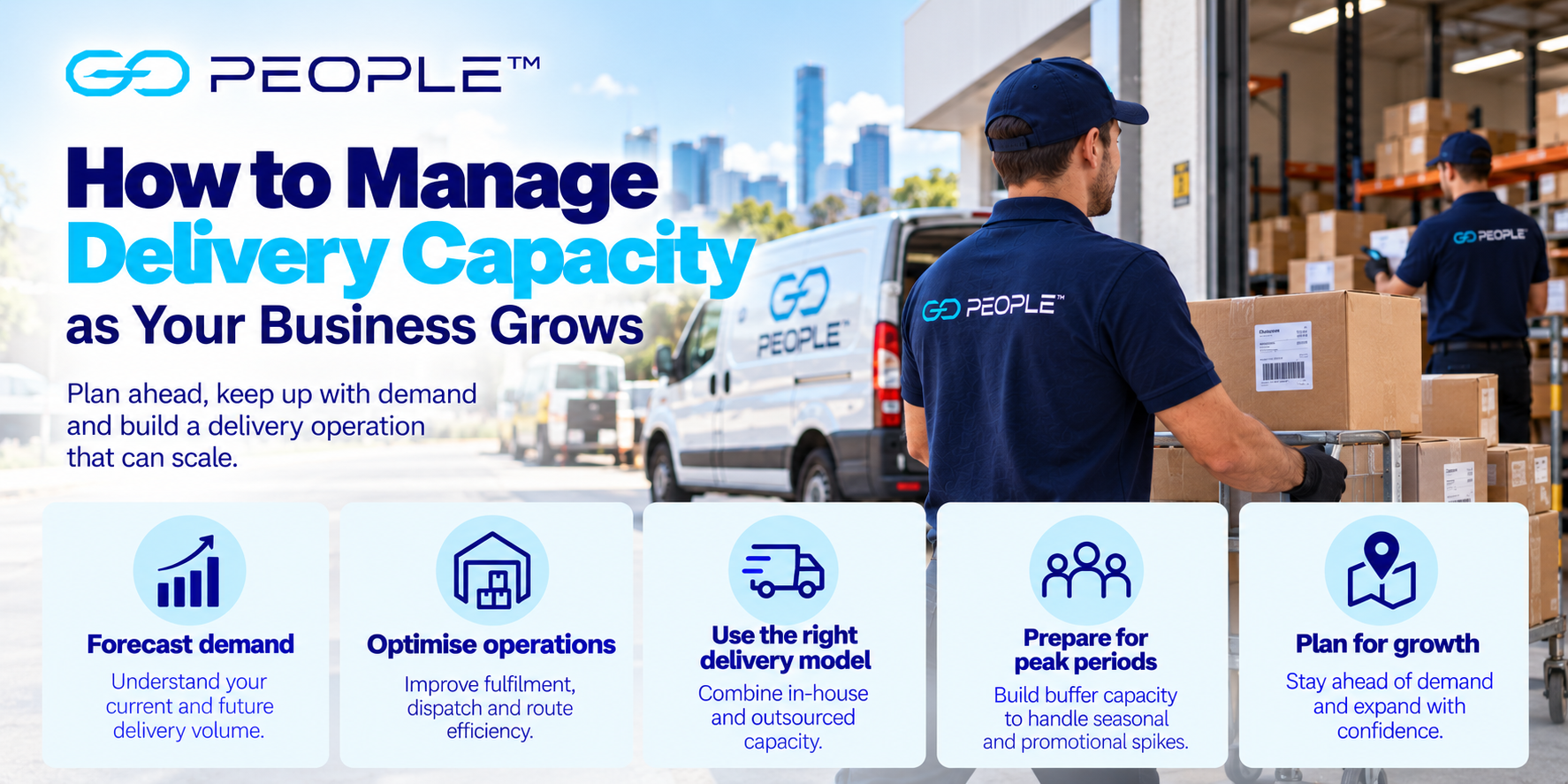
As a business grows, delivery capacity can become a problem surprisingly quickly.
At lower volumes, the operation may be straightforward. A small warehouse team prepares the orders, a few drivers or courier bookings handle the deliveries, and unusual demand can be managed manually.
Then order volume increases.
What once worked comfortably begins to create:
- parcels waiting for dispatch;
- overloaded routes;
- additional vehicles or drivers;
- missed collection times;
- increasing delivery costs;
- more customer enquiries; and
- difficulty coping with promotions or peak periods.
The problem is not necessarily that the delivery operation is badly managed.
It may simply have reached its capacity.
Delivery capacity planning helps businesses understand how much volume their current operation can reliably handle, where the constraints are, and when they should optimise, add capacity or change their delivery model.
What Is Delivery Capacity Planning?
Delivery capacity planning is the process of matching expected delivery demand with the resources required to fulfil and deliver those orders.
Those resources can include:
- warehouse labour;
- picking and packing capacity;
- loading and dispatch areas;
- vehicles;
- drivers;
- delivery routes;
- courier capacity;
- customer-service resources; and
- technology.
A common mistake is to think only about driver capacity.
But the complete process is:
Orders → Picking → Packing → Dispatch → Collection → Routing → Delivery → Exceptions
A constraint anywhere in this chain can limit the number of deliveries the business can successfully handle.
For example, adding another delivery vehicle does not solve the problem if the warehouse cannot prepare orders quickly enough.
Start by Understanding Current Delivery Demand
Before deciding how much capacity you need, understand your existing delivery profile.
Track at least:
- deliveries per day;
- deliveries per week;
- busiest day;
- busiest hour or dispatch period;
- delivery locations;
- service types;
- average stops per route;
- failed deliveries;
- urgent deliveries; and
- seasonal variations.
Monthly averages alone can be misleading.
Imagine a business completing 10,000 deliveries per month.
That sounds like approximately 500 deliveries per business day.
But actual demand might look like:
| Day | Deliveries |
|---|---|
| Monday | 350 |
| Tuesday | 420 |
| Wednesday | 470 |
| Thursday | 510 |
| Friday | 750 |
Planning around an average of 500 would leave Friday significantly under-resourced.
Capacity should therefore be designed around the shape of demand, not simply its average.
Understand Normal Capacity and Peak Capacity
It is useful to separate two concepts.
Normal Capacity
The volume your operation can comfortably process under ordinary conditions.
Peak Capacity
The maximum volume you can process for a limited period without service quality deteriorating significantly.
For example:
Normal capacity: 1,000 orders per day
Peak capacity: 1,300 orders per day
Operating at 1,300 every day would mean peak capacity has effectively become normal demand.
That is usually a sign that additional capacity or process improvement is required.
Businesses need some buffer because delivery demand is rarely perfectly predictable.
Find the Real Capacity Constraint
When delivery performance starts deteriorating, businesses sometimes assume they need more drivers.
That may not be the problem.
Capacity constraints can occur throughout the operation.
Inventory
Orders cannot progress because stock is unavailable or difficult to locate.
Picking
Warehouse staff cannot pick orders quickly enough.
Packing
Orders accumulate at packing stations.
Dispatch
Parcels are ready but cannot be staged or handed over efficiently.
Collection
Delivery capacity is available, but collection windows are missed.
Routing
Drivers spend too much time travelling between stops.
Vehicles
There is insufficient vehicle capacity.
Drivers
There are not enough available drivers for the required routes.
Customer Service
Delivery volume grows faster than the team’s ability to manage exceptions.
The first step is therefore:
Find the bottleneck before buying more capacity.
Measure Order-to-Dispatch Time
One of the most useful capacity indicators is:
Order received → parcel dispatched
If this time begins increasing as volume grows, the fulfilment operation may be approaching capacity.
For example:
| Daily Orders | Average Order-to-Dispatch |
|---|---|
| 500 | 4 hours |
| 700 | 4.5 hours |
| 900 | 6 hours |
| 1,100 | 11 hours |
The problem becomes visible before the warehouse completely fails.
Increasing processing time is often an early warning sign.
For a broader review of fulfilment issues, see How to Fix Ecommerce Order Fulfilment Problems.
Measure Deliveries per Route
For businesses operating delivery routes, track how many deliveries are completed per route.
But do not treat the number as a universal benchmark.
Twenty deliveries across a large geographic area may require more resources than 40 deliveries concentrated within nearby suburbs.
Route productivity depends on factors such as:
- distance;
- geographic density;
- traffic;
- parking;
- building access;
- delivery requirements;
- parcel handling;
- and delivery windows.
The useful comparison is usually against your own historical routes with similar characteristics.
Delivery Density Can Matter More Than Volume
Consider two businesses, each making 100 deliveries.
Business A
The 100 customers are concentrated within a relatively compact metropolitan area.
Business B
The 100 customers are widely dispersed.
They have the same delivery volume but very different capacity requirements.
As a business grows, look at:
deliveries per geographic area
rather than only:
total deliveries
Higher delivery density can make multi-drop routing considerably more practical.
Low-density growth may require additional routes even when total order growth appears modest.
Track Driver and Vehicle Utilisation
Businesses with their own fleets should understand how heavily their delivery resources are being used.
Useful measures may include:
- driver hours available;
- driver hours used;
- vehicles available;
- route duration;
- deliveries per route;
- kilometres per route;
- vehicle loading;
- waiting time; and
- overtime.
Consistently high utilisation can look efficient, but operating with virtually no spare capacity creates risk.
A vehicle breakdown, staff absence or unexpected order spike can immediately affect service.
The objective is not necessarily 100% utilisation.
It is enough utilisation to be efficient while maintaining sufficient operational resilience.
Don’t Forget Warehouse Dispatch Capacity
Delivery capacity starts inside the warehouse.
Imagine you have enough drivers to collect 2,000 parcels.
But the warehouse can only prepare 1,500 before collection.
Your actual delivery capacity is:
1,500 parcels
Adding drivers does nothing.
Businesses should therefore measure:
- orders picked per hour;
- orders packed per hour;
- parcels staged per hour;
- dispatch cut-off performance;
- parcels ready when collection arrives; and
- warehouse backlog.
Delivery and fulfilment capacity should be planned together.
Watch for Capacity Warning Signs
You may be approaching the limit of your current delivery model when you see several of these patterns:
- order-to-dispatch times increasing;
- more overtime;
- drivers regularly finishing later;
- more missed collections;
- routes becoming overloaded;
- increasing urgent courier bookings;
- more failed deliveries;
- customer enquiries increasing;
- warehouse backlogs;
- frequent vehicle shortages;
- declining first-attempt delivery success; or
- management spending increasing time solving daily delivery problems.
One bad day is not necessarily a capacity problem.
A repeated trend is more significant.
Forecast Delivery Demand
Capacity planning should look forward, not just backwards.
Start with historical delivery volume and consider upcoming changes such as:
- sales growth;
- new customers;
- promotions;
- new products;
- new geographic areas;
- seasonal demand;
- major retail events; and
- changes to delivery promises.
A simple forecast might begin with:
Current average daily volume × expected growth
If current volume is 1,000 deliveries per day and expected growth is 20%:
1,000 × 1.20 = 1,200 deliveries
But averages are only the beginning.
You should also forecast the likely peak.
Plan Separately for Peak Periods
Peak periods can place very different demands on a delivery operation.
Examples include:
- Black Friday;
- Christmas;
- major promotions;
- product launches;
- seasonal events; and
- large customer campaigns.
Before a peak, estimate:
Expected orders
↓
Orders requiring delivery
↓
Warehouse processing requirement
↓
Required routes / delivery capacity
↓
Exception-management capacity
↓
Customer-service capacity
A delivery plan that only considers drivers can still fail if packaging, warehouse or support capacity is insufficient.
For more detail, see How to Manage Delivery Delays During Peak Seasons.
Maintain Buffer Capacity
Businesses need some ability to absorb unexpected demand.
If your entire delivery operation is planned to operate at maximum capacity every day, even a small disruption can create a backlog.
Buffer capacity might come from:
- spare internal driver hours;
- additional vehicles;
- flexible shifts;
- external delivery providers;
- overflow courier arrangements; or
- the ability to move suitable volume between delivery models.
The right buffer depends on demand volatility and the consequences of insufficient capacity.
A highly predictable operation may require less flexibility than one with large promotional spikes.
Optimise Before Automatically Adding More Resources
When capacity becomes tight, the first solution should not always be:
Add another driver.
First look for avoidable inefficiencies.
For example:
Poor Route Planning
Drivers spend unnecessary time travelling between stops.
Low Delivery Density
Orders could potentially be grouped differently.
Warehouse Waiting
Drivers lose productive time waiting for parcels.
Manual Administration
Staff spend significant time creating bookings or transferring order information.
Failed Deliveries
Capacity is consumed by repeat attempts.
Inappropriate Service Selection
Urgent services are being used because routine orders missed dispatch.
Removing these inefficiencies may create additional effective capacity without proportionally increasing resources.
Use Route Optimisation
For businesses making multiple deliveries, route optimisation can help improve the use of existing capacity.
Instead of treating each destination independently, routes can be planned around multiple stops.
This can help reduce:
- unnecessary travel;
- inefficient sequencing;
- duplicated driving;
- and avoidable route time.
As delivery density increases, route planning becomes increasingly important.
See Route Optimisation for Delivery: How Businesses Can Plan More Efficient Routes.
Consider Multi-Drop Delivery as Volume Grows
A business making a handful of individual deliveries may be comfortable booking them separately.
As volume increases, a multi-drop model may become more appropriate.
Multiple deliveries can be grouped into a planned route from a common pickup location.
This can be useful when:
- many deliveries leave from one location;
- destination addresses vary;
- delivery density is sufficient;
- and orders can be organised into routes.
GoBUNDLE is GoPeople’s multi-drop delivery service for businesses, combining dedicated delivery runs with route optimisation, live tracking and digital proof of delivery.
Know When to Add Internal Drivers
Adding internal delivery capacity can make sense when:
- demand is predictable;
- routes are consistent;
- utilisation is sufficient;
- the business wants direct operational control; and
- the economics support additional fixed resources.
But an internal driver creates more than a wage cost.
Businesses may also need to consider:
- vehicles;
- insurance;
- recruitment;
- training;
- management;
- leave;
- scheduling;
- maintenance;
- fuel;
- administration; and
- spare capacity.
The decision should therefore compare the total cost and operational implications, not simply hourly driver cost.
Know When to Outsource Delivery Capacity
External delivery capacity can be useful when:
- volume is variable;
- demand is growing quickly;
- peak periods create temporary spikes;
- geographic coverage is expanding;
- internal resources are constrained; or
- delivery management is becoming a distraction from the core business.
Outsourcing can convert some delivery capacity from a fixed operational commitment into a more flexible model.
That does not mean every business should outsource everything.
The appropriate model depends on delivery volume, geography, control requirements and economics.
See When Should Your Business Outsource Deliveries? for a more detailed comparison.
Consider a Hybrid Delivery Model
For many growing businesses, the choice does not need to be:
100% internal
or
100% outsourced.
A hybrid model can use different capacity for different requirements.
For example:
Internal fleet
→ stable, predictable core routes
Multi-drop provider
→ additional metropolitan volume
Next-day provider
→ regular parcel deliveries
Same-day service
→ selected time-sensitive orders
On-demand courier
→ genuinely urgent exceptions
This can allow a business to retain internal capability while gaining flexibility when demand changes.
Don’t Use Urgent Couriers to Hide Capacity Problems
An increase in urgent courier bookings can be an important warning sign.
Ask why those bookings are occurring.
Are they genuinely urgent customer requirements?
Or are they recovering from:
- missed dispatch;
- inventory problems;
- picking errors;
- late warehouse processing;
- overloaded routes;
- or insufficient normal delivery capacity?
If emergency delivery becomes routine, the business may be paying premium costs to compensate for a capacity problem elsewhere.
Track urgent bookings by reason, not only by cost.
Plan for Geographic Expansion
Growth does not always mean more deliveries within the same area.
A business may begin receiving orders from new suburbs, cities or regions.
That can change delivery capacity dramatically.
For example:
500 additional deliveries inside an existing dense area
may be easier to absorb than:
200 deliveries spread across a new geographic market.
Before expanding delivery coverage, assess:
- expected order density;
- pickup location;
- warehouse location;
- available delivery services;
- expected cost;
- service expectations;
- support requirements; and
- whether a new fulfilment location may eventually be needed.
Geography is a capacity variable.
Include Exception Management in Capacity Planning
If delivery volume doubles, delivery exceptions may also increase substantially even if the failure rate stays unchanged.
Suppose:
2,000 deliveries × 3% exceptions = 60 exceptions
At:
4,000 deliveries × 3% = 120 exceptions
Delivery performance did not deteriorate.
But the support workload doubled.
Capacity planning should therefore include:
- customer support;
- delivery investigations;
- redelivery administration;
- returns;
- warehouse reconciliation; and
- exception management.
See How to Manage Delivery Failures at High Volume for a detailed exception-management framework.
Track Capacity KPIs
A useful delivery-capacity dashboard might include:
| KPI | What It Shows |
|---|---|
| Daily delivery volume | Current demand |
| Peak daily volume | Maximum demand |
| Order-to-dispatch time | Fulfilment pressure |
| Orders ready by cut-off | Dispatch performance |
| Deliveries per route | Route productivity |
| Route duration | Driver utilisation |
| Kilometres per delivery | Geographic efficiency |
| First-attempt success | Delivery effectiveness |
| Exception rate | Failure workload |
| Urgent delivery percentage | Potential capacity problems |
| Overtime | Resource pressure |
| Delivery cost per order | Capacity economics |
The most useful metric is often not a single number.
It is the trend across several indicators.
Create Capacity Trigger Points
Do not wait until the operation fails before deciding what to do.
Create trigger points in advance.
For example:
Trigger 1 — Optimise
Volume increases and route efficiency begins declining.
Action: review routing, dispatch and delivery density.
Trigger 2 — Add Flexible Capacity
Peak periods regularly exceed normal capacity.
Action: establish overflow capacity.
Trigger 3 — Change Delivery Model
Individual delivery bookings become inefficient at higher volume.
Action: assess multi-drop or alternative delivery models.
Trigger 4 — Add Permanent Capacity
Demand is consistently above the existing operation’s sustainable level.
Action: assess additional internal or external capacity.
Trigger 5 — Reconsider Network Design
Growth expands significantly into new geographic areas.
Action: review warehouse locations and delivery network structure.
The exact thresholds should be based on your own operation.
Run Capacity Scenarios Before You Need Them
A useful planning exercise is to ask:
What would happen if delivery volume increased tomorrow?
Model several scenarios.
Current
1,000 deliveries/day
+20%
1,200 deliveries/day
+50%
1,500 deliveries/day
+100%
2,000 deliveries/day
For each scenario, ask:
- Can inventory support it?
- Can the warehouse pick it?
- Can packing process it?
- Can dispatch stage it?
- Can collections handle it?
- How many routes are required?
- Is driver capacity available?
- Can support handle the exceptions?
- What would delivery cost become?
This exposes bottlenecks before they become emergencies.
A Delivery Capacity Planning Checklist
Demand
- ☐ Average daily volume known
- ☐ Peak daily volume known
- ☐ Weekly patterns understood
- ☐ Seasonal peaks identified
- ☐ Growth forecast prepared
- ☐ Geographic demand mapped
Warehouse
- ☐ Picking capacity measured
- ☐ Packing capacity measured
- ☐ Dispatch cut-offs monitored
- ☐ Warehouse backlog tracked
- ☐ Parcels ready before collection
Delivery
- ☐ Routes measured
- ☐ Delivery density understood
- ☐ Driver utilisation monitored
- ☐ Vehicle capacity understood
- ☐ Failed deliveries measured
- ☐ Urgent bookings categorised
Flexibility
- ☐ Peak buffer available
- ☐ Overflow process defined
- ☐ External capacity considered
- ☐ Multi-drop options assessed
- ☐ Contingency plan documented
Growth
- ☐ +20% volume scenario tested
- ☐ +50% volume scenario tested
- ☐ New geographic areas assessed
- ☐ Support capacity included
- ☐ Trigger points established
Where GoPeople Fits Into a Scalable Delivery Strategy
Different stages of growth may require different delivery models.
GoEXPRESS — Next-Day Delivery
GoEXPRESS provides next-day parcel delivery for businesses, with pickups from customer warehouses in Sydney, Melbourne and Brisbane.
This can support businesses moving regular parcel volume without building the entire delivery operation internally.
GoBUNDLE — Multi-Drop Delivery
GoBUNDLE is designed for businesses making multiple deliveries from a pickup location.
It can be useful as delivery density and multi-stop volume increase.
GoSAMEDAY — Same-Day Delivery
GoSAMEDAY provides same-day delivery for eligible business pickups.
GoVIP — On-Demand Courier
GoVIP provides on-demand courier delivery for urgent and time-sensitive jobs.
A growing business may use one or several delivery models depending on its order profile.
Capacity Planning Is About Staying Ahead of Growth
Delivery capacity problems rarely appear overnight.
Usually there are warning signs:
more overtime
↓
longer warehouse processing
↓
overloaded routes
↓
more urgent bookings
↓
increasing exceptions
↓
higher support workload
↓
declining customer experience
The mistake is waiting until the final stages before acting.
A better approach is to monitor demand, utilisation, fulfilment, routes, exceptions and costs while there is still time to respond.
The goal is not to maintain unlimited spare capacity.
It is to know:
what your operation can reliably handle, where the next constraint will appear, and what you will do when demand reaches it.
That turns delivery growth from a recurring operational emergency into something the business can plan for.
Frequently Asked Questions
What is delivery capacity planning?
Delivery capacity planning is the process of matching expected delivery demand with the warehouse, driver, vehicle, route, courier and support resources needed to fulfil it reliably.
How do I know if my business is running out of delivery capacity?
Warning signs can include increasing order-to-dispatch times, overtime, overloaded routes, missed collections, more urgent courier bookings, growing backlogs and increasing delivery exceptions.
How much spare delivery capacity should a business have?
There is no universal percentage. The appropriate buffer depends on demand volatility, peak periods, delivery requirements and how quickly additional capacity can be obtained.
Should a growing business hire more drivers or outsource deliveries?
It depends on volume consistency, geography, costs and control requirements. Predictable core routes may support internal capacity, while variable or peak demand may benefit from external capacity. Some businesses use a hybrid model.
How does route optimisation increase delivery capacity?
Better route planning can reduce unnecessary travel and improve the number of deliveries that can be completed using existing driver and vehicle resources.
Why does warehouse capacity matter to delivery capacity?
A business cannot deliver parcels that have not been picked, packed and prepared for collection. If warehouse processing is the bottleneck, adding drivers will not solve the underlying capacity problem.
What delivery capacity KPIs should businesses track?
Useful metrics include daily and peak delivery volume, order-to-dispatch time, on-time dispatch, deliveries per route, route duration, first-attempt success, exception rate, urgent-delivery usage, overtime and delivery cost per order.