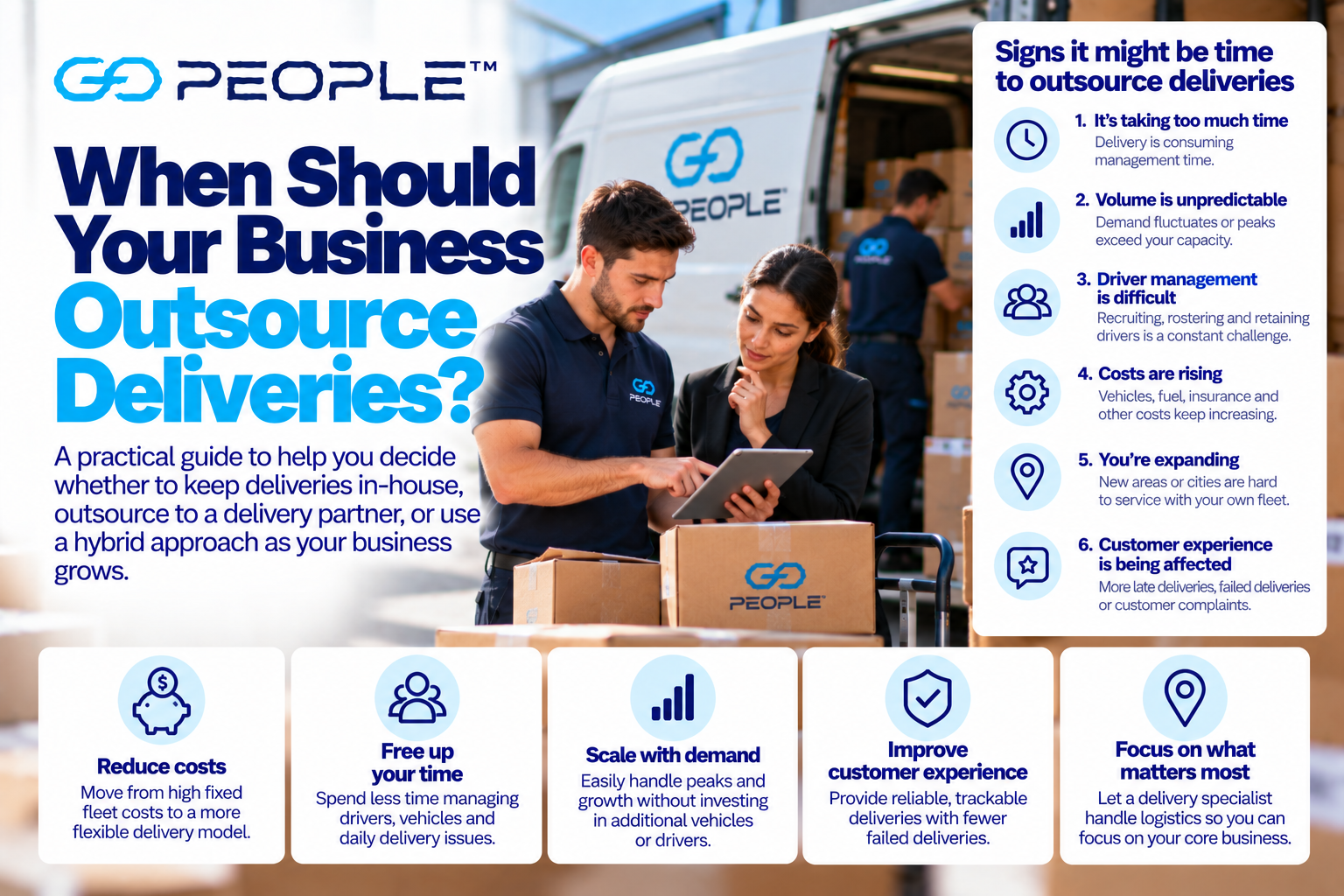
At some point, growing businesses face a delivery question that has little to do with individual parcels:
Should we still be doing this ourselves?
In-house delivery can make perfect sense when a business is small.
Perhaps:
- the owner makes deliveries after work;
- a staff member takes orders out in the company van;
- one or two drivers cover a local area; or
- deliveries are fitted around other responsibilities.
At low volume, this can feel simple and inexpensive.
But as the business grows, delivery can quietly become an operation of its own.
You may suddenly be managing:
- drivers;
- vehicles;
- fuel;
- insurance;
- rostering;
- route planning;
- customer tracking;
- failed deliveries;
- peak periods;
- driver absences;
- delivery enquiries; and
- proof of delivery.
The question is therefore not whether outsourcing is always better than running your own fleet.
It isn’t.
The real question is:
At what point does outsourcing some or all of your deliveries become more efficient than continuing to manage everything internally?
This guide provides a framework for making that decision.
What Does It Mean to Outsource Deliveries?
Outsourcing delivery means using an external delivery provider to perform some or all of the transport work that would otherwise be handled internally.
That could mean outsourcing:
- every delivery;
- a particular city;
- next-day parcels;
- same-day orders;
- multi-drop routes;
- urgent deliveries;
- peak-period overflow; or
- deliveries beyond your normal service area.
It does not have to be an all-or-nothing decision.
Many businesses can use a hybrid delivery model, keeping some work in-house while outsourcing other delivery requirements.
Why Businesses Start With In-House Delivery
In-house delivery has obvious attractions.
The business controls:
- the vehicles;
- the drivers;
- the schedule;
- the customer interaction; and
- the delivery process.
For a business with predictable local volume, that control can be valuable.
Imagine a florist with:
- one store;
- a small delivery radius;
- one van; and
- relatively predictable daily demand.
An internal delivery operation may work perfectly well.
Problems usually begin when the business changes but the delivery model does not.
Growth Changes the Economics of Delivery
Suppose the florist grows into:
- several locations;
- ecommerce orders;
- larger delivery areas;
- corporate customers;
- Valentine’s Day peaks;
- Mother’s Day peaks; and
- hundreds of weekly deliveries.
The original delivery model may now struggle.
The business has moved from:
“Someone takes the orders out.”
to:
“We operate a delivery fleet.”
Those are very different operational responsibilities.
Sign 1: Delivery Is Taking Too Much Management Time
One of the clearest warning signs is management attention.
Ask how much time is spent dealing with:
- driver rosters;
- vehicle problems;
- late deliveries;
- route planning;
- customer enquiries;
- recruitment;
- driver absences;
- failed deliveries;
- delivery disputes; and
- daily dispatch issues.
That time has a cost.
If a warehouse manager spends two hours every day managing delivery problems, those hours are no longer available for:
- fulfilment;
- inventory;
- staff;
- productivity; or
- process improvement.
Delivery cost should therefore include management time, not merely wages and fuel.
Sign 2: Your Delivery Volume Is Highly Variable
An internal fleet works most efficiently when demand is reasonably predictable.
Suppose you employ enough drivers to handle:
500 deliveries per day
but ordinary demand is only:
300 deliveries.
You may be paying for unused capacity.
Now suppose a promotion suddenly generates:
800 deliveries.
You don’t have enough capacity.
This creates the fundamental fleet problem:
How much capacity should you own?
Build for average demand and peaks overwhelm you.
Build for peak demand and quieter periods create idle cost.
Outsourcing can convert at least part of that capacity requirement into a more variable model.
Sign 3: Peak Periods Keep Breaking Your Operation
Many businesses experience demand spikes around:
- Christmas;
- Black Friday;
- Cyber Monday;
- Valentine’s Day;
- Mother’s Day;
- major promotions;
- product launches; or
- seasonal events.
If your delivery operation performs well for most of the year but repeatedly fails during peaks, you may not need to outsource everything.
You may simply need overflow capacity.
A hybrid model can allow:
normal volume → internal fleet
and:
overflow volume → external delivery provider
This avoids building permanent capacity solely for several peak weeks each year.
For more planning strategies, see How to Manage Delivery Delays During Peak Seasons.
Sign 4: Driver Absences Create Immediate Problems
If one driver calling in sick causes the entire delivery schedule to collapse, the operation may be too dependent on individual employees.
Small fleets are particularly vulnerable.
A business with:
2 drivers
loses:
50% of its driver capacity
when one is unavailable.
A business with 100 drivers does not face the same proportional impact.
Businesses should consider whether they have enough redundancy to manage:
- illness;
- leave;
- resignations;
- licence issues;
- vehicle breakdowns; and
- unexpected demand.
External delivery capacity can provide another option when internal resources are unavailable.
Sign 5: Recruiting Drivers Has Become a Business Function
Hiring drivers involves more than placing an advertisement.
Depending on the employment or contracting model, businesses may need to manage:
- recruitment;
- screening;
- onboarding;
- training;
- documentation;
- scheduling;
- performance;
- turnover; and
- replacement recruitment.
If delivery is not your core business, ask whether managing a driver workforce is where you want your team spending its time.
For some businesses, the answer will still be yes.
For others, it becomes a distraction from the core operation.
Sign 6: You Need More Vehicles
Vehicles create fixed and semi-fixed costs.
Potential costs include:
- purchase or lease;
- finance;
- registration;
- insurance;
- servicing;
- tyres;
- repairs;
- fuel;
- cleaning;
- parking;
- tolls; and
- eventual replacement.
The important question is not:
“How much does the van cost?”
It is:
“What does this vehicle cost us per productive delivery?”
A vehicle sitting unused still costs money.
Calculate the True Cost of an In-House Fleet
Businesses frequently underestimate internal delivery costs because expenses are spread across different accounts.
A useful calculation is:
Driver costs
Vehicle costs
Fuel and tolls
Insurance
Technology
Management
Recruitment and training
Administration
Failed-delivery costs
Idle capacity
=
Total internal delivery cost
Then divide that cost by the number of successfully completed deliveries.
This gives a more meaningful cost-per-delivery figure.
Driver Cost Is More Than the Hourly Rate
Suppose a driver is paid an hourly wage.
The business may also incur other employment-related or operational costs depending on the arrangement.
The driver’s productive delivery time may also be lower than paid time because the day can include:
- loading;
- waiting;
- returning to the warehouse;
- vehicle preparation;
- breaks;
- traffic;
- administrative work; and
- unsuccessful deliveries.
A simple hourly wage comparison can therefore be misleading.
Vehicle Utilisation Matters
Consider two identical vans.
Van A
Completes productive delivery work most of the day.
Van B
Completes deliveries for three hours and sits idle for the remainder.
Both may have similar:
- registration;
- insurance;
- financing; and
- depreciation.
But their cost per productive delivery can be very different.
Businesses operating internal fleets should measure utilisation rather than simply counting vehicles.
Sign 7: Route Planning Is Becoming Complicated
A handful of addresses can be planned manually.
Dozens or hundreds of destinations are different.
As delivery volume grows, route planning needs to consider:
- stop sequence;
- distance;
- traffic;
- delivery constraints;
- driver capacity;
- customer requirements; and
- operational priorities.
Poor routing can increase:
- kilometres;
- fuel;
- driver hours;
- late deliveries; and
- cost.
If staff are manually building complex routes every morning, delivery has become a logistics operation.
For more detail, see Route Optimisation for Delivery: How Businesses Can Plan More Efficient Routes.
Sign 8: Your Customers Expect Better Tracking
A driver with a mobile phone may be enough operationally for a very small business.
It does not necessarily create a scalable customer experience.
As order volume grows, customers may expect:
- tracking;
- delivery notifications;
- status updates;
- proof of delivery; and
- support when something goes wrong.
Building these capabilities internally can require technology, integrations and ongoing maintenance.
An external delivery platform may already provide some of that infrastructure.
Tracking Also Reduces Internal Work
Tracking is not just a customer feature.
Without visibility, support staff may repeatedly ask:
- Has the driver collected this?
- Where is the driver?
- Has this been delivered?
- Why was delivery unsuccessful?
- Who accepted it?
This can lead to calls and messages between:
customer → support → dispatch → driver
A better tracking system can reduce that information chain.
See How Delivery Tracking Can Reduce Customer Service Enquiries for a detailed explanation.
Sign 9: Failed Deliveries Are Becoming Expensive
An unsuccessful delivery can create additional work.
Depending on the situation, it may require:
- customer contact;
- driver time;
- return transport;
- warehouse handling;
- another delivery attempt;
- investigation; or
- refund/replacement decisions.
Internal fleets sometimes underestimate these costs because the same employees and vehicles perform the additional work.
But the cost still exists.
Track:
first-attempt delivery success
and:
cost per unsuccessful delivery
to understand the real impact.
For prevention strategies, see How to Reduce Failed Deliveries and Improve First-Attempt Delivery Success.
Sign 10: Your Delivery Area Is Expanding
An internal fleet may work well when every customer is within a compact local area.
Growth can change that.
Perhaps orders now come from:
- the other side of the city;
- another metropolitan area;
- another state; or
- locations that make your current routes inefficient.
Expanding the internal fleet into every new area may require:
- more drivers;
- more vehicles;
- local knowledge;
- new facilities;
- additional management; and
- additional technology.
Outsourcing can allow businesses to access delivery capacity in appropriate service areas without replicating the entire internal operation.
Sign 11: Delivery Is Preventing Geographic Expansion
Sometimes delivery becomes a constraint on sales.
The business may be capable of selling into a new area but reluctant because it cannot fulfil deliveries efficiently.
That is an important strategic signal.
Your delivery operation should support growth rather than define an unnecessarily small market.
Before investing in your own fleet in a new location, compare the economics with external delivery options.
Sign 12: Your Delivery Costs Are Difficult to Understand
If nobody can confidently answer:
“What does each successful delivery actually cost us?”
the business may not have enough visibility into its fleet.
This does not automatically mean outsourcing is better.
But it does mean the current model needs closer analysis.
At minimum, calculate:
- cost per delivery;
- cost per kilometre;
- cost per route;
- driver utilisation;
- vehicle utilisation;
- failed-delivery cost; and
- management cost.
Then compare those numbers with external alternatives.
Sign 13: Delivery Costs Are Rising Faster Than Order Volume
Suppose orders increase by:
20%
but delivery costs increase by:
45%.
Something may not be scaling efficiently.
Possible causes include:
- longer routes;
- additional vehicles;
- low utilisation;
- overtime;
- inefficient dispatch;
- failed deliveries;
- fragmented demand; or
- poor route planning.
Outsourcing is one possible response, but first understand the underlying cause.
Sign 14: You Are Building Technology Just to Run Deliveries
As an internal operation grows, businesses may need systems for:
- dispatch;
- route planning;
- driver allocation;
- GPS visibility;
- notifications;
- proof of delivery;
- customer tracking;
- delivery reporting; and
- integrations.
If logistics is core to your competitive advantage, investing in these systems may make sense.
If not, ask whether recreating delivery technology is the best use of your development resources.
Sign 15: Customer Support Is Becoming a Delivery Tracking Team
If support spends a large percentage of its time answering:
“Where is my order?”
you may have a delivery-visibility problem.
That creates costs beyond transport.
Delivery should ideally provide enough information for customers and support teams to understand what is happening without repeatedly contacting drivers.
This becomes increasingly important at higher volumes.
Sign 16: Delivery Problems Are Damaging Customer Experience
Customers usually do not care whether delivery is operated internally or outsourced.
They care whether it works.
Warning signs include increasing:
- late-delivery complaints;
- missing-parcel enquiries;
- failed deliveries;
- wrong-address incidents;
- tracking complaints; and
- delivery-related refunds.
If delivery performance is damaging customer trust, the business needs to improve the model—whether that means improving the internal fleet, outsourcing, or using a hybrid approach.
See How to Repair Customer Trust After Delivery Problems.
In-House vs Outsourced Delivery
There is no universal winner.
Both models have advantages.
| Factor | In-House Fleet | Outsourced Delivery |
|---|---|---|
| Direct operational control | High | Shared with provider |
| Fixed fleet costs | Usually higher | Often lower |
| Capacity flexibility | Depends on fleet size | Potentially greater |
| Driver management | Internal responsibility | Provider responsibility |
| Vehicle management | Internal responsibility | Provider responsibility |
| Delivery technology | Business must provide/build | May be included |
| Peak capacity | Requires planning/resources | May be easier to scale |
| Brand control | High | Requires provider alignment |
| Geographic expansion | Requires resources | Depends on provider coverage |
| Cost structure | More fixed/semi-fixed | Often more variable |
The right answer depends on the business.
When Keeping Delivery In-House Makes Sense
Outsourcing is not automatically superior.
Keeping delivery internal may make sense when:
- delivery is central to the brand experience;
- volume is highly predictable;
- routes are stable;
- vehicle utilisation is consistently high;
- specialised equipment is required;
- goods need specialist handling;
- the business has strong logistics expertise;
- internal delivery provides a genuine competitive advantage; or
- outsourcing cannot meet operational requirements.
For some businesses, owning delivery capability is strategic.
When Outsourcing Becomes Attractive
Outsourcing may become more attractive when:
- volume fluctuates significantly;
- fleet utilisation is poor;
- delivery management consumes excessive time;
- driver recruitment is difficult;
- technology requirements are growing;
- delivery areas are expanding;
- peaks regularly exceed capacity;
- delivery is not a core capability; or
- external providers can deliver more efficiently.
Several of these factors together create a stronger case than any single factor alone.
The Fixed-Cost vs Variable-Cost Question
One of the biggest differences is cost structure.
Internal Fleet
Many costs exist regardless of daily volume.
Examples:
- vehicle finance;
- registration;
- insurance;
- salaried staff;
- software;
- parking;
- management.
Outsourced Delivery
Costs may be more closely related to actual delivery usage, depending on the commercial arrangement.
This can make external delivery attractive when demand fluctuates.
However, businesses should compare total costs, not assume variable always means cheaper.
A Simple Break-Even Framework
Suppose your internal fleet costs:
$30,000 per month
including:
- drivers;
- vehicles;
- fuel;
- insurance;
- technology;
- management; and
- other relevant costs.
And it completes:
3,000 successful deliveries
The simplified internal cost is:
$30,000 ÷ 3,000 = $10 per successful delivery
Now compare that with an external option.
But don’t stop at the quoted courier price.
Compare equivalent costs and service levels, including:
- pickup;
- delivery;
- surcharges where applicable;
- redelivery;
- failed deliveries;
- tracking;
- proof of delivery;
- administration;
- internal management; and
- customer support.
The correct comparison is:
total internal cost
versus:
total outsourced cost
for an equivalent outcome.
Don’t Forget Opportunity Cost
Suppose outsourcing costs slightly more per delivery.
That does not automatically make it the worse option.
Ask what internal resources are released.
If outsourcing allows:
- a manager to focus on warehouse productivity;
- capital to be invested in inventory rather than vehicles;
- developers to focus on ecommerce rather than routing systems; or
- the business to expand without opening another delivery operation,
those benefits have value.
This is the opportunity-cost side of the decision.
Compare Cost Per Successful Delivery
Avoid comparing:
internal cost per delivery attempt
with:
external quoted delivery price
unless they represent the same thing.
A more useful measure is often:
Total delivery operation cost ÷ successfully completed deliveries
This incorporates the impact of:
- unsuccessful attempts;
- redeliveries;
- driver time;
- customer support; and
- operational overhead.
For broader delivery-cost analysis, see How Businesses Can Reduce Delivery Costs Without Sacrificing Service.
Consider a Hybrid Delivery Model
Many businesses do not need to choose between:
100% internal
and:
100% outsourced.
A hybrid model can combine both.
For example:
Internal Fleet
Handles:
- predictable local routes;
- specialist deliveries;
- important customer relationships.
External Provider
Handles:
- overflow;
- peaks;
- additional cities;
- urgent jobs;
- next-day parcels; or
- variable demand.
This can preserve control where it matters while adding flexibility elsewhere.
Hybrid Model: Keep the Core, Outsource the Peaks
This is particularly useful for businesses with strong seasonal demand.
Instead of owning enough vehicles for the busiest day of the year:
normal capacity → internal
peak capacity → outsourced
This can improve utilisation during quieter periods.
Hybrid Model: Keep Local, Outsource Expansion
A business may have an efficient fleet in one city.
Rather than immediately building fleets in additional cities, it could retain the existing operation and use delivery providers elsewhere.
This allows the business to test demand before committing capital.
Hybrid Model: Keep Scheduled Routes, Outsource Exceptions
Predictable routes may be efficient internally.
Unexpected jobs may not be.
For example:
Regular daily route → internal
Urgent replacement → outsourced on-demand
This prevents urgent jobs from disrupting the planned internal route.
Match Outsourced Services to Different Delivery Needs
Outsourcing also does not mean using one service for every order.
Different requirements can use different delivery models.
Regular Next-Day Parcels
For eligible business pickups in Sydney, Melbourne and Brisbane, GoEXPRESS provides next-day parcel delivery with tracking and proof of delivery.
Multiple Deliveries From One Location
GoBUNDLE provides multi-drop delivery for businesses with multiple destinations, combining dedicated delivery runs with route optimisation, tracking and digital proof of delivery.
Same-Day Requirements
GoSAMEDAY provides same-day delivery for eligible business pickups.
Urgent Individual Jobs
GoVIP provides an on-demand courier option for urgent and time-sensitive requirements.
The appropriate service depends on the actual delivery requirement and service eligibility.
Evaluate More Than Price
When selecting an outsourced provider, compare more than the quoted delivery fee.
Consider:
- service coverage;
- pickup requirements;
- delivery timeframes;
- tracking;
- proof of delivery;
- customer notifications;
- integrations;
- support;
- exception handling;
- failed-delivery process; and
- pricing structure.
A low quoted price can become expensive if the service creates:
- additional support;
- repeated failures;
- manual administration; or
- customer complaints.
See How to Choose a Courier Service for Your Business for a more detailed provider-selection framework.
Ask How Exceptions Are Handled
Normal deliveries are relatively easy to compare.
The differences often become apparent when something goes wrong.
Ask:
- What happens after an unsuccessful delivery?
- How are missing parcels investigated?
- What proof of delivery is available?
- How are address problems handled?
- What information can support teams access?
- How are customers updated?
Exception management is part of the delivery service.
Understand the Technology
If your business processes significant volume, investigate whether the provider can support your operational workflow.
Depending on your needs, this may include:
- online booking;
- bulk booking;
- integrations;
- API connectivity;
- tracking;
- proof of delivery;
- delivery reporting; and
- customer notifications.
The goal is to reduce manual work rather than replace one manual delivery process with another.
Test Before Moving Everything
Businesses do not necessarily need to outsource the entire fleet immediately.
A pilot can provide useful evidence.
For example, outsource:
- one route;
- one city;
- one service type;
- overflow volume; or
- a percentage of orders.
Then compare performance.
Measure Internal and External Delivery the Same Way
Use consistent KPIs.
Possible measures include:
- cost per successful delivery;
- on-time performance;
- first-attempt success;
- failed-delivery rate;
- customer enquiries;
- delivery complaints;
- proof-of-delivery availability;
- administrative time; and
- customer satisfaction.
Without consistent measurement, the comparison becomes subjective.
Measure Management Hours
This is often overlooked.
Track how many hours each week are spent managing:
Internal Delivery
- drivers;
- rosters;
- routes;
- vehicles;
- incidents;
- customer issues.
Outsourced Delivery
- bookings;
- exceptions;
- provider communication;
- reconciliation.
Multiply those hours by an appropriate internal cost.
Management is part of the delivery cost.
Measure Capital Requirements
Internal fleets tie up capital.
Vehicles, equipment and technology may require investment before they generate any delivery capacity.
Ask:
If we didn’t invest this capital in delivery, where else could the business use it?
Possibilities include:
- inventory;
- marketing;
- technology;
- warehouse automation;
- new locations; or
- product development.
Capital allocation is part of the outsourcing decision.
Measure Scalability
Ask what happens if orders increase by:
20%
then:
50%
then:
100%.
For an internal fleet, growth may require:
- more drivers;
- more vehicles;
- more parking;
- more dispatch staff;
- more technology; and
- more management.
For outsourced delivery, scalability depends on provider capability and commercial arrangements.
Neither should be assumed.
Test the model against realistic growth scenarios.
Measure Peak-Day Performance
Average daily performance can hide capacity problems.
Suppose an internal fleet performs extremely well Monday to Thursday but fails every Friday when volume doubles.
The average may still look acceptable.
Measure:
- normal days;
- peak days;
- promotional periods; and
- seasonal peaks
separately.
Capacity problems often appear at the edges.
Measure Customer Impact
The delivery model should ultimately support the customer experience.
Track:
- late-delivery complaints;
- WISMO enquiries;
- failed deliveries;
- missing-parcel enquiries;
- repeat contacts;
- refunds caused by delivery; and
- customer satisfaction.
A delivery model that appears inexpensive but creates substantial customer-service cost may not actually be inexpensive.
Don’t Outsource a Broken Process
Outsourcing does not automatically fix poor fulfilment.
If your warehouse regularly:
- packs orders late;
- uses incorrect addresses;
- mislabels parcels;
- misses cut-offs;
- provides incomplete delivery information; or
- hands over the wrong goods,
an external provider cannot solve the underlying problem.
Before outsourcing, understand which problems are actually caused by delivery and which originate internally.
Define the Handover Clearly
A successful outsourced operation needs a clear boundary.
The business should understand:
- when orders will be ready;
- where pickup occurs;
- how parcels are identified;
- how many items are handed over;
- what information is supplied;
- what happens after collection; and
- how exceptions are managed.
A poor handover creates problems regardless of provider quality.
Keep Accurate Address Data
Outsourcing does not remove responsibility for good order information.
Incorrect:
- addresses;
- unit numbers;
- postcodes;
- contact numbers; or
- delivery instructions
can still create unsuccessful deliveries.
Improving data quality benefits both internal and outsourced operations.
Plan the Transition
If moving substantial delivery volume externally, avoid changing everything without preparation.
A transition plan may include:
Phase 1 — Analyse
Understand current costs, volumes and problems.
Phase 2 — Select
Choose suitable external services.
Phase 3 — Pilot
Test a controlled portion of volume.
Phase 4 — Compare
Measure internal versus external performance.
Phase 5 — Integrate
Improve booking, tracking and operational workflows.
Phase 6 — Expand
Move additional volume where the evidence supports it.
Phase 7 — Review
Continue measuring cost and service quality.
This reduces transition risk.
Communicate Changes Internally
Outsourcing affects more than drivers.
Teams that may need to understand the new process include:
- warehouse;
- customer service;
- ecommerce;
- operations;
- finance;
- sales; and
- management.
Everyone should understand:
- how deliveries are booked;
- where tracking is found;
- how exceptions are handled;
- who owns customer enquiries; and
- how delivery performance is measured.
Communicate the Customer Experience
Customers generally do not need to understand your outsourcing strategy.
They need a consistent delivery experience.
Focus on:
- accurate delivery expectations;
- useful tracking;
- clear notifications;
- proof of delivery where available; and
- effective support.
Whether a parcel is delivered by an employee or external provider should not create unnecessary confusion for the customer.
A Practical Outsourcing Decision Scorecard
Score each statement from:
1 = strongly disagree
to:
5 = strongly agree
Capacity
- Our delivery volume fluctuates significantly.
- Peaks regularly exceed internal capacity.
- Driver absences cause major disruption.
Cost
- Vehicle utilisation is inconsistent.
- We do not have a clear cost per successful delivery.
- Delivery costs are rising faster than order volume.
Management
- Delivery consumes substantial management time.
- Recruiting and managing drivers is difficult.
- Route planning requires significant manual work.
Technology
- Customers expect better tracking.
- We need better proof of delivery.
- Building delivery technology internally is becoming expensive.
Growth
- We want to expand into new geographic areas.
- Delivery capacity is limiting sales growth.
- Buying more vehicles would require significant capital.
Customer Experience
- Delivery complaints are increasing.
- Failed deliveries create significant cost.
- Customer support spends too much time chasing delivery information.
A high score does not automatically mean:
Outsource everything.
It means the business has strong reasons to investigate outsourcing or a hybrid model more seriously.
Questions to Ask Before Outsourcing Deliveries
Before making a decision, ask:
- What does our internal fleet actually cost?
- What is our cost per successful delivery?
- How much fleet capacity is unused?
- What happens during peaks?
- How much management time does delivery consume?
- Which delivery requirements are predictable?
- Which requirements are variable?
- What delivery capabilities do customers expect?
- Which parts of delivery genuinely need internal control?
- Could a hybrid model work better?
- What external services are available in our locations?
- How will we measure whether outsourcing works?
Answer these with data rather than assumptions.
The Best Model May Change as the Business Grows
A delivery model is not a permanent identity.
The best approach at:
$1 million revenue
may not be the best approach at:
$10 million revenue.
The best approach in:
one city
may not work across:
five cities.
And the right model for:
100 deliveries per week
may be very different at:
10,000 deliveries per week.
Review the decision as the business changes.
Outsourcing Is Ultimately a Resource Allocation Decision
The question is not simply:
“Can we deliver this ourselves?”
Most businesses can.
The better question is:
“Is operating our own delivery capability the best use of our people, capital and management attention?”
For some businesses, the answer will be yes.
For others, delivery becomes more effective when some or all of the operation is handled by a specialist provider.
And for many, the strongest answer sits somewhere in the middle:
keep the delivery capabilities that create genuine value internally, and outsource the parts that benefit from scale, flexibility or specialist infrastructure.
That is the decision businesses should evaluate.
Frequently Asked Questions
When should a business outsource deliveries?
Outsourcing becomes worth considering when delivery volume fluctuates, fleet utilisation is low, peaks exceed capacity, driver management consumes substantial time, geographic coverage is expanding or the business needs tracking and delivery technology it does not want to build internally.
Is outsourced delivery cheaper than running your own fleet?
Not necessarily. Businesses should compare the total cost of each model, including drivers, vehicles, fuel, insurance, technology, management, failed deliveries and administration. The better option depends on volume, utilisation and operational requirements.
What is a hybrid delivery model?
A hybrid model combines internal and outsourced delivery. For example, a business might keep predictable local routes in-house while outsourcing peak volume, additional cities or urgent deliveries.
How do you calculate the cost of an in-house delivery fleet?
Include driver costs, vehicles, fuel, tolls, insurance, technology, management, recruitment, administration, failed deliveries and idle capacity. Dividing total cost by successful deliveries provides a useful cost-per-delivery measure.
Should a small business own delivery vehicles?
It depends on delivery volume, route predictability, vehicle utilisation, product requirements and the importance of direct operational control. Businesses should compare the full cost and strategic value of ownership against external alternatives.
Can a business outsource only some deliveries?
Yes. Businesses can outsource specific routes, cities, peak-period overflow, next-day parcels, multi-drop runs or urgent jobs while retaining other deliveries internally.
What should businesses compare when choosing a delivery provider?
Compare coverage, delivery options, tracking, proof of delivery, pricing, support, exception handling, failed-delivery processes, technology and how well the provider fits the business’s actual delivery requirements.