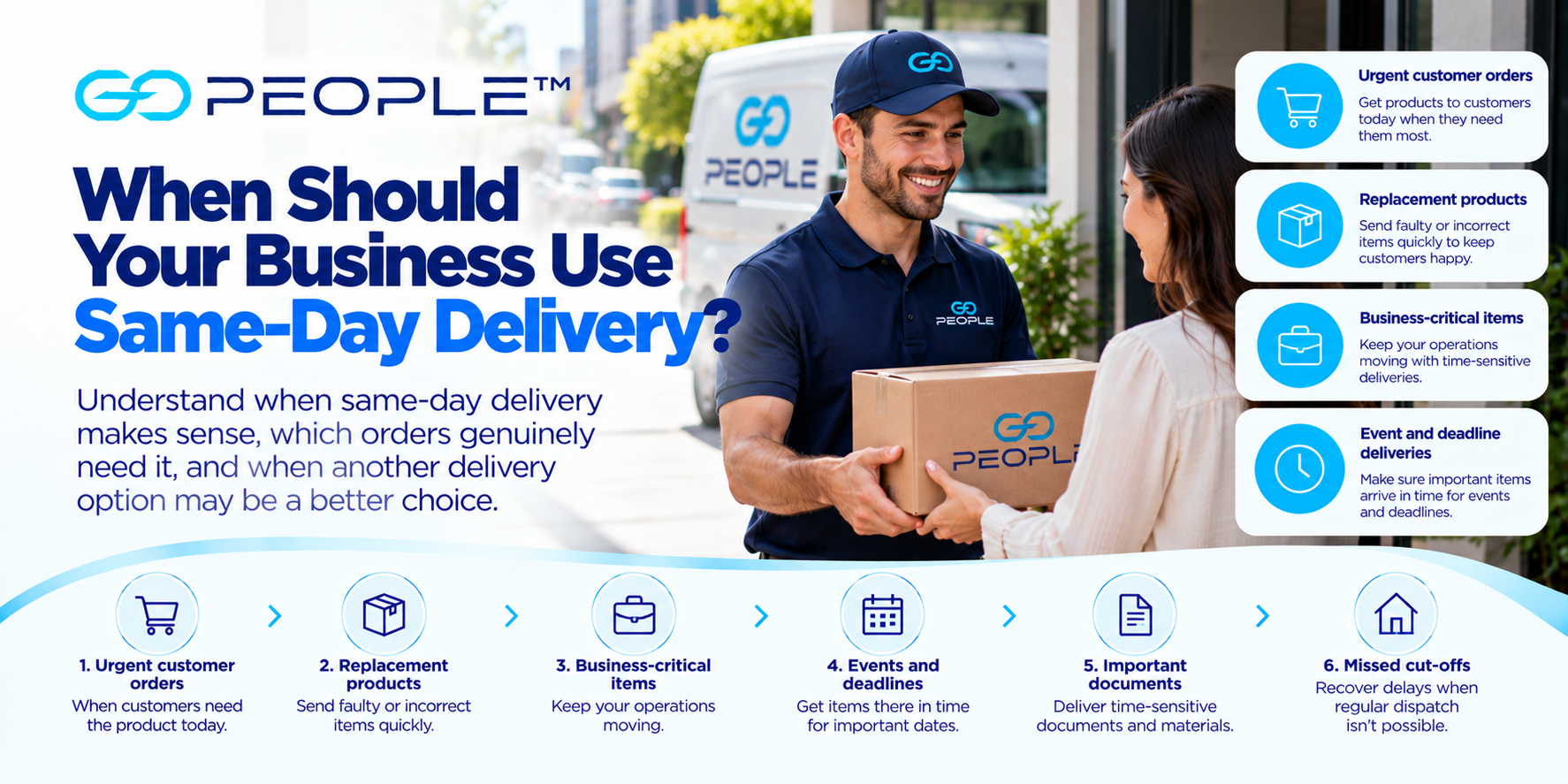
Same-day delivery sounds attractive.
A customer places an order today and receives it today. For urgent purchases, replacement products and time-sensitive business requirements, that speed can create real value.
But that doesn’t mean every order should be sent using a same-day courier.
Faster delivery can cost more, require tighter fulfilment cut-offs and leave less room for operational delays. If the customer doesn’t genuinely need the order today, another delivery model may be more appropriate.
The question businesses should ask isn’t:
“Can we deliver this today?”
It is:
“Does delivering this today create enough value to justify using a same-day service?”
This guide explains when same-day delivery makes sense, when it may not, and how businesses can choose the right delivery option for different orders.
What Is Same-Day Delivery?
Same-day delivery means an item is collected and delivered within the same day, subject to the provider’s service area, booking requirements, cut-offs and other applicable conditions.
For businesses, it can sit between regular planned delivery and highly urgent on-demand courier requirements.
Typical same-day deliveries might include:
- retail orders needed today
- replacement products
- time-sensitive business items
- important documents
- forgotten items
- urgent customer orders
The defining requirement is straightforward:
The item genuinely needs to reach its destination today.
Same-Day Delivery Isn’t the Same as Instant Delivery
“Same-day” doesn’t necessarily mean the parcel will arrive immediately after booking.
A same-day service may operate within booking cut-offs, collection schedules and delivery windows.
An on-demand courier may be more appropriate when an individual job needs to be arranged urgently.
Businesses should therefore distinguish between:
Needs to arrive sometime today
and
Needs to move urgently now.
That distinction can help determine which service is appropriate.
When Should a Business Use Same-Day Delivery?
There are several situations where receiving something today can create meaningful value.
1. When a Customer Genuinely Needs the Product Today
This is the clearest use case.
A customer may be purchasing something because they need it that day.
Examples could include:
- an item required for an event
- a replacement product
- an urgent retail purchase
- supplies needed before the next business day
In these cases, delivery speed isn’t simply a nice feature.
It is part of the reason the customer is purchasing.
If the product arrives tomorrow, it may no longer solve the customer’s problem.
2. When You’re Replacing a Faulty or Incorrect Product
Mistakes happen.
A customer might receive:
- the wrong product
- a damaged item
- an incomplete order
- something that doesn’t work as expected
Where appropriate, sending a replacement quickly can help resolve the situation.
Suppose a customer needs the product for work today.
Telling them:
“We’ll send another one sometime next week”
may create further frustration.
A same-day replacement can sometimes turn a poor initial experience into a much better recovery.
However, the urgency should still be assessed case by case.
Not every replacement requires same-day delivery.
3. When a Business-Critical Item Is Needed Today
Same-day delivery isn’t only for ecommerce.
Businesses may urgently need:
- documents
- equipment
- replacement components
- supplies
- stock
- samples
The value of receiving the item can be much greater than the courier fee.
For example, if a missing component is preventing work from continuing, the commercial cost of waiting until tomorrow may exceed the cost of same-day delivery.
This is where urgency should be evaluated against business impact, not merely transport price.
4. When a Customer Has Paid for Faster Delivery
If a business offers a same-day option at checkout and the customer selects it, the delivery operation needs to support that promise.
This requires coordination between:
Checkout → Inventory → Picking → Packing → Dispatch → Courier
Offering same-day delivery isn’t useful if orders regularly sit in the warehouse until after the booking cut-off.
Before adding the option to your ecommerce store, make sure your fulfilment process can reliably support it.
5. When Timing Is Connected to an Event
Some products lose value if they arrive after a particular time or date.
Examples might include products required for:
- meetings
- presentations
- celebrations
- events
- scheduled work
In these situations, tomorrow may simply be too late.
Businesses should still confirm that the chosen service and delivery timeframe are appropriate rather than making an unsupported guarantee.
6. When an Important Document Needs to Arrive Today
Despite digital communication, businesses can still have physical documents or materials that need to move between locations.
Where physical delivery is genuinely required that day, same-day or on-demand courier delivery may be appropriate.
The correct choice depends on how urgent the job actually is.
If it simply needs to arrive by the end of the day, same-day may be suitable.
If it needs to leave immediately, an on-demand option may be a better fit.
7. When You’ve Missed a Regular Dispatch
Sometimes the urgency is created by the business rather than the customer.
An order may have:
- missed a warehouse cut-off
- been overlooked
- been held because of a stock problem
- been delayed by an internal error
A faster delivery service can sometimes help recover the original customer expectation.
But businesses shouldn’t make this a routine operating model.
If same-day couriers are constantly being used to compensate for warehouse problems, the underlying fulfilment process needs attention.
8. When Fast Service Can Protect an Important Customer Relationship
Some B2B deliveries have greater commercial significance than the delivery itself.
A delayed item might affect:
- an important customer
- a project deadline
- a business relationship
- ongoing operations
In those cases, paying for faster delivery may be commercially sensible.
The calculation should consider the value of the customer relationship rather than viewing the courier fee in isolation.
When Same-Day Delivery May Not Be the Best Choice
The fact that something can be delivered today doesn’t mean it should be.
Regular Ecommerce Orders
Many ordinary ecommerce purchases aren’t genuinely urgent.
Customers may be perfectly satisfied with a reliable next-day service, particularly when the expected delivery timeframe is clearly communicated.
Using same-day delivery for every order can increase delivery costs without creating equivalent customer value.
For eligible regular business parcel volumes from warehouses in Sydney, Melbourne and Brisbane, GoEXPRESS provides next-day delivery.
Large Numbers of Deliveries From One Pickup
Suppose your business has 40 or 50 deliveries leaving the same location.
Treating every destination as an unrelated courier job may not be the most efficient approach.
A multi-drop service can be more appropriate.
GoBUNDLE is designed for multiple deliveries from one pickup and includes route optimisation.
The destinations can vary from run to run, making it relevant to businesses with changing daily delivery requirements.
Highly Urgent Individual Jobs
Sometimes “today” isn’t specific enough.
The item needs to move urgently.
For those time-sensitive individual jobs, an on-demand courier may be more appropriate.
GoVIP is GoPeople’s on-demand courier option within supported areas.
Specialist Goods
Same-day speed doesn’t override shipment requirements.
Some goods may require:
- specialist freight
- dangerous-goods handling
- temperature-controlled transport
- two-person handling
- specialist lifting equipment
- vehicles outside a standard courier operation
Those items should use an appropriate provider even if delivery is urgent.
Never force a shipment into an unsuitable service simply to achieve a faster timeframe.
Same-Day vs Next-Day vs On-Demand vs Multi-Drop
The distinction becomes clearer when the options are compared directly.
| Situation | Delivery approach to consider |
|---|---|
| Customer genuinely needs the order today | Same-day |
| Regular ecommerce parcel | Next-day |
| Multiple destinations from one pickup | Multi-drop |
| Unexpected highly urgent individual job | On-demand |
| Replacement required today | Same-day or on-demand depending on urgency |
| Regular warehouse parcel volume | Next-day |
| Many changing local destinations | Multi-drop |
| Specialist/heavy/regulated goods | Appropriate specialist provider |
This is a starting framework rather than a universal rule.
Service availability, parcel requirements, locations and operational conditions still need to be checked.
How to Decide Whether an Order Is Really Urgent
Businesses can use a simple set of questions.
Question 1: What Happens If It Arrives Tomorrow?
This is often the most useful test.
If the answer is:
“Nothing significant”
then same-day delivery may not be necessary.
If the answer is:
“The customer can’t use it when needed”
or:
“The business can’t continue work”
then speed may have substantial value.
Question 2: Did the Customer Request Same-Day Delivery?
If the customer has explicitly selected an available same-day option, the order should be handled according to that service commitment.
If the customer hasn’t requested urgent delivery, consider whether upgrading it creates enough value to justify the additional cost.
Question 3: What Is the Value of Arriving Today?
Think beyond the product price.
The value might include:
- preventing downtime
- recovering a service failure
- meeting an event deadline
- retaining an important customer
- completing urgent work
Sometimes a relatively inexpensive item has very high time value.
Question 4: Can Your Fulfilment Operation Actually Support It?
A same-day courier can’t collect an order that hasn’t been prepared.
Check:
- inventory availability
- picking time
- packing time
- booking cut-off
- pickup availability
- delivery location
The complete operation needs to fit within the required timeframe.
Same-Day Delivery Starts in the Warehouse
Businesses sometimes treat delivery speed as entirely the courier’s responsibility.
It isn’t.
Imagine:
Order placed: 9:00 am
Warehouse starts picking: 3:30 pm
Order ready: 4:30 pm
The available same-day delivery options may now be very different from what they were at 9:00 am.
If same-day delivery is an important part of your customer proposition, urgent orders need to be identified and prioritised early.
That can require:
- clear order flags
- warehouse prioritisation
- suitable packing processes
- known booking cut-offs
- rapid exception handling
Fast delivery requires fast fulfilment.
Understand Same-Day Cut-Off Times
Same-day delivery generally has practical booking and collection constraints.
The later an order enters the process, the less time remains to:
- prepare it
- collect it
- route it
- complete delivery
Businesses should understand applicable cut-offs before advertising same-day delivery to customers.
Don’t create a website promise that your warehouse or delivery provider cannot consistently support.
Check Service Coverage
Same-day delivery is not necessarily available from every pickup location to every destination.
Coverage can vary according to:
- pickup location
- destination
- service
- booking time
- operational requirements
GoPeople’s GoSAMEDAY has limited pickup areas in supported capital cities with broader metropolitan delivery areas.
Businesses should check service eligibility rather than assuming a particular address is covered.
Check the Parcel Requirements
Urgency doesn’t change the physical characteristics of a shipment.
Before booking, check:
- dimensions
- weight
- packaging
- number of items
- handling requirements
- restricted goods
Large or unusual shipments may need a different delivery solution.
See our guide to shipping large items in Australia for further considerations.
Make Sure the Address Is Correct
An urgent courier sent to the wrong address isn’t fast delivery.
It is a fast mistake.
For same-day orders, there may be less time to correct problems before delivery.
Make sure you have:
- correct street address
- unit or suite number
- correct suburb and postcode
- recipient name
- contact number
- useful access information
Address accuracy should be part of fulfilment, not something checked only after delivery fails.
Consider Recipient Availability
Same-day delivery can create another challenge:
The customer may not have expected the parcel so quickly.
Depending on the delivery and applicable conditions, recipient availability or property access can matter.
Where appropriate, customers should receive useful delivery information so they understand what is happening.
A fast delivery that fails because nobody can receive it may create more cost and frustration than a well-planned delivery tomorrow.
Tracking Matters More When Timing Matters
The more urgent the order, the more likely the customer is to care about its progress.
If something is genuinely needed today, the customer may want to know:
- Has it been collected?
- Is it moving?
- What is the current status?
- Has delivery been completed?
Useful tracking reduces uncertainty.
We’ve covered this more broadly in Why Real-Time Tracking Is a Must for Online Shopping.
Communicate Meaningful Updates
Don’t assume that fast delivery removes the need for communication.
If anything, urgency can make communication more important.
Useful updates might include:
- booking or dispatch confirmation
- delivery progress
- important status changes
- unsuccessful delivery information
- completion
Customers generally don’t need every internal operational event.
They need information that helps them understand what is happening.
What Happens If Same-Day Delivery Fails?
Businesses should understand the exception process before something goes wrong.
Ask:
- What happens if access isn’t available?
- What happens if the recipient can’t be reached?
- What happens after an unsuccessful attempt?
- Is redelivery possible?
- Are additional charges involved?
- Where does the item go?
- How is the customer informed?
A same-day promise doesn’t mean every delivery will always succeed on the first attempt.
Clear exception processes are essential.
Same-Day Delivery and Customer Experience
Speed can contribute to a strong customer experience, but only when the rest of the delivery works.
A same-day order that is:
- poorly communicated
- delivered incorrectly
- damaged
- impossible to track
isn’t a great experience simply because it moved quickly.
Customers also value:
- reliability
- visibility
- accurate delivery
- product condition
- useful support
Our guide to improving the customer delivery experience explores the complete journey.
Same-Day Delivery Has a Commercial Cost
Businesses should evaluate same-day delivery economically.
Suppose:
Regular delivery cost = $8
Same-day delivery cost = $18
The relevant question isn’t simply:
“Is $18 expensive?”
It is:
“Does receiving this order today create at least enough additional value to justify the difference?”
That value could come from:
- customer-paid delivery fees
- higher conversion
- retaining an important customer
- avoiding downtime
- resolving a service failure
- protecting an order
The numbers will vary by business.
The principle is to connect urgency with commercial value.
Don’t Automatically Offer Same-Day Delivery for Free
A business can offer customers faster delivery without necessarily absorbing the entire cost.
For example:
Next-day delivery — standard option
Same-day delivery — premium option
Customers who genuinely value the additional speed can choose it.
Another model might combine a free-delivery threshold with paid premium delivery.
See our guide to free delivery strategy for the economics behind different approaches.
Measure Whether Customers Actually Use Same-Day Delivery
If you offer same-day delivery, monitor what happens.
Useful measures include:
Selection Rate
What percentage of eligible customers choose it?
Conversion Rate
Does offering same-day delivery influence purchasing?
Delivery Cost
What does the service cost per order?
On-Time Performance
Are the expected timeframes being met?
Failed Deliveries
Does urgency create recipient-access problems?
Customer Feedback
Do customers value the option?
Repeat Purchasing
Do customers who use same-day delivery return?
Don’t maintain a costly service simply because it sounds competitive.
Measure whether it creates value.
Don’t Use Same-Day Delivery to Hide Operational Problems
This deserves particular attention.
If your business repeatedly pays for urgent delivery because orders:
- weren’t picked on time
- missed dispatch
- were forgotten
- were packed incorrectly
- weren’t booked properly
the solution isn’t simply more same-day couriers.
Analyse the cause.
A useful metric is:
Why did this order require urgent delivery?
Categorise the answer.
Over time, you may discover that many “urgent” deliveries were actually preventable.
Fixing those internal problems can reduce delivery costs without reducing customer service.
Build Rules for Your Team
If staff choose delivery services manually, create clear guidelines.
For example:
Use Next-Day When:
- order is routine
- tomorrow meets the customer expectation
- parcel fits service requirements
Use Same-Day When:
- delivery is genuinely required today
- service coverage is available
- fulfilment can meet the cut-off
- shipment is suitable
Use On-Demand When:
- an unexpected individual delivery is highly urgent
- the requirement needs a more immediate response
Use Multi-Drop When:
- multiple deliveries leave from one pickup location
- destinations can be organised into a run
Use Specialist Transport When:
- the shipment has requirements outside standard courier services
Rules reduce the risk of staff automatically choosing the fastest—or cheapest—option without considering the actual requirement.
A Same-Day Delivery Decision Checklist
Before booking, ask:
Urgency
- Does this genuinely need to arrive today?
- What happens if it arrives tomorrow?
Customer
- Did the customer request same-day?
- Is the customer available to receive it where required?
Fulfilment
- Is the product in stock?
- Can it be picked and packed before cut-off?
- Is the shipment ready for collection?
Location
- Is the pickup address eligible?
- Is the destination within the applicable service area?
Shipment
- Does it meet size and weight requirements?
- Is it packaged appropriately?
- Does it require specialist handling?
Information
- Is the address correct?
- Do we have the recipient’s contact information?
- Are relevant delivery instructions available?
Economics
- What does same-day delivery cost?
- Who pays for it?
- What value does delivering today create?
Alternative
- Would next-day meet the requirement?
- Is an on-demand courier more appropriate?
- Would a multi-drop run be more efficient?
If you can answer those questions, choosing the appropriate service becomes much easier.
Frequently Asked Questions About Same-Day Delivery
What is same-day delivery?
Same-day delivery means an eligible shipment is collected and delivered within the same day, subject to the provider’s booking requirements, cut-offs, coverage and service conditions.
It doesn’t necessarily mean immediate or direct delivery.
When should a business use same-day delivery?
Same-day delivery is most useful when receiving the item today creates meaningful value.
Examples can include urgent customer orders, replacement products, time-sensitive business items and products required for a particular event.
Is same-day delivery better than next-day delivery?
Not necessarily.
If tomorrow meets the customer’s needs, next-day delivery may be more appropriate.
Same-day delivery is most valuable when the additional speed solves a genuine requirement.
What’s the difference between same-day and on-demand courier delivery?
Same-day delivery is designed around the requirement for an eligible item to arrive within the same day.
On-demand courier delivery is generally used for urgent individual jobs arranged as required.
The exact service structures vary by provider.
Is same-day delivery more expensive?
It can be more expensive than less urgent delivery options because faster services can require different operational resources.
Businesses should compare the additional cost with the value created by delivering the item today.
Should businesses offer customers same-day delivery?
It can be worthwhile if there is customer demand and the business can reliably support the service operationally.
Before offering it, check fulfilment capability, delivery coverage, cut-offs, pricing and customer demand.
Where is GoPeople same-day delivery available?
GoSAMEDAY is GoPeople’s same-day delivery service. Availability depends on the pickup and delivery location and applicable service requirements.
Businesses should use the GoPeople service eligibility checker to check availability for their pickup location.
Same-Day Delivery Should Solve a Same-Day Problem
Same-day delivery can be extremely valuable.
But the value comes from solving a genuine time-sensitive requirement, not simply from being faster.
Use it when:
The customer genuinely needs the order today.
A replacement needs to arrive quickly.
A business-critical item can’t wait.
Timing is connected to an event or deadline.
The commercial value of speed justifies the cost.
For routine orders, another delivery option may provide better economics while still meeting customer expectations.
The strongest delivery strategy isn’t one that sends everything as quickly as possible.
It is one that understands which orders need speed, which don’t, and which delivery model best fits each requirement.