Choosing a courier service can look straightforward: compare a few prices, check how quickly each provider can deliver and choose one.
For businesses that rely on delivery every day, however, the decision is much more important.
Your delivery provider can affect:
- customer experience
- delivery costs
- warehouse operations
- support workload
- delivery visibility
- failed deliveries
- scalability
- repeat purchasing
The cheapest courier isn’t necessarily the lowest-cost option, and the fastest service isn’t necessarily the right service for every order.
A business sending 500 ecommerce parcels from a warehouse has very different requirements from a retailer making 15 local deliveries, or an office that occasionally needs an urgent document delivered across the city.
The key is to understand what your business actually needs from delivery before comparing providers.
This guide explains how Australian businesses can evaluate courier services and choose the right delivery model for their operation.
Start With Your Delivery Profile
Before comparing courier companies, understand your own delivery operation.
Gather information about:
- number of deliveries
- frequency
- pickup locations
- customer locations
- average distance
- parcel dimensions
- parcel weights
- delivery urgency
- business-to-business vs residential deliveries
- failed-delivery rates
- seasonal peaks
Don’t rely on a handful of unusual orders.
Look at several weeks or months of actual delivery data where possible.
This creates a realistic picture of what you need a courier provider to handle.
How Many Deliveries Do You Send?
Delivery volume can significantly affect which service model makes sense.
A business sending:
2 urgent deliveries per week
has very different requirements from one sending:
200 parcels per day
or:
40 local deliveries from one store every afternoon.
Consider both average and peak volumes.
If your normal volume is 100 parcels per day but increases to 400 during Christmas, your provider needs to cope with more than the average.
Ask whether the delivery operation can scale with your business.
How Often Do You Need Deliveries?
Frequency matters as much as volume.
Some businesses need:
- daily warehouse collections
- scheduled pickups several times per week
- occasional urgent deliveries
- seasonal delivery campaigns
- ad-hoc courier jobs
A provider that works well for occasional bookings may not be the best operational fit for regular high-volume dispatch.
Similarly, a business with only occasional urgent deliveries may not need a complex scheduled-delivery arrangement.
Match the service to the actual pattern of work.
Understand the Different Delivery Models
“Courier service” can describe several different types of delivery.
Understanding the difference makes provider comparisons much easier.
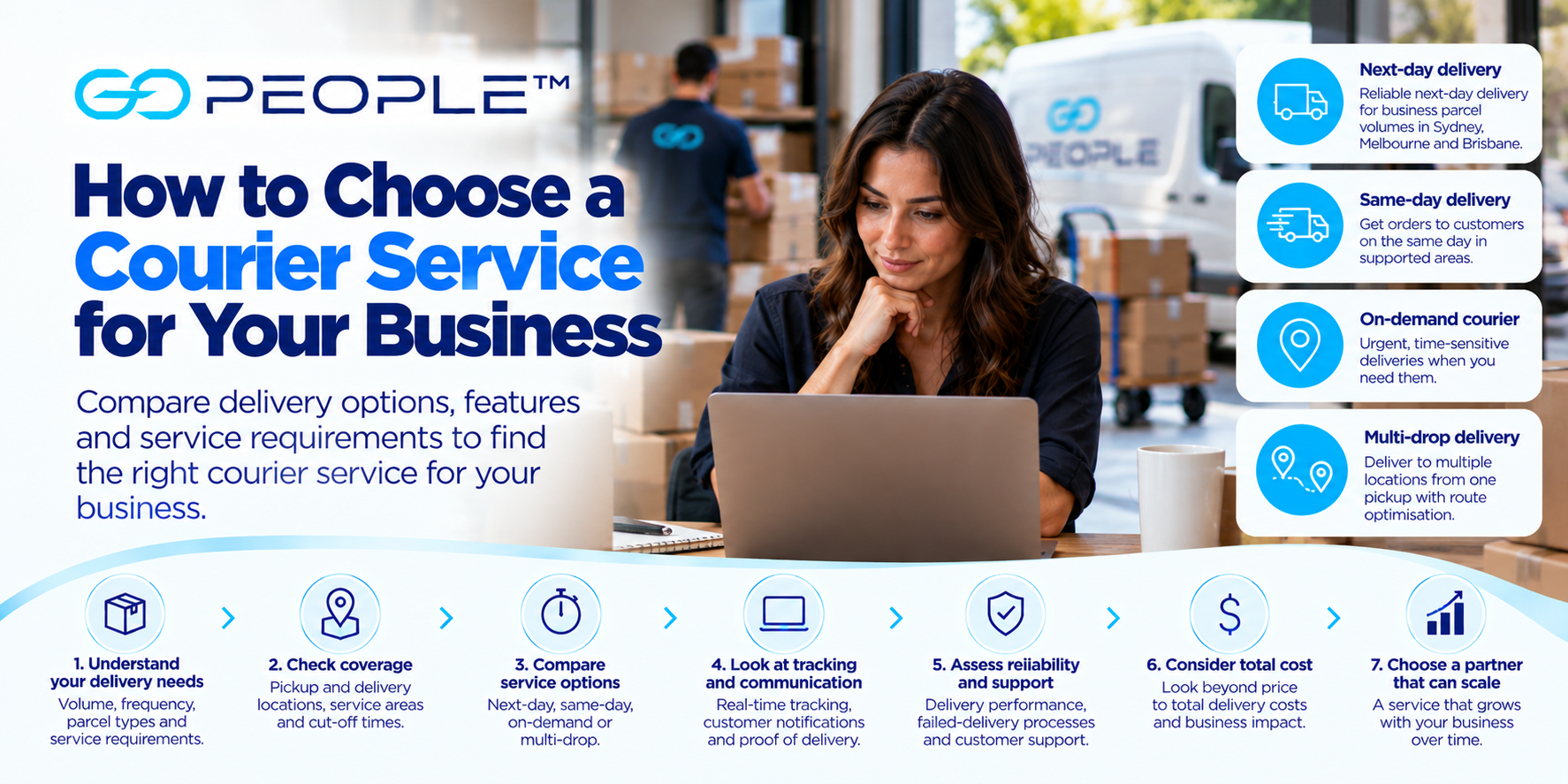
Next-Day Delivery
Next-day delivery is designed for orders that don’t need to arrive immediately but where businesses want a relatively fast, predictable delivery timeframe.
It can suit:
- ecommerce parcels
- retail orders
- regular business deliveries
- warehouse dispatch
- planned parcel volumes
For businesses with regular parcel volumes, next-day delivery can provide a balance between speed and operational efficiency.
GoPeople’s GoEXPRESS provides next-day delivery for eligible business parcel volumes from warehouses in Sydney, Melbourne and Brisbane.
Same-Day Delivery
Same-day delivery is appropriate when the order needs to arrive on the same day it is collected.
It can suit:
- time-sensitive retail orders
- urgent replacement products
- important business items
- customers specifically choosing same-day delivery
GoPeople’s GoSAMEDAY provides same-day delivery within supported service areas.
Same-day shouldn’t automatically be used for every order simply because it is faster.
If the customer doesn’t need the product today, another delivery model may be more efficient.
On-Demand Courier
An on-demand courier is useful when an individual delivery needs to be organised quickly.
Typical examples might include:
- urgent documents
- forgotten items
- replacement products
- time-sensitive business deliveries
- unexpected delivery requirements
GoVIP is GoPeople’s on-demand courier option for urgent and time-sensitive jobs.
Multi-Drop Delivery
Multi-drop delivery is different.
Instead of treating each destination as a completely separate courier booking, multiple deliveries are organised into a delivery run.
For example:
Warehouse → Customer A → Customer B → Customer C → Customer D → Customer E
This can be useful for businesses that regularly have many deliveries leaving from one pickup location.
GoBUNDLE provides multi-drop delivery with route optimisation.
Which Delivery Model Does Your Business Need?
A simplified comparison looks like this:
| Requirement | Delivery Model to Consider |
|---|---|
| Regular ecommerce parcels | Next-day |
| Customer needs order today | Same-day |
| One urgent delivery | On-demand |
| Many deliveries from one pickup | Multi-drop |
| Regular warehouse parcel volume | Next-day |
| Multiple changing local destinations | Multi-drop |
| Urgent replacement item | Same-day or on-demand |
These aren’t universal rules.
Actual suitability depends on the shipment, location, service requirements and provider.
But identifying the delivery model first makes it much easier to compare the right services.
1. Check Pickup Coverage
A courier provider isn’t useful if it doesn’t collect from where your business operates.
Check:
- pickup suburbs
- postcode coverage
- warehouse locations
- service availability
- pickup cut-offs
- scheduled collection options
This is especially important for businesses operating from multiple warehouses or stores.
Don’t assume that because a courier delivers into an area, it also offers the same pickup service from that location.
Pickup and delivery coverage can be different.
2. Check Delivery Coverage
Next, look at where your customers actually are.
Analyse your historical orders by:
- postcode
- suburb
- city
- state
- metropolitan vs regional location
You may discover that most customers are concentrated within particular metropolitan areas.
That information can help determine whether a local or metropolitan delivery provider can handle a meaningful proportion of your orders.
Some businesses may also use multiple providers for different geographic requirements.
There is no rule that every shipment must go through one carrier.
3. Check Parcel Size and Weight Requirements
Every delivery service has limits.
Before selecting a courier, understand what you actually ship.
Review:
- typical parcel dimensions
- average weight
- largest parcel
- smallest parcel
- unusual shapes
- fragile products
- multi-piece shipments
A service that works perfectly for small ecommerce parcels may not be appropriate for furniture, pallets or very heavy goods.
Similarly, don’t assume that a provider offering vans automatically accepts every item that physically fits inside one.
Check the applicable service requirements.
For larger shipments, see our guide to shipping large items in Australia.
4. Consider Product Handling Requirements
Some products need more than standard parcel delivery.
Examples can include goods requiring:
- temperature control
- dangerous-goods handling
- specialist lifting
- two-person handling
- installation
- specialist freight equipment
If your products have special requirements, confirm that the provider is actually equipped and authorised to handle them.
Don’t assume a standard courier service is suitable.
This is particularly important for regulated goods.
5. Compare Delivery Speed Carefully
Faster sounds better, but speed needs context.
Ask:
Does the customer actually need this order today?
If not, paying for an urgent service may provide little additional value.
A better strategy can be to offer different service levels.
For example:
Regular order → next-day
Needs to arrive today → same-day
Urgent individual requirement → on-demand
This allows delivery spending to reflect the customer’s actual requirement.
6. Look Beyond the Headline Delivery Time
A provider might advertise a particular delivery timeframe, but businesses should understand how that timeframe works operationally.
Ask about:
- booking cut-offs
- pickup windows
- warehouse requirements
- service areas
- weekends
- public holidays
- exclusions
- unsuccessful deliveries
A next-day service isn’t useful if your warehouse consistently misses the collection cut-off.
Similarly, same-day delivery needs to fit both the courier’s operation and your fulfilment process.
7. Evaluate Tracking
Tracking has become an important part of the customer experience.
After an order is dispatched, customers often want to know:
Where is it?
A useful tracking system can give customers and businesses visibility without requiring constant manual enquiries.
Look for information such as:
- current status
- delivery progress
- relevant delivery events
- completion information
- proof of delivery
We’ve covered the customer side of this in Why Real-Time Tracking Is a Must for Online Shopping.
8. Check Customer Notifications
Tracking is useful when customers know where to find it.
Ask what communication the delivery service supports.
Depending on the service, that may include:
- tracking links
- SMS updates
- email notifications
- delivery status changes
- delivery completion notifications
More notifications aren’t automatically better.
What matters is whether customers receive useful information at important stages.
9. Understand Proof of Delivery
Proof of delivery can become important when a customer asks:
“Where is my parcel?”
Depending on the service, proof may include:
- completion status
- timestamp
- photo
- signature
- location information
Ask what information is available and how your team can access it.
A strong proof-of-delivery process can make delivery enquiries much easier to investigate.
10. Ask What Happens When Delivery Fails
Successful deliveries are easy.
The quality of a delivery operation often becomes clearer when something goes wrong.
Ask potential providers:
- What happens if the recipient isn’t available?
- What happens when access is impossible?
- How is an incorrect address handled?
- What happens to the parcel afterward?
- Is redelivery available?
- Are additional charges involved?
- How is the customer informed?
Don’t wait for your first failed delivery to discover the process.
11. Examine the Support Model
When something goes wrong, who can your team contact?
Consider:
- available support channels
- support hours
- response processes
- escalation paths
- access to tracking information
- investigation procedures
Businesses with significant delivery volumes may need a different level of support from occasional courier users.
The cheapest provider can become expensive if your staff spend hours every week chasing delivery information.
12. Consider Integrations
Businesses with regular delivery volumes should think beyond manual bookings.
Depending on your operation, useful integration capabilities might connect delivery with:
- ecommerce platforms
- order-management systems
- warehouse processes
- internal systems
- APIs
The objective is to reduce unnecessary manual work.
If staff repeatedly copy:
- customer names
- addresses
- phone numbers
- order numbers
from one system into another, there may be opportunities for automation.
13. Consider Address and Data Quality
Courier performance isn’t determined solely by the courier.
Bad input creates bad outcomes.
If your business regularly sends:
- incomplete addresses
- wrong postcodes
- missing unit numbers
- incorrect phone numbers
even an excellent delivery provider will struggle.
When comparing courier services, also review your own checkout and fulfilment processes.
Better delivery requires good information from both parties.
14. Look at Route Optimisation for Multi-Drop Operations
If your business sends many local deliveries from one location, route planning can become a significant operational issue.
A poor route can create:
- unnecessary kilometres
- longer delivery times
- higher operating costs
- inefficient vehicle use
Route optimisation helps organise multiple stops into a more efficient sequence based on available delivery information.
This is particularly relevant to multi-drop operations.
See our guide to delivery route optimisation for more detail.
15. Compare Price—But Don’t Stop There
Price matters.
Businesses should understand what they are paying and how delivery charges are calculated.
But comparing only the headline price can be misleading.
Consider the total cost of delivery.
That can include:
Courier charge
- Redelivery costs
- Support workload
- Manual administration
- Replacement products
- Failed deliveries
- Customer compensation
A service that costs slightly more per successful delivery may still be commercially better if it reduces other costs.
16. Understand the Pricing Model
Ask how charges are determined.
Depending on the provider and service, pricing might be affected by:
- distance
- zones
- weight
- dimensions
- urgency
- delivery quantity
- service type
- additional handling
- redelivery
Businesses should also understand potential additional fees.
A pricing model should be predictable enough that you can incorporate delivery costs into your commercial planning.
17. Look at Delivery Cost Per Successful Order
Suppose:
Provider A: $8.00 per delivery
Provider B: $8.50 per delivery
Provider A initially appears cheaper.
But imagine Provider A produces more failed deliveries, support enquiries and redelivery costs.
The true economics may be different.
Businesses should consider:
Total delivery-related cost ÷ successful deliveries
rather than looking only at the initial courier charge.
This is especially important at scale.
Our guide to reducing delivery costs explores the broader cost equation.
18. Evaluate Reliability
Delivery speed receives a lot of attention.
Reliability is often more important.
A customer who is told:
“Your order will arrive tomorrow”
generally expects that promise to be met.
A provider that occasionally delivers extremely quickly but frequently misses expectations may create a worse customer experience than one with a realistic and consistent service.
Look at actual performance where available.
Consider:
- on-time delivery
- first-attempt success
- failed deliveries
- customer complaints
- damage
- tracking quality
19. Consider Scalability
The courier that works for you today also needs to fit where the business is heading.
Ask:
- Can the provider handle increased volume?
- What happens during peak periods?
- Can additional pickup locations be supported?
- Can the operation handle seasonal campaigns?
- Can systems be integrated?
- Are different delivery models available?
You don’t necessarily need a provider that can solve every hypothetical future problem.
But you should avoid building an operation that needs to be completely replaced as soon as order volume grows.
20. Consider the Customer Experience
Your customers don’t necessarily care which courier company you use.
They care about what happens to their order.
From their perspective:
They bought from you.
Evaluate the delivery experience as if you were the recipient.
Can customers:
- understand when the order will arrive?
- track the delivery?
- receive useful updates?
- understand what happens after a failed attempt?
- get help when something goes wrong?
We’ve created a full guide to improving the customer delivery experience.
21. Review Your Own Support Workload
Delivery providers can affect your internal team.
Track how many customer enquiries relate to:
- delivery status
- late parcels
- failed delivery
- missing parcels
- wrong addresses
- proof of delivery
If your customer-service team spends a significant amount of time handling delivery enquiries, better tracking and delivery visibility may have measurable operational value.
Courier evaluation should therefore involve customer-service teams as well as warehouse and finance teams.
22. Don’t Choose a Provider Based on One Unusual Order
A common mistake is designing the entire delivery operation around exceptional requirements.
Suppose 95% of orders are ordinary ecommerce parcels and 5% require specialist freight.
It may not make sense to choose the provider for the 95% based entirely on the needs of the 5%.
Instead, businesses can sometimes use:
- a primary provider for regular deliveries
- another provider for specialist requirements
Build the delivery operation around the real order profile.
23. Consider Using More Than One Delivery Service
There is no requirement to use one service for every order.
A business might use:
Next-day for regular ecommerce orders.
Multi-drop for batches of local deliveries.
Same-day when customers genuinely need an order today.
On-demand for urgent exceptions.
Specialist freight for goods outside ordinary courier requirements.
This can create a more flexible delivery operation than forcing every order through one model.
24. Trial the Courier Before Moving Everything
If delivery is important to your business, avoid moving your entire operation based solely on a sales presentation.
Where practical, run a controlled trial.
For example:
- one warehouse
- one region
- one product category
- a defined percentage of orders
- a limited trial period
Measure actual performance.
This allows you to compare providers using your own deliveries rather than assumptions.
25. Define the Trial Before It Starts
Decide what success looks like.
Potential measures include:
| Metric | Why It Matters |
|---|---|
| On-time delivery | Reliability |
| First-attempt success | Delivery effectiveness |
| Failed deliveries | Operational friction |
| Cost per delivery | Direct expense |
| Cost per successful delivery | Better total-cost measure |
| Customer enquiries | Support workload |
| Tracking quality | Customer visibility |
| Damage reports | Product protection |
| Redelivery rate | Additional cost |
| Customer feedback | Experience |
Collect the same information for your existing operation where possible.
Otherwise, you may know how the new provider performs but have nothing meaningful to compare it with.
Courier Service Evaluation Checklist
Before choosing a provider, ask these questions.
Service Fit
- What delivery model do we actually need?
- How many deliveries do we send?
- How frequently?
- What are our peak volumes?
Coverage
- Can the provider collect from our locations?
- Can it deliver to our main customer areas?
- Are there postcode restrictions?
Products
- What are our typical parcel dimensions?
- What do they weigh?
- Are any goods fragile, oversized or specialised?
- Are there prohibited or restricted items?
Speed
- What delivery timeframes are available?
- What are the cut-offs?
- Can our warehouse meet them?
Technology
- Is tracking available?
- What notifications are provided?
- Is proof of delivery available?
- Can systems be integrated?
Exceptions
- What happens after a failed delivery?
- How are delays handled?
- What is the redelivery process?
- How are investigations managed?
Support
- How do we contact support?
- What information can support access?
- What is the escalation process?
Commercial
- How is pricing calculated?
- What additional charges can apply?
- What is the total cost per successful delivery?
Scale
- Can the provider handle peak volume?
- Can it support growth?
- Can we add additional locations?
Performance
- How will performance be measured?
- Can we trial the service first?
- How often will we review results?
If a provider can’t clearly answer the questions most important to your operation, investigate further before committing.
Frequently Asked Questions About Choosing a Courier Service
What should a business look for in a courier service?
Start with operational fit.
Consider coverage, delivery speed, parcel requirements, tracking, proof of delivery, failed-delivery processes, support, pricing, technology and scalability.
The right weighting depends on your business.
Should I choose the cheapest courier?
Not necessarily.
The initial courier price is only one part of the total cost.
Failed deliveries, redeliveries, customer support, manual administration and replacement products can all add expense.
Compare total delivery economics rather than only the quoted price.
What is the difference between same-day and on-demand courier delivery?
Same-day delivery is designed for deliveries that need to arrive within the same day.
On-demand courier delivery is generally used for urgent individual jobs that need to be arranged as required.
Exact service definitions vary by provider, so businesses should check the applicable terms and coverage.
When should a business use multi-drop delivery?
Multi-drop delivery can be useful when multiple deliveries leave from the same pickup location and need to go to different destinations.
Organising them into a delivery run can be more efficient than treating each stop as an unrelated courier booking.
Is tracking important when choosing a courier?
For many businesses, yes.
Tracking can give both the business and recipient better visibility into delivery progress and may reduce repetitive customer enquiries.
Consider not only whether tracking exists but how useful and accessible the information actually is.
Should an ecommerce business use more than one courier service?
It can make sense.
Different orders can have different requirements.
A business might use next-day delivery for regular ecommerce parcels, same-day for urgent customer orders, on-demand for exceptions and specialist freight for goods outside standard courier requirements.
How can I check which GoPeople service is available for my business?
GoPeople offers different delivery services depending on location and delivery requirements.
You can use the GoPeople service eligibility checker to check availability for your pickup location.
The Right Courier Is the One That Fits Your Operation
There isn’t one courier service that is automatically right for every Australian business.
A good choice depends on your:
Orders.
Customers.
Locations.
Products.
Delivery timeframes.
Technology.
Support requirements.
Costs.
Start by understanding your delivery profile.
Then compare providers against the factors that actually affect your operation.
Where possible, trial the service and measure real performance before making a larger commitment.
Most importantly, don’t choose a courier based solely on the lowest quoted price or fastest advertised delivery.
Choose the delivery operation that gives your business the right combination of service fit, visibility, reliability, customer experience and sustainable cost.