For an ecommerce or retail business, the customer experience doesn’t end when someone completes checkout.
In many ways, that’s when a new part of the experience begins.
The customer has paid for an order and is now waiting for the business to fulfil its promise.
They want to know:
Has my order been dispatched?
When will it arrive?
Where is it now?
Do I need to be home?
What happens if something goes wrong?
A great product and an excellent website can win the sale, but the delivery experience can influence how the customer feels about the entire purchase.
That’s why businesses should treat delivery as part of the customer experience—not simply a transport function that happens after checkout.
This guide explains how businesses can improve the delivery experience from the moment an order is placed through to successful delivery and post-delivery support.
What Is the Customer Delivery Experience?
The delivery experience includes every interaction a customer has between placing an order and successfully receiving it.
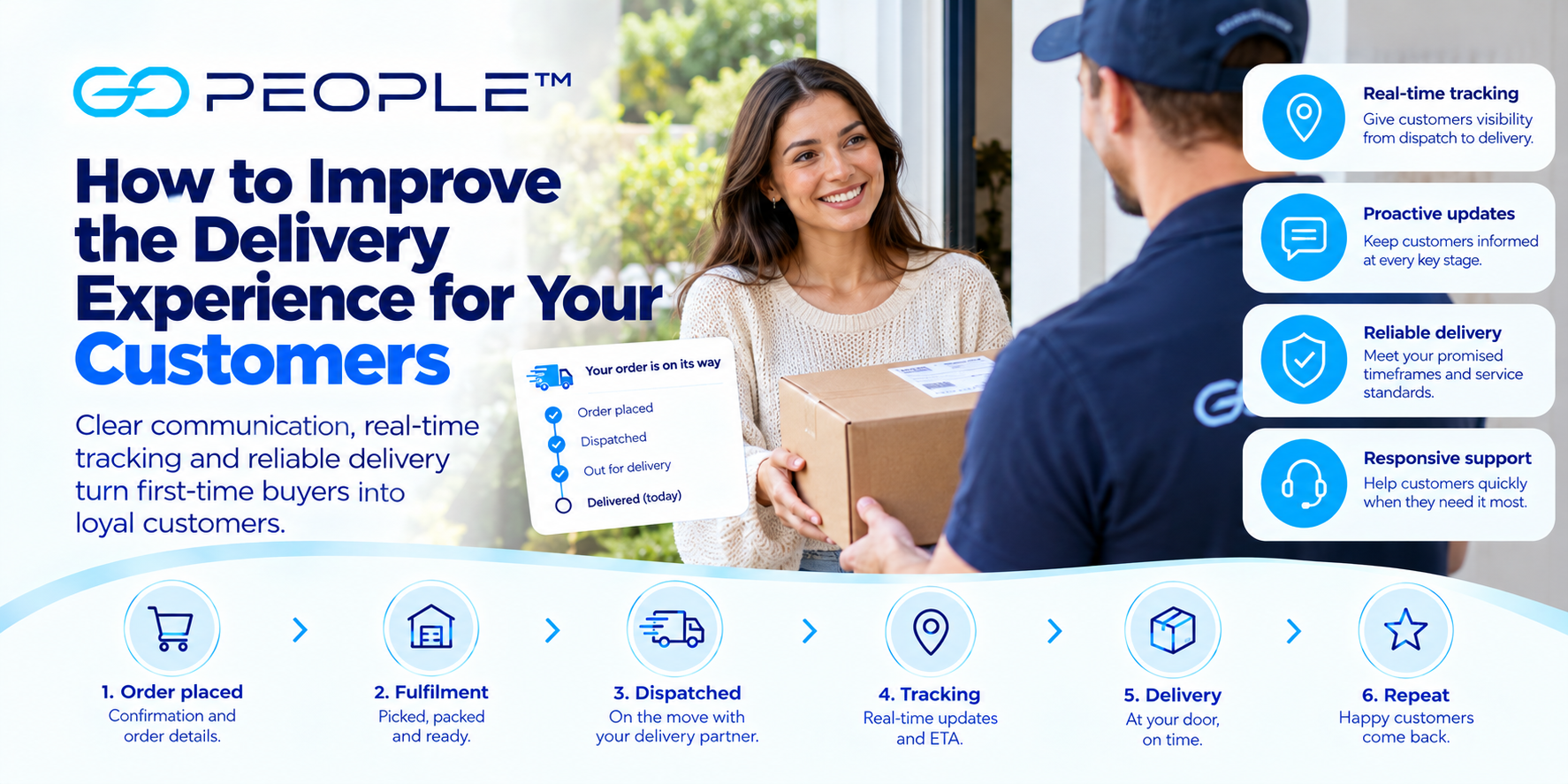
That can include:
Order placed
↓
Order confirmed
↓
Order prepared
↓
Dispatched
↓
Tracking available
↓
Delivery updates
↓
Delivery attempted or completed
↓
Proof of delivery
↓
Support if something goes wrong
Customers don’t necessarily distinguish between the retailer, warehouse, technology platform and delivery provider involved in those stages.
From their perspective, they bought something from your business.
That makes the delivery experience part of your brand experience.
Why Delivery Experience Matters
Consider two customers who buy identical products from two different retailers.
Customer A
Receives:
- clear order confirmation
- realistic delivery expectations
- tracking information
- useful status updates
- successful delivery
- clear proof of delivery
Customer B
Receives:
- vague delivery information
- no meaningful tracking
- no updates
- an unexpected delay
- uncertainty about where the parcel is
Both customers eventually receive the same product.
But their perception of the retailers may be very different.
The physical product isn’t the only thing customers remember.
They also remember how easy—or difficult—it was to receive it.
1. Set Clear Delivery Expectations Before Purchase
A better delivery experience starts before the customer has actually ordered.
Where relevant, customers should be able to understand:
- available delivery options
- expected timeframes
- delivery charges
- service-area restrictions
- free-delivery thresholds
- important conditions
Don’t make customers reach the final payment screen before revealing important delivery information.
Clear expectations reduce uncertainty and help customers choose the delivery option that suits them.
This can also reduce checkout friction. We explore that further in our guide to reducing cart abandonment.
2. Don’t Promise Delivery Speeds You Can’t Reliably Achieve
Fast delivery can be attractive.
Unreliable delivery isn’t.
Businesses sometimes focus so heavily on offering the fastest possible timeframe that they overlook whether their operation can consistently support it.
Suppose you promise next-day delivery.
To achieve that consistently, several things need to happen:
Order received → Stock available → Picked → Packed → Ready before cut-off → Collected → Sorted → Delivered
If the warehouse regularly misses dispatch cut-offs, the problem isn’t necessarily the delivery provider.
The customer only sees that the promised timeframe wasn’t achieved.
It is better to communicate a realistic delivery expectation and meet it than advertise an aggressive promise that frequently fails.
3. Match the Delivery Service to the Order
Not every order needs the same delivery speed.
Using the fastest available option for every shipment can increase costs unnecessarily.
At the same time, using a slower option for genuinely urgent orders can create a poor customer experience.
Businesses should consider:
- urgency
- customer expectation
- location
- parcel characteristics
- order value
- delivery cost
- operational requirements
A regular ecommerce parcel may be suitable for next-day delivery.
An urgent replacement product may need same-day or on-demand delivery.
Multiple deliveries leaving the same warehouse may be more efficiently organised as a multi-drop run.
The right delivery experience starts with choosing the right delivery model.
4. Confirm the Order Immediately
Once a customer completes checkout, remove uncertainty.
A clear order confirmation should tell them that the transaction was successful.
Depending on the business, it may include:
- order number
- products purchased
- delivery address
- contact details
- selected delivery method
- expected next step
This is also a useful opportunity for customers to notice obvious errors.
For example, they may realise that an old delivery address was automatically selected.
Identifying an address problem before dispatch is much easier than fixing it after a driver has already attempted delivery.
5. Collect Accurate Delivery Information
A delivery provider can only work with the information supplied.
Common address problems can include:
- incorrect street numbers
- missing apartment numbers
- wrong postcodes
- old saved addresses
- business names omitted from commercial addresses
- incomplete contact details
- unclear access instructions
Businesses can reduce avoidable delivery problems by improving the information collected during checkout.
Where relevant, collect:
- full delivery address
- unit or suite number
- recipient name
- mobile number
- business name
- appropriate delivery instructions
The objective isn’t to make checkout longer.
It’s to collect the information genuinely required for successful delivery.
6. Validate Addresses Where Practical
Address validation can help identify some mistakes before an order enters fulfilment.
Depending on the ecommerce platform and technology being used, this might involve:
- address autocomplete
- postcode validation
- suburb/postcode matching
- prompting customers to confirm unusual addresses
Technology won’t catch every problem.
A customer can still select the wrong valid address.
But reducing obvious formatting and address errors can improve delivery quality.
7. Keep Customers Informed After Dispatch
After dispatch, silence creates uncertainty.
Customers shouldn’t need to contact support simply to find out whether their order is moving.
Useful communication might include:
- order dispatched
- delivery underway
- delivery status changes
- unsuccessful delivery information
- delivery completed
The exact updates available depend on the delivery service.
The principle is more important than the number of notifications:
Tell customers useful information when something meaningful changes.
8. Provide Real-Time Tracking Where Available
Tracking gives customers visibility into the delivery process.
Instead of asking your support team:
“Where is my order?”
customers can check the latest available information themselves.
Useful tracking may include:
- current delivery status
- relevant delivery events
- delivery progress
- delivery date information
- proof of delivery
Tracking is particularly valuable when the delivery doesn’t proceed exactly as expected.
We’ve covered this in detail in Why Real-Time Tracking Is a Must for Online Shopping.
9. Make Tracking Easy to Find
Having tracking is not enough if customers can’t find it.
Tracking information might be provided through:
- dispatch emails
- SMS notifications
- customer accounts
- order-status pages
- tracking links
Avoid making customers search through multiple emails or navigate a complicated support site just to find basic delivery information.
The easier tracking is to access, the more useful it becomes.
10. Explain Tracking Statuses Clearly
A tracking system can contain a lot of operational information.
Customers don’t necessarily understand logistics terminology.
Statuses should help answer:
What is happening?
and ideally:
What happens next?
For example, a status such as In Transit is more useful when customers understand what it means in the context of their delivery.
We explain common terminology in What Does “In Transit” Mean?.
Clear language can reduce unnecessary confusion.
11. Avoid Too Many Notifications
Communication is useful.
Constant communication isn’t necessarily better.
Sending a customer an email or SMS for every minor operational event can create notification fatigue.
Prioritise meaningful updates.
A customer generally cares about events such as:
- order confirmed
- dispatched
- delivery approaching
- unsuccessful attempt
- delivered
- action required
Internal logistics events that don’t help the customer make a decision may not need to generate a notification.
12. Use Delivery Instructions Properly
Some deliveries require additional information.
Examples might include:
- building access
- reception location
- gate instructions
- safe delivery instructions where applicable
- business opening hours
- relevant contact details
Businesses should provide customers with an appropriate way to communicate useful instructions.
However, delivery instructions shouldn’t be used to request something outside the service’s capabilities or terms.
Clear, practical instructions are more useful than long notes containing unnecessary information.
13. Make Failed Deliveries Easier to Understand
Even a well-run delivery operation will sometimes encounter unsuccessful deliveries.
Possible causes include:
- inaccessible buildings
- unavailable recipients
- incorrect addresses
- restricted delivery locations
- missing access information
The customer experience depends heavily on what happens next.
Customers should be able to understand:
- that the delivery was unsuccessful
- why, where appropriate
- what happens next
- whether they need to take action
Uncertainty is often more frustrating than the failed attempt itself.
14. Have a Clear Exception Process
Delivery operations don’t always go according to plan.
Businesses need processes for situations such as:
- delayed deliveries
- missing parcels
- incorrect addresses
- unsuccessful delivery attempts
- damaged products
- parcels marked delivered but not found
- wrong-address deliveries
Support staff should know what information to collect and what action should happen next.
This reduces the risk of customers receiving different answers depending on which person handles the enquiry.
Our guide to common delivery problems covers these situations in more detail.
15. Don’t Make Customers Chase Multiple Companies
From the customer’s perspective, they purchased from the retailer.
Telling them to repeatedly contact different parties can create a frustrating experience.
Businesses should understand:
- when the customer should contact the retailer
- when the delivery provider can assist
- what information each party can access
- how delivery investigations are handled
Where possible, make the support path clear.
Customers shouldn’t need to understand your internal supplier relationships simply to find their order.
16. Give Support Teams Access to Delivery Information
Customer-service teams can only provide good delivery support if they can see what happened.
Useful information might include:
- tracking status
- delivery events
- timestamps
- delivery instructions
- proof of delivery
- investigation status
Without visibility, support agents may have little choice but to say:
“We’ll contact the courier and get back to you.”
Better operational visibility can make support faster and more useful.
17. Use Proof of Delivery
Proof of delivery can help businesses and customers understand whether a delivery was completed.
Depending on the service, this may include information such as:
- delivery status
- timestamp
- delivery location information
- photo
- signature
The exact proof available varies by delivery type and provider.
The objective is to create a reliable record of the delivery event.
This becomes particularly important when a customer reports that they can’t locate an item shown as delivered.
18. Handle “Delivered but Not Received” Carefully
A parcel marked as delivered doesn’t always mean the customer can immediately find it.
Before assuming it is lost, useful checks may include:
- reviewing tracking
- checking proof of delivery
- checking the delivery location
- asking whether another household member or colleague received it
- checking reception or building management where relevant
- reviewing delivery instructions
If the parcel still can’t be located, follow the applicable investigation process.
Customers should receive clear guidance rather than being left to guess what to do.
19. Communicate Delays Proactively
A late delivery is frustrating.
A late delivery with no information can be significantly worse.
If a business knows that a delivery has been delayed, proactive communication can help reset expectations.
The message should focus on useful information rather than excuses.
Where possible, tell customers:
- that there is a delay
- the current status
- what happens next
- whether they need to do anything
For businesses experiencing recurring delays, see What to Do When Deliveries Are Always Late.
20. Treat Delivery Problems as Customer-Experience Data
Complaints aren’t only support tickets.
They are data.
If customers repeatedly complain about:
Late deliveries
investigate dispatch and delivery performance.
If they complain about:
Poor tracking
review tracking visibility and communications.
If they report:
Failed apartment deliveries
review address collection and access instructions.
If they report:
Damaged products
review packaging and handling.
Patterns are more useful than isolated incidents.
Use them to improve the operation.
21. Reduce Failed Deliveries Before They Happen
The best failed-delivery process is avoiding unnecessary failures in the first place.
Businesses can improve first-attempt success by focusing on:
- accurate addresses
- correct contact details
- useful instructions
- realistic delivery timeframes
- appropriate authority-to-leave settings where applicable
- customer notifications
Every avoided redelivery can reduce:
- transport cost
- customer frustration
- support workload
- operational complexity
22. Make Delivery Part of Customer Retention
A customer has already taken a risk when buying from you for the first time.
They may wonder:
Will the product be good?
Will the company actually send it?
Will it arrive when expected?
A successful first order answers those questions.
That creates confidence.
The next time the customer needs a similar product, buying from a business that has already delivered successfully may feel easier than trying an unknown competitor.
Delivery can therefore contribute to customer retention.
23. Ask for Feedback After Delivery
The period after successful delivery can be a natural opportunity to request feedback.
Depending on the business, that could include:
- product reviews
- service feedback
- customer satisfaction surveys
- review requests
Don’t ask too early.
A customer can’t meaningfully review a product they haven’t received.
Feedback can also reveal weaknesses in the delivery journey that internal metrics don’t capture.
24. Connect Delivery With Ecommerce Marketing
Marketing generates the customer.
Delivery helps determine what happens to the relationship afterward.
This creates a useful cycle:
Marketing → Purchase → Delivery → Customer experience → Review → Repeat purchase → Referral
A poor delivery experience can interrupt that cycle.
A good one can support it.
Our ecommerce marketing guide explores this relationship in more detail.
25. Use the Right Delivery Model for Different Orders
A good customer experience doesn’t necessarily mean every order should be delivered as quickly as physically possible.
It means choosing a delivery service appropriate to the customer’s requirement.
Next-Day Delivery
For eligible business parcel volumes from warehouses in Sydney, Melbourne and Brisbane, GoEXPRESS provides next-day delivery.
This can suit regular ecommerce and business parcel flows where orders don’t require an urgent individual courier.
Multi-Drop Delivery
Businesses with multiple deliveries leaving from one location may consider GoBUNDLE.
GoBUNDLE is designed for multi-drop delivery and includes route optimisation.
Same-Day Delivery
For eligible orders that need to arrive on the same day, GoSAMEDAY provides a same-day delivery option.
On-Demand Courier
For urgent and time-sensitive individual jobs, GoVIP provides an on-demand courier option.
Businesses can check GoPeople service availability for their pickup location.
26. Measure the Delivery Experience
You can’t improve delivery performance effectively without measuring it.
Useful indicators can include:
| Metric | What It Can Reveal |
|---|---|
| On-time delivery | Reliability against expected timeframes |
| First-attempt success | How often deliveries succeed without another attempt |
| Failed deliveries | Address, access or recipient issues |
| Delivery complaints | Customer pain points |
| Support enquiries | Where customers lack information |
| Damage reports | Packaging or handling problems |
| Redeliveries | Additional operational cost |
| Repeat purchase | Longer-term customer behaviour |
No single metric defines the customer experience.
Look for patterns across operational and customer data.
27. Review the Entire Journey Regularly
Businesses often optimise individual parts of delivery without reviewing the complete experience.
Walk through the process as if you were the customer.
Before Purchase
Can I understand delivery cost and timing?
After Purchase
Do I know my order was received?
After Dispatch
Can I easily track it?
During Delivery
Do I receive useful updates?
If Something Goes Wrong
Do I understand what happens next?
After Delivery
Can I confirm that the order was delivered successfully?
Looking at the entire journey can reveal gaps that individual teams may not notice.
A Customer Delivery Experience Checklist
Use this checklist to review your current process.
Before Checkout
- Are delivery costs clear?
- Are expected timeframes visible?
- Are service restrictions explained?
- Can customers choose an appropriate option?
Checkout
- Is the address complete?
- Are contact details collected?
- Can useful delivery instructions be provided?
- Is the selected delivery option clear?
Fulfilment
- Is stock actually available?
- Can the warehouse meet the promised dispatch timeframe?
- Is packaging appropriate?
- Is the correct service being booked?
Tracking
- Does the customer receive tracking?
- Is it easy to access?
- Are statuses understandable?
- Are meaningful updates provided?
Delivery
- Are instructions available to the delivery operation?
- Can the customer understand what is happening?
- Is proof of delivery available where applicable?
Exceptions
- Is there a clear failed-delivery process?
- Are delays communicated?
- Can support teams access delivery information?
- Are investigations handled consistently?
After Delivery
- Can customers provide feedback?
- Are recurring complaints analysed?
- Is delivery performance connected to retention data?
If several of those questions are difficult to answer, there is probably an opportunity to improve the customer delivery experience.
Frequently Asked Questions About Customer Delivery Experience
What makes a good delivery experience?
A good delivery experience is reliable, transparent and easy to understand.
Customers should know what to expect, have access to useful tracking or status information, receive appropriate updates and know what to do if something goes wrong.
How can businesses improve delivery communication?
Start by identifying the moments customers genuinely care about.
Useful communication can include order confirmation, dispatch, significant delivery updates, unsuccessful delivery information and delivery confirmation.
Avoid sending unnecessary notifications that don’t help the customer.
Why is real-time tracking important?
Tracking gives customers greater visibility after their order has been dispatched.
It can reduce uncertainty and may reduce repetitive support enquiries because customers can check delivery progress themselves.
What should businesses do when a delivery is late?
Check the current delivery status and determine whether the delay is isolated or part of a recurring problem.
Where appropriate, communicate the delay proactively and explain what happens next.
Recurring late deliveries should trigger a broader review of fulfilment, dispatch and delivery performance.
How can businesses reduce failed deliveries?
Improve address accuracy, collect relevant contact information, provide appropriate delivery instructions and communicate with customers about delivery progress.
Businesses should also analyse why deliveries fail rather than treating every failed attempt as unrelated.
Does faster delivery always create a better customer experience?
No.
Speed is only one part of delivery quality.
A slightly slower service that meets its communicated timeframe can create a better experience than a faster service that is unreliable or poorly communicated.
The delivery option should match the customer’s actual requirement.
How does delivery affect customer retention?
Delivery is one of the final stages of an ecommerce purchase and can strongly influence how customers remember the transaction.
A reliable, visible and well-communicated delivery can reinforce confidence in the retailer, while repeated delivery problems can discourage customers from purchasing again.
Better Delivery Creates a Better Customer Experience
Customers don’t see delivery as an isolated logistics function.
They see it as part of buying from your business.
That means improving the delivery experience requires more than simply moving parcels faster.
It means:
Setting realistic expectations.
Collecting accurate information.
Choosing the right delivery service.
Providing useful tracking.
Communicating meaningful updates.
Handling exceptions clearly.
Learning from recurring problems.
The objective isn’t to create a delivery operation where nothing ever goes wrong.
No logistics network can promise that.
The objective is to create an experience where deliveries are well planned, customers have useful visibility, and problems are handled clearly when they occur.
When businesses connect checkout, fulfilment, tracking, delivery and support, delivery becomes more than the final step of an order.
It becomes part of the reason a customer feels confident ordering again.