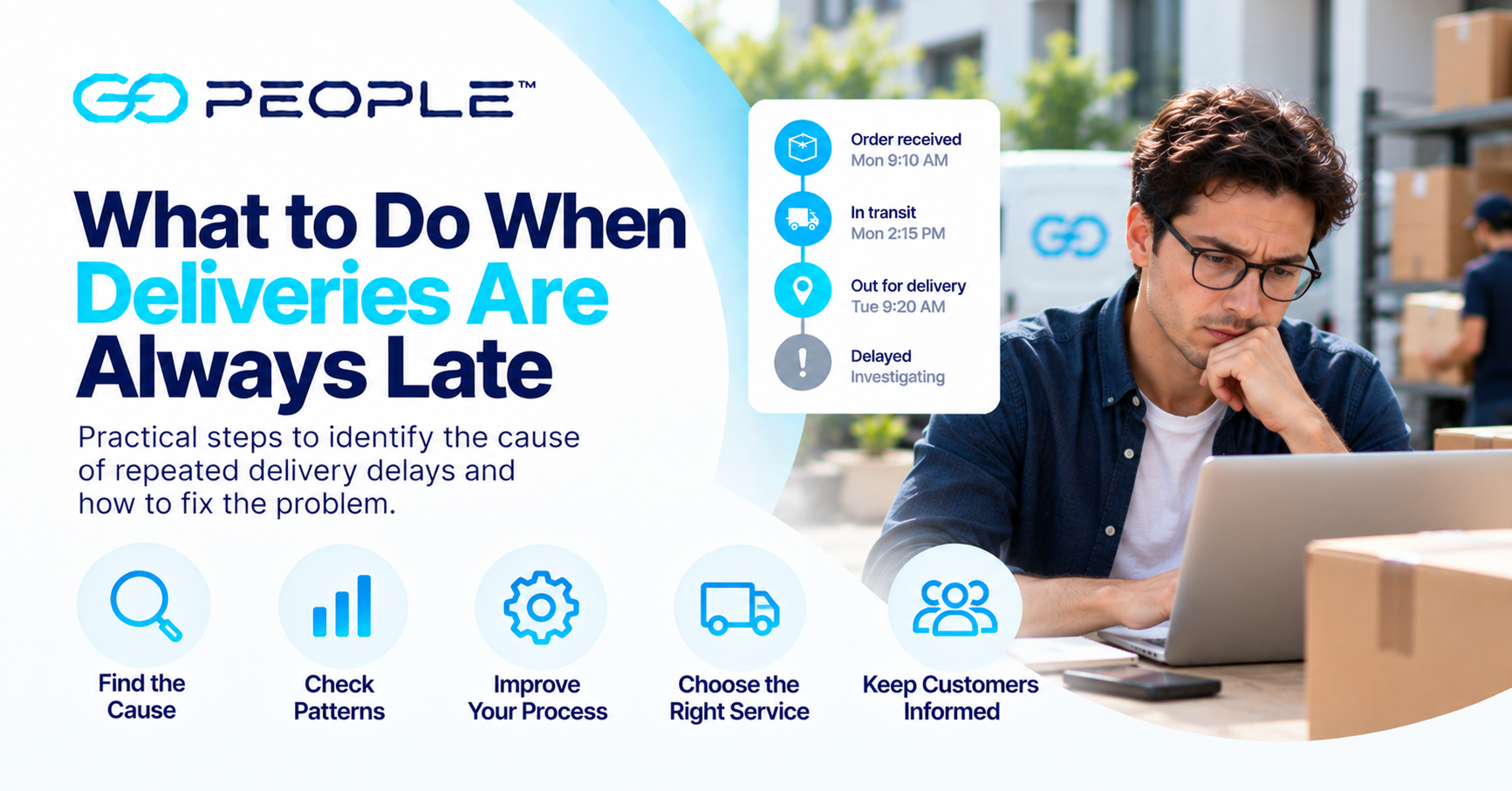
One late delivery can happen.
But when deliveries are consistently late, it’s usually worth looking beyond the individual parcel.
Repeated delays may indicate a problem with the delivery service being used, the timeframe being promised to customers, the booking process, address information, order preparation or another part of the delivery workflow.
For businesses, the goal shouldn’t simply be to chase each late parcel individually.
The better question is:
Why do our deliveries keep arriving late, and what can we change?
Here’s where to start.
1. Confirm That Deliveries Are Actually Late
Before investigating the cause, define what “late” means.
Compare the actual delivery time against the timeframe that was genuinely promised.
For example, was the customer promised:
- delivery on a particular day;
- same-day delivery;
- next-day delivery; or
- another delivery timeframe?
There’s an important difference between:
“The customer hoped it would arrive by 2pm.”
and:
“The delivery was supposed to be completed by 2pm.”
Businesses need a clear benchmark before they can measure delivery performance properly.
2. Look for a Pattern
Don’t analyse recurring delivery problems one parcel at a time.
Look at multiple deliveries together.
Ask:
- Are delays happening on particular days?
- Are certain pickup locations affected more often?
- Are particular destinations causing problems?
- Are delays concentrated around peak periods?
- Is one delivery service responsible for most late deliveries?
- Are deliveries being booked later than intended?
- Are certain types of orders regularly delayed?
Patterns can reveal problems that aren’t obvious when individual deliveries are investigated separately.
One late parcel may be an exception.
Twenty similar late parcels may indicate a process problem.
3. Check When Orders Are Actually Ready for Collection
Sometimes the delivery provider receives the blame even though the delay began before collection.
Look at the complete timeline:
Customer order → Picking and packing → Ready for collection → Delivery booked → Collected → Delivered
If an order is supposed to leave at 10am but isn’t ready until 1pm, the delivery process is already starting three hours behind.
Businesses should compare:
- when the order was received;
- when fulfilment began;
- when it was ready;
- when delivery was booked;
- when it was collected; and
- when it was delivered.
This helps separate warehouse delays from delivery delays.
4. Check Whether You’re Using the Right Delivery Service
A recurring delivery problem can happen when the service doesn’t match the promise being made to customers.
Different orders require different delivery models.
GoEXPRESS — Next-Day Delivery
Suitable for businesses requiring next-day parcel delivery from customer warehouses in supported locations.
GoBUNDLE — Multi-Drop Delivery
Designed for businesses completing multiple deliveries as part of an optimised delivery run.
GoSAMEDAY — Same-Day Delivery
For business deliveries that need to be completed on the same day.
GoVIP — On-Demand Courier
For urgent and time-sensitive courier requirements.
If an order genuinely needs urgent delivery, using a service designed for a different timeframe may create unrealistic expectations.
Likewise, paying for urgent delivery when the customer doesn’t require it may unnecessarily increase costs.
The delivery service should match the actual requirement.
5. Review Your Booking Cut-Offs
When is the delivery being booked?
If staff regularly book jobs at the last possible moment, small operational delays can become significant.
Review:
- internal order cut-off times;
- warehouse preparation times;
- courier booking times;
- pickup requirements; and
- the timeframe being promised to customers.
Your internal cut-off may need to be earlier than the delivery provider’s final cut-off.
That creates enough operational time for picking, packing and preparing the order before collection.
6. Check Address Quality
Incorrect or incomplete delivery information can create delays even when everything else is working properly.
Common problems include:
- incorrect street numbers;
- missing unit numbers;
- wrong postcodes;
- outdated addresses;
- missing business names;
- incomplete recipient information; and
- unclear access instructions.
If late deliveries frequently involve address corrections or difficulty accessing the destination, improve the information being collected before the delivery begins.
For ecommerce businesses, address validation during checkout can help reduce some common errors.
7. Investigate Unsuccessful Delivery Attempts
A parcel that doesn’t arrive when expected isn’t always a late delivery in the traditional sense.
Sometimes the driver reached the destination but couldn’t complete the delivery.
Possible reasons include:
- nobody was available;
- the building was locked;
- the driver couldn’t access the property;
- the address was incomplete;
- the parcel couldn’t be left safely; or
- another delivery requirement couldn’t be satisfied.
Check the tracking history.
If unsuccessful attempts are common, the problem may require better recipient information or delivery instructions rather than simply a faster courier.
8. Use Tracking to Find Where Delays Occur
Tracking isn’t only for customers.
It can also help businesses understand the delivery process.
Review the available delivery events to identify where time is being lost.
For example:
Was collection delayed?
Did the parcel spend longer than expected between stages?
Was delivery attempted?
Did something happen during the final delivery stage?
Looking at delivery events across multiple late orders can help identify recurring patterns.
For more on tracking, see How to Track Your Delivery in Real Time.
9. Improve Customer Communication
Sometimes a delay can’t be prevented.
Traffic, severe weather, operational disruption and unexpected events can affect deliveries.
When that happens, communication becomes important.
Customers generally want to know:
What’s happening?
Has my delivery been delayed?
What happens next?
Tracking and customer notifications can reduce uncertainty.
Businesses should avoid promising a new delivery time unless it has actually been confirmed.
Accurate information is better than an optimistic estimate that creates another missed expectation.
Read Why Real-Time Tracking Matters for Online Shopping for more.
10. Compare the Promise With Actual Performance
Businesses sometimes create their own delivery problems by promising customers more than the delivery operation is designed to provide.
For example, marketing might promise an aggressive delivery timeframe without considering:
- order-processing time;
- warehouse cut-offs;
- collection schedules;
- service availability;
- destination requirements; and
- peak periods.
Review the complete customer promise.
If customers are consistently being told to expect something the operation cannot reliably deliver, changing the wording may be just as important as changing the courier.
A realistic promise that is consistently achieved can create a better experience than an ambitious promise that is frequently missed.
11. Measure the Right Delivery Metrics
If late deliveries are recurring, start measuring them.
Useful questions include:
- What percentage of deliveries arrive within the expected timeframe?
- How many deliveries require another attempt?
- Which locations experience the most delays?
- Which services have the most delivery exceptions?
- How often do customers contact support about late deliveries?
- Are delays increasing or decreasing over time?
Don’t collect data simply because it’s available.
Measure information that helps you identify and fix operational problems.
12. Review Your Delivery Provider With Evidence
If you’ve checked your own processes and delays continue, review the performance of your delivery provider.
Bring data rather than isolated complaints.
For example:
“During the last month, 18 of our 120 deliveries missed the expected delivery timeframe, and most of the delays occurred during the final delivery stage.”
That’s far more useful than:
“Our deliveries always seem late.”
Useful delivery-provider discussions should focus on:
- actual performance;
- recurring exceptions;
- affected locations;
- operational causes; and
- what can realistically be improved.
Don’t Solve Every Late Delivery by Choosing a Faster Service
This is an important distinction.
If a next-day delivery regularly arrives late because the order isn’t ready for collection on time, switching everything to same-day delivery doesn’t solve the underlying problem.
Likewise, if customers are receiving unrealistic promises, paying for faster delivery may simply increase costs.
First determine why deliveries are late.
Then choose the appropriate solution.
Sometimes that means a faster service.
Sometimes it means:
- earlier order preparation;
- better address data;
- better booking processes;
- clearer customer expectations;
- improved delivery instructions; or
- a different delivery provider.
What to Do When One Delivery Is Late
If you’re dealing with an individual late parcel rather than a recurring business problem:
Step 1: Check Tracking
Review the latest delivery event.
Step 2: Check the Expected Timeframe
Confirm whether the parcel is actually overdue.
Step 3: Look for a Delivery Exception
Check whether delivery was attempted or another issue has been recorded.
Step 4: Contact the Appropriate Party
If the parcel is genuinely overdue and tracking doesn’t explain the situation, contact the sender or relevant delivery support team.
Step 5: Avoid Making Assumptions
Late doesn’t automatically mean lost.
If the parcel appears to be missing, see What to Do When Your Package Goes Missing.
How Businesses Can Reduce Late Deliveries
A practical improvement plan might look like this:
Improve order cut-offs
Give fulfilment teams enough time to prepare orders.
Validate delivery information
Reduce avoidable address problems.
Match the service to the requirement
Don’t use one delivery model for every order.
Track delivery performance
Identify recurring delays rather than relying on anecdotes.
Improve customer visibility
Use tracking and notifications to keep recipients informed.
Review unsuccessful deliveries
Determine whether access, address or recipient issues are contributing to delays.
Integrate delivery workflows
Reduce unnecessary manual steps where appropriate.
For a broader operational guide, see 10 Ways to Improve Your Delivery Process.
Why Late Deliveries Matter to Customer Experience
Delivery is part of the customer’s overall experience with a business.
When a promised timeframe is repeatedly missed, customers may become frustrated even if the product itself is excellent.
But speed isn’t the only consideration.
Customers also value:
- realistic delivery expectations;
- useful tracking;
- clear communication; and
- knowing what happens when something goes wrong.
That’s why improving delivery performance is about more than simply making parcels move faster.
Read How Fast Deliveries Can Improve Customer Satisfaction for more.
Frequently Asked Questions
Why are my deliveries always late?
Recurring late deliveries can have several causes, including unrealistic delivery promises, late order preparation, incorrect address information, unsuitable delivery services, unsuccessful delivery attempts or problems within the delivery operation. Look for patterns across multiple deliveries rather than assuming every delay has the same cause.
What should I do if a delivery is late?
Check the latest tracking information and confirm the expected delivery timeframe. If the parcel is genuinely overdue and tracking doesn’t explain the delay, contact the appropriate sender or delivery support team.
How can businesses reduce late deliveries?
Review order preparation, booking cut-offs, address quality, service selection, unsuccessful delivery attempts and actual delivery performance. Identifying where delays occur is usually more effective than simply selecting a faster service.
Does faster delivery always improve reliability?
No. Speed and reliability aren’t the same thing. A faster service can be appropriate for urgent orders, but recurring operational problems still need to be identified and addressed.
Can incorrect addresses cause late deliveries?
Yes. Incorrect or incomplete address information can delay delivery or result in an unsuccessful attempt.
How can tracking help with late deliveries?
Tracking can help businesses and recipients understand the latest delivery status and identify events associated with a delay. Reviewing patterns across multiple deliveries can also help businesses investigate recurring problems.
Should I change courier companies if deliveries are always late?
First establish where the delays are occurring. If your own preparation, booking and customer information are working properly but the delivery provider repeatedly misses the agreed timeframe, reviewing alternative arrangements may be appropriate.
Fix the Cause, Not Just the Late Parcel
When one delivery is late, the immediate priority is getting useful information about that parcel.
When deliveries are always late, the priority changes.
You need to understand the system.
Look at when orders are prepared, when deliveries are booked, which services are being used, whether addresses are accurate, where delivery exceptions occur and whether customer promises match operational reality.
Then fix the part of the process that’s actually causing the problem.
That’s how businesses move from repeatedly chasing late parcels to building a more reliable delivery operation.