I checked the live article first. The current page has the right broad topic, but it’s quite generic and includes several things I’d remove: drones/autonomous vehicles, “see where parcels are at any moment”, keeping spare vehicles and extra staff ready, employee bonus advice, and a very broad “local delivery service” sales pitch. GoPeople
This is a good opportunity to turn it into a genuinely useful business delivery-process guide while keeping the existing URL and search intent.
Use this replacement:
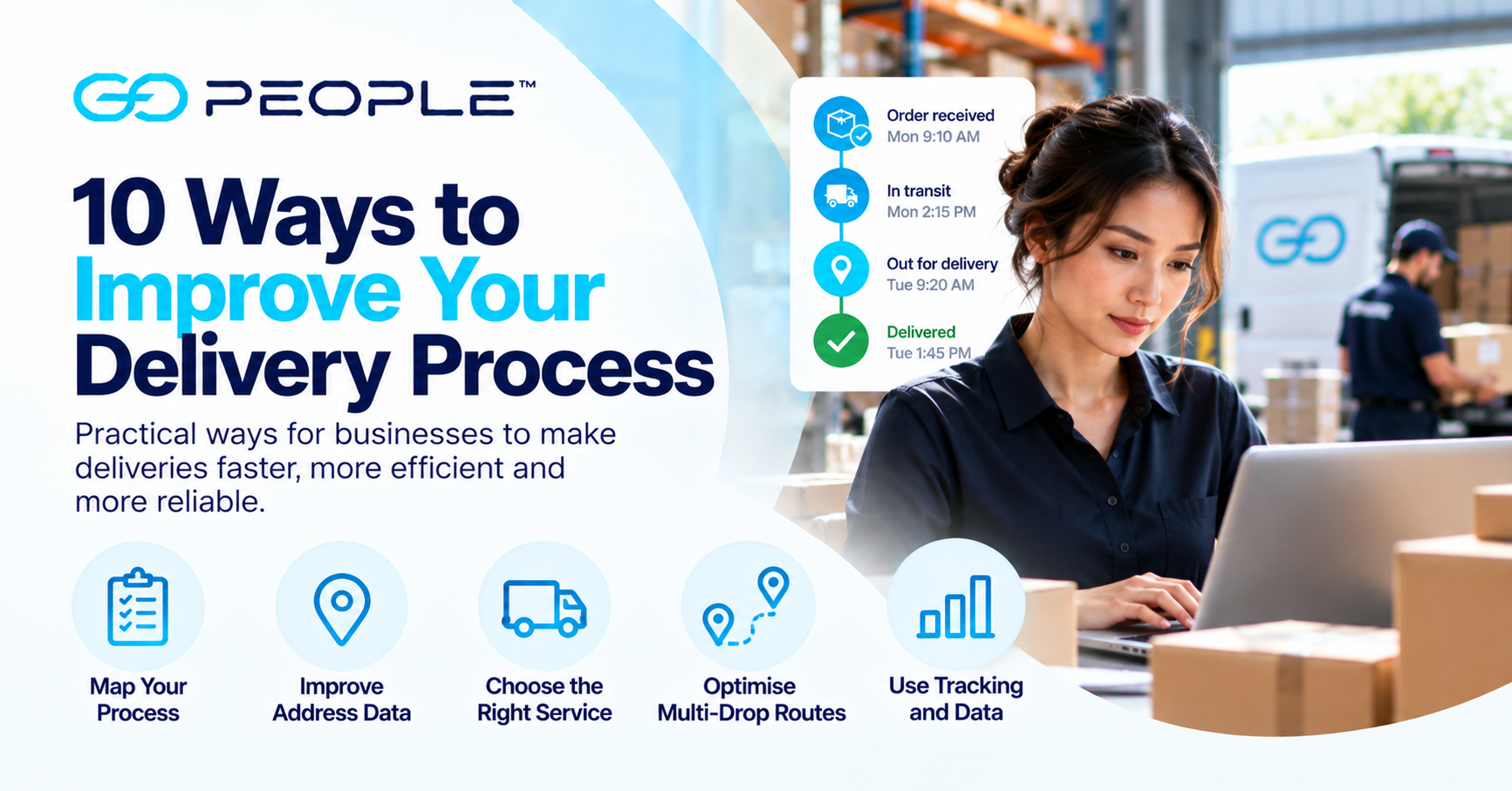
10 Ways to Improve Your Delivery Process
A good delivery process isn’t simply about getting parcels from one place to another as quickly as possible.
For businesses, an effective delivery operation needs to manage the entire journey — from receiving an order and preparing the delivery through to tracking, customer communication and proof of delivery.
Small problems at any stage can create delays, increase costs and generate unnecessary customer enquiries.
The good news is that improving your delivery process doesn’t always require rebuilding your entire logistics operation.
Here are 10 practical areas businesses can review.
1. Map Your Current Delivery Process
Before changing anything, understand how deliveries currently move through your business.
Map the process from:
Order received → Order prepared → Delivery booked → Parcel collected → Delivery in progress → Delivered
Then look for points where unnecessary work or delays occur.
For example:
- Are staff manually entering the same information more than once?
- Are deliveries frequently booked late?
- Are incorrect addresses creating problems?
- Are customers regularly contacting you for delivery updates?
- Are unsuccessful deliveries common?
- Is proof of delivery difficult for staff to find?
These recurring problems can reveal where improvements will have the greatest impact.
2. Improve Address and Customer Data
A delivery process is only as reliable as the information supplied with the delivery.
Incorrect or incomplete addresses can lead to delays, unsuccessful delivery attempts and additional customer support.
Before a delivery is booked, make sure you have the information required for that job, such as:
- recipient name;
- street address;
- unit or suite number;
- suburb and postcode;
- valid contact details; and
- relevant delivery instructions.
For ecommerce businesses, address validation during checkout can also help reduce common data-entry mistakes.
The objective is simple:
Get the delivery information right before the parcel leaves.
Fixing an incorrect address after a delivery is underway is usually much harder.
3. Choose the Right Delivery Service
Not every parcel needs the same delivery speed or delivery model.
Using an urgent courier for every delivery can increase costs unnecessarily. Using a slower service for genuinely time-sensitive orders can create a poor customer experience.
Businesses should match the delivery service to the requirement.
For example:
GoEXPRESS — Next-Day Delivery for regular business and ecommerce parcel volumes.
GoBUNDLE — Multi-Drop Delivery when a business has multiple deliveries that can be grouped efficiently.
GoSAMEDAY — Same-Day Delivery when orders need to reach customers that day.
GoVIP — On-Demand Courier for urgent and time-sensitive deliveries.
The fastest option isn’t automatically the best option.
The goal is to choose the delivery model that matches the customer’s needs and the economics of the order.
4. Consolidate Deliveries Where It Makes Sense
Businesses making multiple deliveries can often improve efficiency by considering them together rather than treating every delivery as an isolated job.
This is particularly useful when several parcels:
- leave from the same location;
- are ready around the same time; and
- need to be delivered within compatible timeframes.
Grouping suitable deliveries can make route planning more efficient and reduce unnecessary individual courier movements.
This is the principle behind multi-drop delivery.
It won’t suit every delivery, particularly urgent individual jobs, but it can be valuable for businesses with recurring local delivery volumes.
5. Use Route Optimisation for Multi-Drop Deliveries
Once multiple deliveries are being completed on the same run, the sequence matters.
Simply delivering orders in the sequence they were received may create unnecessary travel.
Route optimisation can consider multiple destinations together and help determine a more efficient delivery sequence.
That becomes increasingly important as the number of stops increases.
For businesses managing multi-drop delivery, better route planning can help reduce:
- unnecessary kilometres;
- inefficient delivery sequences;
- avoidable travel time; and
- manual route-planning work.
Technology is particularly valuable here because calculating efficient routes manually becomes difficult as delivery volumes grow.
6. Give Customers Useful Delivery Tracking
One of the easiest ways to improve the delivery experience is to give customers better visibility.
Without useful tracking information, customers may contact the business simply to ask:
“Where is my order?”
Tracking can help recipients understand the progress of a delivery without needing to contact customer support for every update.
It can also help businesses investigate situations where something hasn’t gone according to plan.
Useful delivery visibility may include information such as:
- current delivery status;
- recent delivery events;
- delivery progress;
- completed delivery information; and
- proof of delivery where applicable.
Tracking shouldn’t be treated merely as a feature on a delivery page.
It’s part of the customer communication process.
Read Why Real-Time Tracking Matters for Online Shopping for more about this.
7. Automate Customer Notifications
Tracking is useful when customers actively check it.
Notifications can make the process even easier by providing relevant updates as the delivery progresses.
Depending on the delivery service, customers may receive updates at important stages of the delivery journey.
This reduces the need for businesses to manually send delivery updates and helps recipients understand what is happening.
The important point is not to send as many notifications as possible.
It’s to send useful information at useful moments.
For example, customers generally care more about meaningful delivery events than constant low-value updates.
Good communication reduces uncertainty.
8. Make Proof of Delivery Easy to Access
The delivery process doesn’t finish simply because a driver reaches the destination.
Businesses also need a clear record that the delivery was completed.
Digital proof of delivery can provide useful information when:
- a customer asks whether an order was delivered;
- support staff need to investigate a delivery;
- the sender needs confirmation of completion; or
- there is a dispute about what happened.
The key operational improvement is accessibility.
If staff have to search through emails, call drivers or manually piece together information every time somebody asks about a delivery, the process isn’t efficient.
Delivery information should be easy for the appropriate team to find.
9. Integrate Delivery With Your Existing Systems
Manual data entry creates work and increases the possibility of errors.
As delivery volumes grow, businesses should consider whether their delivery process can connect more effectively with the systems they already use.
Depending on the business, this may include:
- ecommerce platforms;
- warehouse systems;
- order-management systems;
- customer-service workflows; and
- other business software.
Integration can reduce repetitive administrative work and make it easier for delivery information to move between systems.
Instead of:
Receive order → Copy details → Enter delivery → Copy tracking → Send tracking
a more integrated process can automate appropriate parts of that workflow.
This is one reason technology has become increasingly important in modern delivery operations.
Read How Technology Is Changing Courier and Delivery Services for more.
10. Measure the Problems That Actually Affect Your Business
Businesses can collect enormous amounts of delivery data.
That doesn’t mean every metric deserves equal attention.
Start with operational questions that matter to your business.
For example:
Are deliveries arriving within the expected timeframe?
How often are deliveries unsuccessful?
How many customer enquiries are caused by delivery problems?
Are particular destinations or delivery types creating recurring issues?
How much does delivery cost per order or per run?
Are customers receiving the delivery information they need?
Look for patterns rather than isolated incidents.
If the same problem occurs repeatedly, investigate the underlying process.
One late parcel may be an exception.
Repeated late deliveries may indicate that the service, booking process, operational workflow or customer promise needs attention.
Don’t Optimise Only for Speed
“Improve delivery” is often interpreted as “make every delivery faster”.
That’s too simplistic.
A better delivery process balances several factors:
Speed
Customers should receive orders within the timeframe they’ve been promised.
Reliability
The delivery service should consistently perform against the expected timeframe.
Cost
The delivery model needs to make commercial sense for the business.
Visibility
Businesses and customers should have useful information about delivery progress.
Communication
Recipients should understand what is happening and what to do if something changes.
Efficiency
Staff shouldn’t spend unnecessary time manually booking deliveries, planning routes or answering avoidable tracking enquiries.
A delivery process that is slightly faster but significantly more expensive or difficult to manage isn’t necessarily an improvement.
Review the Customer Experience as Well as Logistics
Delivery optimisation shouldn’t stop at the warehouse door.
From the customer’s perspective, delivery is part of the purchasing experience.
Consider what happens after the customer places an order.
Do they know when to expect it?
Can they track it?
Will they receive useful updates?
What happens if delivery is unsuccessful?
Can your support team quickly understand what happened?
These questions matter because customers experience the whole delivery journey, not your internal logistics process.
That’s why delivery speed, tracking and communication can all influence customer satisfaction.
See How Fast Delivery Improves Customer Satisfaction for more.
What Should You Improve First?
You don’t need to implement everything at once.
Start with the problems that occur most frequently or create the greatest cost.
For example:
If customers constantly ask “Where is my order?”
Improve tracking visibility and customer notifications.
If deliveries frequently fail because of incorrect details
Improve address and recipient-data collection.
If staff spend too much time manually booking deliveries
Investigate integrations and workflow automation.
If multi-drop routes are inefficient
Improve route planning and consider route optimisation.
If you’re paying too much for urgent delivery
Review whether every order genuinely requires an urgent service.
If delivery problems are difficult to investigate
Improve access to tracking events and proof of delivery.
The best improvement is usually the one that removes a recurring problem.
How GoPeople Supports Business Delivery
GoPeople provides delivery services for different business requirements, supported by technology designed to improve delivery visibility and management.
Businesses can select from:
- Next-Day Delivery — GoEXPRESS
- Multi-Drop Delivery — GoBUNDLE
- Same-Day Delivery — GoSAMEDAY
- On-Demand Courier — GoVIP
The appropriate service depends on factors such as delivery volume, urgency, pickup location and destination requirements.
Businesses can also check service availability for their location.
Frequently Asked Questions
How can a business improve its delivery process?
Start by mapping the current delivery workflow and identifying recurring problems. Common areas for improvement include address accuracy, service selection, route planning, tracking, customer notifications, proof of delivery and system integration.
How can businesses make deliveries more efficient?
Efficiency can be improved by reducing manual work, grouping suitable deliveries, optimising multi-drop routes, improving delivery data and choosing the appropriate service for each delivery requirement.
Can route optimisation reduce delivery costs?
For multi-drop operations, more efficient routing can reduce unnecessary travel and improve the way multiple destinations are handled. The actual impact depends on the delivery operation and route.
How does tracking improve the delivery process?
Tracking gives businesses and recipients greater visibility into delivery progress. It can reduce uncertainty, support customer communication and provide useful information when a delivery needs investigation.
Should every ecommerce order use same-day delivery?
No. Different orders have different requirements. Next-day delivery may be suitable for regular ecommerce orders, while same-day or on-demand delivery may make more sense when speed is genuinely important.
Why is proof of delivery important?
Proof of delivery provides a record of delivery completion and can help businesses respond to customer enquiries or investigate disputes.
How often should businesses review their delivery performance?
There isn’t one appropriate frequency for every business. Businesses with regular delivery volumes should review performance often enough to identify recurring problems and determine whether changes are improving results.
Improving Delivery Is a Continuous Process
The most effective delivery operations aren’t created by making one large change.
They improve by identifying friction and removing it systematically.
Better customer data can prevent address problems.
Better service selection can balance speed and cost.
Route optimisation can improve multi-drop operations.
Tracking and notifications can improve visibility.
Integrations can reduce manual work.
And delivery data can show businesses where the next improvement should be made.
Start with the biggest recurring problem in your current delivery process, fix it, measure the result and move to the next one.
That’s how small operational improvements can add up to a much better delivery experience.