Proof of delivery is one of those delivery features that seems simple until something goes wrong.
A parcel is marked Delivered.
The customer says:
“I don’t have it.”
Now the business needs to answer several questions.
When was it delivered? Where was it left? Was someone present? Was a photograph taken? Was a signature required? What information did the driver record?
That is where proof of delivery, commonly shortened to POD, becomes important.
For businesses sending parcels regularly, proof of delivery is more than confirmation that a driver completed a job. It can help customer-service teams investigate disputes, understand failed handovers, maintain delivery records and identify recurring problems in the delivery process.
This guide explains what proof of delivery means, what information it can contain, how it differs from tracking and how businesses can use it effectively.
What Is Proof of Delivery?
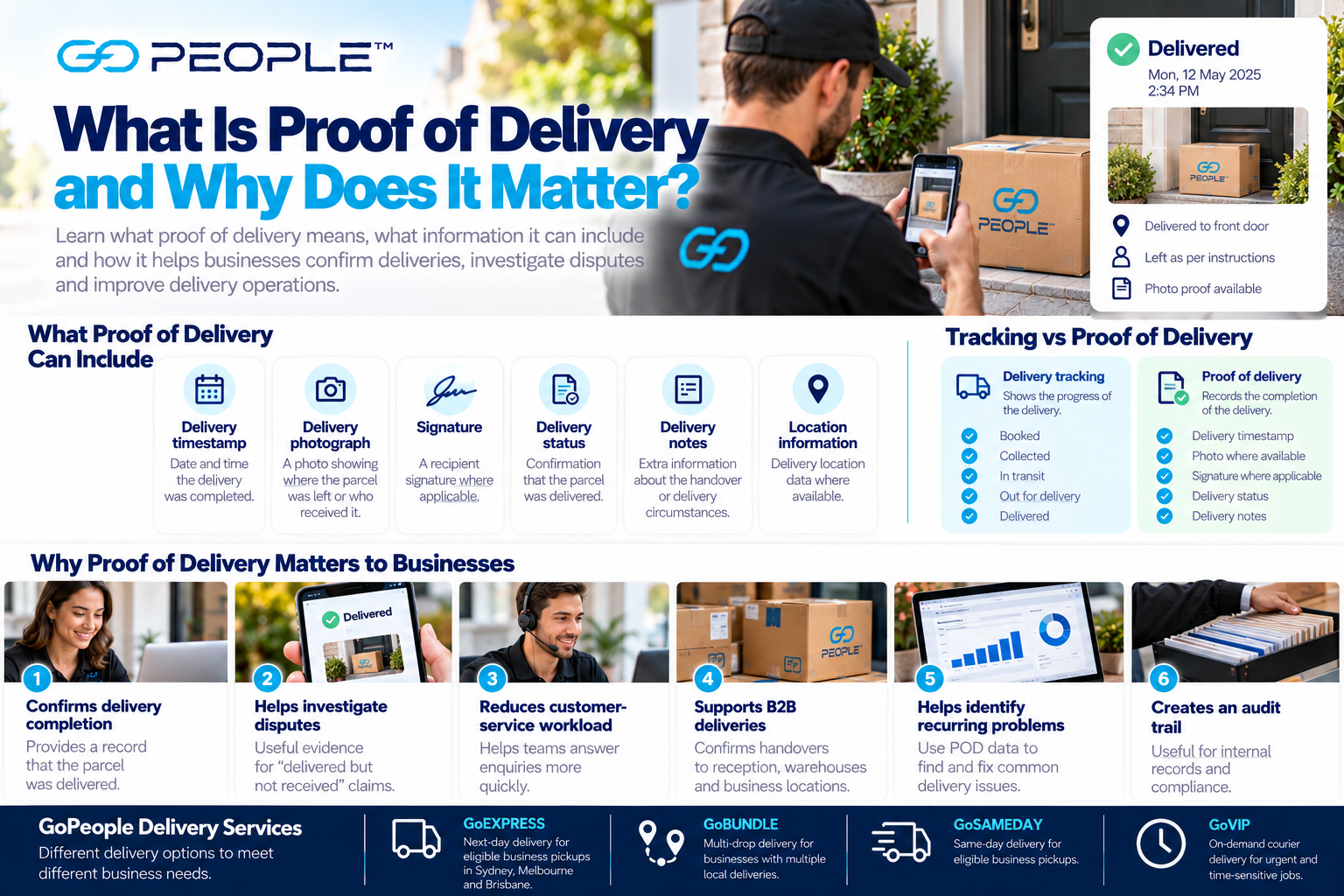
Proof of delivery is a record associated with the completion of a delivery.
Depending on the delivery service and circumstances, it may contain information such as:
- delivery status;
- date;
- timestamp;
- photograph;
- signature;
- recipient or handover information;
- location information;
- delivery notes; or
- other evidence associated with completion.
Not every delivery produces the same form of POD.
For example, one delivery may require a signature while another may be completed under an applicable authority-to-leave arrangement.
The important principle is that POD provides information about what happened at the end of the delivery journey.
Proof of Delivery vs Delivery Tracking
Tracking and proof of delivery are related, but they serve different purposes.
Delivery tracking
Tracking shows the progress of the delivery.
Depending on the service, statuses might include:
Booked → Collected → In Transit → Out for Delivery → Delivered
Tracking answers questions such as:
Where is my parcel in the delivery process?
Has it been collected?
Is it out for delivery?
Proof of delivery
POD focuses on the completion of the delivery.
It helps answer:
When was it delivered?
What evidence was recorded?
Was a photograph taken?
Was a signature captured where applicable?
What information is available about the handover?
A useful way to think about it is:
Tracking explains the journey.
Proof of delivery records the outcome.
Businesses generally benefit from having access to both.
What Can Proof of Delivery Include?
The exact information depends on the provider, service, delivery instructions and circumstances.
Common forms include the following.
Delivery Timestamp
A timestamp records when the delivery was completed.
This can help establish a basic timeline when investigating a customer enquiry.
For example, if a customer contacts support at 4:30 pm and the delivery record shows completion at 2:15 pm, the team has a specific event to investigate.
Delivery Photograph
A delivery photograph can provide visual context about where a parcel was left or what occurred at the destination.
Depending on the circumstances, it may help identify:
- the entrance;
- doorstep;
- reception area;
- parcel location; or
- another relevant feature of the delivery location.
This can be particularly useful when a customer says:
“The parcel says delivered, but I can’t find it.”
A photograph may help the customer recognise where the parcel was placed.
However, a photograph should not automatically be treated as absolute proof that every aspect of a delivery was correct.
It is one piece of evidence that can assist an investigation.
Signature
Some delivery circumstances may involve obtaining a signature.
A signature can provide evidence that the parcel was handed over rather than simply left at the location.
Businesses should understand:
- when signatures are required;
- which services support them;
- who may sign;
- what happens if nobody is available; and
- how the signature record can be accessed.
Requirements vary between services, so businesses should not assume that every delivery automatically includes a signature.
Delivery Status
The final delivery status is itself an important record.
Examples might include:
- delivered;
- unsuccessful attempt;
- returned;
- redirected; or
- another service-specific status.
This status helps the business understand whether the delivery process actually reached completion.
It also provides context for other POD information.
Delivery Notes
Drivers or delivery systems may record additional information associated with an attempt or completion.
Depending on the service, this could help explain:
- where the parcel was left;
- an access issue;
- a handover;
- why delivery could not be completed; or
- another relevant circumstance.
Notes can be especially valuable when the standard tracking status does not tell the complete story.
Location Information
Some delivery systems may capture location information associated with delivery activity.
This can provide another data point when investigating what occurred.
Location data should still be interpreted alongside other evidence.
For example, location information may help establish that delivery activity occurred near a particular address, while a photograph, timestamp or other record may provide additional context.
No single data point should automatically replace a proper investigation when the circumstances are disputed.
Why Proof of Delivery Matters to Businesses
POD becomes most valuable when there is uncertainty.
When every delivery goes perfectly, businesses may rarely need to examine the record.
When something goes wrong, however, that information can become extremely useful.
1. It Helps Confirm Delivery Completion
The most basic purpose of POD is to provide a record that the delivery was completed.
Without it, the business may know that a parcel entered the delivery network but have limited information about the final handover.
A completion record closes that information gap.
This is particularly important for businesses sending large numbers of parcels because customer-service teams cannot personally monitor every delivery.
2. It Helps Investigate “Delivered but Not Received” Claims
One of the most common situations where POD becomes important is:
“Tracking says delivered, but I haven’t received anything.”
There are several possible explanations.
The parcel may have been:
- left somewhere the recipient has not checked;
- accepted by another person;
- delivered to reception;
- placed at an entrance;
- delivered to an incorrect location;
- removed after delivery; or
- affected by another issue requiring investigation.
Customer service can review the available delivery evidence rather than relying only on the word Delivered.
Depending on the available records, the investigation might examine:
- timestamp;
- photograph;
- delivery notes;
- location information;
- signature where applicable;
- delivery instructions; and
- other relevant records.
The purpose is not to automatically prove that the customer is wrong.
It is to establish what happened as accurately as possible.
3. It Can Reduce Unnecessary Customer-Service Work
Without accessible delivery information, even simple enquiries can require manual investigation.
Imagine a customer says:
“Where did you leave my parcel?”
If the support team can access useful POD information, they may be able to answer quickly.
Without it, they may need to:
- contact operations;
- locate the delivery record;
- contact the delivery provider;
- wait for a response;
- potentially contact the driver; and
- return to the customer later.
Multiply that process across hundreds of deliveries and the operational cost becomes significant.
Good delivery visibility helps support teams resolve straightforward enquiries more efficiently.
4. It Helps Businesses Handle Delivery Disputes
Delivery disputes can involve different claims.
For example:
“The parcel never arrived.”
POD can provide information about the recorded completion.
“It was delivered to the wrong place.”
A photograph or other delivery information may assist the investigation.
“Nobody signed for this.”
The team can check whether the service required a signature and what record exists.
“It arrived much later than expected.”
The timestamp can help establish when completion occurred.
POD does not necessarily resolve every dispute immediately.
But it gives businesses more evidence with which to investigate.
5. It Creates a Better Delivery Audit Trail
Businesses often need to understand an order after the event.
A useful delivery record can connect:
Order → booking → pickup → tracking events → delivery attempt → final outcome
This creates a clearer audit trail.
For example, if a business receives a complaint several days later, staff can review the history rather than depending on memory.
This becomes increasingly important as delivery volume grows.
At 10 deliveries a week, staff may remember individual orders.
At thousands of deliveries, reliable records become essential.
6. It Can Help With B2B Deliveries
Proof of delivery can be particularly valuable for business-to-business deliveries.
A parcel may be delivered to:
- reception;
- loading dock;
- warehouse;
- mailroom;
- store;
- office;
- site contact; or
- another business location.
Later, someone inside the recipient organisation may say the item cannot be found.
The delivery record can help establish when and how the parcel reached the destination.
This does not eliminate internal receiving problems, but it gives both businesses a useful starting point.
7. It Can Support Internal Customer-Service Teams
Customer-service teams are often caught between the customer and the delivery operation.
The customer asks:
“What happened?”
Support needs access to enough information to answer.
Useful POD can allow support teams to investigate without immediately escalating every question.
A well-designed support workflow might provide access to:
- current tracking status;
- delivery history;
- delivery timestamp;
- POD;
- delivery instructions;
- relevant notes; and
- exception information.
The more useful information frontline staff can access, the less dependent they are on manual investigations for routine questions.
8. It Can Help Identify Recurring Delivery Problems
POD should not only be used one delivery at a time.
At scale, delivery records can help businesses identify patterns.
For example:
- repeated access problems at certain locations;
- recurring unsuccessful apartment deliveries;
- frequent disputes from particular delivery types;
- unclear authority-to-leave instructions;
- common customer-address problems; or
- repeated handover issues.
Instead of asking:
“What happened to this parcel?”
businesses can start asking:
“Why does this type of problem keep happening?”
That shift turns POD from a dispute-resolution tool into an operational improvement tool.
Digital Proof of Delivery
Historically, proof of delivery might have meant a paper docket signed by the recipient.
Modern delivery systems can make POD digital.
Digital POD can potentially make delivery information:
- available sooner;
- easier to search;
- linked to the delivery record;
- accessible to customer-service teams; and
- easier to analyse.
For example, instead of searching through physical paperwork, a business may be able to open the delivery record and view the relevant information directly.
This is particularly valuable for ecommerce and high-volume delivery operations.
Proof of Delivery and Authority to Leave
Proof of delivery and authority to leave are related concepts, but they are not the same thing.
Authority to leave
This relates to whether a parcel may be left without a direct recipient handover, subject to the applicable delivery instructions and service conditions.
Proof of delivery
This is the record associated with what happened when the delivery was completed.
Where a parcel is appropriately left, POD may provide information about that completion.
Businesses should understand the rules applying to their chosen delivery service rather than assuming every parcel can be left unattended.
What Proof of Delivery Does Not Necessarily Prove
This distinction is important.
A delivery record is evidence.
It does not mean every dispute should automatically be dismissed.
For example, a photograph of a parcel near a doorway may show where it was placed at a particular point in time.
It may not, by itself, answer every possible question about what happened afterwards.
Similarly:
A timestamp
Shows when the delivery event was recorded.
A photograph
Provides visual evidence associated with the delivery.
A signature
Provides evidence of a recorded handover where applicable.
Location data
Provides information associated with the delivery location.
When a genuine dispute occurs, businesses should consider the available evidence together rather than treating one field as automatically conclusive.
Proof of Delivery vs Signature on Delivery
These terms are sometimes confused.
A signature can be one form of proof of delivery, but POD is broader.
Proof of delivery may include:
Timestamp + status + photograph + delivery information
without necessarily including a signature.
Whether a signature is required depends on the service and delivery circumstances.
Businesses choosing a delivery provider should therefore ask:
“What proof of delivery do you provide?”
rather than only:
“Do you collect signatures?”
Proof of Delivery vs Tracking Number
A tracking number identifies or references the shipment.
It allows systems and users to retrieve information about the parcel.
Proof of delivery is the evidence associated with the final delivery outcome.
In simple terms:
Tracking number = identifies the delivery
Tracking = shows progress
Proof of delivery = records completion
All three can work together.
What Happens When POD and the Customer’s Account Conflict?
Suppose tracking shows the parcel as delivered and a delivery photograph exists, but the customer says the parcel is not there.
The business should not simply respond:
“We have a photo, so the case is closed.”
Instead, investigate.
A practical process may include:
Step 1: Verify the delivery address
Was the correct address supplied?
Step 2: Review tracking
What happened during the delivery journey?
Step 3: Review POD
Check available photographs, timestamps, signatures or other evidence.
Step 4: Compare the evidence with the destination
Does the available information appear consistent with the delivery location?
Step 5: Check delivery instructions
Were there specific instructions relevant to the handover?
Step 6: Follow the provider’s investigation process
If the evidence does not resolve the issue, escalate according to the applicable process.
The objective is to determine what happened, not simply to find evidence supporting one side.
Example: Delivered but Customer Can’t Find the Parcel
Imagine an ecommerce customer contacts support:
“My tracking says delivered at 2:34 pm, but nothing is at my front door.”
Without POD, the support team may know very little.
With a useful delivery record, the team might establish:
- delivery completed at 2:34 pm;
- a photograph was captured;
- the photograph shows a side entrance;
- delivery instructions referred to a side entrance.
The support agent can ask the customer to check that location.
If the parcel still cannot be found, the business can continue the investigation with more context.
This demonstrates why POD works best when combined with good delivery instructions and tracking.
Example: Business Recipient Cannot Locate the Parcel
Consider a supplier delivering an important parcel to a large office.
The sender later receives:
“We haven’t received it.”
The delivery record shows completion earlier that morning.
Further information indicates that the parcel was handed over at reception.
The recipient organisation can now check internally with:
- reception;
- mailroom;
- purchasing;
- receiving staff; or
- the intended employee.
Again, POD does not guarantee the parcel will immediately be found.
But it significantly improves the starting point for investigation.
How POD Can Reduce the Cost of Delivery Problems
Delivery problems create costs beyond the original courier charge.
Potential costs include:
- customer-service time;
- investigation;
- replacement product;
- redelivery;
- refund;
- warehouse handling;
- administrative work; and
- lost customer trust.
Suppose a support team spends 20 minutes investigating each disputed delivery.
If better delivery information allows some cases to be resolved in five minutes, the business saves 15 minutes per affected order.
At scale, those savings can become meaningful.
This is why delivery technology should not be evaluated only by what it does for the driver.
It can also affect the efficiency of the business’s support operation.
How Long Should Businesses Keep Proof of Delivery?
There is no universal retention period appropriate for every business and every type of delivery.
The right approach may depend on:
- business requirements;
- customer contracts;
- type of goods;
- provider terms;
- privacy obligations;
- record-keeping requirements; and
- other legal or regulatory considerations.
Businesses with specific compliance requirements should obtain appropriate professional advice rather than relying on a general delivery guide.
Operationally, businesses should at least understand:
- how long POD remains accessible;
- who can access it;
- how it is stored; and
- how historical delivery records can be retrieved.
Privacy Matters Too
Proof of delivery can involve information relating to people and locations.
Businesses and delivery providers should handle that information appropriately.
Potential POD data may include:
- names;
- addresses;
- signatures;
- photographs;
- location information; and
- timestamps.
Businesses should understand how their delivery providers handle and retain this information and ensure their own internal access is appropriate.
This article provides operational guidance rather than legal advice. Businesses with specific privacy or regulatory requirements should obtain advice appropriate to their circumstances.
What Businesses Should Ask a Delivery Provider About POD
When comparing delivery providers, ask:
- What proof of delivery is captured?
- Is POD available digitally?
- How quickly does it become available?
- Can our customer-service team access it?
- Can customers access any of the information?
- Are photographs available where applicable?
- Are signatures supported where required?
- What timestamps are recorded?
- Is location information captured?
- How long is the record retained?
- What happens when a customer disputes a delivery?
- How is a wrong-address delivery investigated?
- Can POD information be accessed through an integration or system?
- What privacy controls apply?
- What happens if POD is unavailable?
These questions reveal much more than simply asking whether a provider offers “tracking”.
Building POD Into Your Customer-Service Process
Businesses should decide in advance what support staff should do when a delivery is disputed.
A simple workflow might be:
Customer enquiry
↓
Confirm order and address
↓
Check tracking
↓
Review POD
↓
Review delivery instructions
↓
Resolve if evidence is sufficient
↓
Escalate for investigation if required
This avoids reinventing the process for every customer.
It also creates more consistent support.
Use POD to Improve First-Attempt Delivery Success
POD is usually associated with completed deliveries, but the broader delivery records surrounding it can also help businesses understand unsuccessful attempts.
For example, repeated exceptions may reveal problems with:
- address quality;
- apartment access;
- customer availability;
- delivery instructions;
- business opening hours; or
- service selection.
Businesses can then improve the process upstream.
For more practical strategies, see How to Reduce Failed Deliveries and Improve First-Attempt Delivery Success.
POD Is Most Valuable When Combined With Tracking
Proof of delivery answers an important question:
How did the delivery finish?
Tracking answers another:
How did it get there?
Together, they create a much more complete delivery record:
Booked → Collected → In Transit → Out for Delivery → Delivered → POD
If something goes wrong, customer-service teams can examine the journey rather than looking only at the final status.
For businesses handling large delivery volumes, that visibility can make investigations considerably more efficient.
Proof of Delivery in GoPeople Services
GoPeople’s business delivery services use digital delivery information to provide visibility into delivery progress and completion.
The appropriate service depends on the delivery requirement.
GoEXPRESS provides next-day parcel delivery for eligible business pickups in Sydney, Melbourne and Brisbane.
GoBUNDLE provides multi-drop delivery for businesses sending multiple deliveries from a pickup location, with live tracking and digital proof of delivery.
GoSAMEDAY provides same-day delivery for eligible business pickups, with delivery tracking and digital proof of delivery.
GoVIP provides on-demand courier delivery for urgent and time-sensitive jobs, with delivery visibility and proof of delivery.
Service features and availability can vary according to the delivery requirement, so businesses should confirm the relevant service when booking.
Proof of Delivery Is More Than a Signature
The idea of proof of delivery used to be closely associated with a signature on a piece of paper.
Modern delivery operations can provide a much richer digital record.
Depending on the service, POD can help businesses understand:
when a delivery happened + how it was completed + what evidence exists
That information can improve:
- customer support;
- dispute investigation;
- delivery visibility;
- internal record keeping; and
- operational analysis.
The most important benefit appears when something does not go according to plan.
Instead of beginning with:
“We don’t know what happened.”
the business can begin with evidence.
And that can make the difference between a long, frustrating delivery dispute and a much faster path toward understanding and resolving the problem.
Frequently Asked Questions
What does proof of delivery mean?
Proof of delivery is a record associated with the completion of a delivery. Depending on the service, it may include a timestamp, photograph, signature, delivery status, location information or other delivery evidence.
Is a signature the same as proof of delivery?
No. A signature can be one form of proof of delivery, but POD can include other evidence such as photographs, timestamps and delivery information.
What is the difference between tracking and proof of delivery?
Tracking shows the progress of a parcel through the delivery process. Proof of delivery focuses on the final delivery outcome and evidence associated with completion.
Does a delivery photo prove that the customer received the parcel?
A photograph provides useful evidence associated with the delivery, but it may not answer every question in a disputed case. Businesses should consider all available delivery information when investigating.
What should I do if tracking says delivered but the customer cannot find the parcel?
Confirm the delivery address, review tracking and available POD, check delivery instructions and follow the delivery provider’s investigation process if the available information does not resolve the issue.
Why is digital proof of delivery useful for businesses?
Digital POD can make delivery records easier to access, search and review. This can help customer-service teams investigate enquiries and reduce manual administrative work.
What should businesses look for in a proof-of-delivery system?
Look for accessible delivery records, useful timestamps, photographs or signatures where applicable, integration with tracking, appropriate data handling and a clear process for investigating disputed deliveries.