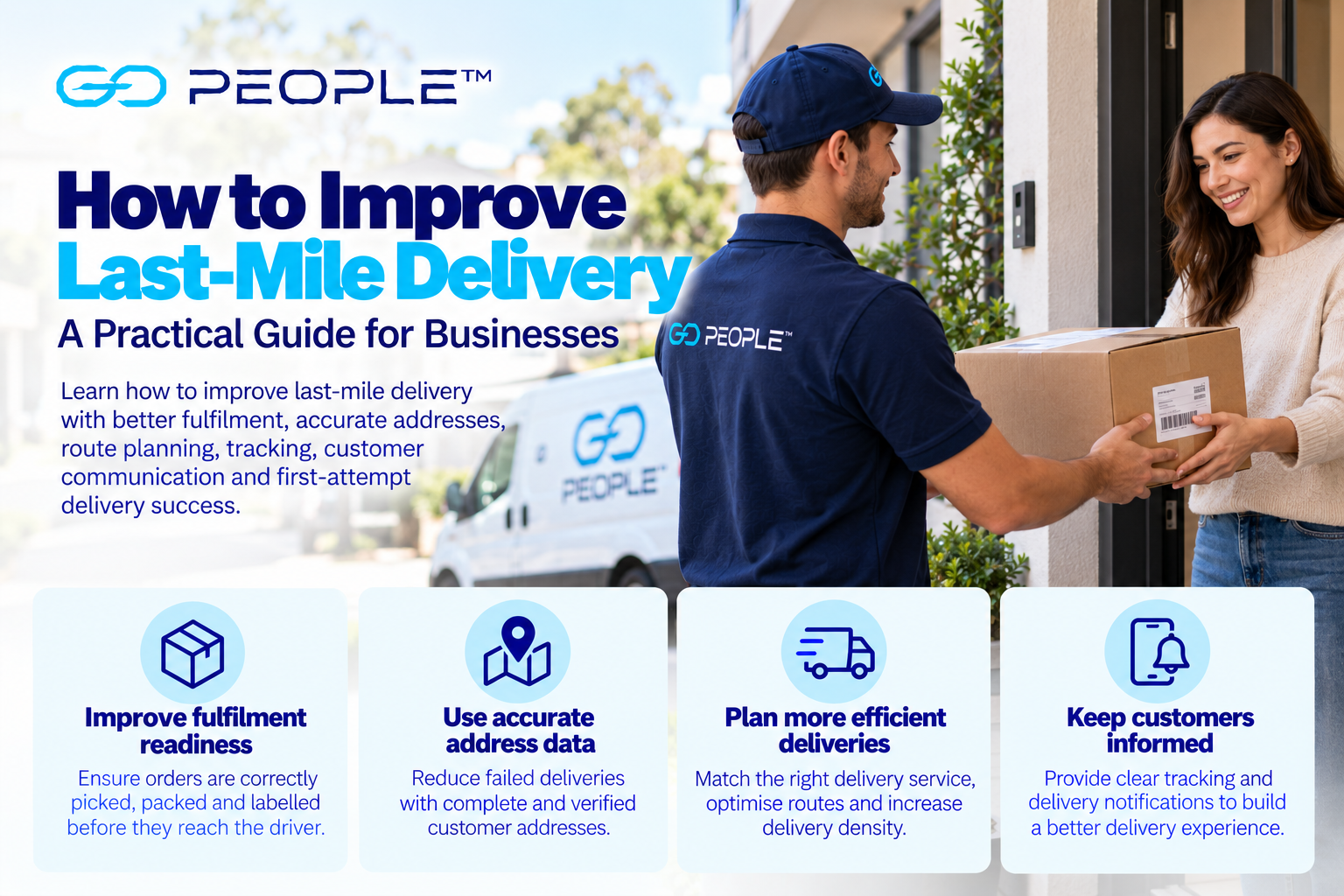
Last-mile delivery is where the customer finally experiences the result of everything that happened before it.
The order may have been processed correctly. Inventory may have been accurate. Picking and packing may have gone perfectly.
But if the final delivery is late, difficult to track or unsuccessful, the customer may still consider the overall experience poor.
That makes last-mile performance particularly important for ecommerce retailers, 3PLs and other businesses delivering directly to customers.
Improving last-mile delivery is not simply about driving faster. It requires the whole operation to work together:
Fulfilment readiness → accurate addresses → appropriate delivery service → efficient routing → tracking → customer communication → successful first attempt → proof of delivery → exception management
Here is how businesses can improve each part of that process.
1. Start Before the Last Mile Begins
Many last-mile problems are created before the parcel reaches a driver.
Common examples include:
- incorrect addresses;
- missing unit numbers;
- late warehouse dispatch;
- incorrect labels;
- unsuitable packaging;
- wrong delivery service;
- missing customer contact details; and
- incomplete delivery instructions.
Once a parcel is already on the road, these problems become much more expensive to fix.
The first step in improving last-mile delivery is therefore improving dispatch readiness.
Before handover, confirm that the order is:
- correctly picked;
- securely packed;
- correctly labelled;
- matched to the right customer;
- assigned to an appropriate delivery service; and
- ready by the required collection time.
A reliable last mile depends on a reliable first mile.
2. Improve Address Quality
Poor address data is one of the most preventable causes of delivery problems.
Typical issues include:
- missing apartment numbers;
- incorrect postcodes;
- wrong suburbs;
- incomplete street addresses;
- old saved addresses; and
- missing business or building information.
Businesses should capture accurate address information as early as possible.
Depending on the ecommerce and fulfilment systems being used, this may involve:
- address validation;
- structured address fields;
- postcode/suburb checking;
- confirmation before checkout;
- and internal review of suspicious addresses.
It is far easier to correct an address before dispatch than after a failed delivery attempt.
3. Capture Useful Delivery Instructions
An address tells the driver where to go.
It does not always explain how to complete the delivery.
For example, a recipient may be in:
- an apartment building;
- gated property;
- shopping centre;
- office tower;
- hospital;
- school;
- warehouse complex; or
- building with a particular reception point.
Useful delivery instructions can reduce uncertainty.
The important operational question is:
Do the instructions entered by the customer actually reach the delivery process?
If customers enter instructions during checkout but those notes disappear when the order moves into another system, the information has little value.
Review the entire information flow from:
Checkout → order management → fulfilment → delivery booking → driver
4. Match the Delivery Service to the Order
Not every order requires the same delivery service.
Using the fastest service for everything can increase costs unnecessarily.
Using a slower service for genuinely urgent orders can create customer problems.
Businesses should consider:
- customer expectation;
- urgency;
- pickup location;
- destination;
- order value;
- delivery volume;
- parcel requirements; and
- service availability.
A practical delivery strategy may use several service types.
For example:
Routine parcel needed tomorrow
→ Next-day delivery
Many deliveries from one location
→ Multi-drop delivery
Order genuinely required today
→ Same-day delivery
Single urgent delivery
→ On-demand courier
The objective is to use the appropriate service rather than forcing every order through the same model.
5. Improve Route Planning
For businesses making multiple deliveries, route planning can have a major effect on last-mile efficiency.
A poor route may create:
- unnecessary kilometres;
- excessive driving time;
- inefficient delivery sequences;
- higher vehicle utilisation;
- more pressure on drivers; and
- later deliveries.
Route optimisation considers multiple destinations together rather than treating each delivery independently.
Depending on the operation, route planning may consider:
- pickup point;
- delivery addresses;
- geographic density;
- service requirements;
- route duration;
- delivery priorities;
- and other operational constraints.
For businesses with many local deliveries, this is one reason multi-drop delivery can be more efficient than booking every delivery separately.
See Route Optimisation for Delivery: How Businesses Can Plan More Efficient Routes for a more detailed guide.
6. Increase Delivery Density
Delivery density describes how closely destinations are grouped.
Consider two routes with 30 deliveries.
Route A
30 deliveries spread across a very large geographic area.
Route B
30 deliveries concentrated within several nearby suburbs.
Route B may be much more efficient because the driver spends less time travelling between stops.
Businesses can improve delivery density by:
- grouping deliveries geographically;
- planning delivery days by area;
- consolidating orders;
- using appropriate delivery windows;
- and allocating deliveries intelligently.
Density becomes particularly important as delivery volume grows.
7. Reduce Warehouse Waiting Time
An efficient delivery route can still start badly if the driver arrives and the parcels are not ready.
Warehouse waiting can create:
- delayed departure;
- route disruption;
- additional costs;
- pressure later in the route; and
- poorer delivery performance.
Create a clear definition of ready for collection.
For example:
- picking complete;
- packing complete;
- labels applied;
- delivery data confirmed;
- parcels staged;
- handover count available.
Ideally, parcels should be ready before the planned collection rather than being finished while the driver waits.
8. Reconcile the Handover
At high volume, businesses should know what physically left the warehouse.
Compare:
Parcels expected for collection
with
parcels actually handed over
This helps answer an important question if a parcel later appears missing:
Did it enter the delivery process?
Without a clear handover process, warehouse and delivery teams can spend considerable time determining where responsibility changed.
9. Give Customers Useful Tracking
After dispatch, customers want visibility.
Common questions include:
- Has my order left?
- Where is it?
- Is it coming today?
- Has something gone wrong?
- Has it been delivered?
Tracking helps customers answer many of these questions without contacting the retailer.
It also helps business support teams investigate delivery issues.
Good tracking should provide information that customers can actually understand.
Internal logistics codes may be operationally useful, but customer-facing tracking should explain what is happening in clear language.
For more detail, see How to Track Your Delivery in Real Time.
10. Use Proactive Delivery Notifications
Tracking is useful when the customer checks it.
Notifications are useful when something important changes.
Depending on the delivery process, useful notifications may include:
- dispatched;
- tracking available;
- meaningful delivery progress;
- delivery exception;
- action required;
- and delivery completed.
Avoid sending messages for every minor internal scan.
The objective is not maximum communication.
It is useful communication.
For a complete framework, see Delivery Notifications: How to Keep Customers Informed From Dispatch to Delivery.
11. Focus on First-Attempt Delivery Success
Every failed first attempt can create additional work.
Depending on the situation, that can include:
- another delivery attempt;
- customer support;
- return handling;
- warehouse processing;
- customer communication;
- and additional delivery cost.
A useful KPI is:
Successful first attempts ÷ total first attempts × 100
For example:
950 successful first attempts ÷ 1,000 attempts = 95%
Track the percentage over time, but also investigate why unsuccessful attempts occur.
12. Categorise Failed Deliveries
Do not put every failed delivery into one category.
Break failures into causes such as:
- incorrect address;
- missing unit;
- access issue;
- recipient unavailable;
- incomplete instructions;
- operational delay;
- parcel problem;
- or other relevant causes.
This turns failure data into something actionable.
For example, if missing apartment numbers are a major cause, the solution may be better checkout data—not a change of courier.
If access issues dominate, delivery instructions may need improvement.
If late dispatch is causing missed delivery expectations, the warehouse process needs attention.
See How to Reduce Failed Deliveries and Improve First-Attempt Delivery Success for more strategies.
13. Don’t Automatically Redeliver Without Fixing the Problem
If a delivery fails because the address is wrong, sending the parcel out again with the same address may simply produce another failure.
Before redelivery, identify:
Why did the first attempt fail?
Then determine whether something needs to change.
That might involve:
- correcting an address;
- improving access information;
- confirming customer details;
- or following another appropriate process.
The objective is not merely to attempt delivery again.
It is to improve the likelihood of successful completion.
14. Manage Exceptions Separately From Normal Deliveries
As volume increases, staff should not need to manually watch every successful parcel.
Focus human attention on deliveries that are not progressing normally.
A scalable model is:
Normal delivery
→ continue standard process
Exception
→ identify → categorise → prioritise → assign → resolve
Typical exceptions may include:
- unsuccessful delivery;
- incorrect address;
- unexpected delay;
- access problem;
- missing parcel;
- delivery dispute;
- or return.
For larger operations, see How to Manage Delivery Failures at High Volume.
15. Use Proof of Delivery
Tracking shows the journey.
Proof of delivery helps confirm completion.
Depending on the delivery service, POD may include information such as:
- delivery status;
- timestamp;
- photograph;
- signature;
- or another completion record.
This information can help businesses investigate situations where a customer says:
“It says delivered, but I can’t find it.”
It also provides a clearer operational record of completed deliveries.
See What Is Proof of Delivery and Why Does It Matter?.
16. Give Customer Service Delivery Visibility
If customers can see tracking information but support staff cannot, every enquiry becomes unnecessarily difficult.
Customer-service teams should have access to the information they need to answer routine delivery questions.
This might include:
- current status;
- tracking history;
- delivery exception;
- relevant customer instructions;
- proof of delivery;
- and appropriate next steps.
The goal is to avoid:
Customer → support → operations → courier → operations → support → customer
when the answer could have been available immediately.
17. Measure the Cost of Failed Delivery
Businesses often measure the courier charge but overlook the cost of delivery failure.
A failed delivery can create:
Courier cost
redelivery
customer-service time
warehouse handling
administration
possible replacement/refund
A useful measure is:
Total delivery-related cost ÷ successful deliveries
This gives a better picture than comparing courier rates alone.
A slightly more expensive service can potentially be cheaper overall if it reduces other operational costs.
18. Track the Right Last-Mile KPIs
A practical last-mile dashboard does not need hundreds of metrics.
Start with measures that help identify operational problems.
| KPI | What It Helps Measure |
|---|---|
| On-time dispatch | Fulfilment readiness |
| First-attempt success | Delivery effectiveness |
| Failed-delivery rate | Delivery problems |
| Exceptions per 1,000 deliveries | Normalised exception level |
| Delivery enquiries | Customer visibility |
| Repeat delivery attempts | Recovery efficiency |
| Cost per successful delivery | Delivery economics |
| Proof-of-delivery disputes | Completion quality |
| Exception resolution time | Operational responsiveness |
Review trends rather than isolated days.
19. Separate Warehouse Performance From Delivery Performance
A customer experiences:
Order → Delivery
But internally, businesses should separate:
Order → Dispatch
from
Dispatch → Delivery
This helps identify where delays actually occur.
For example:
Customer orders Monday.
Warehouse dispatches Wednesday.
Courier delivers Thursday.
The customer waited three days.
But the parcel spent two days in fulfilment and one day in delivery.
Without separating the stages, the business might incorrectly blame the last mile.
20. Review Performance by Delivery Type
If you use several delivery models, do not combine them into one performance figure.
Measure separately:
- next-day;
- multi-drop;
- same-day;
- on-demand; and
- any other relevant service.
Each solves a different customer need.
Comparing them as though they are identical can produce misleading conclusions.
21. Look for Geographic Patterns
Some areas may consistently generate more:
- apartment access problems;
- long travel times;
- difficult parking;
- business-hour restrictions;
- or failed deliveries.
Mapping exceptions geographically can reveal opportunities to:
- change route planning;
- improve customer instructions;
- alter delivery windows;
- or use a different service approach.
This becomes increasingly useful as delivery volume grows.
22. Plan for Peak Periods
A last-mile operation that works well at average volume may struggle during:
- Black Friday;
- Christmas;
- major promotions;
- product launches;
- or other demand spikes.
Businesses should understand:
normal delivery capacity
and
peak delivery capacity.
Before a peak period, consider:
- forecast order volume;
- warehouse staffing;
- dispatch capacity;
- pickup capacity;
- delivery capacity;
- customer cut-offs;
- packaging supplies;
- support capacity; and
- contingency options.
Do not wait until volume has already exceeded capacity.
23. Use a Hybrid Delivery Strategy Where Appropriate
One provider or delivery model does not necessarily need to handle every order.
A growing business may use:
- regular next-day delivery for standard ecommerce parcels;
- multi-drop routes for concentrated local orders;
- same-day delivery for selected urgent orders;
- on-demand delivery for exceptional urgent jobs.
The correct mix depends on the business.
A hybrid approach can allow delivery resources to match different customer requirements rather than forcing every order into one service.
24. Connect Delivery Data Back to the Rest of the Business
Last-mile data should not remain isolated inside the delivery operation.
It can reveal problems elsewhere.
For example:
High Wrong-Address Rate
Review checkout and customer data.
High Damage Rate
Review packaging.
High Late-Dispatch Rate
Review fulfilment.
High Customer-Enquiry Rate
Review tracking and notifications.
High Failed-Access Rate
Review delivery instructions.
High Emergency-Courier Spend
Review inventory, picking and dispatch.
Delivery data is valuable because it shows where the customer’s order journey actually breaks.
A Practical Last-Mile Improvement Process
Rather than trying to improve everything simultaneously, use a simple cycle.
Step 1: Establish a Baseline
Measure:
- delivery volume;
- first-attempt success;
- failed deliveries;
- delivery enquiries;
- exception categories;
- and cost.
Step 2: Identify the Biggest Problem
Do not start with the easiest metric.
Find the issue creating the most:
- failures;
- cost;
- customer complaints;
- or operational work.
Step 3: Find the Root Cause
Ask why it is happening.
For example:
Failed delivery
Why?
Wrong address.
Why?
Missing apartment number.
Why?
Checkout allows incomplete apartment addresses.
Now you have something specific to improve.
Step 4: Change One Process
Improve the relevant:
- checkout;
- warehouse process;
- route;
- delivery instruction;
- notification;
- service selection;
- or other workflow.
Step 5: Measure Again
Did the relevant KPI improve?
If not, investigate further.
Step 6: Repeat
Continuous improvement is more effective than a one-off “delivery optimisation project”.
Last-Mile Delivery Audit Checklist
Before Dispatch
- ☐ Inventory available
- ☐ Correct item picked
- ☐ Packaging suitable
- ☐ Address complete
- ☐ Contact details available
- ☐ Delivery instructions captured
- ☐ Appropriate service selected
Dispatch
- ☐ Order ready on time
- ☐ Correct label attached
- ☐ Parcels staged correctly
- ☐ Handover reconciled
- ☐ Tracking generated
Delivery
- ☐ Tracking available
- ☐ Customer receives useful updates
- ☐ Route planned efficiently
- ☐ Exceptions visible
- ☐ Failed deliveries categorised
Completion
- ☐ Delivery status recorded
- ☐ Proof of delivery available where applicable
- ☐ Disputes investigated consistently
- ☐ Returns reconciled
Improvement
- ☐ First-attempt success tracked
- ☐ Exception rate measured
- ☐ Delivery enquiries measured
- ☐ Costs reviewed
- ☐ Root causes analysed
- ☐ Recurring problems assigned corrective actions
Where GoPeople Fits
GoPeople provides several business delivery services that can support different parts of a last-mile delivery strategy.
GoEXPRESS — Next-Day Delivery
GoEXPRESS provides next-day parcel delivery for businesses, with pickups from customer warehouses in Sydney, Melbourne and Brisbane.
This can suit businesses moving regular parcel volume from warehouses to customers.
GoBUNDLE — Multi-Drop Delivery
GoBUNDLE is designed for businesses with multiple deliveries leaving from a pickup location.
It combines dedicated delivery runs with route optimisation, live tracking and digital proof of delivery.
GoSAMEDAY — Same-Day Delivery
GoSAMEDAY provides same-day delivery for eligible business pickups.
GoVIP — On-Demand Courier
GoVIP provides on-demand courier delivery for urgent and time-sensitive jobs.
The appropriate service depends on the delivery requirement, pickup location, destination, urgency and service availability.
Improving Last-Mile Delivery Is an End-to-End Process
The last mile may be the final stage of delivery, but improving it requires looking much further upstream.
A strong operation connects:
Accurate inventory
↓
Reliable fulfilment
↓
Correct customer information
↓
Appropriate service selection
↓
Efficient dispatch
↓
Route planning
↓
Tracking and communication
↓
First-attempt delivery
↓
Proof of delivery
↓
Exception management
↓
Performance analysis
The objective is not simply to make individual drivers move faster.
It is to remove unnecessary friction from the entire process.
When businesses improve the system around the delivery, they can create a last-mile operation that is easier to manage, more scalable and more useful to customers.
Frequently Asked Questions
What is last-mile delivery?
Last-mile delivery is the final stage of the delivery journey, when an order moves through the local delivery process to its final recipient.
How can businesses improve last-mile delivery?
Start with accurate addresses, reliable fulfilment, appropriate delivery-service selection, efficient route planning, useful tracking, proactive customer communication and systematic management of failed deliveries.
What causes last-mile delivery problems?
Common causes include incorrect addresses, access problems, poor delivery instructions, late dispatch, inefficient routing, unavailable recipients and problems with fulfilment or customer communication.
How can businesses reduce failed deliveries?
Track why deliveries fail, then address the underlying causes. Improvements may include better address data, clearer delivery instructions, customer notifications and more appropriate delivery planning.
What are the most useful last-mile delivery KPIs?
Useful measures include first-attempt delivery success, failed-delivery rate, exceptions per 1,000 deliveries, delivery enquiries, exception resolution time and cost per successful delivery.
Why is tracking important in last-mile delivery?
Tracking gives businesses and customers visibility after dispatch. It can reduce uncertainty, support customer-service teams and make delivery exceptions easier to investigate.
Is route optimisation important for last-mile delivery?
For multi-stop delivery operations, route optimisation can reduce unnecessary travel and help businesses organise deliveries more efficiently.