Peak seasons can expose weaknesses in a delivery operation that remain almost invisible during normal trading periods.
A fulfilment process that works comfortably with 200 orders a day may struggle at 500. A warehouse pickup that normally takes 15 minutes may become a bottleneck when hundreds of additional parcels need to be packed, labelled and staged. A delivery provider that has enough capacity during an ordinary week may face much heavier demand around major shopping events.
For Australian businesses, peak periods can include Christmas, Black Friday, Cyber Monday, major promotional campaigns, product launches and other seasonal spikes.
The solution is not simply to tell customers that couriers are busy.
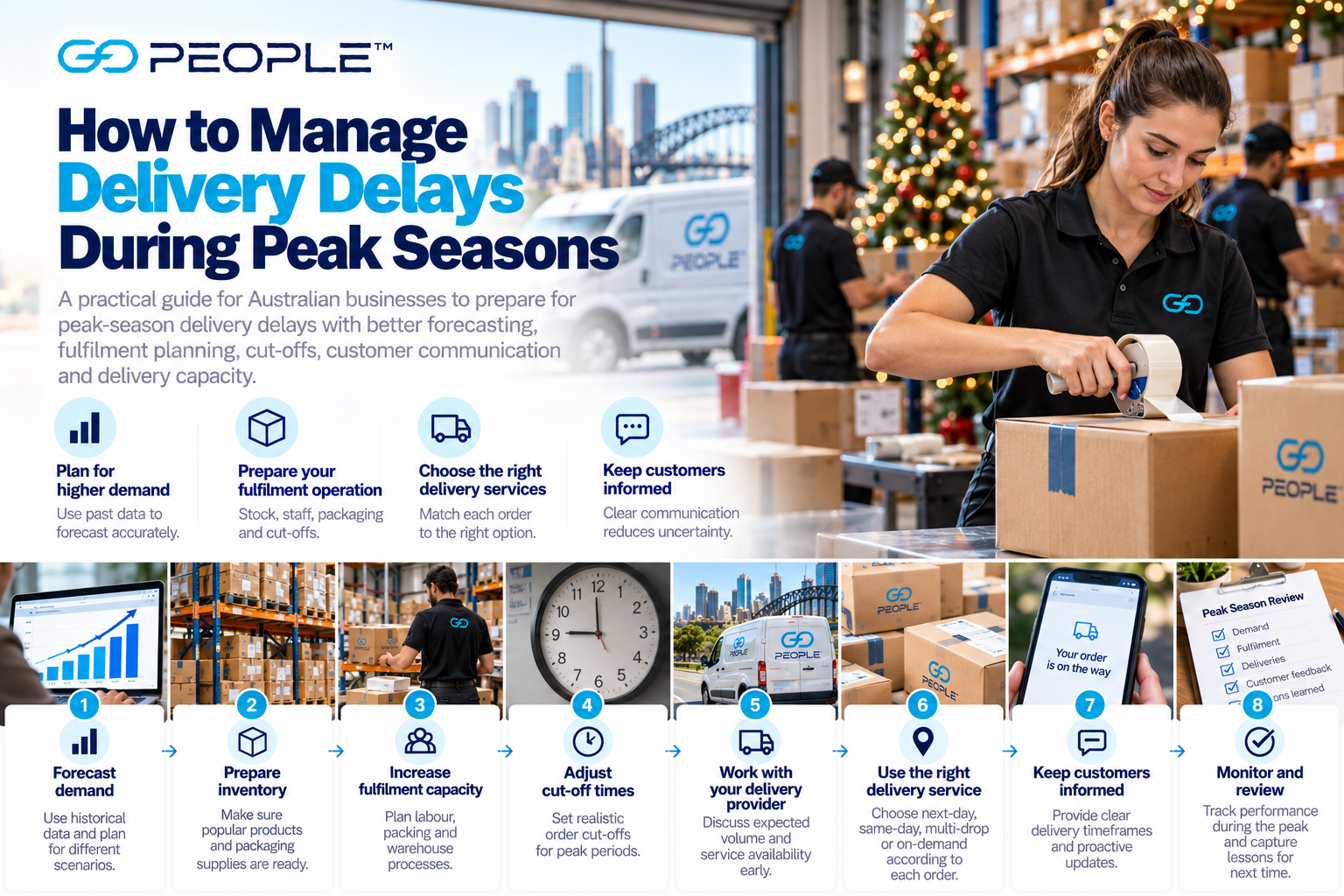
Businesses can prepare for peak demand by forecasting earlier, identifying operational constraints, adjusting cut-offs, matching orders to the right delivery services and communicating clearly when conditions change.
This guide explains how.
Why Delivery Delays Increase During Peak Seasons
Peak-season delivery problems rarely have a single cause.
Instead, several parts of the order-to-delivery process can become overloaded at the same time.
A simplified ecommerce journey looks like:
Order → Payment → Picking → Packing → Dispatch → Pickup → Delivery network → Final delivery
If any stage reaches capacity, the effect can flow through everything that follows.
For example, a business might blame a delivery provider because orders are arriving late.
But if parcels are being packed six hours later than usual, they may already be missing the intended pickup or delivery cycle before they reach the carrier.
Peak-season planning therefore needs to consider the entire fulfilment and delivery system.
1. Forecast Peak Demand Before It Arrives
The first step is understanding how much demand you are likely to face.
Businesses can review historical data such as:
- daily order volume;
- weekly order volume;
- previous Christmas sales;
- Black Friday performance;
- promotional periods;
- average parcels per order;
- delivery destinations;
- returns;
- failed deliveries; and
- customer-service enquiries.
Then consider what will be different this year.
For example:
- Is the customer base larger?
- Has website traffic increased?
- Is marketing spend higher?
- Are you running a larger promotion?
- Have you added new products?
- Are you offering a stronger discount?
- Are you entering new markets?
Historical data is a starting point, not necessarily the final forecast.
2. Create More Than One Forecast
Predicting one exact number can create false confidence.
Instead, consider several scenarios.
For example:
| Scenario | Daily orders | Operational implication |
|---|---|---|
| Normal | 500 | Existing operation |
| Expected peak | 800 | Additional packing capacity |
| High peak | 1,100 | Additional labour and pickup planning |
| Extreme peak | 1,500 | Contingency plan required |
These numbers are illustrative.
The important question is:
What happens if demand is significantly higher than expected?
A business that prepares only for its most likely forecast may struggle when a campaign performs exceptionally well.
3. Find Your Real Capacity Limit
Every operation has constraints.
Possible bottlenecks include:
- inventory;
- picking;
- packing;
- label printing;
- warehouse space;
- loading areas;
- staff;
- carrier pickup capacity;
- vehicle capacity;
- delivery network capacity; and
- customer support.
Suppose your website can generate 2,000 orders a day.
That doesn’t mean your warehouse can dispatch 2,000 orders a day.
If the packing operation can complete only 900 orders, then 900 is effectively the current fulfilment capacity.
Identifying this before peak season gives the business time to respond.
4. Measure Orders Per Labour Hour
One useful warehouse metric is:
Orders dispatched ÷ labour hours = orders per labour hour
Imagine a team dispatches 600 orders using 60 labour hours.
That’s:
10 orders per labour hour
If peak demand is expected to reach 1,000 orders, the business can estimate the additional labour required, while allowing for the fact that productivity may change as the warehouse becomes busier.
This isn’t a perfect forecasting model.
But it is much more useful than simply assuming:
“The team will work faster.”
5. Prepare Inventory Before the Peak
A delivery cannot leave if the product isn’t available.
Before major sales periods, businesses should consider:
- expected product demand;
- stock availability;
- supplier lead times;
- warehouse replenishment;
- fast-moving products;
- promotional SKUs; and
- stock allocation between locations.
Overselling can create a delivery problem before fulfilment even begins.
If an item shown as available cannot actually be dispatched, the customer may experience the issue as a “late delivery” even though the carrier never received the parcel.
Accurate inventory is therefore part of delivery reliability.
6. Pre-Pack Where Practical
Some businesses may be able to prepare popular products before demand peaks.
This can include:
- assembling packaging;
- preparing inserts;
- pre-packing standard bundles;
- preparing promotional kits;
- organising packing materials; and
- staging frequently ordered products.
The goal is to reduce the amount of work required after each order arrives.
For example, if a promotion is built around one standard six-product bundle, preparing some components in advance may be more efficient than assembling every order from scratch after checkout.
7. Make Sure Packaging Supplies Don’t Become the Bottleneck
Businesses naturally focus on product inventory.
But peak fulfilment can also stop because the warehouse runs out of:
- cartons;
- mailers;
- tape;
- labels;
- protective materials;
- printer supplies; or
- other packing consumables.
Estimate packaging requirements based on expected order volume and maintain an appropriate buffer.
A warehouse full of stock is not particularly useful if the business cannot pack it.
8. Review Your Order Cut-Off Times
Peak periods may require different order cut-offs from normal trading.
Imagine:
- carrier pickup is at 4 pm;
- normal warehouse processing takes two hours;
- peak processing increases to four hours.
If the website continues accepting orders until the normal cut-off, the warehouse may be unable to prepare everything before pickup.
A useful approach is:
Pickup time − fulfilment time − operational buffer = realistic customer cut-off
During peak periods, the buffer may need to increase.
It is better to set a realistic expectation than promise a timeframe the operation cannot consistently achieve.
9. Don’t Promise Delivery Based Only on Normal Conditions
A common mistake is displaying normal delivery expectations during abnormal demand.
If the business knows fulfilment will take longer during a major sale, customer-facing information should reflect that.
Review delivery messaging across:
- product pages;
- checkout;
- shipping pages;
- order confirmation emails;
- promotional emails;
- customer-service scripts; and
- tracking communications.
Customers can be more understanding of a longer timeframe when it is explained before they place the order.
Surprise is often what creates frustration.
10. Coordinate With Your Delivery Provider Early
Do not wait until the busiest day of the year to tell your delivery provider that parcel volume has tripled.
Before major peaks, discuss expected:
- daily volume;
- pickup location;
- parcel profile;
- peak dates;
- pickup requirements;
- destination mix; and
- unusual operational requirements.
The more predictable the demand, the easier it is for everyone involved to plan.
Businesses should also ask whether peak conditions affect:
- pickup schedules;
- cut-off times;
- service availability;
- delivery timeframes;
- capacity; or
- pricing.
Do not assume normal operating conditions automatically apply during every peak.
11. Understand Your Destination Mix
Peak delivery planning is not only about how many parcels you send.
It also matters where they are going.
Analyse order data by:
- postcode;
- suburb;
- city;
- metropolitan vs regional destination;
- residential vs business address; and
- service requirement.
Two businesses sending 1,000 parcels may create very different delivery workloads if one has highly concentrated metropolitan demand while the other sends orders across widely dispersed destinations.
Destination analysis can also help determine which delivery model is appropriate.
12. Use the Right Delivery Service for Each Order
Peak periods can become expensive if every order is automatically assigned the fastest available service.
Segment orders according to actual requirements.
For example:
Routine ecommerce orders
A next-day service may be appropriate where available and consistent with the customer promise.
Multiple local deliveries
A multi-drop service may be more efficient when many orders leave the same pickup location.
Genuine same-day requirements
Use same-day delivery when the customer genuinely needs the order that day.
Urgent individual deliveries
An on-demand courier may be appropriate for a specific time-sensitive order.
The objective is not to make every delivery as fast as possible.
It is to make the right deliveries fast enough.
13. Use Multi-Drop Delivery Where It Fits
Peak periods can produce many deliveries leaving the same location for customers across a metropolitan area.
Booking each delivery independently may not always be the most efficient model.
A coordinated multi-drop route can group multiple destinations into one delivery run.
This can help businesses:
- consolidate pickup activity;
- reduce duplicated travel;
- optimise route sequence;
- maintain delivery visibility; and
- manage local delivery volume more efficiently.
GoBUNDLE is GoPeople’s multi-drop delivery option for suitable business delivery runs.
14. Optimise Delivery Routes
When many deliveries need to be completed, route efficiency becomes increasingly important.
A poor route may involve:
- unnecessary backtracking;
- repeated travel through the same area;
- inefficient destination sequencing;
- avoidable kilometres; and
- longer completion times.
Route planning should consider more than straight-line distance.
Factors can include:
- traffic;
- delivery windows;
- business opening hours;
- destination density;
- road conditions;
- access restrictions; and
- delivery priority.
See Route Optimisation for Delivery: How Businesses Can Plan More Efficient Routes for more detail.
15. Reduce Failed Deliveries Before the Peak
A failed delivery creates additional work at exactly the time when capacity is already under pressure.
Potential consequences include:
- another delivery attempt;
- return transport;
- warehouse handling;
- customer-service enquiries;
- investigation;
- replacement orders; and
- refunds.
Before peak season, improve the quality of delivery information.
Check that orders include:
- correct street address;
- correct suburb;
- correct postcode;
- unit number;
- building information;
- recipient phone number; and
- useful delivery instructions.
Reducing avoidable failures helps protect delivery capacity.
Our guide on how to reduce failed deliveries explains this in more detail.
16. Pay Particular Attention to Apartments and Secure Buildings
Peak delivery volumes can magnify access problems.
Apartment and commercial addresses may require:
- unit numbers;
- intercom information;
- concierge access;
- building instructions;
- loading-zone access;
- reception opening hours; or
- recipient availability.
If your checkout or customer account system can collect useful instructions, encourage customers to provide them before dispatch.
A driver discovering an access problem at the door is much harder to resolve than a business identifying missing information before pickup.
17. Use Tracking to Reduce Uncertainty
Customers tend to become more concerned about delivery during major shopping periods.
Tracking can help answer questions such as:
- Has my order been dispatched?
- Has the parcel been collected?
- Is it moving?
- Is it out for delivery?
- Was delivery attempted?
- Has it been delivered?
Better visibility can reduce unnecessary:
“Where is my order?”
enquiries.
It also helps customer-service teams distinguish between:
- a parcel progressing normally;
- a fulfilment delay;
- a delivery exception; and
- a genuinely overdue delivery.
See Why Real-Time Tracking Matters for Online Shopping.
18. Communicate Delays Before Customers Ask
When a significant delay occurs, silence usually makes the customer experience worse.
A useful communication should explain:
- what has happened;
- what the customer should expect next;
- whether they need to do anything; and
- where they can find further information.
Avoid vague messages such as:
“Your order has been delayed.”
when more useful information is available.
A better message might explain that dispatch is taking longer than usual because of unusually high order volume and provide the revised expected timeframe.
The exact wording should reflect what the business genuinely knows.
19. Separate Fulfilment Delays From Delivery Delays
This distinction is important.
Fulfilment delay
The order has not yet been handed to the delivery provider.
Possible causes:
- stock problem;
- picking backlog;
- packing backlog;
- payment issue;
- warehouse capacity.
Delivery delay
The parcel has been dispatched but is not progressing according to the expected delivery timeframe.
Possible causes:
- traffic;
- network congestion;
- weather;
- route disruption;
- access problems;
- delivery exceptions.
The customer may simply see:
“My parcel is late.”
But internally, businesses should identify where the delay actually occurred.
Otherwise they may attempt to fix the wrong problem.
20. Create an Exception Queue
During normal periods, staff may be able to investigate delivery issues individually as they appear.
During peak season, that approach can become chaotic.
Instead, create an exception process.
Potential categories include:
- not dispatched;
- pickup missed;
- tracking not updating;
- delayed;
- unsuccessful delivery;
- wrong address;
- recipient unavailable;
- delivered but not received;
- damaged; and
- return to sender.
Then define:
- who owns each category;
- what information should be checked;
- when the customer should be contacted;
- when the delivery provider should be contacted; and
- when the issue should be escalated.
This reduces duplicated investigations and inconsistent responses.
21. Prioritise Exceptions by Impact
Not every delivery issue has the same urgency.
A practical priority system might consider:
- customer promise;
- how overdue the order is;
- product value;
- whether the customer has contacted support;
- whether the parcel is missing;
- whether the order is time-sensitive; and
- whether multiple deliveries are affected by the same incident.
For example, a parcel one hour behind schedule may not require the same response as a high-value order that has had no tracking movement for several days.
Prioritisation helps support teams use limited peak-season resources effectively.
22. Prepare Customer Support for Increased Volume
Higher parcel volume generally creates more delivery enquiries.
Even if the percentage of orders requiring support stays constant, the number of enquiries can rise substantially.
For example:
Normal period:
1,000 orders × 2% requiring delivery support = 20 enquiries
Peak period:
5,000 orders × 2% = 100 enquiries
The problem rate has not changed.
The support workload has increased fivefold.
Peak planning should therefore include customer-service capacity, not only warehouse and delivery capacity.
23. Build a Peak-Season Delivery Dashboard
Businesses do not necessarily need complicated analytics.
A simple operational dashboard can track metrics such as:
| Metric | Why it matters |
|---|---|
| Orders received | Incoming demand |
| Orders awaiting fulfilment | Warehouse backlog |
| Orders dispatched | Fulfilment throughput |
| Parcels awaiting pickup | Dispatch bottleneck |
| Deliveries completed | Delivery throughput |
| Failed deliveries | Exception workload |
| Customer enquiries | Customer impact |
| Average fulfilment time | Warehouse performance |
| Delivery cost per order | Cost control |
Review these frequently during major peaks.
The objective is to identify problems while they can still be corrected, rather than discovering them after the promotion ends.
24. Watch the Backlog, Not Just Today’s Orders
Suppose a warehouse normally dispatches 1,000 orders per day.
During a promotion:
- Monday receives 1,300 orders;
- Tuesday receives 1,400;
- Wednesday receives 1,200.
If capacity remains 1,000 per day, the operation creates a growing backlog.
After Monday: 300 orders
After Tuesday: 700 orders
After Wednesday: 900 orders
Even when new order volume starts falling, customers can continue experiencing delays because yesterday’s backlog still needs to be cleared.
This is why peak operations should monitor:
new demand + outstanding backlog
rather than daily orders alone.
25. Create a Contingency Plan
Ask:
What could realistically go wrong?
Possible scenarios include:
- order volume exceeds forecast;
- warehouse staff are unavailable;
- packaging materials run out;
- inventory is incorrect;
- pickup is delayed;
- carrier capacity becomes constrained;
- technology fails;
- severe weather affects deliveries;
- major roads close; or
- customer support becomes overwhelmed.
Then define a response.
For example:
| Risk | Possible response |
|---|---|
| Volume exceeds warehouse capacity | Extend fulfilment resources / adjust customer promise |
| Packaging shortage | Maintain backup supplies |
| Pickup constraint | Escalate early with delivery provider |
| Delivery disruption | Update customers and adjust expectations |
| Support overload | Prioritise exceptions and use standard processes |
The objective isn’t to predict every possible event.
It is to avoid making important decisions for the first time during a crisis.
26. Avoid Hiding Delays With Faster Delivery
A common operational mistake is trying to compensate for a slow warehouse by buying faster delivery.
Imagine the business promises next-day delivery.
The order sits in the warehouse for two days.
The team then upgrades the parcel to an urgent courier service to recover the customer promise.
This may solve an individual case, but if it becomes routine, it can create significant additional cost.
The better solution is to identify why fulfilment is late.
Premium delivery should be used because the order requires it, not as a permanent workaround for an upstream process problem.
27. Know When to Stop Taking Orders Under the Existing Promise
Sometimes demand genuinely exceeds capacity.
Continuing to promise the same delivery timeframe can make the situation worse.
Businesses may need to:
- extend dispatch timeframes;
- change website messaging;
- move order cut-offs earlier;
- temporarily adjust promotions;
- restrict certain delivery options; or
- provide revised delivery expectations.
This can feel uncomfortable during a successful sales period.
But accepting unlimited orders under an unrealistic promise can create:
- cancellations;
- refunds;
- support costs;
- negative reviews;
- repeat-purchase damage; and
- operational chaos.
Revenue is valuable only when the business can fulfil the promise attached to it.
28. Review Performance Immediately After the Peak
Once demand returns to normal, conduct a post-peak review.
Ask:
Forecasting
How close was actual demand to the forecast?
Inventory
Which products ran out?
Fulfilment
Where did the warehouse slow down?
Delivery
Which services and destinations experienced the most problems?
Failed deliveries
What were the most common causes?
Customer support
Which questions generated the most enquiries?
Costs
Where did unexpected expenses occur?
Technology
Did integrations and systems perform reliably?
Customer experience
What generated complaints, cancellations or positive feedback?
Document the answers while the experience is still fresh.
That information becomes the starting point for the next peak.
A Simple Peak-Season Delivery Checklist
6–8 Weeks Before
- Review previous peak data
- Forecast demand
- Review inventory
- Estimate packaging requirements
- Identify fulfilment capacity
- Discuss expected volume with delivery providers
- Review service coverage
- Identify likely bottlenecks
2–4 Weeks Before
- Confirm staffing
- Prepare packaging
- Review order cut-offs
- Check tracking and integrations
- Update customer-service procedures
- Confirm delivery instructions and address data
- Test contingency plans
During the Peak
- Monitor order volume
- Monitor fulfilment backlog
- Monitor pickups
- Monitor delivery exceptions
- Review failed deliveries
- communicate significant delays
- adjust customer promises where necessary
After the Peak
- Analyse performance
- Review complaints
- calculate additional costs
- identify bottlenecks
- document lessons
- update the plan for next time
How GoPeople Can Fit Into Peak Delivery Planning
Different peak-season orders can require different delivery models.
GoEXPRESS provides next-day parcel delivery for eligible business pickups in Sydney, Melbourne and Brisbane.
GoBUNDLE provides multi-drop delivery for businesses sending multiple local deliveries from a pickup location.
GoSAMEDAY provides same-day delivery for eligible business pickups.
GoVIP provides on-demand courier delivery for urgent and time-sensitive individual jobs.
Service availability varies by location and delivery requirement, so businesses should check eligibility rather than assuming every service is available everywhere.
Peak Delivery Is an Operations Problem, Not Just a Courier Problem
When peak-season deliveries fall behind, it is easy to blame the final stage of the journey.
But delivery performance depends on the complete operation:
Forecasting → inventory → fulfilment → packaging → dispatch → pickup → delivery → tracking → customer communication
A weakness anywhere in that chain can eventually appear to the customer as a late parcel.
The strongest peak-season strategy therefore combines:
- realistic forecasting;
- sufficient fulfilment capacity;
- early carrier planning;
- appropriate service selection;
- accurate customer data;
- clear delivery expectations;
- useful tracking;
- structured exception management; and
- contingency planning.
The objective isn’t to eliminate every possible delay.
It is to prevent avoidable delays, identify genuine problems quickly and communicate clearly when conditions change.
Frequently Asked Questions
Why are deliveries often delayed during peak seasons?
Peak periods can increase pressure across inventory, warehousing, packing, pickup, delivery networks and customer support at the same time. Delays can therefore originate before a parcel ever reaches the delivery provider.
How early should businesses prepare for peak delivery periods?
Preparation should begin well before the expected peak. Businesses need enough time to review forecasts, inventory, staffing, packaging, fulfilment capacity, delivery arrangements and customer communications.
Should businesses change delivery estimates during peak periods?
If normal delivery expectations are no longer realistic, businesses should consider adjusting customer-facing timeframes and cut-offs. Accurate expectations are generally better than promising a timeframe the operation cannot consistently meet.
How can businesses reduce peak-season delivery delays?
Forecast demand, identify capacity limits, prepare inventory and packaging, coordinate with delivery providers, improve address data, reduce failed deliveries, optimise routes and monitor fulfilment backlogs throughout the peak.
What is the difference between a fulfilment delay and a delivery delay?
A fulfilment delay occurs before the parcel is handed to the delivery provider, such as a picking or packing backlog. A delivery delay occurs after dispatch while the parcel is moving through the delivery process.
Can tracking help during peak periods?
Yes. Tracking can give customers and businesses visibility into parcel progress and help distinguish normal movement from delivery exceptions. It can also reduce unnecessary status enquiries.
Should every peak-season order use express or same-day delivery?
No. Businesses should select delivery services according to actual urgency, customer promises, destination and cost. Using premium delivery for every order can unnecessarily increase delivery expenses.