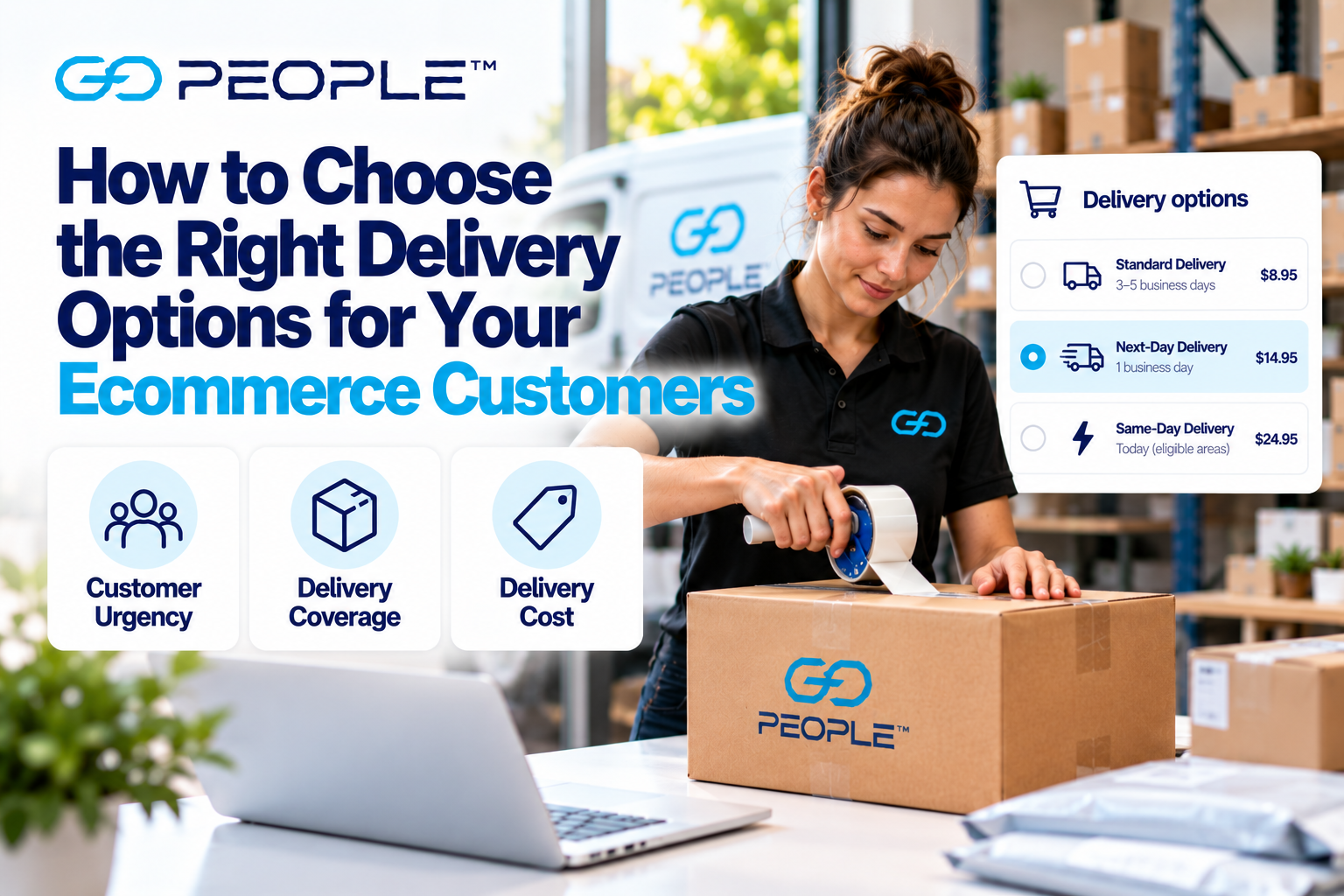
Choosing ecommerce delivery options sounds simple until you try to design the checkout.
Should delivery be free?
Should customers be able to pay for faster delivery?
Do you need same-day delivery?
Should every postcode see the same options?
What happens when an order is placed late in the afternoon?
And how many choices should you show before the checkout itself becomes confusing?
The best delivery strategy is rarely about offering the greatest number of options. It is about offering a small number of useful choices that match customer needs and that your operation can fulfil reliably and profitably.
For many ecommerce businesses, that means combining different delivery speeds and service models rather than forcing every order through the same process.
Here is how to design the right delivery mix.
Why Ecommerce Delivery Options Matter
Delivery sits between the online purchase and the physical customer experience.
Before placing an order, customers may want to know:
- How much will delivery cost?
- When will the order arrive?
- Can I get it faster?
- Does the business deliver to my area?
- Can I track it?
- What happens if I’m not home?
The delivery options presented at checkout help answer some of those questions.
They can also influence whether a customer completes the purchase.
A delivery proposition that is expensive, confusing or too slow for the customer’s needs can create friction.
But offering every imaginable delivery service is not necessarily the answer.
Too much choice can make checkout more complicated and make fulfilment harder to manage.
The objective is to create a delivery menu that is simple for the customer and sustainable for the business.
Start With Customer Needs, Not Courier Services
A common mistake is starting with:
“What services does our courier offer?”
Start instead with:
“What delivery situations do our customers actually have?”
You might discover several broad groups.
Routine Customers
They want their order reasonably quickly but are not particularly time-sensitive.
Urgent Customers
They genuinely need the product today.
Price-Sensitive Customers
They are willing to wait longer if delivery costs less.
Convenience-Focused Customers
They care about tracking, communication and a predictable arrival.
Business Customers
They may care more about reliability and operational timing than consumer-style delivery promotions.
Your delivery options should solve real customer problems rather than simply displaying every available service.
Understand Your Current Orders
Before changing checkout, analyse your existing order data.
Useful information includes:
- average daily orders;
- average order value;
- gross margin;
- customer postcodes;
- fulfilment locations;
- average parcel size;
- average parcel weight;
- current delivery cost;
- failed-delivery rate;
- customer-service enquiries;
- repeat-purchase behaviour; and
- current delivery timeframes.
Then ask:
Where are our customers?
How quickly do they actually need their orders?
How much does delivery cost us?
Which orders generate delivery complaints?
Which customers might pay for a faster option?
Data provides a much better foundation than copying another retailer’s shipping policy.
The Main Ecommerce Delivery Options
Different retailers use different terminology, but most delivery propositions can be grouped into a few broad categories.
Standard or Economy Delivery
Standard delivery is typically the most economical option available to the customer.
It can suit:
- non-urgent purchases;
- price-sensitive customers;
- low-value orders;
- destinations where faster services are not available; and
- businesses prioritising lower delivery costs.
The key requirement is clarity.
Customers should understand the expected timeframe before purchase.
“Standard delivery” means little if the customer has no idea whether that means two days or two weeks.
Next-Day Delivery
Next-day delivery provides a strong middle ground between slower standard delivery and urgent same-day services.
It can work particularly well for ecommerce because it offers customers a fast delivery promise while giving the business more fulfilment flexibility than a same-day service.
It may suit:
- regular ecommerce parcels;
- repeat purchases;
- fashion;
- beauty;
- retail products;
- replacement products; and
- customers who value speed but do not need the order immediately.
GoEXPRESS is GoPeople’s next-day business parcel delivery service for eligible pickups in Sydney, Melbourne and Brisbane.
Same-Day Delivery
Same-day delivery can be valuable when receiving the product today makes a meaningful difference.
Examples can include:
- last-minute gifts;
- urgent replacement products;
- items needed for an event;
- time-sensitive business supplies; and
- customers willing to pay for additional convenience.
But same-day delivery requires tighter coordination between:
inventory → checkout → fulfilment → pickup → delivery
It should not automatically be offered to every customer.
For a detailed decision framework, see Should Your Ecommerce Business Offer Same-Day Delivery?.
GoSAMEDAY provides same-day delivery for eligible business pickups.
On-Demand Delivery
An on-demand courier is designed for particularly urgent individual requirements.
This might be appropriate when:
- an item is needed urgently;
- the order is unusually time-sensitive;
- a business needs a direct courier solution; or
- a specific delivery requires greater urgency than routine parcel delivery.
It generally should not be treated as the default ecommerce shipping method.
GoVIP is GoPeople’s on-demand courier option for urgent and time-sensitive jobs.
Multi-Drop Delivery
Multi-drop delivery works differently from simply offering customers a faster checkout option.
It is an operational model for businesses that have multiple deliveries leaving one pickup location.
Instead of treating each destination as an entirely separate courier movement, orders can be organised into a coordinated route.
This can suit businesses with:
- multiple local orders;
- changing destination addresses;
- regular metropolitan delivery runs; and
- enough delivery density to benefit from route optimisation.
GoBUNDLE is GoPeople’s multi-drop delivery option for suitable business delivery runs.
Don’t Offer Too Many Checkout Options
More choice is not always better.
Imagine a checkout displaying:
- Economy
- Standard
- Regular
- Express
- Priority
- Next-Day
- Same-Day
- Premium Same-Day
- Urgent Courier
The differences may be obvious internally.
They may not be obvious to the customer.
A simpler structure might be:
Standard — lowest-cost option
Next-Day — faster option
Same-Day — available for eligible urgent orders
The exact mix depends on the business.
Each option should have a clear reason to exist.
Make the Differences Obvious
Customers should be able to understand the trade-off between delivery options quickly.
A useful delivery choice usually communicates:
Speed + Price + Eligibility
For example:
| Delivery option | Customer benefit | Suitable for |
|---|---|---|
| Standard | Lower cost | Non-urgent orders |
| Next-Day | Faster routine delivery | Most eligible ecommerce orders |
| Same-Day | Receive it today | Urgent eligible orders |
| On-Demand | Urgent individual delivery | Time-sensitive requirements |
The exact timeframes and prices should reflect your actual services.
Avoid vague labels that require customers to guess what they mean.
Should Ecommerce Delivery Be Free?
Customers often like free delivery.
Businesses still have to pay for it.
“Free shipping” normally means the cost is being absorbed somewhere else, such as:
- product margin;
- minimum order value;
- membership;
- marketing budget; or
- overall pricing.
Before offering free delivery, understand the economics.
A simplified model is:
Order revenue
− cost of goods
− payment costs
− fulfilment costs
− delivery costs
− expected returns/support costs
= contribution
If free delivery turns profitable orders into unprofitable ones, the offer may not be sustainable.
Use Free-Delivery Thresholds Strategically
Instead of offering free delivery on every order, some retailers use a minimum order threshold.
For example:
Free standard delivery on qualifying orders over $X.
The threshold should be based on your economics.
A useful starting point is to examine:
- current average order value;
- gross margin;
- delivery cost;
- basket distribution; and
- customer behaviour.
Suppose your average order value is $75.
A free-delivery threshold at $80 may encourage some customers to add another product.
A threshold at $250 may be so far from normal customer behaviour that it has little effect.
The actual numbers need to come from your business.
Don’t Automatically Make Premium Delivery Free
There is an important distinction between:
Free standard delivery
and:
Free fastest delivery
Customers who need an order urgently may be more willing to pay for premium speed.
One possible structure is:
Standard delivery — free above threshold
Next-Day — fixed upgrade
Same-Day — premium upgrade where eligible
This preserves customer choice while reducing the risk that the business subsidises expensive urgent delivery for every order.
Match Delivery Options to Order Value
Not every order can support the same delivery cost.
Suppose two customers place orders.
Order A
Value: $25
Gross margin: $10
Delivery cost: $12
Order B
Value: $250
Gross margin: $100
Delivery cost: $12
The same delivery cost has a dramatically different effect on each order.
This is why delivery strategy should consider:
- order value;
- gross margin;
- product category; and
- customer value.
A delivery promotion that works for high-margin products may be unsustainable for low-margin items.
Geography Should Determine Eligibility
Not every delivery option needs to be available everywhere.
This is especially important for faster services.
Eligibility may depend on:
- fulfilment location;
- customer postcode;
- pickup area;
- delivery area;
- order time;
- inventory location; and
- service availability.
For example, a retailer might offer:
Next-Day
to eligible metropolitan customers.
Same-Day
to a smaller set of eligible local postcodes.
Other delivery options
to customers outside those areas.
This is better than making a blanket promise that cannot be fulfilled consistently.
Show Only Options the Customer Can Actually Use
Ideally, checkout should not show an unavailable delivery service and then reject it later.
The system should determine eligibility using information such as:
customer postcode + fulfilment location + order time + inventory + service rules
and show the relevant choices.
This creates a cleaner checkout and reduces disappointment.
Inventory Location Changes the Delivery Menu
A customer may live only five kilometres away.
That does not mean same-day delivery is possible if their product is stored in another state.
Delivery eligibility should consider where the actual inventory will be fulfilled.
For retailers with multiple warehouses or stores, this can become more complex.
The system may need to determine:
- where inventory is available;
- which location will fulfil the order;
- which delivery services are available from that location; and
- whether the customer qualifies.
This is why delivery speed is partly an inventory-management problem.
Split Orders Need Special Attention
Suppose a customer orders three products.
Two are available in Sydney.
One is available only in Melbourne.
If checkout promises same-day delivery for the entire order without understanding inventory allocation, the promise may be impossible.
Businesses with multiple fulfilment locations need rules for:
- split shipments;
- partial delivery;
- delivery pricing;
- customer communication; and
- service eligibility.
The checkout promise should reflect what can actually be fulfilled.
Cut-Off Times Need to Reflect Fulfilment
A delivery cut-off is not simply a courier deadline.
The warehouse needs enough time to prepare the order before pickup.
A useful model is:
Carrier/pickup deadline
− fulfilment time
− operational buffer
= customer order cut-off
For example:
Pickup: 3:00 pm
Typical fulfilment: 90 minutes
Operational buffer: 30 minutes
Indicative checkout cut-off:
1:00 pm
This is only an example.
Each business should calculate its own cut-offs using real operational data.
Don’t Use the Same Cut-Off Every Day Without Checking Capacity
Fulfilment capacity can change.
For example:
- Monday may have unusually high weekend backlog;
- Friday may have different pickup arrangements;
- Black Friday may create several times normal volume;
- Christmas may require earlier cut-offs.
Delivery promises should reflect operational reality.
If necessary, businesses should adjust cut-offs during peak periods rather than continuing to accept orders under a promise they cannot achieve.
Consider the Customer’s Actual Urgency
A useful checkout can allow the customer to decide how much speed matters.
For example:
“I want the lowest delivery cost.”
Standard option.
“I want it tomorrow.”
Next-day.
“I need it today.”
Same-day where eligible.
This is better than the retailer guessing urgency for every customer.
Customers who value speed can choose it.
Customers who do not can avoid paying for it.
Tracking Should Be Part of the Delivery Proposition
Customers are not only choosing how quickly the parcel moves.
They are also choosing an experience after checkout.
Tracking can help them understand:
- whether the order has been dispatched;
- whether it has been collected;
- whether it is in transit;
- whether it is out for delivery;
- whether delivery was attempted; and
- whether it has been delivered.
When comparing delivery options or providers, businesses should therefore evaluate visibility as well as speed and price.
See Why Real-Time Tracking Matters for Online Shopping.
Proof of Delivery Matters Too
The delivery journey does not end simply because a system says:
Delivered
Businesses may later need to understand:
- when delivery occurred;
- what evidence exists;
- where the parcel was left;
- whether a signature was captured where applicable; or
- what happened during a disputed delivery.
Our guide What Is Proof of Delivery and Why Does It Matter? explains this in detail.
Delivery options should therefore be evaluated across the entire customer experience:
Checkout → fulfilment → tracking → delivery → proof → support
Think About Failed Deliveries
A cheap delivery option can become expensive if it frequently creates unsuccessful attempts.
Failed deliveries can result from:
- incorrect addresses;
- missing unit numbers;
- inaccessible buildings;
- recipient unavailable;
- unclear instructions; or
- unsuitable delivery arrangements.
Potential costs include:
- redelivery;
- support time;
- returns;
- refunds;
- replacement orders; and
- customer dissatisfaction.
When comparing delivery options, look beyond the initial price.
Consider the total operational cost.
Delivery Options for Apartments
Apartment deliveries can require more information than house deliveries.
Useful details may include:
- unit number;
- building name;
- intercom information;
- concierge instructions;
- access information; and
- recipient phone number.
If a large proportion of your customers live in apartments, the checkout should make it easy to provide these details.
Better address information can improve first-attempt delivery success.
Delivery Options for Business Addresses
Business recipients can create different requirements.
Important information may include:
- business name;
- floor;
- suite;
- reception;
- loading dock;
- contact person;
- opening hours; and
- delivery instructions.
A parcel arriving after the business closes may become an unsuccessful delivery even if the street address is correct.
Customer type should therefore influence how delivery information is collected.
Use Checkout Data to Improve Delivery
Checkout can capture valuable operational information.
Depending on your business, useful fields might include:
- mobile number;
- email;
- unit number;
- company name;
- delivery instructions; and
- other necessary address details.
Avoid collecting unnecessary information.
But make sure the data required for successful delivery is available and flows into the delivery process.
The information chain should work:
Customer → ecommerce platform → fulfilment → delivery booking → delivery provider
If important instructions disappear between systems, the checkout has not solved the problem.
Don’t Make Delivery Options Too Complicated
A retailer can create operational complexity very quickly.
Imagine offering:
- six delivery speeds;
- different rules for every suburb;
- five free-delivery thresholds;
- product-specific exceptions;
- different cut-offs every day;
- separate promotional rules; and
- manual overrides.
Even if each rule makes sense individually, together they can become difficult for:
- customers;
- warehouse staff;
- support teams;
- developers; and
- finance.
Complexity has a cost.
Where possible, create a small number of clear rules.
A Simple Three-Tier Ecommerce Delivery Model
Many businesses can start with a structure similar to:
1. Standard / Value
For customers prioritising price over speed.
2. Fast / Next-Day
For customers wanting faster routine delivery.
3. Urgent / Same-Day
For eligible customers who genuinely need the order today.
This is not the correct model for every retailer.
But it demonstrates a useful principle:
Each delivery option should solve a different customer need.
When Multi-Drop Fits Behind the Checkout
The delivery service shown to the customer does not necessarily need to match the operational method used behind the scenes.
Suppose 50 customers select a local delivery option.
Operationally, the retailer may be able to group those orders into an optimised multi-drop route.
The customer cares primarily about:
- cost;
- expected arrival;
- tracking;
- successful delivery.
The business cares additionally about:
- route efficiency;
- pickup consolidation;
- delivery density; and
- cost per stop.
This means checkout strategy and delivery operations should be designed together.
Test Delivery Options Rather Than Guessing
Businesses should treat delivery options like other ecommerce features.
Test them.
For example, compare:
Test A
Standard + Next-Day
Test B
Standard + Next-Day + Same-Day
Then measure:
- conversion rate;
- cart abandonment;
- option selection;
- average order value;
- gross margin;
- delivery cost;
- on-time performance;
- failed deliveries;
- support contacts; and
- repeat purchases.
You may discover that customers strongly value one option and barely use another.
Remove choices that add complexity without creating value.
Measure Delivery Option Adoption
A simple metric is:
Orders selecting option ÷ eligible orders = adoption rate
Suppose:
- 10,000 customers qualify for same-day;
- 400 select it.
Same-day adoption is:
4%
That does not automatically mean the option is good or bad.
You then need to understand:
- profitability;
- customer segment;
- repeat behaviour;
- operational cost; and
- strategic value.
But adoption provides an important starting point.
Measure Margin by Delivery Option
Do not look only at revenue.
Compare contribution after delivery.
For each option, consider:
Revenue
− product cost
− payment cost
− fulfilment cost
− delivery cost
− expected support/returns cost
= contribution
You may find:
- standard delivery produces the highest margin;
- next-day customers spend more;
- same-day attracts valuable urgent orders;
- free delivery on low-value baskets loses money.
That information should shape your checkout strategy.
Measure Delivery Performance by Option
Customers judge the promise they selected.
Track performance separately for:
- standard;
- next-day;
- same-day; and
- other services.
Useful metrics include:
- on-time delivery;
- failed-delivery rate;
- first-attempt success;
- customer enquiries;
- redelivery;
- complaints; and
- cost per order.
A delivery option with strong adoption but poor reliability may damage customer experience.
Review “Where Is My Order?” Enquiries
Customer-service data can reveal problems that analytics miss.
If customers using a particular option repeatedly ask:
“Where is my order?”
possible causes include:
- unclear delivery expectations;
- weak tracking;
- poor notifications;
- late fulfilment;
- inaccurate status information; or
- actual delivery delays.
The solution may not require a faster service.
It may require better information.
Avoid Promising “Fast” Without Explaining What It Means
Words such as:
- fast;
- express;
- priority; and
- rapid
can sound appealing but provide little certainty.
Where possible, customers should understand the expected timeframe.
For example:
Next-Day Delivery
is clearer than:
Super Fast Shipping
provided next-day is genuinely what the service delivers for that eligible order.
Clear expectations are part of the product.
Delivery Options During Peak Seasons
The best delivery menu in March may not be appropriate during Black Friday or Christmas.
Peak periods can affect:
- fulfilment time;
- carrier capacity;
- cut-offs;
- inventory;
- delivery timeframes; and
- customer expectations.
Businesses may need to:
- move cut-offs earlier;
- adjust displayed timeframes;
- temporarily restrict premium services;
- change eligibility; or
- communicate additional processing time.
See How to Manage Delivery Delays During Peak Seasons for a complete planning framework.
When to Add a New Delivery Option
Consider adding an option when there is evidence of unmet demand.
Examples:
- customers repeatedly ask for faster delivery;
- customers abandon because delivery is too slow;
- a significant customer cluster is close to inventory;
- competitors are meeting a genuine customer need you cannot;
- business customers require a different delivery model; or
- a new fulfilment location makes faster delivery practical.
Do not add an option merely because the technology allows it.
Every option creates:
- checkout complexity;
- fulfilment rules;
- support requirements;
- pricing logic; and
- operational responsibility.
It should earn its place.
When to Remove a Delivery Option
Consider simplifying if an option:
- has very low adoption;
- creates customer confusion;
- is consistently unprofitable;
- performs poorly;
- overlaps another service;
- generates disproportionate support enquiries; or
- is operationally difficult to fulfil.
Removing an unnecessary option can improve both checkout simplicity and operational consistency.
A Delivery-Option Decision Framework
Before offering a delivery option, work through these seven questions.
1. Does the customer need it?
Is there genuine demand?
2. Is the inventory close enough?
Can the order realistically be fulfilled using the service?
3. Can fulfilment support it?
Can the warehouse or store prepare the order before the required cut-off?
4. Is the customer eligible?
Does the pickup/delivery combination fall within service coverage?
5. Do the economics work?
Does the order retain an acceptable contribution after delivery cost?
6. Can we deliver the promise reliably?
A delivery option is only valuable if customers can trust it.
7. Can we support it operationally?
Can customer service, technology, fulfilment and finance all manage the option effectively?
If several answers are no, the service probably should not appear at checkout yet.
Example: Designing a Delivery Menu
Imagine an ecommerce retailer has:
- a Sydney warehouse;
- customers across Australia;
- a large concentration of Sydney metropolitan customers;
- moderate order values;
- strong demand for faster local delivery.
Instead of offering the same service to everyone, the retailer might design:
Customers outside the eligible local area
Standard delivery options appropriate to those destinations.
Eligible metropolitan customers
Next-day delivery.
Selected local customers ordering before the cut-off
Optional same-day delivery.
Unusually urgent individual orders
On-demand courier where appropriate.
The exact structure would depend on the retailer’s delivery providers and service eligibility.
The principle is to match the menu to the order, rather than making every customer fit one delivery model.
How GoPeople Fits Into an Ecommerce Delivery Mix
GoPeople provides several business delivery options that can address different requirements.
GoEXPRESS — Next-Day Delivery
GoEXPRESS is designed for next-day business parcel delivery from eligible pickup locations in Sydney, Melbourne and Brisbane.
GoBUNDLE — Multi-Drop Delivery
GoBUNDLE is designed for businesses sending multiple deliveries from one pickup location, with route optimisation, live tracking and digital proof of delivery.
GoSAMEDAY — Same-Day Delivery
GoSAMEDAY provides same-day delivery for eligible business pickups.
GoVIP — On-Demand Courier
GoVIP provides an on-demand option for urgent and time-sensitive individual deliveries.
Businesses should check service eligibility for their actual pickup and delivery requirements rather than assuming every option is available in every location.
Build the Delivery Menu Around the Customer and the Economics
There is no universal ecommerce delivery menu.
The right mix depends on:
customer demand + inventory location + fulfilment capability + geography + order economics + delivery performance
For many businesses, the strongest approach is relatively simple:
an economical option for customers who can wait
a faster option for routine ecommerce orders
a premium option for customers with genuine urgency
Then allow actual customer behaviour to guide the strategy.
Measure which services customers choose.
Measure what they cost.
Measure whether they arrive when promised.
Measure how they affect conversion and repeat purchasing.
And remove complexity that doesn’t create value.
The goal isn’t to offer the most delivery options.
It is to offer the right delivery options to the right customers at the right time.
Frequently Asked Questions
What delivery options should an ecommerce business offer?
It depends on customer demand, geography, fulfilment capability and economics. Many retailers can benefit from a simple mix of a value option, a faster next-day option and same-day delivery for eligible urgent orders.
Should ecommerce businesses offer free delivery?
Free delivery can help customers, but the business still absorbs the cost. Before offering it, calculate the impact on contribution margin and consider whether a minimum order threshold is appropriate.
Should every customer see the same delivery options?
Not necessarily. Delivery eligibility can vary based on destination, fulfilment location, order time, inventory and service coverage.
How many delivery options should be shown at checkout?
There is no universal number, but each option should serve a clearly different customer need. Too many similar choices can create confusion and operational complexity.
Is same-day delivery necessary for ecommerce?
No. It can be valuable for urgent purchases and certain customer segments, but reliable next-day or other delivery options may be more appropriate for routine orders.
How should businesses choose a free-delivery threshold?
Use actual data including average order value, gross margin and delivery cost. The threshold should encourage useful customer behaviour without making orders uneconomic.
How can businesses tell whether a delivery option is working?
Measure adoption, conversion, average order value, contribution margin, delivery cost, on-time performance, failed deliveries, support enquiries and repeat purchasing.