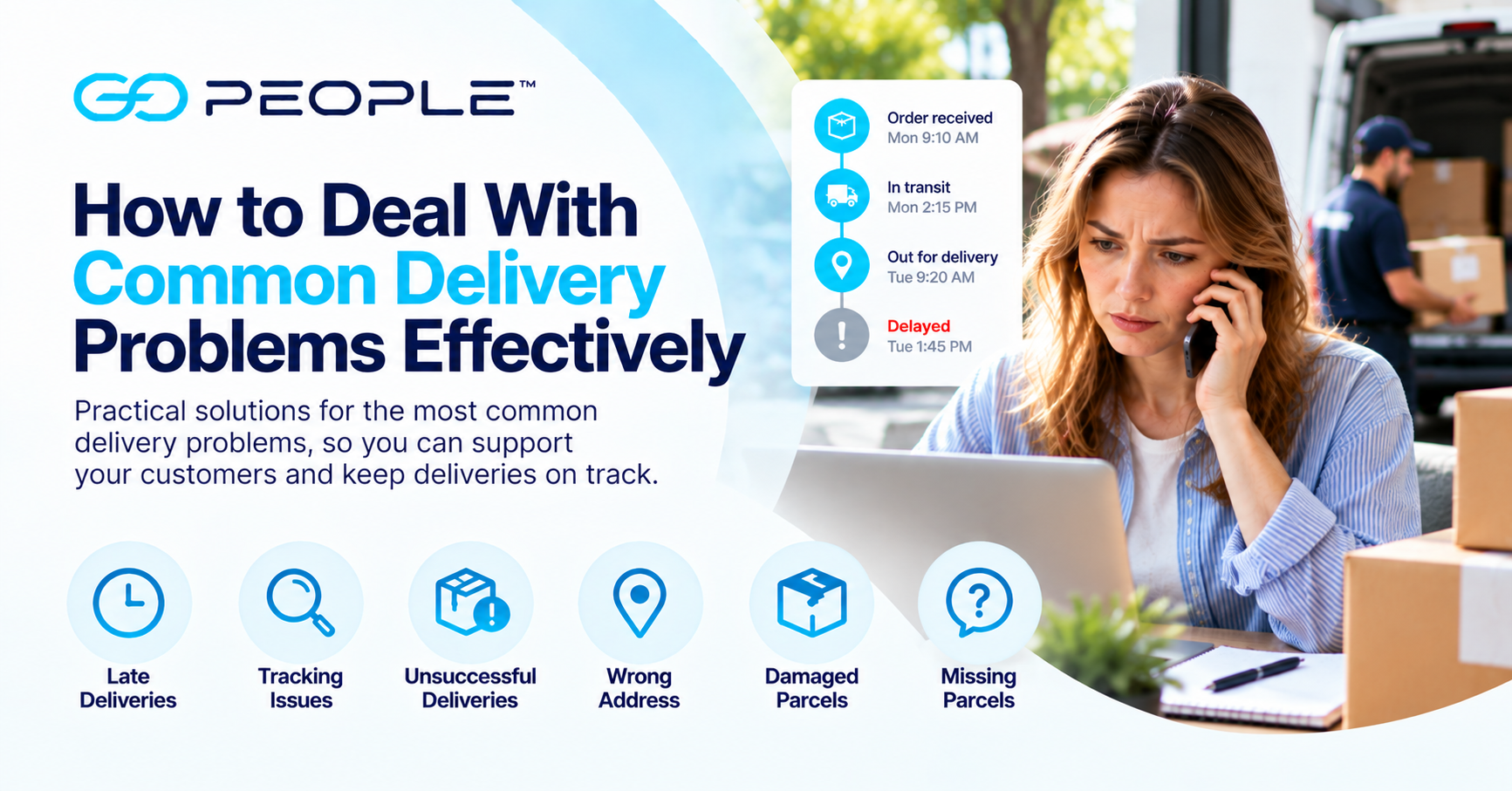
Delivery problems happen.
A parcel may be delayed, an address may be incorrect, a recipient may be unavailable, or a customer may report that a delivery cannot be found.
For businesses, the important question isn’t simply how to prevent every possible delivery problem. It’s also:
What should you do when something goes wrong?
Having a clear process can help businesses investigate problems faster, communicate more effectively with customers and determine the appropriate next step.
Here are some of the most common delivery problems and practical ways businesses can respond.
1. A Delivery Is Running Late
A late delivery doesn’t automatically mean the parcel is lost.
There may be delays during collection, sorting, transportation or the final delivery stage.
What to Do
Start by checking the latest available tracking information.
Look for:
- the current delivery status;
- the most recent delivery event;
- when that event occurred;
- whether delivery has already been attempted; and
- whether there is information indicating an exception or delay.
If the delivery is still progressing through the network, avoid giving the customer an unverified explanation or promising a new delivery time that hasn’t been confirmed.
Instead, communicate what is known.
For example, explain that the delivery is delayed, provide the latest available information and tell the customer what will happen next.
How to Reduce Future Problems
Businesses should also review whether the delivery timeframe promised to the customer was realistic.
Choosing the right service matters.
A regular ecommerce parcel may be suitable for next-day delivery, while an order that genuinely needs to arrive that day may require same-day delivery.
2. Tracking Hasn’t Updated
Customers often assume that a parcel isn’t moving when tracking hasn’t changed.
That isn’t necessarily the case.
Tracking information depends on events being recorded throughout the delivery process, and there can sometimes be a period between visible updates.
What to Do
First, check:
- the latest recorded event;
- when it occurred;
- the expected delivery timeframe; and
- whether the delivery is actually overdue.
If the parcel remains within its expected timeframe, it may simply be progressing between tracking events.
If there has been no update for an unusual period or the expected delivery timeframe has passed, the business may need to contact the delivery provider for further information.
Avoid telling the customer that a parcel is lost simply because tracking hasn’t recently changed.
For a more detailed explanation, see How to Track Your Delivery in Real Time.
3. The Recipient Wasn’t Available
An unsuccessful delivery attempt can occur when the recipient isn’t available or the driver cannot safely complete the delivery.
What happens next depends on the delivery service and the circumstances of the attempted delivery.
What to Do
Check the delivery information first.
Determine:
- whether an attempt was made;
- whether access to the property was possible;
- whether the driver was authorised to leave the parcel;
- whether further recipient action is required; and
- what the applicable redelivery or collection process is.
Don’t immediately promise another delivery attempt until you’ve confirmed what the delivery provider’s process requires.
How to Reduce Future Attempts
Accurate recipient contact information and delivery instructions can help.
Customer notifications can also give recipients greater visibility as their delivery progresses.
4. The Address Is Incorrect or Incomplete
Incorrect addresses can cause delays, unsuccessful deliveries or parcels being taken to the wrong location.
Common problems include:
- incorrect street numbers;
- missing unit numbers;
- wrong suburbs or postcodes;
- outdated customer addresses; and
- typing errors.
What to Do
If the problem is identified before delivery, determine whether the address can still be corrected through the applicable delivery process.
If delivery has already been attempted or completed, don’t assume that changing the address in your own system will automatically redirect the parcel.
The next step will depend on the parcel’s current status.
How to Prevent Address Problems
Businesses can improve address quality by:
- validating addresses during checkout where practical;
- requiring unit numbers where relevant;
- confirming postcodes;
- reducing manual data entry; and
- using integrations to transfer delivery information accurately.
5. A Customer Says Their Parcel Is Missing
This is one of the situations where businesses should avoid jumping to conclusions.
A customer saying, “I can’t find my parcel,” doesn’t necessarily establish that the parcel has been lost.
What to Do
Start with the delivery record.
Check:
- the latest tracking status;
- whether the delivery is marked as completed;
- available proof of delivery;
- delivery timestamps;
- available delivery-location information; and
- any relevant delivery notes.
If the available information doesn’t resolve the issue, follow the delivery provider’s investigation process.
Give the customer a clear explanation of what is happening next rather than repeatedly asking them to check tracking themselves.
Avoid Duplicate Investigations
If an investigation has already been opened, keep subsequent communication connected to that enquiry where possible.
Opening multiple enquiries about the same parcel can make the situation harder to manage rather than speeding up the resolution.
6. A Parcel Was Delivered to the Wrong Address
A wrong-address delivery requires more than simply checking whether tracking says “Delivered.”
The important question is whether the parcel was delivered to the correct destination.
What to Do
Confirm the address originally supplied with the delivery.
Then review the available delivery information, which may include:
- proof of delivery;
- delivery time;
- delivery notes;
- relevant location information; and
- other information associated with the completed job.
If the information suggests that the parcel may have been delivered incorrectly, follow the appropriate investigation process.
Don’t tell the customer to retrieve a parcel from an unknown address themselves unless that is clearly appropriate and safe.
7. A Parcel Arrives Damaged
Damage may occur because of packaging, handling or conditions during transportation.
For the customer, however, the immediate issue is that the product they ordered hasn’t arrived in the expected condition.
What to Do
Ask the customer to retain the parcel and packaging where appropriate and gather the information required under the relevant claims or investigation process.
Useful information may include:
- photographs of the parcel;
- photographs of the damaged item;
- details of the packaging;
- delivery information; and
- evidence relevant to the value of the goods.
Then follow the applicable process for the delivery service.
Prevention Starts Before Collection
Appropriate packaging remains one of the most important ways businesses can reduce the risk of damage.
Packaging should be suitable for the product and the normal conditions of transportation.
8. The Driver Can’t Access the Delivery Location
Apartment buildings, commercial premises, hospitals, shopping centres and gated properties can all create access problems.
A correct street address doesn’t necessarily mean the driver can reach the recipient.
What to Do
Check whether useful access instructions were supplied.
Depending on the delivery status and service, the recipient may need to provide additional information or a further delivery process may be required.
Avoid promising that the driver can simply return later unless that has been confirmed.
How Businesses Can Help
Where relevant, collect information such as:
- building or business name;
- unit or suite number;
- reception instructions;
- access details supported by the delivery process; and
- a valid recipient contact number.
Better information before collection can prevent unnecessary problems later.
9. The Customer Says They Didn’t Receive Delivery Notifications
Delivery communication can be affected by incorrect contact information or other factors.
What to Do
First confirm that the contact details associated with the delivery are correct.
Then use the tracking information available to explain the current delivery status rather than relying solely on whether a notification was received.
For future orders, businesses should ensure that customer contact information is transferred accurately into the delivery system.
10. The Customer Needs the Delivery Urgently After Something Has Gone Wrong
This situation requires particular care.
A delayed or unsuccessful delivery doesn’t automatically mean the existing parcel can simply be converted into an urgent delivery.
What to Do
Establish what has happened to the original parcel first.
Is it:
- still with the driver;
- returning to a warehouse;
- awaiting another process;
- under investigation; or
- already completed?
Only then can the available options be determined.
If a separate urgent delivery genuinely needs to be arranged, an on-demand courier service may be appropriate depending on the circumstances and service availability.
A Simple Process for Handling Delivery Problems
Businesses don’t need a completely different support process for every possible delivery issue.
A useful framework is:
Step 1: Identify the Delivery
Confirm the correct tracking number, order number or delivery reference.
Step 2: Check the Latest Information
Review the current status, latest event and any available delivery information.
Step 3: Establish What Actually Happened
Don’t assume that “late” means lost, “delivered” means correctly delivered, or “no update” means the parcel isn’t moving.
Use the available information first.
Step 4: Follow the Appropriate Process
Different problems may require different actions:
- waiting for the next tracking event;
- updating information where permitted;
- arranging the applicable redelivery process;
- opening an investigation; or
- referring the matter to the appropriate party.
Step 5: Tell the Customer What Happens Next
Customers usually want more than an explanation of what went wrong.
They want to know:
What happens now?
Give them the next step and, where possible, a realistic timeframe.
Step 6: Avoid Overpromising
Don’t promise a delivery time, redelivery, refund or outcome that hasn’t been confirmed.
Accurate information is more useful than an optimistic answer that later proves incorrect.
Why Tracking Matters When Something Goes Wrong
Tracking isn’t only useful when deliveries are progressing normally.
It becomes particularly valuable when a customer reports a problem.
Tracking and delivery information can help businesses establish:
- the latest known status;
- when events occurred;
- whether delivery was attempted;
- whether delivery was completed; and
- what the next appropriate action may be.
This can give support teams a better starting point for investigating the issue.
Read Why Real-Time Tracking Matters for Online Shopping for more on the customer experience.
You can also read How Technology Is Changing Courier and Delivery Services to see how tracking, notifications and proof of delivery fit into modern delivery operations.
Communication Matters as Much as the Resolution
Customers don’t expect every delivery network to operate without a single problem.
But when something does go wrong, poor communication can make the situation worse.
A useful customer response should explain:
What we know → What we’re doing → What happens next
Avoid vague responses such as:
“Please wait and see if it arrives.”
Where more investigation is genuinely required, explain that clearly.
For example, tell the customer that the delivery information is being reviewed and what they should expect next.
Clear communication helps reduce uncertainty even when the problem cannot be resolved immediately.
Preventing Repeat Delivery Problems
Individual delivery problems should also be treated as operational information.
If the same problem occurs repeatedly, businesses should look for the underlying cause.
For example:
Repeated incorrect addresses
Review checkout and address-validation processes.
Frequent unsuccessful deliveries
Review recipient information, delivery instructions and communication.
Regular damage claims
Review packaging.
Frequent delivery-status enquiries
Improve tracking visibility and customer notifications.
Repeated delays
Review whether the selected delivery service matches the promise being made to customers.
Looking at patterns can help businesses improve the overall delivery process rather than solving the same problem repeatedly.
Choosing the Right Delivery Service
Some delivery problems begin when the service selected doesn’t match the requirement.
GoPeople provides different delivery models for different business needs:
GoEXPRESS — Next-Day Delivery
GoBUNDLE — Multi-Drop Delivery
GoSAMEDAY — Same-Day Delivery
GoVIP — On-Demand Courier
Choosing an appropriate delivery model can help businesses set more realistic expectations from the beginning.
For businesses considering how delivery problems affect the wider customer experience, also read 6 Delivery Issues That Can Damage Your Brand Reputation.
Frequently Asked Questions
What should I do first when a delivery goes wrong?
Start by identifying the correct delivery and checking its latest tracking information.
Establish what is actually known before deciding what action is required.
What should I do if tracking hasn’t updated?
Check the latest tracking event and whether the delivery is actually overdue.
A period without an update doesn’t automatically mean the parcel is lost. If the expected timeframe has passed or the lack of updates is unusual, further investigation may be appropriate.
What happens if a parcel is delivered to the wrong address?
The delivery information should be reviewed and the appropriate investigation process followed.
Available information such as proof of delivery, timestamps and delivery details may help establish what occurred.
What should I do after an unsuccessful delivery?
Check why the delivery was unsuccessful and what process applies to that delivery.
Depending on the circumstances, another delivery process, collection arrangement or further recipient information may be required.
How can businesses reduce delivery problems?
Accurate customer information, appropriate packaging, realistic delivery promises, tracking, clear communication and choosing the right delivery service can all help reduce avoidable problems.
Can tracking prevent delivery problems?
Tracking doesn’t prevent every problem.
Its value is visibility: it can help businesses and recipients understand what is happening and provide useful information when a delivery needs investigation.
Good Delivery Support Answers One Question
When a customer contacts a business because something has gone wrong with a delivery, they usually want to know one thing:
What happens next?
Effective delivery support starts by establishing the facts, following the appropriate process and giving the customer a clear next step.
Businesses that combine good delivery operations with useful tracking and clear communication are better equipped to manage problems when they occur.
Because good delivery isn’t only about what happens when everything goes according to plan.
It’s also about how effectively you respond when it doesn’t.
Better Tracking. Lower Cost. Faster Deliveries.