A customer may love your products, your website and your service — but their experience with your business doesn’t end at checkout.
Delivery is often the final stage of the purchase journey, and when something goes wrong, customers may associate that experience with the business they purchased from rather than the delivery provider.
Late deliveries, damaged parcels, poor tracking and deliveries to the wrong address can all create frustration.
For businesses, protecting the customer experience means treating delivery as part of the brand experience.
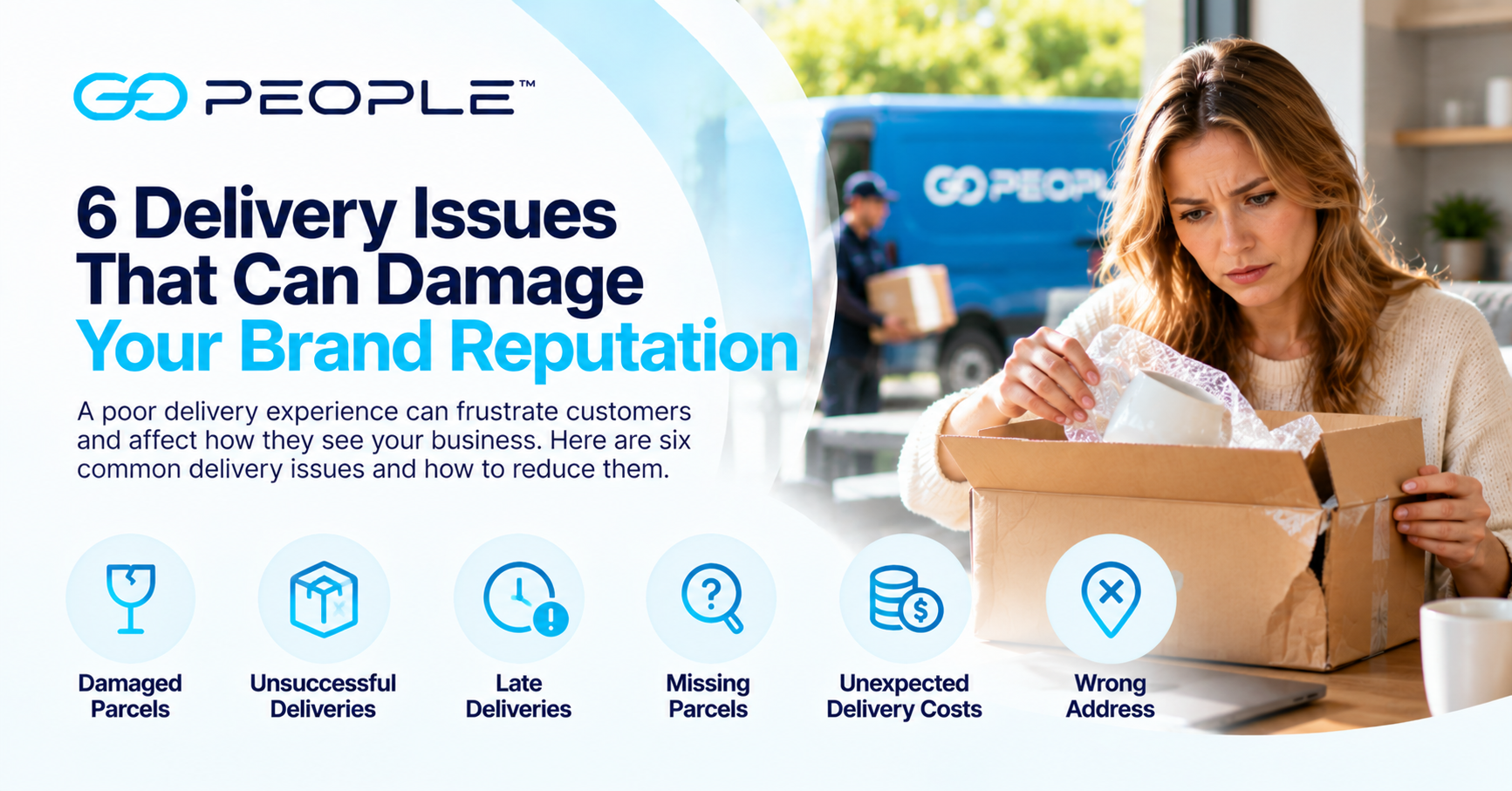
Here are six common delivery problems businesses should pay attention to — and what they can do to reduce them.
1. Damaged Parcels or Products
Few delivery experiences are more disappointing than opening a parcel and discovering that the product inside has been damaged.
Damage can happen for many reasons, including inadequate packaging, movement during transport or the way a parcel is handled or left at the delivery location.
For the customer, however, the cause may matter less than the outcome: the product they ordered hasn’t arrived in usable condition.
How Businesses Can Reduce the Risk
Start with appropriate packaging.
Products should be packed for the conditions they are likely to experience during collection, sorting, transport and final delivery.
Businesses should consider:
- appropriate outer packaging;
- internal protection for fragile products;
- securely sealing parcels;
- clearly labelling shipments;
- avoiding unnecessary empty space inside boxes; and
- following the delivery provider’s packaging requirements.
Good packaging protects more than the product. It also helps protect the customer’s impression of the business.
2. Unsuccessful Delivery Attempts
An unsuccessful delivery can be frustrating for everyone involved.
The recipient doesn’t receive their parcel, the business may receive a customer enquiry, and another delivery attempt or alternative arrangement may be required.
There are many possible causes.
The recipient may not be available, the driver may be unable to access an apartment building, delivery instructions may be incomplete, or the parcel may require someone to be present.
How Businesses Can Improve Delivery Success
Businesses can reduce avoidable problems by collecting accurate delivery information at checkout.
That can include:
- the correct delivery address;
- apartment or unit numbers;
- appropriate contact details; and
- useful delivery instructions where supported.
Customers should also receive tracking information and relevant delivery updates so they have greater visibility as the delivery progresses.
The objective isn’t to assume every unsuccessful delivery can be prevented. It is to give the recipient and delivery provider the information needed to make successful delivery more likely.
3. Late Deliveries
Customers generally understand that deliveries take time.
Problems arise when the delivery experience doesn’t match the expectation that was set.
If a customer is told an order should arrive on a particular day and it doesn’t, the resulting frustration can affect their impression of the retailer.
This becomes even more important when the product is needed for a deadline, event or business requirement.
How Businesses Can Improve Delivery Reliability
The first step is to set realistic expectations.
Don’t promise a delivery speed simply because it sounds attractive. Choose a delivery service that fits the requirements of the order and communicate the expected timeframe clearly.
Different jobs may require different delivery models.
For many ecommerce parcels, next-day delivery may provide an appropriate balance between speed and efficiency.
When an order genuinely needs to arrive that day, same-day delivery may be more appropriate.
For particularly urgent individual jobs, an on-demand courier may be the better option.
The goal isn’t to make every delivery as fast as possible.
It’s to promise appropriately and deliver reliably.
4. Missing Parcels or Unclear Delivery Status
A missing parcel can quickly become a difficult customer-service situation.
Sometimes the parcel is genuinely missing. In other cases, the customer simply doesn’t have enough information to understand what has happened.
For example, a delivery may show as completed while the recipient cannot immediately locate the parcel.
Without useful delivery information, the business and customer may struggle to determine the next step.
How Tracking and Proof of Delivery Help
A good delivery process should create useful information throughout the delivery journey.
Tracking can help businesses and recipients understand the latest delivery status, while proof of delivery can provide information associated with a completed job.
This gives customer-service teams a better starting point when investigating an enquiry.
Businesses should also have a clear process for dealing with deliveries that require investigation rather than simply asking customers to wait indefinitely.
For more information about tracking, see How to Track Your Delivery in Real Time.
5. Delivery Costs That Don’t Match Customer Expectations
Delivery cost can influence the customer’s decision before an order is even placed.
A customer may be comfortable paying for delivery when the charge makes sense relative to the product, delivery speed and convenience being provided.
But unexpected or disproportionately high delivery charges can create friction during checkout.
How Businesses Can Manage Delivery Costs
The answer isn’t necessarily to make every delivery free.
Businesses should understand their fulfilment costs and choose delivery models appropriate for different types of orders.
For example, a business sending many deliveries from one location may have different requirements from a business sending a single urgent parcel.
For multiple deliveries, GoBUNDLE uses a multi-drop delivery model designed for businesses completing multiple deliveries.
Businesses can learn more in our Multi-Drop Delivery Guide.
The important point is to consider delivery cost as part of the overall fulfilment strategy rather than treating every order identically.
6. Parcels Delivered to the Wrong Address
A parcel delivered to the wrong address creates an immediate customer-service problem.
The recipient hasn’t received their order, while the business may need to investigate what happened and determine the appropriate resolution.
Address problems can begin before the parcel reaches the delivery provider.
Incorrect customer details, missing unit numbers, data-entry errors and labelling mistakes can all contribute to delivery problems.
How Businesses Can Reduce Address Errors
Accurate delivery data is essential.
Businesses should:
- validate customer addresses where practical;
- ensure unit and apartment numbers are captured;
- transfer delivery details accurately into fulfilment systems;
- clearly label parcels;
- avoid unnecessary manual re-entry of delivery information; and
- use delivery integrations where appropriate.
If a delivery is reported at the wrong address, businesses should have a clear investigation process and use available delivery information to establish what happened.
Why Delivery Problems Affect Brand Reputation
Customers usually purchase from the retailer, not from its internal logistics operation.
That distinction matters.
From the customer’s perspective, the delivery is part of the order.
If something goes wrong, the customer may contact the business they purchased from and judge that business based on how effectively the problem is handled.
This means delivery experience can affect:
- customer satisfaction;
- customer-service workload;
- reviews and feedback;
- repeat purchasing decisions; and
- overall trust in the business.
Businesses therefore shouldn’t think of delivery purely as transportation.
It is part of the customer experience.
Tracking and Communication Can Make a Major Difference
Not every delivery problem can be prevented.
Traffic, access issues, incorrect customer information and other unexpected situations can affect a delivery.
What businesses can control is how much visibility customers have when something changes.
Real-time delivery information and customer notifications can reduce uncertainty and help recipients understand what is happening.
We’ve covered this in more detail in Why Real-Time Tracking Matters for Online Shopping.
The technology behind modern delivery operations is also explained in How Technology Is Changing Courier and Delivery Services.
Choosing the Right Delivery Service
Different delivery requirements create different risks.
A business sending regular ecommerce parcels may prioritise reliable next-day fulfilment.
Another business may need multiple local deliveries completed from the same pickup point.
Some orders genuinely need same-day delivery, while an occasional urgent parcel may require an on-demand courier.
GoPeople provides different business delivery services for these requirements:
GoEXPRESS — Next-Day Delivery
GoBUNDLE — Multi-Drop Delivery
GoSAMEDAY — Same-Day Delivery
GoVIP — On-Demand Courier
Matching the delivery model to the job can help businesses create a more appropriate and manageable delivery operation.
What Should Businesses Look for in a Delivery Provider?
Price and speed matter, but they shouldn’t be the only considerations.
Businesses should also consider whether a delivery provider can support the customer experience they want to offer.
Important factors can include:
Tracking
Can the business and recipient understand the progress of the delivery?
Proof of Delivery
Is useful information available after a delivery has been completed?
Customer Communication
Can recipients receive relevant delivery updates?
Service Options
Can the provider support different types of delivery requirements?
Delivery Support
What happens when a delivery doesn’t go according to plan?
Technology and Integrations
Can delivery processes connect effectively with the business’s existing operations?
For ecommerce businesses evaluating alternatives, our guide to Australia Post alternatives for ecommerce covers some of these considerations in more detail.
Frequently Asked Questions
What are the most common delivery problems?
Common problems include damaged parcels, unsuccessful delivery attempts, late deliveries, missing parcels, unexpected delivery costs and deliveries to the wrong address.
The specific issues a business experiences will depend on its products, customers and delivery operation.
Can poor delivery damage a company’s reputation?
It can contribute to a poor customer experience.
Customers often see delivery as part of their overall purchase from the retailer, so delivery problems and the way they are resolved can influence how the customer perceives the business.
How can businesses reduce delivery complaints?
Businesses can improve delivery by setting realistic expectations, capturing accurate delivery information, packaging products appropriately, providing tracking and customer updates, and using delivery services suited to the requirements of each order.
Why is proof of delivery important?
Proof of delivery provides information associated with the completion of a delivery.
It can help businesses investigate customer enquiries and better understand what happened when a recipient reports a problem.
Is faster delivery always better?
No.
The appropriate delivery speed depends on the order.
Reliable next-day delivery may be suitable for many ecommerce purchases, while same-day or on-demand delivery may make more sense when the item is genuinely urgent.
Protecting Your Brand Through Better Delivery
A strong delivery experience doesn’t require every parcel to arrive immediately or every delivery to go perfectly.
It requires businesses to set appropriate expectations, choose the right delivery model, provide useful visibility and respond effectively when something goes wrong.
Customers remember the entire purchasing experience — including what happens after checkout.
Treating delivery as part of the customer experience can therefore help businesses protect something much more valuable than an individual parcel:
their relationship with the customer.
Better Tracking. Lower Cost. Faster Deliveries.