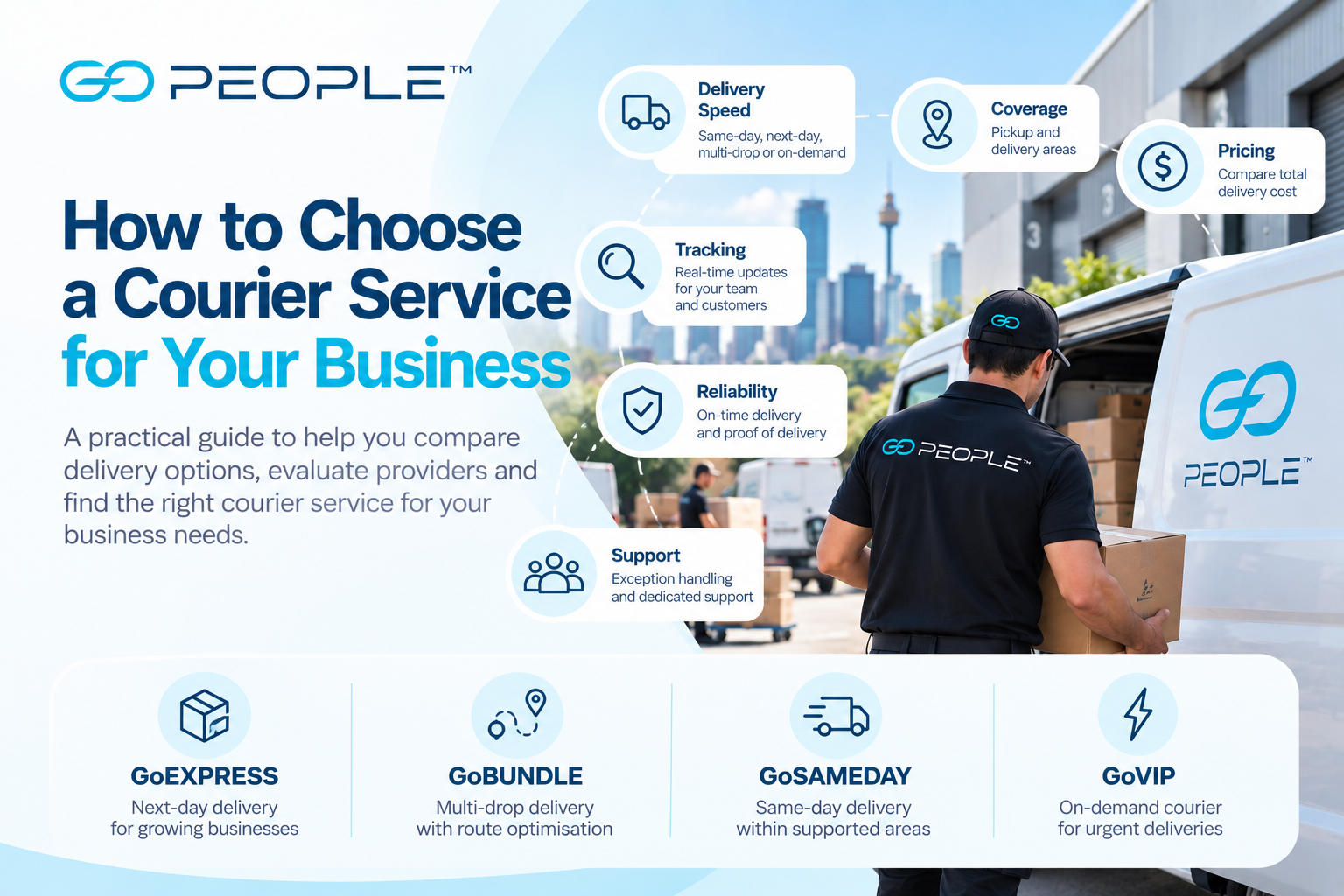
Choosing a courier service for your business is about much more than finding the lowest delivery price.
The right delivery provider needs to fit how your business actually operates: what you send, where orders originate, where customers are located, how quickly deliveries need to arrive and how much visibility your team and customers need along the way.
A retailer dispatching hundreds of ecommerce parcels has very different requirements from a florist making 30 local deliveries, or a business occasionally sending an urgent document across Sydney.
Before comparing courier companies, start by understanding your own delivery profile.
This guide explains the key factors Australian businesses should consider when choosing a courier or delivery service.
Start With Your Delivery Requirements
Before requesting quotes, document what your business actually needs.
At minimum, understand:
- average number of deliveries
- peak delivery volume
- pickup locations
- customer locations
- parcel sizes and weights
- delivery frequency
- required delivery speeds
- typical order value
- business vs residential destinations
- special handling requirements
- customer delivery expectations
This immediately makes comparisons more meaningful.
A provider may offer an excellent service but still be the wrong fit for your particular delivery profile.
1. Understand Your Delivery Volume
Start with volume.
How many deliveries do you make:
- per day?
- per week?
- per month?
- during peak periods?
Then look at how consistent that volume is.
A business making 100 deliveries every weekday has different requirements from one that normally sends five parcels but occasionally needs 200 deliveries after a promotion.
Think about both:
Average volume and peak volume.
A delivery solution needs to work when you’re busy, not only on an average Tuesday.
2. Understand Where Your Orders Start
Pickup location matters.
Ask:
Where are orders physically located when they’re ready for delivery?
That might be:
- one warehouse
- several warehouses
- retail stores
- offices
- fulfilment centres
- multiple branches
Some delivery services have specific pickup areas.
Others may be more flexible.
Don’t assume that because a provider delivers to a suburb, it necessarily collects from your warehouse location using every service it offers.
Confirm pickup eligibility before making a decision.
3. Map Where Your Customers Are
Next, examine delivery destinations.
You may discover that:
- most customers are concentrated in metro areas
- a large proportion are within one city
- deliveries are spread nationally
- particular suburbs dominate your order volume
- business customers are concentrated in commercial areas
This information can influence which delivery model makes sense.
A business with dense local deliveries may benefit from a different solution than a business sending isolated parcels across Australia.
4. Decide How Fast Deliveries Actually Need to Be
Faster isn’t automatically better.
It is usually more useful to ask:
How quickly does the customer genuinely need this order?
Different requirements might include:
Next-Day Delivery
Suitable where customers expect the order the following day and the business can prepare orders according to the applicable collection and cut-off requirements.
Same-Day Delivery
Useful when the order genuinely needs to arrive on the same day.
Multi-Drop Delivery
Useful when a business has many deliveries leaving a common pickup point and wants them organised into a delivery route.
On-Demand Courier
Useful for urgent, time-sensitive or individual delivery requirements.
The correct service depends on the job.
Our guide to same-day vs next-day delivery explains the differences in more detail.
5. Don’t Pay for Speed You Don’t Need
Businesses sometimes default to the fastest service available.
That can increase costs unnecessarily.
For example, an ecommerce customer who orders on Monday afternoon may be perfectly satisfied receiving the parcel on Tuesday.
There may be little benefit in paying for an urgent courier service if next-day delivery meets the customer’s expectation.
Likewise, an urgent replacement required that afternoon shouldn’t automatically be placed into a slower delivery process.
Match the service to the requirement.
6. Compare Pickup and Delivery Coverage Carefully
“Coverage” can mean different things.
A provider may:
- pick up only from certain areas
- deliver to a broader area
- offer different services in different cities
- have postcode restrictions
- apply different cut-offs by service
Ask specific questions.
Instead of:
“Do you deliver in Melbourne?”
ask:
“Can you collect from our warehouse postcode and deliver to the postcodes where our customers are located using the service we need?”
That produces a much more useful answer.
For GoPeople, businesses can use the service eligibility checker to check which services are available for their location.
7. Check Delivery Cut-Off Times
A next-day service isn’t useful if your warehouse cannot meet the required collection or booking cut-off.
Compare delivery providers against your actual fulfilment workflow.
Ask:
- When must orders be ready?
- When are bookings required?
- When does collection occur?
- What happens to orders booked after cut-off?
- Are cut-offs different by location or service?
Then compare those requirements with your own:
Order received → Pick → Pack → Label → Ready for collection
Delivery and warehouse operations need to work together.
8. Evaluate Reliability, Not Just Advertised Speed
A delivery provider may advertise a particular delivery timeframe.
The more important question is:
How consistently can the service meet the timeframe relevant to your business?
Look at your own delivery data where possible.
Monitor:
- on-time deliveries
- late deliveries
- failed deliveries
- redeliveries
- customer complaints
- missing parcels
- damaged items
A service that looks inexpensive on a rate card may become expensive if poor performance creates additional operational costs.
9. Look for Useful Real-Time Tracking
Tracking has become an important part of the delivery experience.
Customers increasingly expect to know what is happening after an order leaves the warehouse.
Useful tracking can help customers understand:
- whether an order has been dispatched
- its current delivery status
- whether delivery is in progress
- whether an exception has occurred
- whether delivery has been completed
Tracking is also valuable internally.
Your customer-service team can access delivery information without relying entirely on phone calls or manual enquiries.
Learn more in our guide to real-time delivery tracking.
10. Check Customer Notifications
Tracking is more useful when customers know where to find it.
Ask how recipients are kept informed.
Depending on the service, notifications might include:
- booking confirmation
- dispatch notification
- tracking link
- delivery updates
- completion notification
The exact communication model will vary between providers.
What’s important is understanding the experience your customer receives.
Remember: the delivery provider may physically perform the delivery, but the customer often associates that experience with your brand.
11. Examine Proof of Delivery
Proof of delivery can become particularly important when a customer says:
“I didn’t receive my order.”
Ask what information is available after completion.
Depending on the provider and service, proof of delivery might include:
- completion status
- timestamp
- photograph
- signature where applicable
- other delivery information
The purpose isn’t simply to prove the customer wrong.
Good delivery records help businesses investigate what happened and resolve disputes more efficiently.
12. Understand What Happens When Delivery Fails
Successful deliveries are easy.
The quality of a delivery operation becomes particularly important when something goes wrong.
Ask prospective providers:
What happens after an unsuccessful delivery attempt?
Understand:
- how the event is recorded
- what the recipient sees
- whether your team is notified
- whether redelivery is available
- how long redelivery may take
- whether additional fees apply
- what happens if the item cannot be delivered
- how returns to sender are handled
Don’t wait until the first failed delivery to discover the process.
13. Look at Exception Management
Not every delivery problem is a failed attempt.
Exceptions can include:
- incorrect addresses
- access problems
- recipient unavailable
- delays
- missing items
- damaged parcels
- delivery disputes
Ask how these situations are investigated and resolved.
The important factors include:
- visibility
- communication
- escalation
- evidence
- resolution process
A low delivery rate is less attractive if your staff spend hours chasing information every time something goes wrong.
14. Evaluate Customer Support
Delivery technology matters, but businesses still need support when unusual situations occur.
Ask:
- How do we contact support?
- When is support available?
- Can our team speak to someone who understands business deliveries?
- How are investigations handled?
- How are urgent problems escalated?
- Can support access tracking and delivery information?
You can learn a great deal about a provider by testing the support experience before signing a major agreement.
15. Consider Your Customer-Service Team
The courier isn’t the only team handling delivery questions.
Your own support staff may receive:
“Where is my order?”
“Why is it late?”
“It says delivered but I can’t find it.”
“Can I change the address?”
A good delivery setup should make these questions easier to resolve.
Consider whether your team can access the information they need without:
- calling the courier
- sending emails
- waiting for manual updates
- switching between multiple systems
Delivery visibility can reduce the operational burden on your internal team.
16. Compare Technology and Integrations
For businesses making occasional deliveries, manual booking may be sufficient.
At higher volumes, integrations become more important.
Depending on your operation, you may need connections with:
- ecommerce platforms
- order-management systems
- warehouse systems
- APIs
- internal business software
Ask:
- Can orders be created automatically?
- Can delivery statuses flow back into our systems?
- Can tracking information be passed to customers?
- Is bulk booking available?
- What technical support is available?
A process that works for 10 orders may become painful at 1,000.
17. Think About Scalability
Your current delivery volume isn’t necessarily your future volume.
Consider what happens if:
50 deliveries per day become 200.
Or:
one warehouse becomes three.
Or:
Sydney expands into Melbourne and Brisbane.
Ask whether the delivery setup can scale without forcing your team to rebuild the entire workflow.
Scalability isn’t only about whether the courier has enough drivers.
It also involves:
- booking
- integrations
- reporting
- billing
- customer support
- operational processes
18. Consider Multi-Drop Delivery for Multiple Orders
Businesses making many deliveries from one pickup location should consider whether booking every order independently is the most efficient model.
A multi-drop service can group multiple destinations into a planned route.
This may be useful for:
- florists
- retailers
- bakeries
- wholesalers
- local ecommerce
- business suppliers
- businesses with recurring delivery runs
GoPeople’s GoBUNDLE is designed for businesses making multiple deliveries from a common pickup point.
Our route optimisation guide explains why route planning matters for multi-drop operations.
19. Understand Parcel Restrictions
Before choosing a provider, make sure it can actually transport what you sell.
Consider:
- dimensions
- weight
- fragility
- packaging
- prohibited goods
- dangerous goods
- temperature requirements
- special handling
Do not assume that a general courier service is appropriate for every product.
For regulated, hazardous, temperature-controlled or specialist goods, confirm the applicable requirements directly with the provider before booking.
20. Look at Packaging Requirements
Courier performance and packaging are connected.
Even a good delivery operation cannot compensate for unsuitable packaging.
Ask whether the provider has:
- maximum dimensions
- weight restrictions
- labelling requirements
- packaging requirements
Then design fulfilment processes around those requirements.
For fragile products, see our guide on how to pack and deliver fragile items safely.
21. Compare Pricing Properly
Courier pricing can be difficult to compare because providers may structure charges differently.
Potential components can include:
- base delivery fee
- distance
- weight
- parcel dimensions
- delivery speed
- fuel-related charges
- redelivery
- waiting time
- additional handling
- account fees
- other service charges
Don’t compare one headline number.
Build several realistic delivery scenarios from your own order data and ask providers to price those.
That gives you a more meaningful comparison.
22. Look Beyond the Cheapest Delivery Price
Suppose:
Provider A = $8 per delivery
Provider B = $10 per delivery
Provider A looks cheaper.
But imagine Provider A also creates more:
- late deliveries
- failed deliveries
- support enquiries
- replacements
- refunds
- redeliveries
The true cost may be higher.
Our guide to the real cost of late deliveries explains why businesses should consider downstream costs as well as the original courier charge.
The relevant question is:
What is our total cost of delivering an order successfully?
23. Understand Fuel and Other Variable Charges
Ask how pricing can change.
For example:
- Are there fuel-related charges?
- How often can they change?
- Are there distance charges?
- Are there peak-period fees?
- Are there waiting fees?
- Are redelivery charges separate?
You want to understand not only today’s quoted rate but also how invoices are calculated.
This makes budgeting and provider comparisons easier.
24. Check Billing and Reporting
High-volume delivery operations can create large invoices.
Ask whether reporting allows you to understand:
- individual jobs
- delivery charges
- surcharges
- failed deliveries
- service types
- dates
- customer references
Good reporting makes it easier for finance and operations teams to reconcile costs.
It can also help identify where delivery spending is increasing.
25. Consider Contract Flexibility
Before signing a long-term agreement, understand:
- minimum volumes
- minimum spend
- notice periods
- price-review mechanisms
- service commitments
- exclusivity
- termination conditions
A delivery arrangement should fit the business’s likely future requirements, not just today’s volume.
For material contracts, have the terms reviewed appropriately before signing.
26. Review Claims and Liability
Businesses should understand what happens if an item is:
- lost
- damaged
- misdelivered
Ask about:
- claims process
- evidence required
- exclusions
- liability limits
- applicable insurance arrangements
- time limits
These conditions can vary considerably.
Read the provider’s current terms rather than assuming all courier services handle claims in the same way.
27. Check How Returns Are Handled
Delivery doesn’t always end at the customer’s door.
Ecommerce businesses may also need:
- customer returns
- failed-delivery returns
- return to sender
- exchanges
Ask how these processes work operationally.
A delivery provider that works well outbound but creates significant complexity for returns may not be the best overall fit.
28. Consider Customer Experience
Customers don’t necessarily think:
“The courier company was late.”
They may think:
“The retailer delivered my order late.”
Delivery is therefore part of your customer experience.
Consider:
- tracking quality
- communication
- delivery reliability
- proof of delivery
- exception handling
- ease of getting help
Our guide on improving the customer delivery experience explores this further.
29. Check Whether the Provider Fits Your Brand Promise
Different businesses make different promises.
A premium retailer may prioritise:
- visibility
- reliability
- communication
A high-volume ecommerce business may prioritise:
- scalability
- cost efficiency
- integrations
A local florist may prioritise:
- multi-drop route efficiency
- careful handling
- delivery timing
An urgent B2B service may prioritise:
- rapid pickup
- direct delivery
- visibility
The courier should support the promise you’re making to customers.
30. Don’t Choose a Provider Based on One Test Delivery
A single successful delivery tells you very little.
If possible, evaluate a meaningful sample.
Test:
- different suburbs
- different days
- residential addresses
- business addresses
- normal volumes
- higher volumes
- different service types
Then measure the results.
A provider should be evaluated on repeatable performance, not one ideal transaction.
Questions to Ask a Courier Provider
Before choosing a provider, ask questions such as:
- Can you collect from our warehouse or business locations?
- Which customer locations can you deliver to?
- What delivery services are available?
- What are the booking and pickup cut-offs?
- How is pricing calculated?
- What additional charges can apply?
- What tracking does our team receive?
- What tracking does the customer receive?
- What proof of delivery is available?
- What happens after a failed delivery?
- How are lost or damaged items investigated?
- How do redeliveries work?
- What support channels are available?
- What integrations do you support?
- Can the service scale during peak periods?
- What reporting is available?
- What parcel restrictions apply?
- What are the claims and liability conditions?
- How are returns handled?
- Are there minimum-volume or contract commitments?
The answers should be documented wherever possible.
Courier Comparison Checklist
A simple comparison table can help businesses avoid choosing on price alone.
| Factor | Provider A | Provider B | Provider C |
|---|---|---|---|
| Pickup coverage | |||
| Delivery coverage | |||
| Next-day option | |||
| Same-day option | |||
| Multi-drop option | |||
| On-demand option | |||
| Cut-off times | |||
| Tracking | |||
| Customer notifications | |||
| Proof of delivery | |||
| Failed-delivery process | |||
| Redelivery process | |||
| Support | |||
| Integrations | |||
| Reporting | |||
| Parcel restrictions | |||
| Pricing | |||
| Additional charges | |||
| Contract requirements | |||
| Claims process |
You can then weight the factors that matter most to your operation.
Warning Signs When Choosing a Courier
Price alone shouldn’t determine the decision.
Be cautious if you cannot get clear answers about:
Pricing
You should understand how charges are calculated.
Coverage
“Metro delivery” isn’t enough if nobody can confirm whether your actual pickup and delivery postcodes qualify.
Failed Deliveries
There should be a clear process for exceptions.
Tracking
Your team should understand what visibility is available.
Support
You should know how to get help when something goes wrong.
Restrictions
The provider should be able to explain what it can and cannot carry.
Terms
Important commercial conditions shouldn’t be a surprise after you begin using the service.
Unclear answers before you become a customer may become bigger problems after you start sending significant volume.
Should You Use One Courier or Multiple Providers?
Some businesses use one provider.
Others use several.
One Provider
Potential advantages include:
- simpler integrations
- simpler billing
- consistent processes
- fewer systems
But relying on one provider may reduce flexibility if your delivery requirements vary substantially.
Multiple Providers
Different providers can be used for:
- different cities
- different delivery speeds
- specialist products
- overflow
- urgent jobs
But this creates additional operational complexity.
The best approach depends on the business.
The goal isn’t to have the fewest or most providers.
It is to create a delivery setup that works reliably without unnecessary complexity.
How GoPeople’s Delivery Services Differ
GoPeople provides several delivery options for businesses in supported areas.
GoEXPRESS — Next-Day Delivery
GoEXPRESS is designed for businesses requiring next-day parcel delivery, including ecommerce retailers and 3PL operations.
GoBUNDLE — Multi-Drop Delivery
GoBUNDLE is designed for businesses that have multiple deliveries leaving from a common pickup point and need an optimised delivery route.
GoSAMEDAY — Same-Day Delivery
GoSAMEDAY is designed for business deliveries that need to be completed on the same day within supported service areas.
GoVIP — On-Demand Courier
GoVIP is designed for urgent and time-sensitive individual courier requirements.
Businesses can check GoPeople service availability for their pickup location.
A Practical Decision Framework
Before making the final decision, work through these five stages.
Step 1: Define Your Delivery Profile
Document:
Volume + Pickup locations + Destinations + Parcel profile + Delivery speed
Step 2: Define Must-Have Requirements
For example:
Tracking + POD + Integration + Same-day capability
Separate genuine requirements from nice-to-have features.
Step 3: Compare Total Cost
Include:
Delivery price + Variable charges + Failed-delivery costs + Internal administration
Step 4: Test the Service
Run enough deliveries to assess normal operational performance.
Step 5: Review the Data
Compare:
- on-time performance
- delivery failures
- support enquiries
- cost
- customer complaints
- operational workload
Then make the decision based on how the service performs for your business.
Frequently Asked Questions About Choosing a Courier Service
How do I choose a courier service for my business?
Start by defining your delivery volume, pickup locations, customer destinations, parcel profile and required delivery speed. Then compare providers on coverage, reliability, tracking, proof of delivery, exception handling, support, integrations and total cost.
Should I choose the cheapest courier?
Not necessarily. The lowest delivery rate can become more expensive if it results in additional failed deliveries, redeliveries, customer support, replacements or refunds. Compare the total cost of successful delivery.
What’s the difference between same-day and next-day delivery?
Same-day delivery is designed to complete the delivery on the day of booking, while next-day delivery is designed for delivery the following day, subject to the applicable service requirements. The appropriate choice depends on customer urgency and operational needs.
What tracking features should a business courier provide?
Useful tracking can include delivery status, progress information, customer tracking and completion information. The exact features vary between services, so businesses should confirm what their team and recipients will actually receive.
What should happen if a courier cannot complete the delivery?
The provider should have a clear failed-delivery process. Businesses should understand how the event is recorded, how recipients are notified, whether redelivery is available, what fees may apply and what ultimately happens to the parcel.
Should my business use more than one courier company?
It depends on your requirements. One provider can simplify operations, while multiple providers can provide flexibility across different locations, delivery speeds or specialist requirements. Additional providers also create more systems and processes to manage.
What should I test before signing a courier contract?
Test real deliveries across representative locations, delivery types and volumes. Review tracking, customer communication, delivery performance, proof of delivery, support, invoicing and exception handling rather than judging the service from a single delivery.