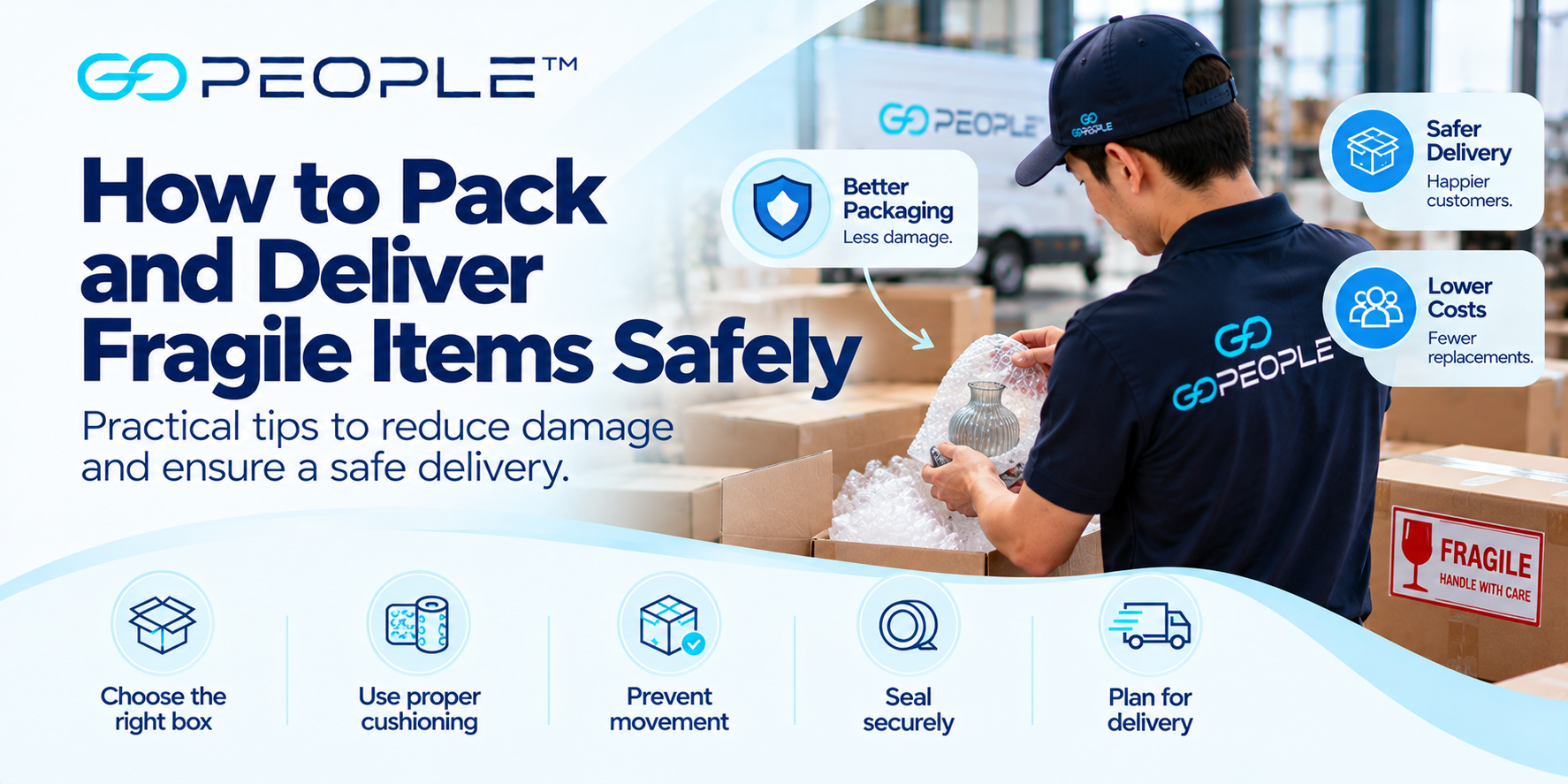
Fragile products create a particular challenge for businesses.
The product needs to survive packing, handling, loading, transport and final delivery without being damaged. A box that looks secure on a warehouse bench may behave very differently once it is moved through a real delivery operation.
Good fragile-item delivery therefore starts before the courier arrives.
Here are practical ways businesses can reduce the risk of damage during delivery.
1. Choose a Box That Fits the Product
Start with packaging that is appropriate for the item’s size, weight and shape.
A box that is too large allows the product to move around during transport.
A box that is too small may not leave enough room for protective material.
Ideally, the package should provide enough space to cushion the item without creating excessive empty space.
For particularly fragile products, a strong corrugated cardboard box may provide more protection than a lightweight mailer or thin carton.
2. Protect the Item, Not Just the Box
The outer box is only the first layer of protection.
Fragile products may need to be individually protected using appropriate materials such as:
- paper cushioning
- corrugated inserts
- moulded inserts
- protective sleeves
- bubble cushioning where appropriate
- foam or other specialist protective materials
The appropriate material depends on the product.
Glassware, electronics, artwork and ceramics all have different vulnerabilities.
3. Prevent Movement Inside the Package
One of the most important packaging tests is simple:
Can the product move significantly inside the box?
Movement increases the chance that an item will strike the side of the package or another product during transport.
Use appropriate cushioning or inserts to keep the item securely positioned.
If several fragile items are packed together, consider separating them so they cannot collide with one another.
4. Protect Vulnerable Areas
Some products have particular weak points.
Examples might include:
- corners
- handles
- screens
- glass surfaces
- protruding components
- decorative elements
These areas may require additional protection.
Don’t assume that wrapping the entire product uniformly provides enough protection for its most vulnerable parts.
5. Use Strong Packaging for Heavy Fragile Items
Fragile doesn’t always mean lightweight.
A heavy fragile item creates additional forces when the package is moved, lifted or stopped suddenly.
The packaging needs to support both the fragility and the weight of the product.
Check that:
- the box is sufficiently strong
- the base is properly secured
- cushioning won’t collapse under the product’s weight
- the package can be safely lifted and handled
If an item requires special handling because of its weight or dimensions, make that part of the delivery planning rather than relying solely on a fragile label.
6. Seal the Package Properly
Once the product is protected, the package needs to remain closed throughout the journey.
Use packaging tape appropriate for the weight and construction of the box.
Pay particular attention to seams and the bottom of heavier packages.
A carefully cushioned product won’t remain protected if the box opens during handling.
7. Use Fragile Labels as a Reminder — Not as Packaging
A FRAGILE or HANDLE WITH CARE label can communicate useful information.
But it isn’t a substitute for proper packaging.
Packages still need to be prepared to withstand normal handling and transport.
Businesses should package fragile goods on the assumption that the item will be picked up, carried, loaded, transported and unloaded during the delivery journey.
8. Think About How the Item Will Travel
The delivery method matters.
A fragile item travelling directly from one business to a nearby customer has a different journey from a parcel passing through a sorting and delivery network.
Before choosing the delivery option, consider:
- product fragility
- package dimensions
- value
- distance
- required delivery timeframe
- number of handling stages
- whether special handling is required
Particularly unusual, high-value or extremely delicate items may require a specialised transport solution rather than a standard parcel service.
9. Secure Fragile Items During Vehicle Transport
Good packaging is important, but packages also need to be loaded appropriately.
Fragile parcels shouldn’t be placed where they are likely to:
- fall
- slide significantly
- be crushed by heavier goods
- have other items fall onto them
For businesses operating their own delivery vehicles, loading procedures should take product weight and fragility into account.
10. Check the Delivery Address and Instructions
Even perfect packaging can’t prevent every delivery problem.
Before dispatch, make sure you have:
- the correct address
- unit or suite number where relevant
- recipient contact information
- appropriate delivery instructions
- relevant access information
Avoidable address problems can lead to additional handling, delays or redelivery — all of which mean the fragile package spends longer in the delivery process.
11. Consider the Customer Handover
Think about what should happen at the destination.
For some fragile or valuable products, leaving the package unattended may not be appropriate.
The appropriate delivery arrangement depends on the product and the service being used.
Businesses should determine their delivery requirements before booking rather than assuming every package should be handled in the same way.
12. Test Your Packaging
If your business regularly sends the same fragile products, don’t wait for customer complaints to discover whether the packaging works.
Test the packaging process.
Review:
- damaged-delivery rates
- customer complaints
- where damage is occurring
- packaging materials
- box dimensions
- product movement
- returns and replacements
If a particular product is repeatedly damaged, investigate the packaging and fulfilment process rather than treating every incident as unrelated.
The Cost of Damaged Deliveries
Damage creates more than the cost of the product.
A damaged order can result in:
replacement product + additional packaging + another delivery + customer support + potential refund + customer dissatisfaction.
For businesses sending significant order volumes, reducing damage rates can therefore improve both customer experience and operational efficiency.
Choosing a Delivery Service for Fragile Products
Different delivery requirements call for different delivery models.
For supported products and locations, GoPeople offers:
GoEXPRESS for next-day business parcel delivery from customer warehouses in Sydney, Melbourne and Brisbane.
GoBUNDLE for multiple deliveries organised into an optimised delivery run.
GoSAMEDAY for same-day business deliveries.
GoVIP for urgent on-demand courier requirements.
Before sending particularly fragile, unusually shaped, high-value or specialist goods, businesses should confirm that the item is suitable for the relevant delivery service.
You can also check GoPeople service availability for your pickup location.
Safe Delivery Starts With Good Preparation
A courier can transport a package carefully, but safe delivery starts with the way the product is prepared.
The most effective approach is to combine:
appropriate packaging + internal protection + secure loading + accurate delivery information + the right delivery service.
For businesses that regularly send fragile products, treating packaging and delivery as one connected process can help reduce damage, replacements and unnecessary customer-service work.