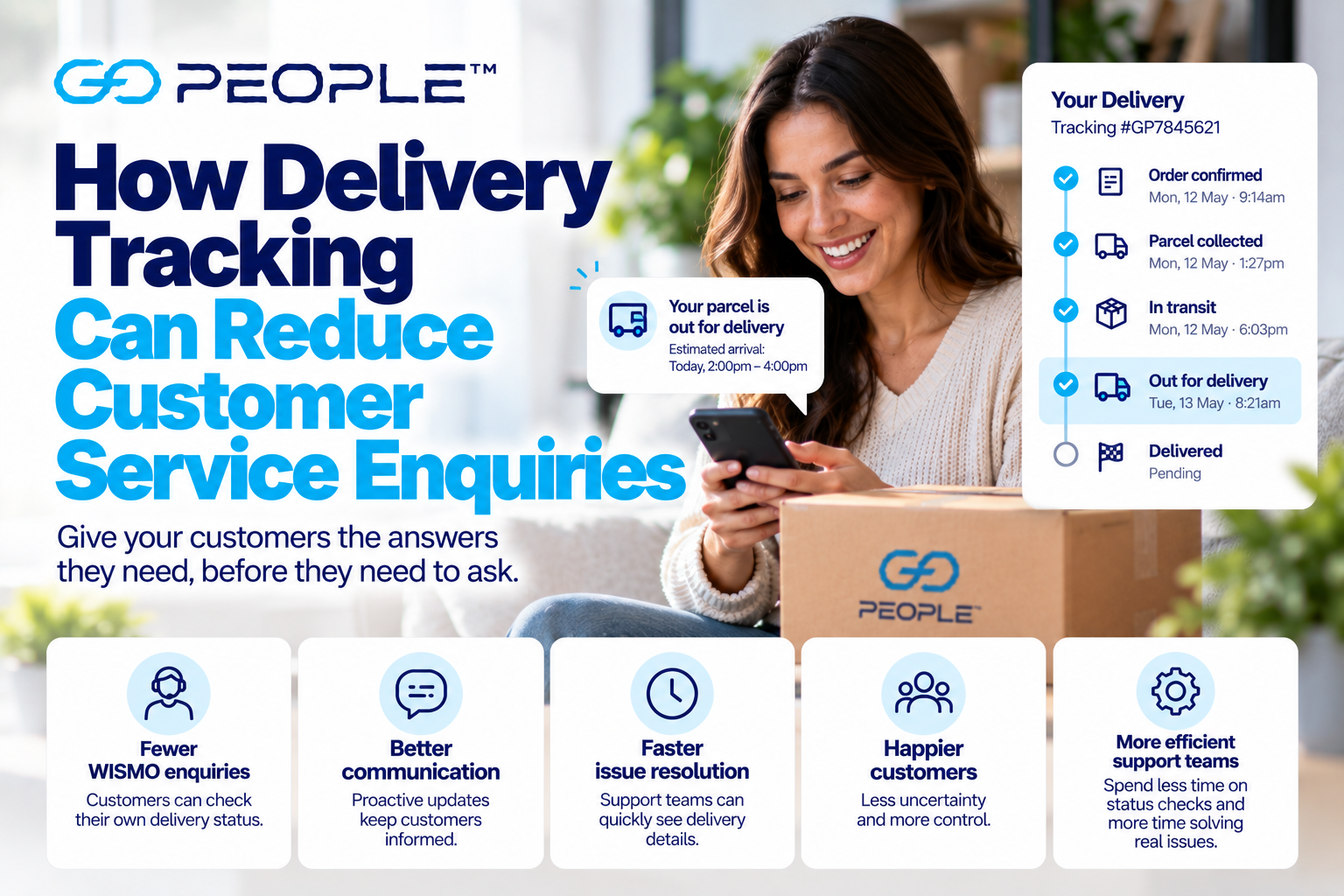
Customer service teams often spend a surprising amount of time answering one simple question:
“Where is my order?”
In ecommerce and business delivery, these enquiries are often called WISMO — “Where Is My Order?” enquiries.
The customer may not have a problem with the delivery itself. They may simply lack enough information to understand what is happening.
Has the parcel left the warehouse?
Has the courier collected it?
Is it out for delivery?
Has something gone wrong?
Was it already delivered?
Without accessible delivery information, the customer has little choice but to contact the business.
That creates work for the customer and the support team.
Good delivery tracking can change this by giving customers useful information before they need to ask for it. It can also give support teams better information when genuine delivery problems occur.
The objective is not to eliminate customer service.
It is to make delivery information self-service where possible and support more effective when it is needed.
Why Delivery Creates So Many Customer Enquiries
Online shopping creates a visibility gap.
Before checkout, customers can see:
- products;
- prices;
- availability;
- reviews; and
- their shopping cart.
After payment, much of that visibility can disappear.
The physical order begins moving through fulfilment and delivery systems that the customer cannot see.
If the only message they receive is:
Your order has been shipped.
they may have no idea what happens next.
As the expected delivery approaches, uncertainty increases.
Eventually, they contact support.
What Is a WISMO Enquiry?
WISMO stands for:
Where Is My Order?
It describes customer enquiries asking about the location, status or expected arrival of an order.
Common questions include:
- Where is my parcel?
- Has my order been dispatched?
- Has the courier collected it?
- Is it coming today?
- What time will it arrive?
- Why hasn’t tracking changed?
- It says delivered — where is it?
- What happens after a failed delivery?
- When will delivery be attempted again?
Some of these are routine status questions.
Others indicate a genuine delivery exception.
Good tracking helps distinguish between the two.
Why WISMO Enquiries Matter to Businesses
One enquiry may take only a few minutes.
At scale, those minutes add up.
Imagine an ecommerce business receives:
100 delivery-status enquiries per day
and each one takes an average of:
5 minutes
That represents:
500 minutes of support work per day
or more than eight hours.
The precise cost will vary by business, but the principle is important.
Every routine delivery question that customers can answer themselves potentially reduces unnecessary support workload.
Tracking Should Answer the Customer’s Next Question
A tracking page should not merely display data.
It should help the customer understand:
What is happening now, and what happens next?
For example, a status such as:
Processing
may be technically accurate but not particularly useful.
The customer may still wonder:
- Has it left the warehouse?
- Is there a problem?
- When will it move?
- When should I expect delivery?
Tracking becomes more valuable when statuses are understandable to ordinary customers.
The Delivery Journey Customers Need to Understand
The exact statuses vary by delivery service, but a customer journey may broadly include:
Order received
↓
Order prepared
↓
Delivery booked
↓
Parcel collected
↓
In transit / processing
↓
Out for delivery
↓
Delivered
or:
Delivery exception
The important point is not to show as many statuses as possible.
It is to show the customer enough information to understand the delivery journey.
Self-Service Tracking Reduces Information Friction
Without tracking, a customer may need to:
- find the retailer’s contact details;
- send an email or call;
- provide an order number;
- wait for support;
- have support check another system; and
- receive the answer.
With useful tracking, the same customer may be able to open a link and see the relevant information immediately.
That is better for both sides.
The customer gets a faster answer.
The support team can focus on issues that genuinely require human assistance.
Tracking Does Not Need to Eliminate Every Enquiry
This is an important distinction.
A tracking system cannot resolve every delivery problem.
Customers may still need support when:
- tracking has not updated;
- an address is wrong;
- delivery was unsuccessful;
- a parcel appears missing;
- a delivery is disputed;
- the parcel was delivered to the wrong location;
- access prevented delivery; or
- the customer does not understand what happens next.
The objective is therefore:
reduce avoidable enquiries + improve the quality of necessary enquiries
Both create operational value.
Proactive Notifications Can Prevent Questions Before They Start
Tracking is reactive if the customer has to remember to check it.
Notifications can make the experience proactive.
Depending on the delivery process, useful updates might tell the customer when:
- the order has been dispatched;
- the parcel has been collected;
- delivery is underway;
- delivery has been completed; or
- an important exception occurs.
The customer does not need to wonder whether anything has changed.
The business tells them.
Don’t Send Notifications That Add No Value
More notifications are not automatically better.
Imagine receiving messages saying:
- Order received.
- Order processing.
- Processing updated.
- Shipment information received.
- Delivery information processed.
- Parcel status updated.
The customer may still have no idea when the parcel is arriving.
Notifications should answer useful questions.
Before sending one, ask:
What does the customer learn from this message?
If the answer is unclear, the notification may simply create noise.
Explain Delivery Statuses in Customer Language
Internal logistics terminology is not always suitable for customers.
A delivery system may contain operational codes that make perfect sense to warehouse or transport teams but mean little to recipients.
Customer-facing tracking should translate relevant information into understandable language.
Instead of forcing customers to decode technical statuses, explain what the status means and, where appropriate, what is expected next.
This can reduce unnecessary confusion.
Tracking Can Improve Support Even When the Customer Calls
Suppose a customer says:
“My parcel hasn’t arrived.”
Without delivery visibility, the support agent may need to contact multiple people before giving an answer.
With useful tracking information, the agent may be able to immediately see:
- current status;
- recent delivery events;
- timestamps;
- whether delivery was attempted;
- whether delivery was completed; and
- proof of delivery where available.
That can make support faster and more consistent.
Give Support Teams Access to the Same Delivery Story
Problems arise when the customer sees one thing while support sees something completely different.
For example:
Customer: “Tracking says it’s out for delivery.”
Support: “Our order system says dispatched.”
Warehouse: “It left yesterday.”
Now three systems appear to tell three different stories.
Where practical, customer-service teams should have access to the relevant delivery information and understand how statuses relate to the customer-facing tracking experience.
This creates a more coherent response.
Tracking Links Should Be Easy to Find
Excellent tracking is not useful if customers cannot find it.
Consider placing tracking access in appropriate customer touchpoints such as:
- dispatch emails;
- SMS notifications;
- customer accounts;
- order-status pages; or
- other relevant communications.
Avoid making customers search the website for a generic tracking page and manually work out which number to enter if a direct tracking link can be provided.
Reducing steps improves self-service.
Tracking Should Work Well on Mobile
Many customers check delivery information from their phones.
A tracking experience should therefore be easy to use on a small screen.
Important information should not require:
- excessive zooming;
- horizontal scrolling;
- navigating multiple menus; or
- reading tiny text.
Customers may be checking tracking while:
- commuting;
- at work;
- away from home; or
- preparing to receive the delivery.
Mobile usability matters.
Real-Time Tracking Reduces Uncertainty
Traditional tracking often tells customers what happened previously.
Modern delivery visibility can also help them understand what is happening now.
Depending on the delivery service, customers may receive information about:
- delivery progress;
- current status;
- whether the delivery is underway;
- expected delivery information; and
- completion.
This reduces the uncertainty between dispatch and delivery.
For more detail, see Why Real-Time Tracking Matters for Online Shopping.
ETA Information Can Reduce “When Will It Arrive?” Enquiries
A customer may already know that their parcel is coming today.
Their next question is:
“When today?”
Where available and sufficiently reliable, estimated arrival information can provide additional visibility.
However, businesses should distinguish between:
ETA
and:
guaranteed arrival time
An ETA can change as the route progresses because of:
- traffic;
- previous delivery times;
- road conditions;
- access problems; and
- route changes.
Presenting an estimate as an exact promise can create more complaints rather than fewer.
Explain When an ETA Is an Estimate
Customers may interpret:
ETA 2:15 pm
as:
The driver will arrive at exactly 2:15 pm.
If the driver arrives at 2:45 pm, they may believe the delivery is late.
Clear wording such as:
Estimated arrival
helps establish the correct expectation.
Tracking should increase certainty without creating false precision.
Delivery Windows Can Also Reduce Enquiries
Sometimes customers do not need an exact ETA.
They simply want to know whether they need to be available in the morning or afternoon.
A useful delivery window can provide enough certainty while allowing greater routing flexibility.
For businesses considering scheduled delivery windows, see Time-Slot Delivery: How Delivery Windows Work for Businesses.
Tracking Becomes Most Valuable When Something Goes Wrong
When delivery is proceeding normally, customers may barely think about tracking.
Its real value often becomes apparent during an exception.
Examples include:
- unsuccessful delivery;
- access problem;
- address issue;
- delayed delivery;
- parcel redirected;
- delivery disputed; or
- missing parcel.
At that point, the customer wants to understand:
What happened?
and:
What happens next?
Good delivery visibility can help support teams answer both questions.
Exception Statuses Need More Explanation Than Normal Statuses
A status such as:
Delivered
is relatively straightforward.
A status such as:
Delivery unsuccessful
creates immediate questions:
- Why?
- Is my parcel safe?
- Will the driver try again?
- Do I need to do something?
- Who should I contact?
- When will it arrive?
Businesses should pay particular attention to the information provided around abnormal delivery events.
This is where customer anxiety and support demand can increase quickly.
Failed Delivery Information Should Explain the Next Step
Suppose tracking only says:
Delivery failed.
That describes the past.
It does not help the customer understand the future.
Where the relevant process is known, support content should help customers understand what normally happens next and whether any action is required.
This can reduce repeated calls asking the same question.
For broader prevention strategies, see How to Reduce Failed Deliveries and Improve First-Attempt Delivery Success.
Proof of Delivery Can Resolve “It Says Delivered” Enquiries
One of the most common delivery disputes is:
“Tracking says delivered, but I don’t have it.”
Proof of delivery can provide additional information for investigation.
Depending on the service, this may include:
- delivery timestamp;
- photograph;
- signature; or
- other completion records.
Support teams can use this information to help determine what happened.
See What Is Proof of Delivery and Why Does It Matter? for a detailed guide.
Proof of Delivery Does Not Mean Every Dispute Is Automatically Resolved
A delivery record is evidence that can support an investigation.
It does not mean the customer should simply be told:
“It says delivered, case closed.”
Possible issues can still include:
- wrong-address delivery;
- wrong unit;
- unexpected safe location;
- another person accepting the parcel; or
- customer being unable to identify the delivery location.
Good support uses proof of delivery as part of the investigation rather than as a substitute for investigation.
Tracking Can Help With Missing-Parcel Investigations
When a parcel appears to be missing, tracking events can help identify the last known stage.
For example:
Booked → Collected → Processed → ?
is different from:
Booked → Collected → Out for delivery → Delivered
The investigation should follow the available evidence.
For prevention strategies, see How to Prevent Lost Parcels During Delivery.
For customer-facing guidance after something goes missing, see What to Do When Your Package Goes Missing.
Tracking Can Reduce Internal Support Escalations
Customer support may not always need to escalate an enquiry to operations.
If the tracking information clearly answers:
- current delivery status;
- last event;
- completion status; and
- relevant next step,
the support agent may be able to resolve the enquiry directly.
That can reduce:
- internal messages;
- calls to drivers;
- warehouse interruptions;
- duplicated investigations; and
- response time.
This is an important operational benefit.
Avoid Calling Drivers for Routine Status Checks
Direct driver contact may sometimes be necessary.
But if every WISMO enquiry requires someone to call the driver, the system does not scale well.
Drivers need to focus on driving and completing deliveries.
A better information flow is:
Delivery system → tracking → customer/support
with driver escalation reserved for situations that genuinely require it.
This can reduce distractions and operational interruptions.
Create a Support Workflow Around Tracking
A simple delivery-enquiry workflow might be:
Step 1: Identify the Delivery
Obtain the relevant tracking or delivery reference.
Step 2: Check Current Status
Review the latest delivery information.
Step 3: Check Recent Events
Determine what has happened so far.
Step 4: Check Proof of Delivery
If the parcel is marked delivered, review available completion information.
Step 5: Identify an Exception
Determine whether the delivery is progressing normally or needs investigation.
Step 6: Explain the Next Step
Give the customer useful information based on the actual status.
Step 7: Escalate When Necessary
Only escalate when the available information cannot resolve the issue.
This creates a repeatable process for support teams.
Build Knowledge Base Content Around Common Tracking Questions
If customers repeatedly ask the same question, create a clear answer.
Useful topics may include:
- What does “in transit” mean?
- What does “out for delivery” mean?
- Why hasn’t tracking updated?
- What happens after an unsuccessful delivery?
- What should I do if my parcel says delivered?
- How do I update delivery information?
- What happens if the driver cannot access my building?
This content can support:
- customers;
- human support agents;
- chatbots;
- voice agents; and
- AI support tools.
The tracking system provides the status.
The knowledge base explains what the status means.
Tracking Data + Knowledge Base = Better Support
Consider this customer question:
“My delivery was unsuccessful. What happens now?”
Tracking provides:
Delivery unsuccessful
A knowledge base provides:
The relevant process after an unsuccessful delivery
Together, they allow support to provide a more useful answer.
Neither component is as effective alone.
This becomes particularly important when businesses automate customer support.
Automated Support Still Needs Accurate Delivery Data
A chatbot or voice agent can answer delivery questions quickly.
But if it cannot access accurate delivery information, it may simply provide generic responses.
Effective delivery automation needs two things:
Live or Relevant Delivery Context
What is happening with this particular parcel?
Reliable Knowledge
What should happen after this type of event?
Combining these can help automated systems answer:
“What happens next?”
rather than merely repeating:
“Your delivery was unsuccessful.”
Don’t Let Automation Invent Answers
This is especially important with AI support.
If delivery information is unavailable or unclear, the system should not guess.
For example, it should not invent:
- a delivery time;
- a redelivery date;
- a driver’s location;
- an investigation outcome; or
- a refund decision.
Automation should be grounded in actual delivery data and approved support processes.
When information is insufficient, escalation is better than fabrication.
Customer Tracking and Internal Tracking Serve Different Purposes
Customers need simplicity.
Operations teams may need detail.
Customer View
Should answer:
- Where is it?
- Is it coming?
- What happened?
- What happens next?
Operations View
May need:
- timestamps;
- detailed status history;
- route information;
- exception codes;
- delivery records;
- support notes; and
- investigation information.
Do not necessarily expose every internal field to customers.
Translate operational complexity into useful customer information.
Measure WISMO Enquiries
Businesses should know how much support demand is delivery-related.
A simple metric is:
WISMO enquiries ÷ total orders × 100
For example:
250 WISMO enquiries ÷ 5,000 orders = 5%
Track this over time.
If improved tracking and notifications are introduced, determine whether the rate falls.
Measure Enquiries by Delivery Stage
Not all WISMO enquiries have the same cause.
Categorise them.
For example:
| Enquiry Type | Likely Opportunity |
|---|---|
| Has my order shipped? | Better dispatch communication |
| Has the courier collected it? | Better pickup status |
| When will it arrive? | Better delivery window/ETA |
| Tracking hasn’t updated | Better exception explanation |
| Delivery unsuccessful | Better next-step guidance |
| Says delivered, can’t find it | Better POD/investigation workflow |
| Where is my missing parcel? | Better exception management |
This turns customer complaints into operational data.
Measure Contact Rate Before and After Delivery Changes
Suppose a business introduces:
- improved tracking;
- SMS notifications;
- clearer delivery statuses; and
- better proof-of-delivery access.
Compare:
support contacts per 1,000 deliveries before
with:
support contacts per 1,000 deliveries after
This helps determine whether the changes actually reduce support demand.
Don’t Optimise Only for Fewer Contacts
A low support-contact rate is not automatically good.
Customers may stop contacting you because:
- they cannot find support;
- response times are poor; or
- they have given up.
The objective is not simply to suppress contacts.
It is to reduce unnecessary contacts while making necessary support easier and more effective.
Track customer satisfaction and delivery outcomes alongside contact volume.
Measure First-Contact Resolution
Another useful metric is:
How often can the customer’s delivery question be resolved in the first interaction?
Better tracking information can improve first-contact resolution because support agents have more evidence available immediately.
For example:
Without delivery data:
“We’ll contact operations and get back to you.”
With delivery data:
“I can see the delivery attempt and explain the next step.”
The second experience is usually more efficient.
Track Average Handling Time Carefully
Better information may reduce how long support agents spend investigating routine enquiries.
But speed should not come at the expense of solving the customer’s problem.
A useful support framework includes:
- enquiry volume;
- handling time;
- first-contact resolution;
- escalation rate;
- customer satisfaction; and
- repeat contact rate.
Together these provide a better picture than handling time alone.
Tracking Can Reveal Operational Problems
If customers repeatedly ask about the same delivery stage, the problem may not be customer service.
It may be operations.
For example:
Many “Has It Been Collected?” Enquiries
Potential pickup or dispatch visibility issue.
Many “Why Hasn’t Tracking Updated?” Enquiries
Potential status or processing issue.
Many “It Says Delivered but I Can’t Find It” Enquiries
Potential delivery-completion or proof-of-delivery issue.
Many “When Will It Arrive?” Enquiries
Potential expectation-setting problem.
Support data can therefore help identify delivery-process improvements.
Customer Service Should Feed Back Into Logistics
Delivery support should not operate in isolation.
A useful feedback loop is:
Customer enquiry
↓
Support categorises problem
↓
Delivery/operations analyse patterns
↓
Process improvement
↓
Fewer recurring problems
For example, if hundreds of customers ask about apartment access, the business might improve how unit and access information is collected.
The enquiry becomes an operational insight.
Delivery Visibility Can Protect Customer Trust
When a delivery is delayed, customers may be more understanding if they know what is happening.
Silence creates uncertainty.
Uncertainty can become frustration.
Useful information gives the customer a sense that the delivery is still being managed.
This does not make a late parcel on time.
But it can make the experience easier to understand.
Be Proactive When Expectations Change
If the expected delivery timing materially changes and the system can identify it, proactive communication may be better than waiting for the customer to notice.
The communication should be:
- accurate;
- concise;
- useful; and
- clear about what happens next.
Avoid promising a new timeframe unless the information supports it.
Tracking Is Part of the Brand Experience
Customers may not distinguish between:
- retailer;
- warehouse;
- courier;
- delivery platform; and
- support team.
They bought from the retailer.
If tracking is confusing, they may perceive the retailer’s delivery experience as confusing.
If tracking is clear and useful, the retailer benefits from that experience.
Delivery visibility should therefore be considered part of the customer journey.
Different Delivery Services Need Different Tracking Expectations
Not every delivery model works identically.
Next-Day Parcel Delivery
Customers typically need visibility from pickup through final delivery.
GoEXPRESS provides next-day parcel delivery for eligible business pickups in Sydney, Melbourne and Brisbane.
Multi-Drop Delivery
Businesses sending multiple deliveries may need visibility across a route.
GoBUNDLE provides multi-drop delivery with route optimisation, live tracking and digital proof of delivery.
Same-Day Delivery
Customers may place greater importance on knowing whether the parcel is progressing within the same day.
GoSAMEDAY provides same-day delivery for eligible business pickups.
On-Demand Courier
For urgent individual deliveries, visibility can be particularly important because the shipment is time-sensitive.
GoVIP provides an on-demand courier option.
The appropriate customer communication should reflect the delivery service being used.
A Practical WISMO Reduction Framework
Businesses looking to reduce routine delivery enquiries can work through these steps.
1. Measure Current WISMO Volume
Understand how many enquiries are delivery-status related.
2. Categorise the Questions
Find out what customers actually want to know.
3. Map Those Questions to Tracking Information
Determine whether the answer already exists somewhere.
4. Improve Customer-Facing Statuses
Translate operational information into understandable language.
5. Make Tracking Easy to Access
Use direct links where appropriate.
6. Add Useful Notifications
Communicate meaningful delivery events proactively.
7. Explain Exceptions
Tell customers what abnormal statuses mean and what happens next.
8. Give Support Better Visibility
Allow agents to access the information needed to investigate.
9. Build Knowledge Base Content
Document recurring questions and approved answers.
10. Measure Again
Track whether enquiry volume and resolution improve.
What Good Delivery Tracking Should Achieve
A useful tracking experience should help answer four questions.
1. Where Is My Delivery in the Process?
Give the customer understandable status information.
2. When Should I Expect It?
Provide appropriate delivery timing information where available.
3. Has Something Gone Wrong?
Make exceptions understandable.
4. What Happens Next?
Explain the next step where the process is known.
If customers can answer those questions themselves, many routine support contacts become unnecessary.
The Goal Is Better Information, Not More Information
Businesses sometimes respond to visibility problems by adding more data.
But customers do not necessarily need:
- internal codes;
- every scan;
- every system timestamp;
- route identifiers; or
- operational terminology.
They need information that helps them make sense of the delivery.
The best tracking experience turns complex logistics data into a simple story:
Your parcel is here.
This is what is happening.
This is what to expect next.
Tracking Turns Customer Service From Status Checking Into Problem Solving
Without tracking, customer service can become a human tracking system.
Customers ask where the parcel is.
Agents investigate.
Agents report back.
Repeat.
Good delivery visibility automates much of that information exchange.
That allows support teams to spend more time on cases where human judgement actually adds value:
- delivery exceptions;
- missing parcels;
- wrong-address deliveries;
- access problems;
- unusual customer requirements; and
- genuine disputes.
The result is not merely fewer enquiries.
It is a better use of customer-service resources.
Frequently Asked Questions
What does WISMO mean?
WISMO stands for “Where Is My Order?” It refers to customer enquiries asking about an order’s delivery status, location or expected arrival.
Can delivery tracking reduce customer service enquiries?
Yes. Useful self-service tracking can answer routine delivery-status questions without requiring customers to contact support. It can also give support teams better information when an enquiry still requires assistance.
What information should a delivery tracking page show?
It should provide understandable delivery status information and, where available and appropriate, expected timing, delivery progress, exceptions and completion information.
Why do customers still contact support when tracking is available?
Tracking may be difficult to find, unclear, outdated or unable to explain an exception. Customers may also need help with issues such as failed deliveries, missing parcels or disputed delivery completion.
How can businesses reduce “Where is my order?” enquiries?
Improve tracking access, use understandable statuses, provide useful notifications, explain delivery exceptions, give support teams access to delivery information and measure the most common reasons customers make contact.
How does proof of delivery help customer service?
Proof of delivery provides additional information when a customer questions whether or where a delivery was completed. Depending on the service, it may include a timestamp, photograph, signature or other completion record.
Should businesses automate delivery support?
Automation can help with routine delivery questions when it has access to accurate delivery information and reliable support guidance. It should not guess when information is unavailable or an issue requires investigation.