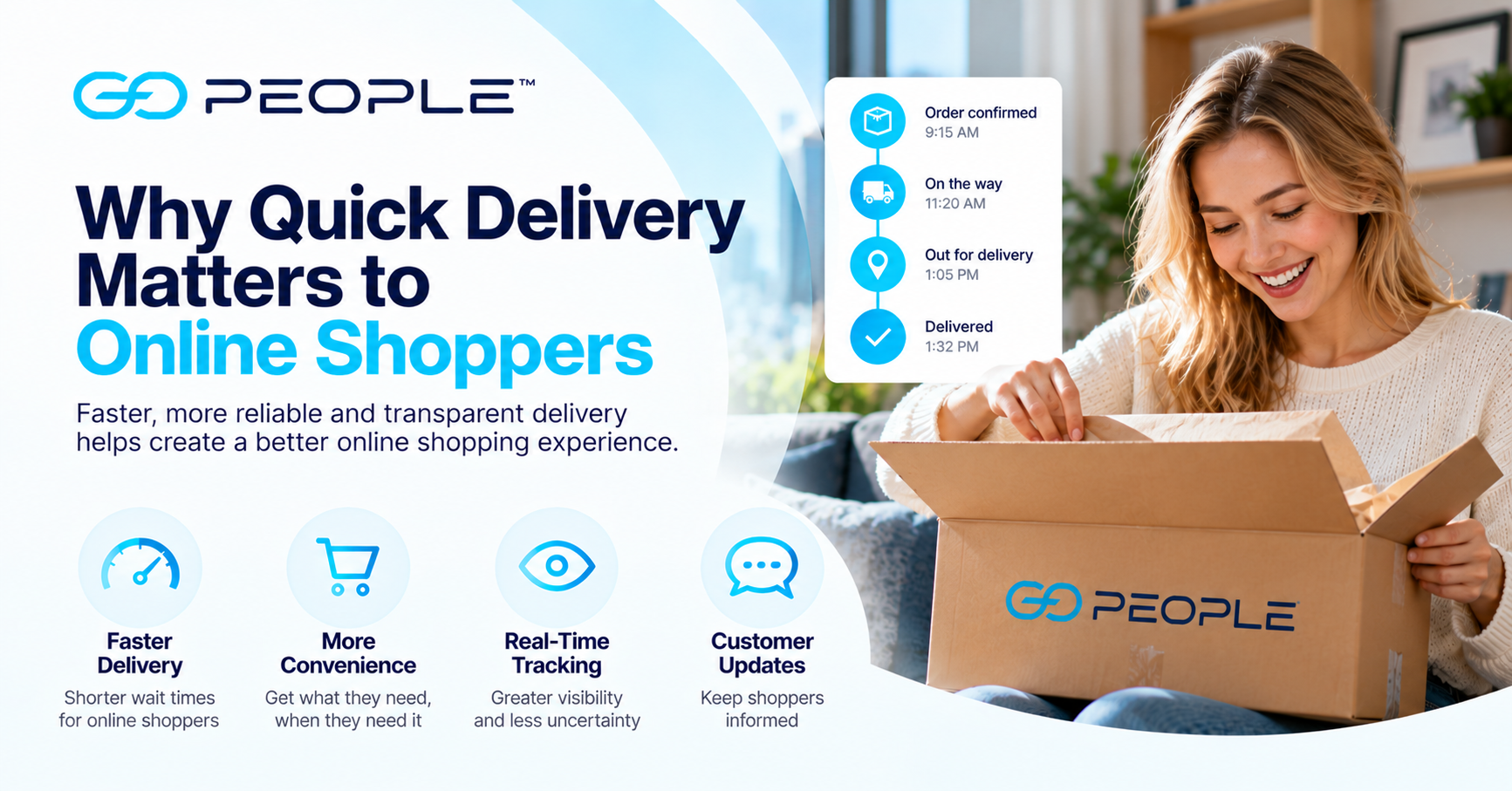
Online shopping has made purchasing products easier than ever, but placing the order is only the beginning of the customer experience.
Once checkout is complete, attention quickly shifts to one question:
When will my order arrive?
Delivery speed can influence how customers perceive an online purchase, particularly when they need an item quickly. But a good ecommerce delivery experience isn’t simply about making every parcel arrive as fast as possible.
Customers also value realistic delivery expectations, useful tracking information and clear communication.
For ecommerce businesses, the objective is to offer the right combination of speed, reliability and visibility.
Why Delivery Has Become Part of the Online Shopping Experience
When shopping in a physical store, customers usually leave with the product immediately.
Online shopping separates the purchase from receiving the product.
That makes delivery part of the transaction itself.
The experience doesn’t necessarily end when the customer clicks Buy Now. It continues while the order is processed, dispatched, transported and ultimately delivered.
A smooth delivery experience can reinforce a positive purchase.
A confusing or unreliable one can create frustration even when the product itself is exactly what the customer wanted.
1. Customers Want to Know When Their Order Will Arrive
Speed matters, but certainty matters too.
Customers don’t necessarily need every order immediately. What they often want is a clear understanding of when they should expect it.
An ecommerce business that provides realistic delivery expectations can help customers make a more informed purchase decision.
This becomes particularly important when someone is buying:
- a gift;
- something required for an event;
- a replacement product;
- an urgent household item;
- supplies needed for work; or
- anything else required by a particular date.
In these situations, the expected delivery time can become part of the purchasing decision.
2. Faster Delivery Reduces the Gap Between Purchase and Fulfilment
Online shopping is convenient, but customers still have to wait for their purchases.
Faster fulfilment reduces the period between paying for a product and actually receiving it.
For products available locally, this can create a shopping experience that combines the convenience of ecommerce with relatively fast fulfilment.
But faster doesn’t always have to mean same-day.
Depending on the order and customer, next-day delivery may provide an appropriate balance between speed and delivery efficiency.
Our guide to next-day delivery for ecommerce businesses explains this model in more detail.
3. Some Purchases Are More Time-Sensitive Than Others
Not every ecommerce order has the same level of urgency.
Someone buying a product they don’t need until next week may care little about whether it arrives tomorrow or the following day.
Someone who needs the same product tonight may have completely different priorities.
That’s why ecommerce businesses can benefit from thinking about delivery as a range of options rather than a single service.
Depending on the circumstances, customers may need:
- standard delivery;
- next-day delivery;
- same-day delivery; or
- an urgent on-demand courier.
Matching delivery speed to the customer’s actual requirement can be more useful than simply trying to make every order as fast as possible.
4. Delivery Options Give Customers More Control
Different customers value different things.
Some prioritise speed.
Others prioritise cost.
Some need certainty around the delivery date, while others are happy to wait.
Where operationally practical, offering appropriate delivery choices allows customers to select an option that better matches their needs.
This can also help ecommerce businesses avoid paying for unnecessary delivery speed on every order.
A customer who genuinely needs an item today can select a faster service where available, while another customer may be perfectly satisfied with next-day delivery.
5. Real-Time Tracking Reduces Uncertainty
Waiting becomes more frustrating when customers don’t know what’s happening.
Delivery tracking helps provide visibility after an order has left the business.
Rather than contacting customer service simply to ask where an order is, customers can use available tracking information to understand its progress.
Depending on the service, tracking may show relevant delivery statuses and updates as the job progresses.
This doesn’t make the parcel physically arrive faster, but it can make the waiting experience much clearer.
Read Why Real-Time Tracking Matters for Online Shopping for a deeper look at this part of the customer experience.
Customers can also read our guide on how to track a delivery in real time.
6. Customer Notifications Help Shoppers Stay Informed
Customers shouldn’t have to continuously refresh a tracking page.
Delivery notifications can help communicate important stages of the journey and alert recipients when something relevant happens.
Good delivery communication can help customers understand:
- when their order is progressing;
- when delivery is approaching;
- when delivery has been completed; or
- when something requires their attention.
This visibility is particularly valuable when customers need to plan around receiving a delivery.
7. Reliability Matters as Much as Speed
A fast delivery promise is useful only when the delivery operation can support it.
If a retailer promises an unrealistic timeframe and the order arrives late, the faster advertised speed may actually create a worse customer experience.
For ecommerce businesses, a more sustainable approach is to set realistic expectations and use delivery services appropriate for each order.
A reliable next-day service may provide a better experience than promising same-day delivery where the business cannot consistently support it.
The objective should be:
Promise appropriately, communicate clearly and deliver reliably.
8. Quick Delivery Can Be Especially Valuable for Local Ecommerce
Businesses holding inventory close to their customers may have more opportunities to provide faster fulfilment.
Products may be dispatched from:
- local warehouses;
- fulfilment centres;
- retail stores;
- 3PL facilities; or
- other local inventory locations.
When the stock and customer are within suitable service areas, businesses may be able to provide faster delivery without moving the parcel through a long-distance network.
This is where last-mile delivery strategy becomes particularly important.
For businesses working with fulfilment providers, see our guide to last-mile delivery for 3PLs in Australia.
9. Delivery Can Affect the Customer’s Overall Impression of the Retailer
Customers generally don’t separate the courier experience entirely from the retailer they purchased from.
If an order arrives smoothly, the retailer benefits from that experience.
If delivery is confusing or poorly communicated, the customer may contact the retailer for help regardless of which company physically transported the parcel.
That means ecommerce businesses should think about delivery as part of customer experience rather than simply a logistics expense.
Speed is one component.
Tracking, communication, reliability and proof of delivery also contribute to the overall experience.
How Fast Should Ecommerce Delivery Be?
There isn’t one correct answer.
The appropriate delivery speed depends on the product, customer, location, inventory and economics of the order.
Next-Day Delivery
For many ecommerce purchases, next-day delivery provides a useful balance between speed and operational efficiency.
GoEXPRESS provides next-day business parcel delivery in supported locations.
Same-Day Delivery
When receiving the product today creates meaningful value for the customer, GoSAMEDAY provides a same-day delivery option within supported service areas.
Our guide to same-day delivery for businesses explains when this model makes sense.
Multi-Drop Delivery
Some retailers have multiple local orders leaving from the same location.
In these circumstances, GoBUNDLE provides a multi-drop delivery model for businesses completing multiple deliveries.
On-Demand Courier
When an individual order is particularly urgent or time-sensitive, GoVIP provides an on-demand courier option.
The right choice depends on the requirements of the particular delivery.
How Ecommerce Businesses Can Improve Delivery
Improving ecommerce delivery doesn’t necessarily mean making every parcel same-day.
Businesses can focus on several areas.
Set Clear Delivery Expectations
Give customers realistic information about when their order is expected to arrive.
Reduce Order Processing Delays
Fast transportation won’t help much if an order spends unnecessary time waiting to be picked, packed or dispatched.
Position Inventory Appropriately
Where practical, holding inventory closer to customer demand can reduce the distance required for fulfilment.
Use the Right Delivery Service
Different orders may justify different delivery speeds.
Match the service to the urgency, volume and delivery location.
Provide Tracking and Updates
Make it easy for customers to understand what is happening after their order has been dispatched.
Review Delivery Performance
Businesses should monitor delivery outcomes and customer enquiries to identify recurring problems in the fulfilment experience.
Quick Delivery with GoPeople
GoPeople provides business delivery services for different ecommerce and fulfilment requirements.
GoEXPRESS — Next-Day Delivery
GoBUNDLE — Multi-Drop Delivery
GoSAMEDAY — Same-Day Delivery
GoVIP — On-Demand Courier
Businesses can select the delivery model that best matches the urgency and structure of their deliveries rather than using the same service for every order.
GoPeople’s delivery technology also provides tracking and delivery information to help businesses and recipients stay informed as deliveries progress.
Frequently Asked Questions
Why is fast delivery important for online shopping?
Fast delivery reduces the time between purchasing a product and receiving it.
It can be particularly important when a customer needs an item urgently or by a specific date. However, delivery reliability and clear expectations are also important parts of the experience.
Do online shoppers expect same-day delivery?
Not necessarily.
Different customers and purchases have different levels of urgency. Many orders may be well suited to next-day delivery, while same-day delivery can be useful when receiving the item that day creates additional value.
Is next-day delivery fast enough for ecommerce?
For many ecommerce orders, yes.
Next-day delivery can provide a useful balance between customer expectations, delivery speed and fulfilment efficiency.
Why is delivery tracking important for ecommerce?
Tracking gives customers greater visibility after an order has been dispatched.
It can help customers understand delivery progress and reduce uncertainty while waiting for their purchase.
How can ecommerce businesses make delivery faster?
Businesses can improve delivery speed by reducing order-processing delays, positioning inventory appropriately, choosing suitable delivery partners and using the right delivery service for each type of order.
The Best Delivery Experience Isn’t Always the Fastest
Speed matters in ecommerce, but the fastest possible delivery isn’t automatically the best choice for every order.
Customers ultimately need a delivery experience that fits their requirements.
Sometimes that means receiving an urgent order on the same day.
Sometimes next-day delivery is entirely appropriate.
What matters is giving customers realistic expectations, keeping them informed and delivering their purchase using a service appropriate for the job.
For ecommerce businesses, combining speed, reliability and visibility creates a stronger delivery experience than focusing on speed alone.
Better Tracking. Lower Cost. Faster Deliveries.