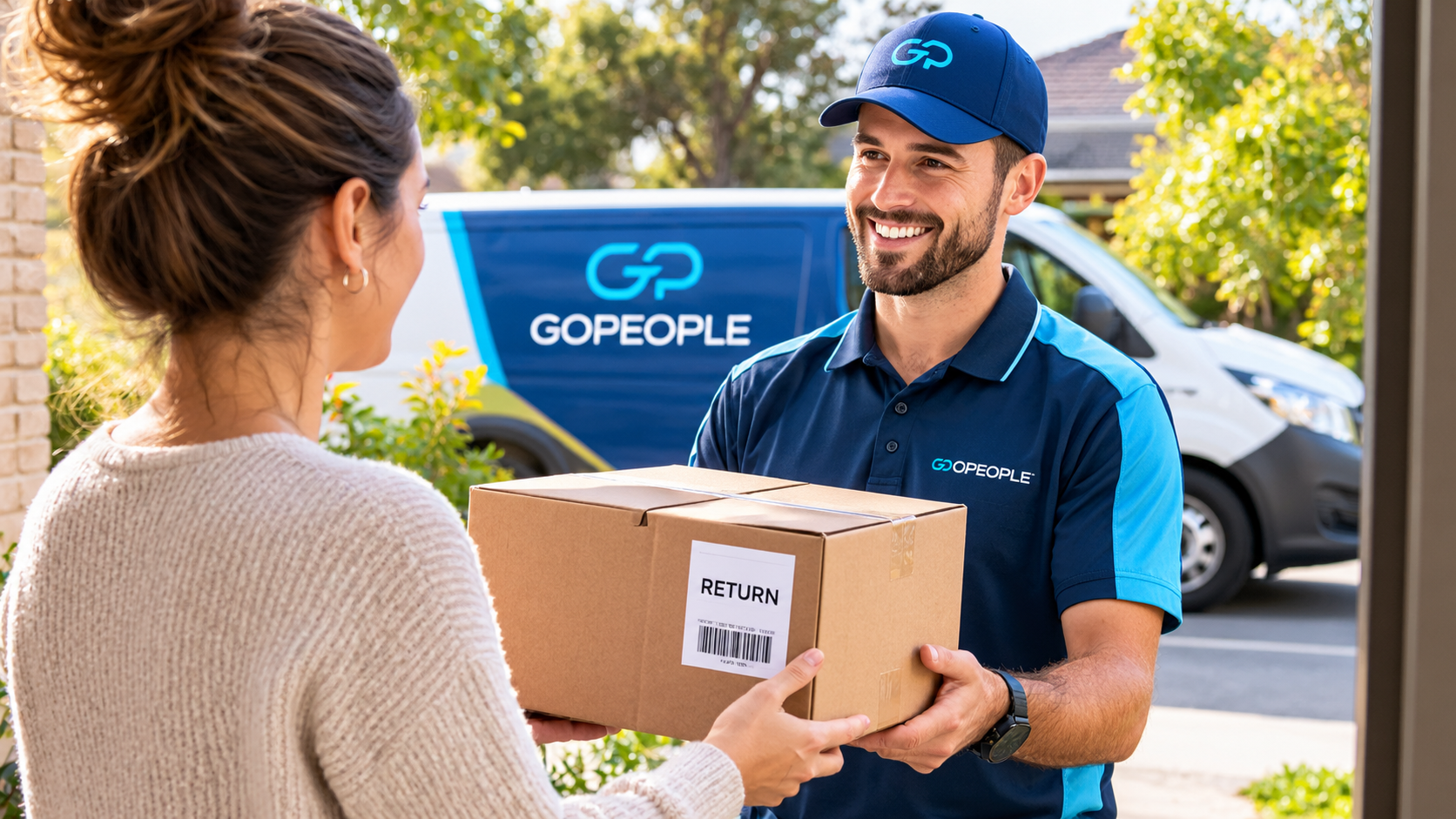
Online returns are an unavoidable part of ecommerce. Customers may need to return clothing that does not fit, exchange a product or send an unwanted item back to the retailer.
For Australian online retailers, the challenge is not simply accepting a return request. It is getting the item from the customer back to the right store, warehouse or fulfilment location efficiently.
Traditional return methods may require customers to visit a drop-off point or wait for a scheduled collection. For certain returns, a same-day courier collection can offer a more convenient alternative.
GoPeople supports eligible ecommerce returns by collecting parcels from customers and delivering them to retailers, stores or warehouses through its GoSAMEDAY and GoVIP courier services.
This guide explains how same-day return collections work, when they make sense and how businesses can organise a more efficient reverse-logistics process.
What Are Ecommerce Returns and Reverse Logistics?
Reverse logistics refers to the movement of goods back through a supply chain after they have been delivered or sold.
In ecommerce, this often involves a customer returning an item to a retailer for an exchange, refund, inspection or other reason.
A typical return process may include:
- The customer requests a return.
- The retailer confirms whether the item is eligible.
- The customer prepares the parcel for collection or drop-off.
- The parcel is transported to a nominated return location.
- The retailer receives and inspects the item.
- The retailer completes the appropriate refund, exchange or other resolution.
Courier transport is one part of this process.
GoPeople can support the physical movement of eligible returned parcels, while the retailer remains responsible for return authorisation, product inspection, refunds and exchanges.
How Same-Day Ecommerce Return Collections Work
A same-day return collection allows a business to arrange for a courier to collect a parcel from a customer and deliver it to a nominated destination on the same day, where the service is available and the booking meets the applicable requirements.
For example, a fashion retailer might need to collect an incorrect item from a customer’s home and return it to a nearby store.
The process typically involves four stages.
1. Confirm the Return with the Customer
Before arranging collection, the retailer should confirm that the item is eligible for return.
This includes checking the return reason, product condition requirements, collection address and intended destination.
The retailer should also explain how the customer needs to package the item.
2. Prepare the Parcel for Collection
The customer should have the parcel securely packaged and ready before the courier arrives.
Appropriate packaging helps protect the item during transport and reduces collection delays.
Any required return reference or identification should be provided according to the retailer’s process.
3. Book the Courier Collection
The retailer can arrange an eligible courier movement using a suitable GoPeople service.
The booking should include accurate collection and delivery addresses, contact details, parcel information and any relevant access instructions.
Service availability, collection timing and delivery requirements should be checked before confirming the booking.
4. Deliver the Return to the Retailer or Warehouse
The courier collects the parcel and transports it to the nominated destination.
Depending on the service, the business can access delivery tracking and completion information.
Once the returned item arrives, the retailer can continue its normal inspection, refund or exchange process.
Benefits of Same-Day Return Collections for Ecommerce Businesses
Same-day return collections are not necessary for every order. However, they can be useful in situations where speed, convenience or operational urgency matters.
Faster Movement of Returned Stock
When a returned product reaches the retailer sooner, the business may be able to inspect it and determine whether it can be restocked, exchanged or processed further.
This can be especially useful for items with time-sensitive resale opportunities.
However, faster transport does not automatically mean faster refunds or restocking. Those outcomes still depend on the retailer’s internal processes.
More Convenient Customer Returns
Some customers find it difficult to visit a parcel drop-off location during business hours.
Arranging collection from their home or workplace can make the return process more convenient.
For selected customers or higher-value orders, a retailer may choose to offer courier collection as part of its customer service.
Better Visibility During Transport
Once a returned parcel has been collected, businesses need to know whether it is progressing towards the nominated destination.
Delivery tracking can help staff respond to enquiries and investigate delays or unsuccessful delivery attempts.
Depending on the selected service, proof-of-delivery information may also help confirm that the parcel reached its destination.
Support for Urgent Exchanges
Some returns are linked to urgent replacement orders.
For example, a retailer may need to retrieve an incorrectly delivered item while arranging a replacement for the customer.
A same-day collection can support the return movement, while the replacement delivery can be organised separately according to the retailer’s requirements.
Flexible Transport for Individual Returns
Not every business needs a dedicated reverse-logistics network.
A retailer handling occasional urgent returns may prefer to book a courier only when required.
This can provide flexibility without committing to a fixed collection schedule.
When Should Retailers Use Same-Day Return Delivery?
Same-day collections are particularly worth considering when a return is time-sensitive or when the customer experience justifies the additional transport cost.
Examples include:
- Incorrect items: Retrieving an item sent to the wrong customer.
- Urgent exchanges: Collecting a return while arranging a replacement.
- Business equipment: Returning eligible equipment to a store or office for inspection.
- High-priority customer service: Offering a convenient collection to resolve an important customer issue.
- Time-sensitive stock: Moving eligible returned goods back to a location where they can be assessed promptly.
For routine, low-value returns, a standard return method may be more economical.
Retailers should consider the value of the goods, transport distance, urgency and overall return cost before choosing same-day collection.
GoSAMEDAY vs GoVIP for Ecommerce Returns
GoPeople offers different courier services for different delivery requirements.
GoSAMEDAY — Same-Day Delivery
GoSAMEDAY is designed for eligible deliveries that need to be completed on the same day.
It may suit retailers arranging a return collection where the parcel can be picked up and delivered within the applicable service requirements.
GoVIP — On-Demand Delivery
GoVIP is designed for on-demand courier requirements.
It may be suitable when a business needs to arrange an individual, time-sensitive collection and delivery.
The most appropriate service depends on the collection address, destination, parcel characteristics, urgency and availability.
Businesses should confirm the applicable booking conditions rather than assuming every return qualifies for same-day transport.
How to Prepare Parcels for Return Collection
A successful return collection starts before the courier arrives.
Retailers should provide customers with clear instructions covering the following areas.
Packaging
Items should be packed securely and appropriately for transport.
Where practical, customers can reuse suitable original packaging, provided it remains strong enough to protect the goods.
Fragile products may require additional protection.
Collection Address
The customer should confirm the complete address, including any unit number, building name, access code or other relevant information.
Incorrect or incomplete addresses can delay collection.
Contact Details
Accurate contact details help support communication when a courier encounters access difficulties or needs clarification.
Parcel Readiness
The parcel should be ready for handover at the agreed collection time or within the applicable collection arrangement.
Customers should not assume that a courier can wait while an item is packaged.
Restricted or Special-Handling Items
Some products may be unsuitable for ordinary courier transport.
Retailers should check applicable restrictions and packaging requirements before booking, particularly for hazardous, fragile, temperature-sensitive or otherwise regulated goods.
How to Reduce the Cost of Ecommerce Returns
Reverse logistics can become expensive when businesses process returns without considering transport costs.
A more efficient approach starts with understanding which returns genuinely need urgent collection.
Set Clear Return Eligibility Rules
Establish which products qualify for courier collection and which should use a standard return method.
For example, urgent exchanges may justify same-day collection, while routine returns may not.
Avoid Unnecessary Collection Attempts
Confirm that the customer is available and that the parcel is ready before arranging a collection.
An unsuccessful collection can create delays and additional operational costs.
Choose the Appropriate Courier Service
The fastest available option is not always the most economical.
Compare the urgency of the return against the cost and service requirements.
Review Return Reasons
If a large proportion of returns result from incorrect product descriptions, picking errors or damaged goods, addressing those causes may reduce the need for return transport.
Courier efficiency is important, but preventing avoidable returns can be even more valuable.
Tracking and Proof of Delivery for Returned Parcels
Tracking is particularly important when a parcel is moving in the opposite direction from a normal ecommerce order.
The customer wants to know whether the item has been collected, while the retailer wants to know whether it has arrived.
Depending on the courier service, useful information may include collection progress, delivery status and proof of delivery.
These records can help businesses investigate situations such as:
- A customer saying the parcel was collected but the retailer has not received it.
- A courier being unable to access the collection address.
- A return being delivered to the wrong location.
- A delay affecting an urgent exchange.
For more information about delivery visibility, see our guide to real-time GPS delivery tracking.
Building a Better Ecommerce Returns Process
Courier collection works best when it is integrated into a clear returns workflow.
Retailers should define who authorises returns, who books collections, where returned goods should be delivered and how receipt is confirmed.
It is also useful to distinguish between the status of the courier movement and the status of the customer’s refund.
For example, a parcel being marked as delivered to the warehouse does not necessarily mean it has been inspected or that a refund has been approved.
Clear communication helps prevent customers from misunderstanding these stages.
Retailers can also measure return performance using indicators such as collection success rate, transport cost per return, time to warehouse receipt and customer enquiries.
These measures can help determine when same-day courier collection delivers sufficient value.
Frequently Asked Questions
Can GoPeople collect returned parcels from customers?
Yes. GoPeople can support eligible customer-to-retailer or customer-to-warehouse parcel movements using its courier services, subject to service availability and booking requirements.
Can a returned parcel be collected and delivered on the same day?
Yes, where an eligible same-day courier service is available and the booking meets its requirements. Timing depends on the collection and delivery locations and other operational factors.
Does GoPeople manage refunds or exchanges?
No. GoPeople provides courier transport. The retailer remains responsible for approving returns, inspecting products, issuing refunds and managing exchanges.
Can returns be delivered directly to a warehouse?
Yes, eligible parcels can be transported to a nominated warehouse, store or other suitable delivery location within the applicable service area.
Is same-day return collection suitable for every product?
No. Suitability depends on the item’s size, weight, packaging, contents and any applicable transport restrictions.
Is same-day return collection always the cheapest option?
No. Same-day collection is most useful when urgency or customer convenience justifies the cost. Routine returns may be better suited to a less urgent transport option.
Make Ecommerce Returns Easier with GoPeople
An effective ecommerce returns process needs more than a clear refund policy. It also needs a practical way to move returned goods from customers back to the business.
For Australian retailers, same-day courier collections can help with urgent exchanges, customer service issues and time-sensitive return movements.
GoPeople supports eligible return collections through GoSAMEDAY and GoVIP, helping businesses arrange transport between customers, stores and warehouses.
Better tracking. Lower cost. Faster deliveries.
Talk to the GoPeople team about your ecommerce return collection and delivery requirements.