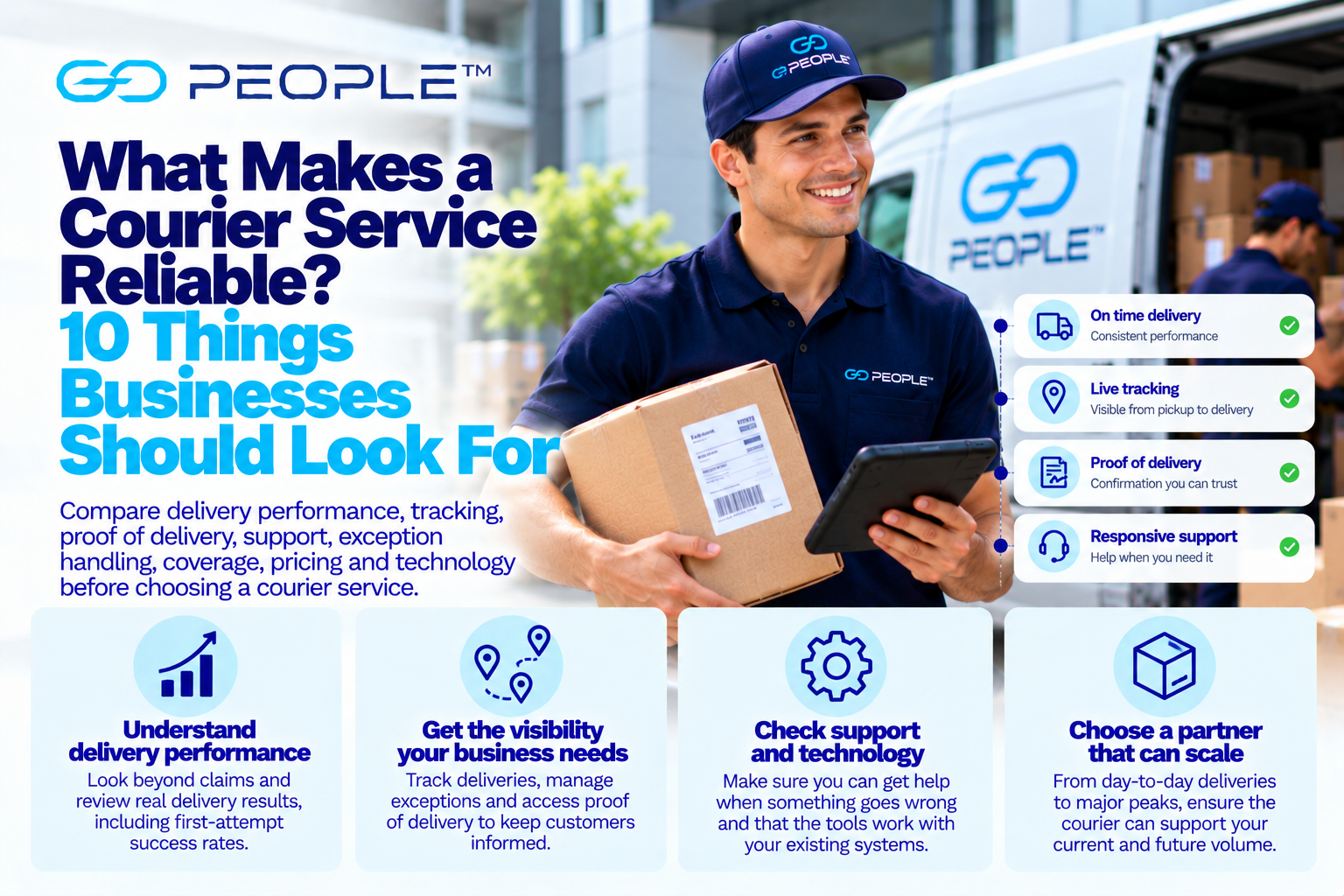
A reliable courier service does more than move a parcel from one location to another.
For a business, the courier becomes part of the customer experience.
If deliveries arrive as expected, customers may barely think about the logistics behind their order.
But when deliveries repeatedly arrive late, tracking provides little information, parcels cannot be located or problems are difficult to resolve, the customer often associates that experience with the business they purchased from—not just the courier.
That makes courier reliability an important operational decision.
But what does reliable actually mean?
It is not simply:
“The parcel eventually arrived.”
A reliable delivery service should be evaluated across the entire delivery process:
Pickup → tracking → delivery → proof of delivery → exception handling → support
Here are 10 factors businesses should consider when assessing a courier service.
1. Consistent Delivery Performance
Reliability starts with the most obvious question:
Does the courier consistently deliver within the service expectations being offered?
A courier that performs well occasionally but unpredictably is difficult for a business to build around.
Consistency matters because businesses make promises to their own customers based on expected delivery performance.
If a business offers next-day delivery, for example, its fulfilment and customer communication processes are built around that expectation.
Repeated delivery problems can create:
- customer complaints;
- support enquiries;
- refunds;
- redeliveries;
- replacements;
- negative reviews; and
- reduced customer confidence.
When evaluating a provider, look beyond individual successful deliveries.
Look for patterns.
2. Clear Service Definitions
A reliable courier should make it reasonably clear what service is actually being provided.
Businesses should understand:
- when the order needs to be ready;
- where collection is available;
- where delivery is available;
- the expected delivery timeframe;
- parcel requirements;
- applicable restrictions; and
- what happens if the normal delivery process cannot be completed.
Vague promises create operational problems.
For example:
“Fast delivery”
does not tell a warehouse when an order must be ready.
“Express”
can mean different things between providers.
Businesses need enough clarity to design their fulfilment processes around the delivery service.
3. Useful Delivery Tracking
Once a parcel leaves the warehouse, the business should not lose visibility over it.
Tracking can help answer questions such as:
- Has the parcel been collected?
- What is its current status?
- Has delivery been attempted?
- Has an exception occurred?
- Has it been delivered?
This visibility is valuable to both operations teams and customers.
Without useful tracking, routine enquiries can turn into manual investigations.
A customer asks:
“Where is my order?”
Customer service asks operations.
Operations contacts the courier.
The courier checks with someone else.
Eventually, an answer returns.
At scale, that is expensive.
Better tracking allows many routine questions to be answered immediately.
For more detail, see Why Real-Time Tracking Is a Must for Online Shopping.
4. Tracking Information Customers Can Understand
Having tracking is not enough.
It needs to be useful.
A tracking system filled with unexplained internal codes can technically provide information while still leaving the customer confused.
Customers generally want to understand:
What is happening?
What happens next?
Useful statuses might communicate concepts such as:
- awaiting collection;
- collected;
- in transit;
- out for delivery;
- delivery attempted; and
- delivered.
The exact terminology varies by provider.
The important point is clarity.
Tracking should reduce uncertainty rather than create it.
5. Proof of Delivery
When a customer says:
“I didn’t receive my order.”
the business needs information.
A simple status reading Delivered may not always be enough to investigate.
Proof of delivery can help provide additional information about delivery completion.
Depending on the service, this may include:
- delivery status;
- timestamp;
- photograph;
- signature; or
- another completion record.
This can help businesses investigate disputes and understand what occurred.
For more information, see What Is Proof of Delivery and Why Does It Matter?.
6. Effective Exception Management
Every delivery network eventually encounters problems.
The real test of a courier is not whether nothing ever goes wrong.
It is:
What happens when something does go wrong?
Common exceptions can include:
- incorrect address;
- inaccessible property;
- unavailable recipient;
- unsuccessful delivery;
- delayed parcel;
- missing parcel;
- damaged parcel; or
- disputed delivery.
A reliable process should make it possible to:
- identify the exception;
- understand what happened;
- determine what happens next;
- communicate appropriately; and
- resolve the issue.
Businesses should investigate exception handling before choosing a provider—not after the first serious problem occurs.
7. Responsive Customer Support
Technology can answer many routine questions.
But some situations still require human support.
The quality of support matters particularly when:
- tracking is unclear;
- a delivery fails;
- an address is wrong;
- a parcel cannot be located;
- a customer disputes delivery; or
- another unusual situation occurs.
When evaluating courier support, consider:
- how support can be contacted;
- whether support staff can access useful delivery information;
- how issues are escalated;
- whether responses provide clear next steps; and
- how difficult problems are managed.
Fast responses are useful.
Useful responses are more important.
8. Clear Customer Communication
A reliable courier experience should help businesses keep customers informed.
Customers generally want to know:
- when the order has been dispatched;
- how to track it;
- whether delivery is progressing;
- whether something has changed;
- whether they need to take action; and
- whether delivery has been completed.
Good communication can reduce uncertainty and routine customer-service enquiries.
It is particularly important when something goes wrong.
A customer who receives a useful exception message may still be disappointed.
But that is generally better than discovering the problem themselves after waiting for a delivery that never arrives.
See Delivery Notifications: How to Keep Customers Informed From Dispatch to Delivery.
9. Appropriate Service Coverage
A courier is only useful if its service matches your actual delivery requirements.
Before comparing providers, understand your own delivery profile.
Ask:
Where Are Your Pickups?
One warehouse?
Several warehouses?
Retail stores?
Different business locations?
Where Are Your Customers?
Concentrated within a metropolitan area?
Spread across several cities?
What Are You Sending?
Parcels?
Documents?
Multiple orders?
Urgent items?
How Quickly Do They Need to Arrive?
Immediately?
Today?
Tomorrow?
How Many Deliveries Do You Have?
A few occasional deliveries?
Dozens every day?
Hundreds?
The answers determine which delivery model is appropriate.
10. Capacity That Can Support Your Business
A courier may work well when you have 20 deliveries.
What happens when you have 200?
Or 2,000?
Businesses should consider whether the delivery model can support:
- normal daily volume;
- promotional spikes;
- seasonal peaks;
- business growth; and
- geographic expansion.
Capacity becomes particularly important during periods such as:
- Christmas;
- Black Friday;
- major promotions;
- product launches; and
- unexpected demand spikes.
A reliable courier relationship should not only work on an average Tuesday.
It should also form part of your plan for busy periods.
Reliability Is More Than Delivery Speed
Businesses often associate reliability with speed.
But they are not the same thing.
Consider two courier services.
Courier A
Promises extremely fast delivery but frequently misses the expected timeframe.
Courier B
Offers a realistic timeframe and performs consistently.
Which is more reliable?
For many businesses, Courier B.
The most useful delivery promise is not necessarily the fastest.
It is one the business can confidently communicate to customers.
That is why delivery strategy should balance:
speed + consistency + visibility + cost
The Cheapest Courier Is Not Necessarily the Lowest-Cost Courier
Courier pricing matters.
But businesses should avoid making the decision solely on the quoted delivery rate.
Imagine:
Courier A
Delivery charge: $10
Courier B
Delivery charge: $11
Courier A appears cheaper.
But suppose Courier A also creates more:
- failed deliveries;
- customer enquiries;
- investigations;
- redeliveries; and
- replacements.
The additional $1 for Courier B could potentially be insignificant compared with the broader operational difference.
The correct metric is closer to:
Total delivery-related cost ÷ successful deliveries
rather than:
quoted price per booking.
For a detailed framework, see The Hidden Costs of Inefficient Delivery Operations.
Measure First-Attempt Delivery Success
One of the most useful reliability measures is:
How often is delivery completed successfully on the first attempt?
A failed delivery can create:
- another delivery attempt;
- return handling;
- customer support;
- administration;
- warehouse handling; and
- customer frustration.
A useful formula is:
Successful first attempts ÷ total delivery attempts × 100
For example:
950 successful first attempts ÷ 1,000 attempts = 95%
Do not compare percentages blindly between providers without considering differences in:
- delivery type;
- customer profile;
- geography;
- parcel type; and
- service requirements.
But within your own operation, the metric can reveal trends.
Measure Delivery Exceptions
Do not simply count completed deliveries.
Track problems as well.
Useful categories can include:
- unsuccessful delivery;
- address problem;
- access problem;
- customer unavailable;
- delay;
- missing parcel;
- damaged parcel; and
- delivery dispute.
Then calculate:
Exceptions ÷ total deliveries
Over time, this helps identify whether reliability is improving or deteriorating.
Measure Delivery-Related Customer Enquiries
Your support team can provide another view of courier performance.
Track questions such as:
- Where is my order?
- Why is my parcel delayed?
- What does this tracking status mean?
- Why was delivery unsuccessful?
- It says delivered—where is it?
- When will redelivery happen?
Calculate:
Delivery enquiries ÷ total deliveries
If delivery volume stays stable while enquiries increase, investigate why.
The problem may be:
- delivery performance;
- tracking;
- notifications;
- customer expectations; or
- exception communication.
Measure Cost per Successful Delivery
A low courier rate can become expensive if a large number of deliveries require additional work.
Calculate:
Courier charges
delivery administration
customer-service costs
failed-delivery costs
redelivery
delivery-related refunds/replacements
÷
successful deliveries
This gives a broader measure of courier economics.
Measure Delivery Performance by Service Type
Do not combine every delivery into one metric if you use different services.
For example:
- next-day parcels;
- same-day deliveries;
- multi-drop routes; and
- urgent on-demand jobs
solve different problems.
Measure them separately.
This makes it easier to determine whether each service is performing appropriately for its purpose.
Look at Reliability Over Time
Do not make major courier decisions based on one excellent week or one terrible day.
Review trends.
For example:
| Metric | Month 1 | Month 2 | Month 3 |
|---|---|---|---|
| Delivery volume | 2,100 | 2,350 | 2,600 |
| First-attempt success | 96% | 95% | 93% |
| Delivery enquiries | 72 | 94 | 141 |
| Exceptions | 84 | 118 | 182 |
| Cost per successful delivery | $X | $Y | $Z |
The pattern matters.
If volume is increasing while performance deteriorates, capacity or process issues may be emerging.
Check Performance During Peak Periods
Average annual performance can hide peak-season problems.
Review separately:
- major promotions;
- Christmas;
- Black Friday;
- product launches; and
- other high-volume periods.
Ask:
Does the provider remain reliable when everyone needs more delivery capacity at the same time?
Peak performance can be more important than average performance for ecommerce businesses.
Technology Matters
A courier service is partly a transportation service and partly an information system.
The physical parcel moves through the delivery network.
At the same time, digital information should help the business understand what is happening.
Depending on the provider and service, useful technology can include:
- booking tools;
- tracking;
- customer notifications;
- route optimisation;
- proof of delivery;
- reporting; and
- integrations.
The right technology can reduce manual work and improve visibility.
Consider Integration With Your Existing Systems
At low volume, manual delivery bookings may be manageable.
At higher volume, repeatedly copying order information can become expensive.
Consider a business processing 500 deliveries.
If staff manually:
- copy customer details;
- create delivery bookings;
- retrieve tracking information;
- update ecommerce orders; and
- notify customers,
even a few minutes per order can create substantial administrative work.
When evaluating courier providers, ask what integration or automation options are available and whether they suit your existing systems.
Reliability Starts With Your Own Operation Too
Not every delivery problem is caused by the courier.
A courier cannot reliably deliver a parcel that:
- has the wrong address;
- was packed incorrectly;
- was not ready for collection;
- has an incorrect label;
- was assigned the wrong service; or
- contains incomplete delivery instructions.
Businesses should therefore measure both:
courier performance
and
internal fulfilment quality.
Otherwise, internal problems may be incorrectly attributed to the delivery provider.
Check Your Address Quality
Track how often delivery issues are caused by:
- wrong street;
- missing unit;
- incorrect postcode;
- wrong suburb;
- incorrect phone number; or
- incomplete access instructions.
If address errors are frequent, improving checkout and fulfilment data may deliver a larger improvement than changing courier providers.
Check Your Dispatch Performance
Ask:
Are parcels ready when they need to be?
Track:
- orders ready on time;
- missed collections;
- late warehouse handovers;
- incorrect labels; and
- missing parcels at dispatch.
A reliable courier cannot compensate indefinitely for an unreliable warehouse.
Understand How Failed Deliveries Are Handled
Before committing significant volume, understand the failed-delivery process.
Ask:
- What happens after an unsuccessful attempt?
- What information is recorded?
- What can the customer see?
- What can our support team see?
- What happens to the parcel?
- How are next steps communicated?
- Are there additional charges?
- Who needs to take action?
Do not wait until thousands of parcels are flowing through the service to discover the answers.
Understand the Support Escalation Path
Normal support handles normal questions.
But what happens when something unusual occurs?
For example:
- high-value delivery dispute;
- repeated delivery failure;
- significant delay;
- multiple affected orders;
- missing shipment; or
- system issue.
Businesses should understand:
Who owns the problem?
How is it escalated?
Who communicates updates?
How is resolution recorded?
This is particularly important for larger delivery accounts.
Check Pricing Transparency
A low advertised price may not represent the final operational cost.
Understand potential charges such as:
- base delivery;
- distance;
- size or weight;
- redelivery;
- failed delivery;
- waiting time;
- special requirements;
- fuel-related charges;
- or other applicable fees.
The exact pricing structure differs between providers.
The principle is simple:
Know what creates the invoice before committing volume.
Look Beyond Marketing Claims
Courier websites often use language such as:
- fast;
- reliable;
- trusted;
- seamless;
- efficient;
- flexible; and
- innovative.
Those words are not evidence.
Turn each claim into a measurable question.
Instead of:
“Are you reliable?”
ask:
“How will we measure delivery performance?”
Instead of:
“Do you have great tracking?”
ask:
“What information can our customers and support team actually see?”
Instead of:
“Do you provide good support?”
ask:
“What happens when a delivery fails?”
Specific questions produce more useful answers.
Test the Courier Before Moving All Your Volume
Where practical, businesses can test a delivery provider before making a major operational change.
A pilot might involve:
- one geographic area;
- one warehouse;
- one delivery type;
- a portion of daily volume; or
- a defined trial period.
Then measure actual performance.
Do not judge the pilot only on whether parcels were delivered.
Measure:
- first-attempt success;
- delivery exceptions;
- tracking quality;
- customer enquiries;
- support response;
- administration;
- cost per successful delivery; and
- operational fit.
Use a Controlled Courier Trial
A useful test could follow this process.
Step 1: Establish Your Current Baseline
Before changing anything, measure your existing provider or internal operation.
Step 2: Define the Test
For example:
100 deliveries per day in one metropolitan area for four weeks.
Step 3: Agree on the Service Requirement
Make sure both sides understand:
- pickup;
- delivery expectation;
- parcel profile;
- volume; and
- operational process.
Step 4: Measure Performance
Track agreed KPIs.
Step 5: Review Exceptions
Look at individual failures, not just averages.
Step 6: Compare Total Cost
Include administration and support—not only delivery fees.
Step 7: Decide Whether to Expand
Move more volume only when the results support it.
Don’t Rely on a Single KPI
A courier could have excellent delivery speed but poor tracking.
Another could have low prices but high failed-delivery rates.
Another could provide good technology but inadequate coverage.
Reliability is multi-dimensional.
A balanced scorecard provides a better view.
A Courier Reliability Scorecard
Score each provider from 1 to 5.
| Factor | Score |
|---|---|
| Delivery performance | /5 |
| First-attempt delivery success | /5 |
| Tracking visibility | /5 |
| Customer notifications | /5 |
| Proof of delivery | /5 |
| Exception management | /5 |
| Customer support | /5 |
| Service coverage | /5 |
| Technology/integrations | /5 |
| Peak-period capacity | /5 |
| Pricing transparency | /5 |
| Reporting/data | /5 |
Maximum score: 60
Do not treat the final number as an automatic purchasing decision.
Some factors will matter more than others depending on your business.
For example, an ecommerce retailer may place greater weight on:
- tracking;
- customer notifications;
- next-day performance; and
- peak capacity.
A business using urgent couriers may prioritise:
- responsiveness;
- immediate visibility;
- support; and
- service availability.
Weight the Scorecard for Your Business
You can improve the scorecard by assigning each factor an importance weighting.
For example:
| Factor | Importance |
|---|---|
| Reliability | 20% |
| Tracking | 15% |
| Cost | 15% |
| Coverage | 10% |
| Support | 10% |
| Exception handling | 10% |
| Technology | 10% |
| Capacity | 10% |
Then score each provider against the factors.
This helps prevent one attractive feature—such as a low price—from dominating the decision.
Questions to Ask a Courier Provider
Before choosing a provider, ask:
Service
- Which delivery services suit our order profile?
- Where can you collect?
- Where can you deliver?
- What parcel restrictions apply?
Performance
- How should we measure delivery performance?
- What reporting is available?
- How are delivery exceptions recorded?
Tracking
- What can our business see?
- What can our customers see?
- Are customer notifications available?
Proof of Delivery
- What POD information is available?
- How can our team access it?
Failed Deliveries
- What happens after an unsuccessful attempt?
- How is the customer informed?
- What costs may apply?
Support
- How do we contact support?
- How are complex issues escalated?
Technology
- What integrations are available?
- Can bookings be automated?
- What reporting can be exported?
Capacity
- How does the service handle volume growth?
- What happens during peak periods?
Pricing
- What charges should we expect beyond the standard delivery rate?
These questions make comparisons much easier.
Warning Signs When Choosing a Courier
Be cautious when:
Pricing Is Difficult to Understand
Unexpected charges make delivery costs difficult to control.
Tracking Provides Very Little Information
This can increase customer-service workload.
Failed-Delivery Processes Are Unclear
You need to know what happens when normal delivery does not succeed.
Support Cannot Access Delivery Information
This can make exceptions difficult to resolve.
Service Coverage Is Vague
Confirm actual pickup and delivery eligibility.
The Provider Cannot Explain Performance Measurement
Reliability should be measurable.
Everything Is Described as “Guaranteed”
Understand the actual service terms rather than relying on marketing language.
Technology Requires Extensive Manual Work
This may become expensive as volume increases.
One Courier May Not Need to Handle Everything
Businesses sometimes assume they need to choose one courier for every delivery.
That is not always necessary.
Different delivery requirements can justify different services.
For example:
Regular parcels needed tomorrow
→ next-day delivery
Many deliveries leaving one location
→ multi-drop delivery
Orders genuinely needed today
→ same-day delivery
One urgent item
→ on-demand courier
A business may use several delivery models within one overall strategy.
Where GoPeople Fits
GoPeople provides different business delivery services for different delivery requirements.
GoEXPRESS — Next-Day Delivery
GoEXPRESS provides next-day parcel delivery for businesses, with pickups from customer warehouses in Sydney, Melbourne and Brisbane.
GoBUNDLE — Multi-Drop Delivery
GoBUNDLE is designed for businesses making multiple deliveries from a pickup location.
It combines dedicated delivery runs with route optimisation, live tracking and digital proof of delivery.
GoSAMEDAY — Same-Day Delivery
GoSAMEDAY provides same-day delivery for eligible business pickups.
GoVIP — On-Demand Courier
GoVIP provides on-demand courier delivery for urgent and time-sensitive jobs.
The appropriate option depends on the delivery requirement and service availability.
Review Courier Performance Regularly
Choosing a courier should not be a one-time decision followed by years without review.
Create a regular performance review.
Weekly Operational Review
Check:
- volume;
- failed deliveries;
- significant exceptions;
- customer complaints; and
- operational problems.
Monthly Performance Review
Check:
- delivery performance;
- first-attempt success;
- cost per successful delivery;
- customer enquiries;
- exception rate;
- support issues; and
- trends.
Peak-Period Review
After major promotions or seasonal peaks, assess:
- capacity;
- delivery performance;
- tracking;
- support;
- customer complaints; and
- whether the current model can support future growth.
This turns courier management into an ongoing business process.
Reliability Should Be Measured, Not Assumed
The word reliable appears on almost every courier website.
That does not make every courier equally reliable.
Businesses need to turn reliability into measurable questions:
Did deliveries arrive as expected?
Were customers able to track them?
Were deliveries completed successfully on the first attempt?
Could we confirm completion?
Were exceptions visible?
Could support resolve problems?
Did the service cope with our volume?
Was pricing predictable?
Did the operation scale?
Once those questions are measured, courier selection becomes less subjective.
Instead of choosing the provider that simply feels trustworthy, businesses can choose based on operational evidence.
And that is a much stronger foundation for a long-term delivery relationship.
Frequently Asked Questions
What makes a courier service reliable?
A reliable courier service should provide consistent delivery performance, useful tracking, clear service expectations, proof of delivery, effective exception handling, appropriate support and enough capacity for the customer’s delivery requirements.
How can a business measure courier reliability?
Useful metrics include first-attempt delivery success, delivery exceptions, customer enquiries, cost per successful delivery, tracking quality and performance during peak periods.
Is the cheapest courier usually the best option?
Not necessarily. A low delivery rate can be offset by higher failed-delivery, support, redelivery and administration costs. Businesses should compare total delivery costs and service performance.
Why is tracking important when choosing a courier?
Tracking gives businesses and customers visibility after dispatch. It can reduce uncertainty, help support teams investigate problems and reduce routine delivery-status enquiries.
What should happen when a courier cannot complete a delivery?
The specific process depends on the service, but businesses should understand how the exception is recorded, what happens to the parcel, what information is available and what the sender or recipient needs to do next.
Should businesses test a courier before moving all their deliveries?
Where practical, a controlled pilot can provide useful real-world evidence. Businesses can test a defined volume or delivery segment and compare performance, cost, tracking, support and exception handling before expanding.
Can a business use more than one courier service?
Yes. Different delivery requirements may suit different services. A business might use next-day delivery for routine parcels, multi-drop for grouped local deliveries, same-day for time-sensitive orders and on-demand courier delivery for urgent jobs.