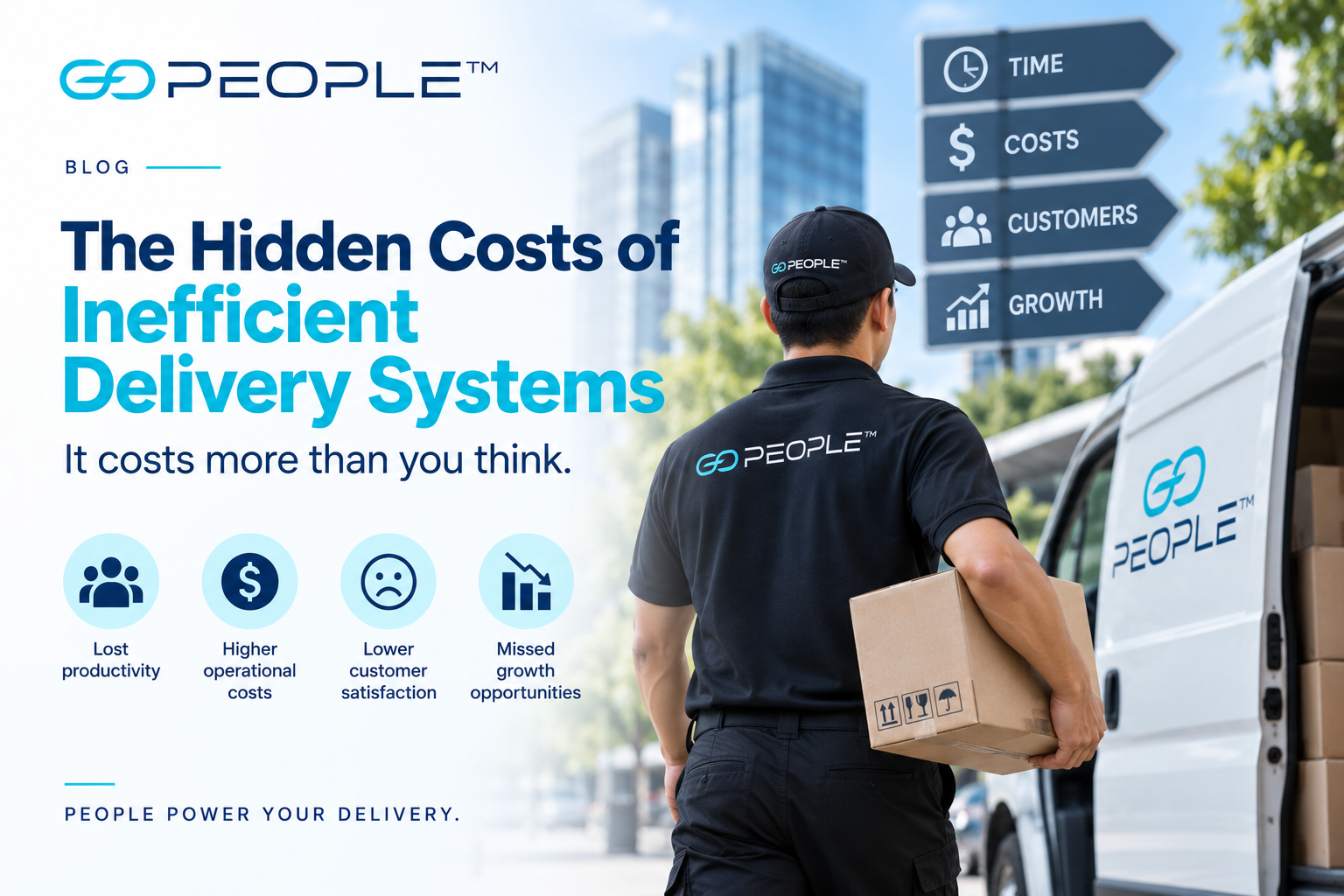
When businesses calculate delivery costs, they usually focus on the obvious expenses: courier charges, driver wages, fuel and vehicle costs.
But those numbers don’t always show the full picture.
An inefficient delivery system can create costs throughout a business — lost staff time, unnecessary kilometres, customer service enquiries, failed deliveries and even opportunities that the business can’t pursue because its delivery operation can’t keep up.
Individually, these costs may seem small. As delivery volumes grow, however, they can quickly add up.
1. Staff Time Is a Delivery Cost Too
One of the easiest costs to overlook is the time employees spend managing deliveries.
In small and growing businesses, staff may regularly find themselves:
- organising drivers and delivery schedules;
- planning routes;
- calling customers about delivery times;
- checking where drivers are;
- dealing with failed deliveries; and
- sometimes making deliveries themselves.
A manager spending two hours making an urgent delivery may appear to have saved the cost of a courier. But those two hours haven’t disappeared — they’ve simply been taken away from sales, customer service, operations or other higher-value work.
As delivery volumes increase, an informal system that once worked can gradually become a significant drain on productivity.
2. Poor Routing Creates Costs on Every Delivery
Ten deliveries shouldn’t necessarily require ten separate trips.
Without proper route planning, businesses can end up sending drivers back and forth across the same suburbs, travelling unnecessary kilometres or allocating deliveries inefficiently.
The consequences include more driving time, greater fuel consumption and fewer deliveries completed during each shift.
Route optimisation becomes increasingly valuable as delivery volumes grow.
For businesses regularly making multiple deliveries in the same metropolitan area, GoBUNDLE combines deliveries into an optimised multi-drop route completed by a dedicated Runner.
Rather than thinking about each delivery individually, businesses can manage the entire run more efficiently.
3. Delivery Problems Become Customer Service Problems
Customers generally don’t separate the courier experience from the business they purchased from.
If an order arrives late, tracking is unclear or the customer doesn’t know whether a delivery has been completed, the complaint usually comes back to the retailer or business — not its internal logistics process.
That creates another hidden cost: customer service workload.
Employees may spend time investigating deliveries, contacting drivers, responding to customers and resolving complaints.
Modern delivery systems can reduce this workload by providing features such as live tracking, recipient notifications and proof of delivery.
These tools don’t simply improve logistics. They help customers understand what’s happening without needing to contact the business for every update.
4. Failed Deliveries Can Cost More Than the Original Delivery
A delivery that doesn’t succeed the first time can create costs well beyond the initial courier charge.
The business may need to arrange another delivery, respond to the customer, locate or return the parcel and spend additional administrative time resolving the problem.
There can also be a less visible cost: customer confidence.
Customers increasingly expect businesses to provide a convenient and transparent delivery experience. Repeated delivery problems can influence whether they choose to purchase from that business again.
Reliable delivery therefore isn’t only an operational issue. It’s part of the overall customer experience.
5. Maintaining Your Own Fleet Creates Fixed Costs
Running an internal delivery operation can make sense for some businesses, particularly when demand is highly predictable.
But it also introduces significant fixed costs and responsibilities.
Vehicles may need to be purchased or leased. Businesses need to manage drivers, insurance, fuel, maintenance, registration, scheduling and unexpected absences.
The bigger challenge is utilisation.
If you maintain enough drivers and vehicles for your busiest periods, you may have excess capacity when demand is quiet. If you structure the fleet around average demand, you may struggle when order volumes suddenly increase.
Flexible delivery services provide an alternative by allowing businesses to access additional capacity when required.
6. Using the Wrong Delivery Service Can Be Expensive
Not every parcel needs an urgent dedicated courier.
Likewise, an urgent business document shouldn’t necessarily be placed into a delivery network designed for less time-sensitive freight.
Using the right delivery model for the job can improve both service and cost efficiency.
GoPeople provides different options depending on the delivery requirement:
GoVIP for urgent and priority deliveries.
GoSAMEDAY for deliveries that need to arrive within the same day.
GoBUNDLE for businesses with multiple deliveries that can be combined into an optimised run.
GoEXPRESS for businesses with larger volumes of parcels requiring next-day delivery.
Rather than paying for maximum speed on every delivery, businesses can match the service to what each delivery actually requires.
7. Inefficient Delivery Can Eventually Limit Growth
This may be the biggest hidden cost of all.
A delivery system that works for 10 orders a day may become difficult to manage at 50, 100 or 500.
When logistics can’t scale with demand, businesses may find themselves restricting delivery areas, declining orders, avoiding faster delivery options or hiring additional staff simply to keep the existing system running.
At that point, delivery is no longer supporting growth. It’s becoming a constraint on it.
A scalable delivery model allows businesses to increase capacity without having to rebuild their entire logistics operation every time order volumes grow.
For ecommerce retailers and businesses with larger parcel volumes, GoEXPRESS next-day delivery provides another way to scale delivery without relying entirely on an internal fleet.
Look Beyond the Courier Charge
The cheapest delivery isn’t necessarily the delivery with the lowest individual courier fee.
To understand the real cost, businesses need to consider the complete process:
How much staff time is involved? How efficient are the routes? How many delivery enquiries are generated? What happens when something goes wrong? And can the system cope when the business grows?
Improving those areas can create benefits well beyond the logistics budget.
The right delivery system should free your team to concentrate on customers and growth rather than spending their day managing drivers, routes and delivery problems.
Explore GoPeople’s business delivery solutions to find a delivery model that fits the way your business operates.