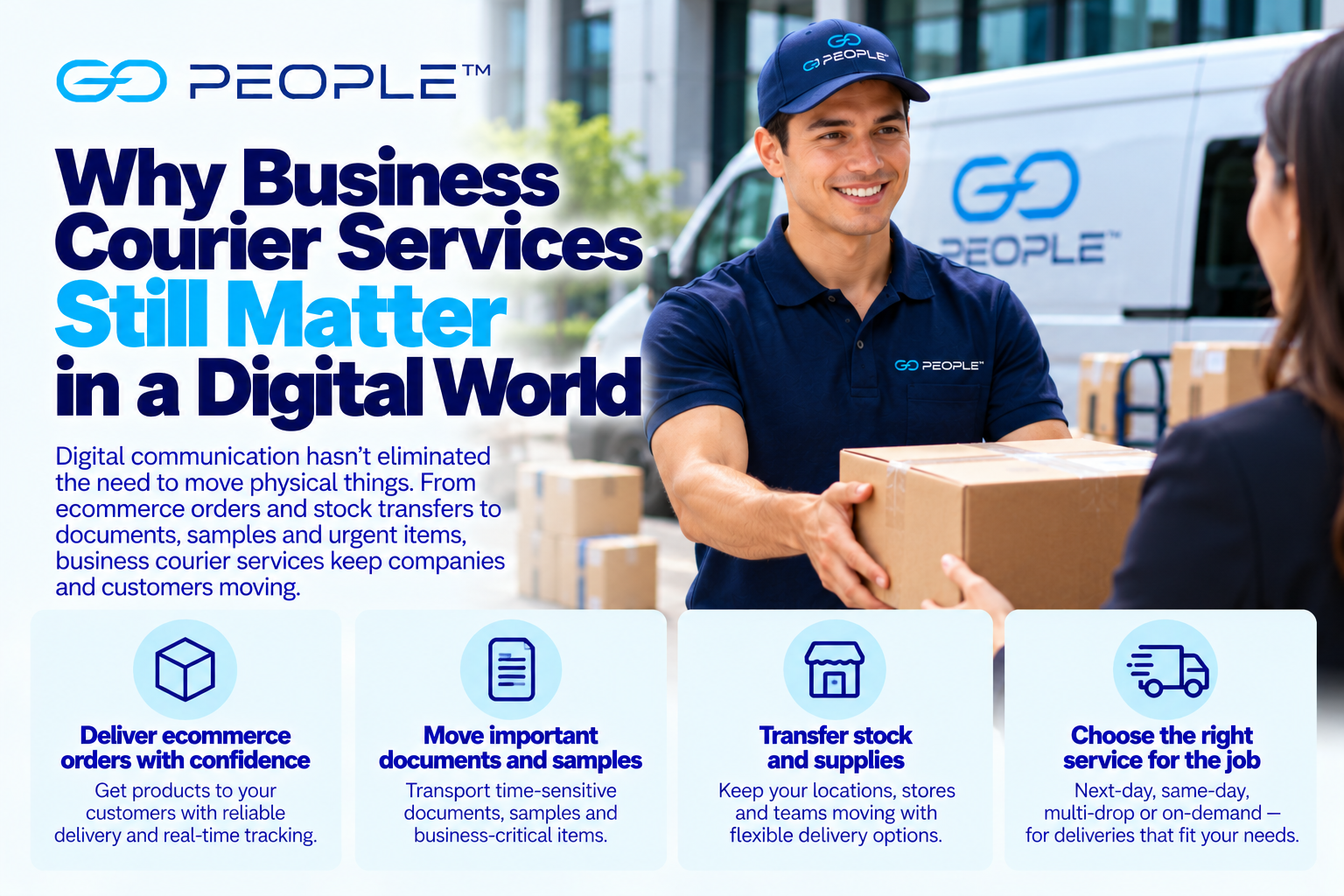
Digital technology has transformed the way businesses communicate.
Contracts can be signed electronically. Invoices can be emailed. Customers can order products online. Teams can collaborate across different cities without exchanging a single piece of paper.
But digital communication has not eliminated the need to move physical things.
Products still need to reach customers.
Stock still needs to move between locations.
Samples still need to reach clients.
Replacement products still need to be delivered.
Some documents and physical materials still need to arrive at a specific place.
And when those items matter to a business, the delivery experience matters too.
That is why business courier services remain an important part of modern operations—even in an increasingly digital economy.
Digital Businesses Still Operate in a Physical World
Consider a typical ecommerce order.
Almost everything before delivery can happen digitally:
Customer discovers product online
↓
Places order
↓
Makes payment
↓
Order enters ecommerce platform
↓
Warehouse receives order
↓
Customer receives confirmation
Then something changes.
The business has to move a physical product from:
Point A → Point B
No email, app or cloud platform can complete that final physical movement.
Technology can make the process easier to manage, but the delivery itself still has to happen.
The same applies to many other business activities.
What Is a Business Courier Service?
A business courier service transports physical items between businesses, customers or other locations.
Depending on the service, these items might include:
- ecommerce parcels;
- retail products;
- business documents;
- samples;
- replacement items;
- parts;
- supplies;
- stock; or
- other suitable goods.
Different deliveries have different requirements.
Some are routine.
Some are urgent.
Some involve one parcel.
Others involve dozens or hundreds of stops.
That is why the more useful question is not:
“Does my business need a courier?”
It is:
“What type of delivery service does this particular job require?”
1. Ecommerce Has Increased the Importance of Physical Delivery
Digital commerce has not reduced the need for delivery.
In many cases, it has made delivery more important.
A traditional retail customer might:
- visit a store;
- choose a product;
- pay;
- take the product home.
In ecommerce:
- the customer visits the website;
- chooses a product;
- pays;
- waits for the business to deliver it.
The delivery process becomes part of the purchase experience.
The retailer may have:
- a great website;
- competitive pricing;
- excellent products;
- smooth checkout; and
- responsive customer service.
But if the delivery experience is poor, that may be what the customer remembers.
2. Customers Want More Than a Parcel Moving From A to B
Modern business delivery is not simply transportation.
Customers increasingly expect visibility.
They want to know:
- Has my order been dispatched?
- Where is it in the delivery process?
- When should I expect it?
- Has there been a problem?
- Has it been delivered?
This makes technology an important part of physical delivery.
A modern delivery experience can combine:
physical transport
with:
digital tracking + notifications + delivery status + proof of delivery
The physical and digital experiences work together.
3. Real-Time Tracking Connects the Digital and Physical Experience
One of the biggest differences between traditional courier services and modern delivery platforms is visibility.
Historically, a parcel could disappear from the customer’s view after collection and reappear at the destination.
Today, tracking can provide much greater visibility into delivery progress.
For businesses, this can help:
- monitor deliveries;
- identify exceptions;
- answer customer enquiries;
- confirm completion; and
- manage delivery performance.
For customers, it reduces uncertainty.
See Why Real-Time Tracking Is a Must for Online Shopping for more detail.
4. Business Documents Have Not Completely Disappeared
Many documents can and should be handled digitally.
But physical document delivery can still arise in business operations.
Examples may include:
- original documents;
- physical records;
- signed materials;
- presentation packs;
- tender materials;
- property-related documents;
- samples accompanying documentation; or
- other items where a physical copy is required.
The important point is not that businesses should use paper instead of digital systems.
They generally should not create physical delivery unnecessarily.
Rather, when a physical item genuinely needs to move, businesses need an appropriate way to transport it.
5. Samples Still Need to Be Delivered
Many sales processes involve something that cannot be emailed.
For example:
- product samples;
- fabric;
- packaging prototypes;
- printed material;
- components;
- merchandise;
- colour samples;
- physical mock-ups; or
- demonstration products.
A photograph may start a conversation.
A physical sample can help close it.
For businesses selling physical products or services involving physical materials, courier delivery can therefore form part of the sales process itself.
6. Replacement Products Can Be Time-Sensitive
Something goes wrong.
A customer receives:
- the wrong product;
- a faulty product;
- an incomplete order; or
- an item that needs replacement.
The replacement delivery now carries more importance than the original order.
Why?
Because the customer has already experienced a problem.
A slow or poorly communicated replacement can compound the frustration.
A well-managed replacement can help recover the experience.
This is an example of where delivery speed should reflect the business context, not merely the parcel.
7. Businesses Still Need to Move Stock Between Locations
Not every delivery goes directly to a consumer.
Businesses may need to move goods between:
- warehouse and store;
- store and store;
- warehouse and office;
- supplier and business;
- business and client;
- distribution points; or
- other operational locations.
For example, one location may run out of an important item while another has excess stock.
The business then has a decision:
Wait for the normal replenishment process
or
move the stock sooner
The appropriate answer depends on:
- urgency;
- value;
- customer impact;
- distance;
- quantity; and
- available delivery options.
8. Retail Stores Can Become Delivery Origins
Physical stores are not only customer destinations.
In some business models, they can also become fulfilment locations.
An order may be fulfilled from:
- a central warehouse;
- a local warehouse;
- a retail store; or
- another inventory location.
This can create opportunities to position stock closer to customers.
But it also creates operational questions:
- Which location should fulfil the order?
- Who picks and packs it?
- Which delivery service should be used?
- When is it ready?
- How is tracking generated?
- Who manages delivery exceptions?
Delivery therefore becomes part of inventory and fulfilment strategy.
9. Business-to-Business Delivery Remains Important
B2B deliveries can be overlooked in discussions dominated by ecommerce.
Yet businesses constantly move physical items to other businesses.
Examples include:
- supplies;
- stock;
- components;
- samples;
- equipment;
- documents;
- replacement products; and
- customer orders.
The recipient may be:
- an office;
- retailer;
- warehouse;
- workshop;
- service centre;
- commercial site; or
- another business location.
These deliveries may have different requirements from residential deliveries.
For example, a commercial location may have:
- receiving hours;
- loading access;
- reception procedures;
- restricted entrances; or
- other delivery instructions.
Accurate delivery information becomes important.
10. Some Business Deliveries Are Genuinely Urgent
Not everything can wait.
A business might suddenly need to deliver:
- an important replacement;
- a time-sensitive item;
- a forgotten piece of equipment;
- a critical document;
- an urgent customer order; or
- another item with a genuine deadline.
This is where an on-demand courier can make sense.
But urgency should be deliberate.
If everything becomes urgent, the problem may be the business process rather than the delivery requirement.
Repeated emergency courier bookings can indicate:
- poor planning;
- late fulfilment;
- inventory problems;
- missed cut-offs; or
- inadequate delivery processes.
Urgent courier services are valuable when they solve genuine exceptions.
They should not automatically become the default workflow.
11. Other Deliveries Need to Arrive Today
There is another category between immediate courier delivery and tomorrow.
The customer or business may require the item today, without necessarily requiring an immediate point-to-point courier.
Same-day delivery can be useful in these situations.
The distinction matters:
Urgent now → on-demand may be appropriate
Needed today → same-day may be appropriate
Needed tomorrow → next-day may be appropriate
The appropriate option depends on eligibility and the particular delivery requirement.
12. Many Parcels Don’t Need Same-Day Delivery
Businesses can easily assume faster is always better.
But customers may not need every order within hours.
For many purchases, next-day delivery can provide a useful balance between:
- speed;
- cost;
- fulfilment;
- customer expectations; and
- operational efficiency.
This is particularly relevant for ecommerce and regular parcel volume.
See Next-Day Delivery for Small Businesses: When Does It Make Sense? for a detailed comparison.
13. Multiple Deliveries Create a Different Problem
Imagine a business has 35 deliveries ready from one location.
Booking 35 individual urgent couriers may not be the most efficient approach.
The problem is no longer:
“How do we deliver this parcel?”
It becomes:
“How do we efficiently deliver all these orders?”
That is a routing problem.
A multi-drop delivery model can be more appropriate when many deliveries can be grouped into a run.
Route optimisation then becomes important.
Instead of considering each delivery independently, the business can consider the route as a whole.
See Route Optimisation for Delivery: How Businesses Can Plan More Efficient Routes for more detail.
14. The Right Courier Service Depends on the Job
Businesses often search for “the best courier”.
There is rarely one universal answer.
Consider these four scenarios.
Scenario A: Ecommerce Parcel Needed Tomorrow
A business has regular parcel volume and the customer requires delivery the following day.
A next-day parcel service may be appropriate.
Scenario B: 40 Local Customer Deliveries
The business has many orders leaving from one location.
A multi-drop delivery run may be appropriate.
Scenario C: Customer Needs Order Today
The order is time-sensitive but does not necessarily require immediate point-to-point delivery.
A same-day service may be appropriate.
Scenario D: Urgent Business Item
The item needs to move quickly because of an immediate business requirement.
An on-demand courier may be appropriate.
These are four different delivery problems.
They should not automatically use the same solution.
15. Courier Services Can Help Businesses Avoid Building Everything In-House
At low volume, a business may handle deliveries itself.
Someone:
- packs the order;
- gets into a vehicle;
- drives to the customer;
- returns;
- and continues working.
That may seem inexpensive.
But the real cost includes:
- employee time;
- vehicle cost;
- fuel;
- parking;
- route planning;
- administration;
- insurance considerations;
- management time; and
- the opportunity cost of taking staff away from their normal work.
As volume increases, the problem becomes larger.
Businesses then face a choice:
Build internal delivery capability
or
use external delivery capacity
or
combine both
For a deeper comparison, see When Should Your Business Outsource Deliveries?.
16. Outsourcing Can Provide Variable Capacity
One challenge with an internal fleet is that delivery demand is rarely perfectly constant.
Imagine normal demand is:
100 deliveries per day
but during a promotion it becomes:
220 deliveries per day.
Building permanent internal capacity for 220 deliveries may leave substantial unused capacity during normal periods.
Building only for 100 creates a problem during peaks.
External delivery services can potentially form part of a more flexible model.
For example:
Internal capacity for core volume
external delivery capacity for additional or specialised requirements
This can create a hybrid delivery strategy.
17. Delivery Technology Matters to Operations Teams Too
Tracking isn’t only a customer feature.
Operations teams need visibility as well.
They may need to know:
- what has been collected;
- what is progressing normally;
- what has been completed;
- what has failed;
- which orders require attention; and
- what happened when a customer raises an enquiry.
Without this visibility, teams can spend significant time manually investigating deliveries.
18. Proof of Delivery Helps Resolve Questions
A delivery can generate disputes such as:
“We didn’t receive it.”
“Where was it left?”
“Was it delivered?”
“What time did it arrive?”
Proof of delivery can help businesses investigate these questions.
Depending on the service, POD may include information such as:
- delivery status;
- time;
- photograph;
- signature; or
- other completion information.
See What Is Proof of Delivery and Why Does It Matter?.
19. Delivery Data Can Improve Business Decisions
Once deliveries are managed digitally, businesses can begin measuring performance.
Useful metrics can include:
| Metric | What It Can Reveal |
|---|---|
| Delivery volume | Demand |
| Delivery cost | Economics |
| On-time dispatch | Fulfilment performance |
| Delivery completion | Delivery performance |
| Failed deliveries | Customer/address/access problems |
| Delivery exceptions | Operational friction |
| Customer enquiries | Visibility problems |
| Cost per successful delivery | True delivery efficiency |
The objective is not data for its own sake.
It is to identify where the process can improve.
20. Courier Integration Can Reduce Manual Work
Consider this workflow:
Customer places order
↓
Staff print order
↓
Staff copy address
↓
Staff open courier system
↓
Staff enter delivery
↓
Staff copy tracking number
↓
Staff update ecommerce system
↓
Staff notify customer
At low volume, this may be manageable.
At higher volume, it creates significant administrative work.
Where suitable integrations are available, information can move more efficiently between systems.
That can reduce:
- repetitive data entry;
- transcription errors;
- administrative time; and
- delays.
21. Delivery Should Be Designed Around Exceptions
As delivery volume increases, manually watching every parcel becomes inefficient.
A better operational model is:
Normal delivery → progresses through normal workflow
Exception → receives human attention
Exceptions might include:
- failed delivery;
- incorrect address;
- unusual delay;
- missing parcel;
- customer access problem;
- disputed delivery; or
- another abnormal event.
This allows teams to focus their attention where it is actually required.
22. Physical Delivery Can Influence Customer Retention
Customers may not think about logistics when everything works.
They notice when it doesn’t.
Repeated problems such as:
- late delivery;
- missing parcels;
- poor tracking;
- unclear communication;
- failed delivery;
- damaged products; or
- difficult support
can affect the overall perception of a business.
Conversely, a reliable delivery experience can reinforce the customer’s decision to buy again.
Delivery is therefore not only an operational function.
It is part of customer experience.
23. Faster Is Not Always Better
Businesses should avoid turning delivery speed into a race with no commercial logic.
Ask:
What does the customer actually need?
A customer ordering a routine product may be perfectly satisfied with tomorrow.
Another customer may genuinely need something today.
A third may have an urgent business requirement that cannot wait.
The right delivery strategy offers appropriate options rather than treating every order identically.
24. Cheap Delivery Is Not Always Low-Cost Delivery
The cheapest quoted delivery price may not produce the lowest total cost.
Consider:
Delivery fee
warehouse administration
failed delivery
customer service
redelivery
replacement
management time
A service that costs slightly less upfront but creates significantly more exceptions can become more expensive overall.
Businesses should therefore evaluate:
cost per successful delivery
rather than simply:
price per booking.
25. Reliability Matters Alongside Speed
A fast promise that is frequently missed may be worse than a realistic promise that is consistently achieved.
Customers generally benefit from knowing:
- what to expect;
- when to expect it;
- how to track it; and
- what happens if something changes.
A strong delivery strategy balances:
speed + reliability + visibility + cost
rather than maximising one factor at the expense of everything else.
Choosing the Right Business Courier Service
When comparing delivery providers, consider more than price.
Service Type
Does the provider offer the delivery model you actually need?
Coverage
Can the service collect from your location and deliver to the required destination?
Tracking
Can your business and customer see delivery progress?
Proof of Delivery
What information is available after completion?
Technology
Can the delivery workflow connect appropriately with your business processes?
Exception Management
What happens when delivery does not go as planned?
Scalability
Can the solution support your expected volume and peaks?
Pricing
Does the total cost make sense for the value of the order and your business model?
For a broader evaluation framework, see How to Choose a Courier Service for Your Business.
Where GoPeople Fits
GoPeople provides several delivery services for different business requirements.
GoEXPRESS — Next-Day Delivery
GoEXPRESS provides next-day parcel delivery for businesses, with pickups from customer warehouses in Sydney, Melbourne and Brisbane.
It is suited to businesses moving regular parcel volume where next-day delivery is appropriate.
GoBUNDLE — Multi-Drop Delivery
GoBUNDLE is designed for businesses making multiple deliveries from one pickup location.
It combines dedicated delivery runs with route optimisation, tracking and digital proof of delivery.
GoSAMEDAY — Same-Day Delivery
GoSAMEDAY provides same-day delivery for eligible business pickups.
It can suit orders that need to reach the recipient that day.
GoVIP — On-Demand Courier
GoVIP provides on-demand delivery for urgent and time-sensitive jobs.
The best option depends on:
- pickup location;
- destination;
- urgency;
- number of deliveries;
- parcel requirements; and
- service availability.
A Simple Business Delivery Decision Framework
When an item needs to move, ask these questions.
1. When Does It Actually Need to Arrive?
Urgently?
Consider an on-demand option.
Today?
Consider same-day.
Tomorrow?
Consider next-day.
2. How Many Deliveries Are There?
One urgent delivery is different from 50 customer deliveries originating from the same location.
For multiple deliveries, consider whether a multi-drop approach is more appropriate.
3. Where Is the Pickup?
Check actual service availability rather than assuming a service covers every location.
4. What Are You Sending?
Consider:
- dimensions;
- weight;
- fragility;
- value;
- handling requirements; and
- whether the item is suitable for the service.
5. What Visibility Does the Customer Need?
Consider:
- tracking;
- notifications;
- delivery status; and
- proof of delivery.
6. What Happens if Delivery Fails?
Have a process for:
- incorrect addresses;
- access problems;
- unsuccessful delivery;
- customer enquiries; and
- other exceptions.
7. What Does the Delivery Really Cost?
Include:
- delivery charge;
- administration;
- fulfilment;
- support;
- failures;
- redelivery; and
- replacement risk.
This creates a much more useful comparison than looking at the courier price alone.
The Future of Courier Services Is More Digital, Not Less Physical
Technology will continue to change delivery.
Businesses will increasingly expect:
- better integrations;
- better tracking;
- more automation;
- smarter routing;
- better customer communication;
- better delivery data; and
- easier exception management.
But none of these developments removes the fundamental physical requirement.
A product ordered online still needs to reach the customer.
Stock still needs to move.
Samples still need to arrive.
Urgent items still need to travel from one place to another.
The future of courier delivery is therefore not digital versus physical.
It is the combination of both:
Digital ordering
digital delivery management
physical transportation
digital visibility
physical completion
That is why business courier services continue to matter.
Frequently Asked Questions
Why do businesses still need courier services in a digital world?
Businesses still need to move physical products, parcels, stock, samples, documents, replacements and other items. Digital technology can manage and provide visibility over the process, but it cannot replace the physical movement of goods.
What is a business courier service?
A business courier service transports suitable physical items between businesses, customers and other locations. Different services may be designed for urgent, same-day, next-day or multi-drop delivery requirements.
How should a business choose between same-day and next-day delivery?
Start with the customer’s actual requirement. If the order genuinely needs to arrive today, same-day may be appropriate. If tomorrow is sufficiently fast, next-day may offer a better operational fit. Service availability and order requirements must also be considered.
When should a business use an on-demand courier?
On-demand delivery can be useful for genuinely urgent or time-sensitive individual jobs. Businesses should avoid using urgent courier services to compensate repeatedly for preventable fulfilment or planning problems.
What is multi-drop delivery?
Multi-drop delivery involves delivering multiple orders or items from a pickup location to multiple destinations, typically using a planned route. It can be useful for businesses with a group of local deliveries.
Why is tracking important for business deliveries?
Tracking gives businesses and customers visibility over delivery progress. It can reduce uncertainty, support customer communication and help operations teams identify delivery exceptions.
What should businesses consider besides courier price?
Businesses should consider coverage, delivery speed, reliability, tracking, proof of delivery, failed-delivery processes, integrations, customer support and the total operational cost of delivery.