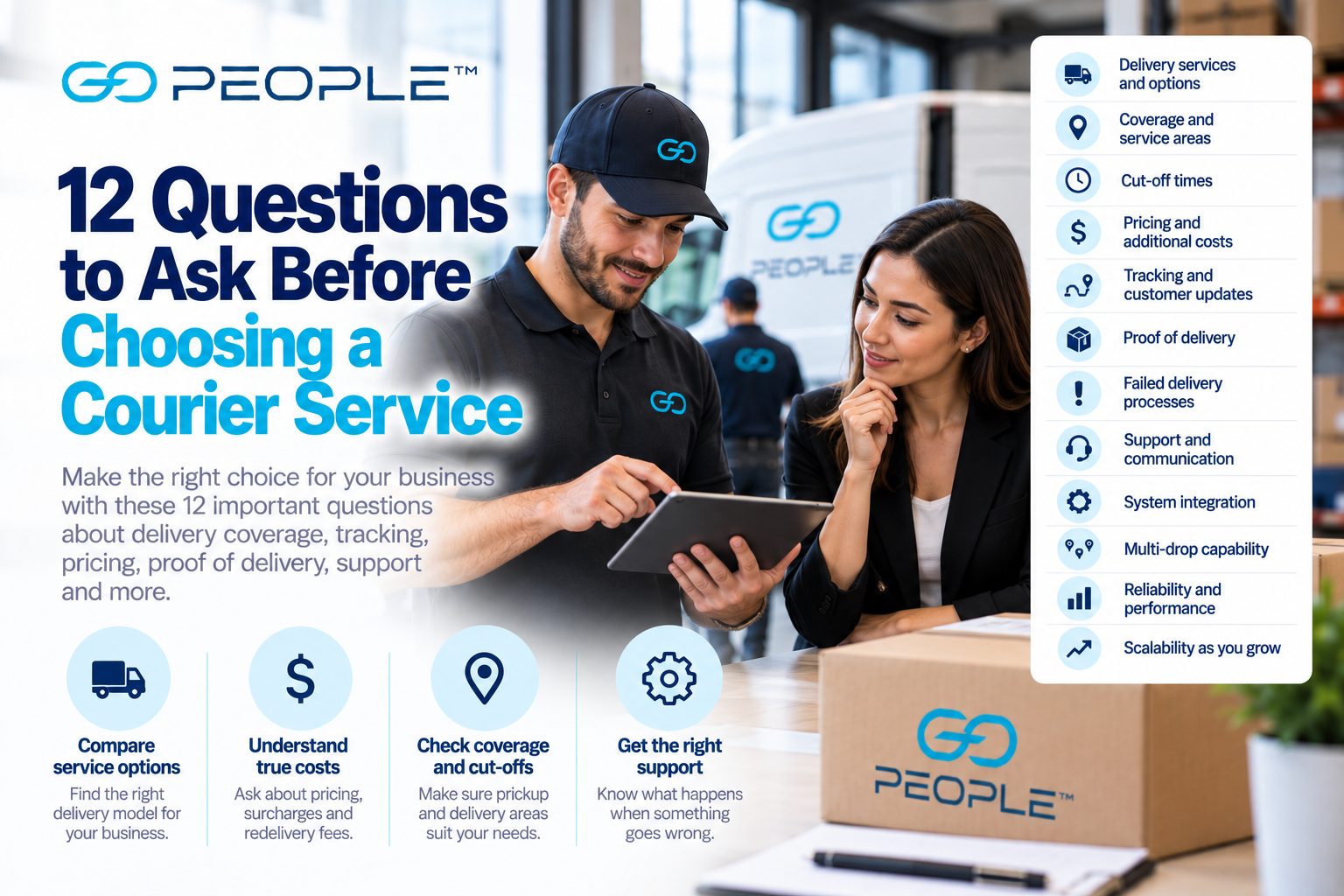
Choosing a courier service is not just about comparing delivery prices.
For businesses sending parcels regularly, the courier becomes part of the customer experience. Delivery coverage, tracking, proof of delivery, support, pricing structure and the way problems are handled can all affect your operations long after the initial booking.
A courier that works well for occasional urgent jobs may not be the right provider for hundreds of ecommerce parcels. Likewise, a next-day parcel network may not be the best solution for a business that needs multiple local deliveries completed from one pickup.
Before choosing a courier service, ask the right questions.
Here are 12 questions that can help you understand what you are actually buying — and whether the service fits your business.
1. What Types of Delivery Services Do You Offer?
Start with the basics.
Ask the courier to explain the different delivery models available rather than simply asking:
“Can you deliver our parcels?”
Different orders may require very different services.
Common options include:
- next-day delivery;
- same-day delivery;
- multi-drop delivery;
- on-demand courier;
- scheduled delivery;
- express or urgent delivery; and
- specialist delivery services.
Then compare these options with your actual order profile.
For example:
| Business requirement | Delivery model to investigate |
|---|---|
| Regular parcels required the following day | Next-day delivery |
| Many destinations from one warehouse | Multi-drop delivery |
| Orders that need to arrive today | Same-day delivery |
| Individual urgent jobs | On-demand courier |
| Recurring delivery routes | Scheduled or multi-drop service |
A courier provider may offer several services, but that does not mean every service is suitable for every shipment.
The first objective is to find the right delivery model, not simply the right courier company.
2. Where Do You Pick Up and Deliver?
Never assume that a courier’s advertised service area applies equally to pickups and deliveries.
Ask specifically:
- Which suburbs or postcodes can you pick up from?
- Which areas can you deliver to?
- Does coverage differ by service?
- Are there regional limitations?
- Are there additional charges outside core service areas?
- How can we check whether an address is eligible?
This is particularly important for businesses operating from multiple warehouses or stores.
A provider might offer broad delivery coverage while only collecting a particular service from selected pickup areas.
If you are planning to advertise a delivery option to customers, confirm coverage before making promises at checkout.
3. What Are Your Cut-Off Times?
Cut-off times can determine whether your delivery promise is operationally achievable.
Ask:
- What time must orders be booked?
- When must parcels be ready?
- What happens if we miss the cut-off?
- Are cut-offs different by city or service?
- Are there different requirements for high-volume customers?
Then compare the courier’s cut-off with your own fulfilment process.
For example, a courier cut-off of 2 pm is not very useful if your warehouse cannot finish picking and packing until 3 pm.
Your actual customer promise depends on:
Order received → picking → packing → dispatch → courier pickup → delivery
All of those stages need to work together.
4. How Does Your Pricing Work?
A headline delivery rate rarely tells you the complete cost.
Ask the provider to explain its pricing structure clearly.
Questions can include:
- Is pricing based on distance?
- Does parcel size or weight affect the price?
- Are there minimum charges?
- Are there fuel levies?
- Are there waiting-time charges?
- Are there redelivery fees?
- Are there after-hours charges?
- Are there surcharges for particular areas?
- Are there account or platform fees?
- Does pricing change with volume?
The objective is to understand your total expected delivery cost, not simply the advertised base rate.
A slightly higher base rate may ultimately cost less if it results in fewer failed deliveries, fewer support enquiries or better route efficiency.
Conversely, an inexpensive service may become costly once additional charges are included.
Ask for examples based on your actual delivery profile.
5. What Tracking Will We and Our Customers Receive?
Tracking should be one of the most important questions in a modern courier evaluation.
Ask to see the actual tracking experience.
Don’t settle for:
“Yes, we have tracking.”
Find out:
- When does tracking begin?
- Can your operations team see delivery progress?
- Can recipients track deliveries?
- Are tracking links available?
- Are delivery statuses easy to understand?
- Are customers notified of important updates?
- Can your support team access tracking information?
- What happens when a delivery is delayed?
- Is proof of delivery available through the same system?
Good tracking can reduce uncertainty for customers and make it easier for businesses to investigate delivery issues.
For more detail, see How to Track Your Delivery in Real Time.
6. What Proof of Delivery Do You Provide?
A delivery status saying Delivered is useful.
Evidence explaining where, when and how it was delivered is even more useful.
Ask what proof of delivery may be available.
Depending on the service, this could include:
- delivery timestamp;
- photograph;
- recipient confirmation;
- signature where required;
- delivery location information; or
- other completion records.
Then ask how your team can access that information.
Proof of delivery becomes particularly important when a customer says:
“My order says delivered, but I can’t find it.”
Without adequate information, your support team may need to begin a lengthy investigation.
With better delivery records, the issue may be much easier to understand.
7. What Happens When a Delivery Fails?
Successful deliveries are easy.
The real test of a courier service often comes when something goes wrong.
Ask:
- What happens if nobody is available?
- What happens if the driver cannot access the building?
- What happens if the address is incorrect?
- Can the recipient provide delivery instructions?
- How are unsuccessful attempts recorded?
- Is the customer notified?
- What happens to the parcel afterwards?
- How does redelivery work?
- Are additional fees involved?
- How long can the resolution process take?
The answer should be clear enough that your customer-service team knows what to tell customers.
A vague process creates vague customer communication.
You should understand the exception process before you need it.
8. How Do You Handle Delivery Problems and Support?
Ask who you contact when there is a problem.
For example:
- Is there a support team?
- What support channels are available?
- What are the support hours?
- Can support see the same tracking information you can?
- How are missing parcels investigated?
- How are wrong-address deliveries handled?
- How are recurring delivery problems escalated?
- Is there a process for business customers?
Support quality is difficult to judge from a sales presentation, so ask for practical examples.
For instance:
“A customer says their parcel is marked delivered but they don’t have it. What happens next?”
or:
“A driver cannot access an apartment building. What does the recipient see, and what does our team need to do?”
Specific scenarios often reveal much more than asking whether the provider has “great customer service”.
9. Can Your Service Integrate With Our Systems?
For occasional deliveries, manual booking may be perfectly adequate.
For higher-volume businesses, repeatedly entering order details can become inefficient and increase the risk of errors.
Ask whether the provider can work with:
- ecommerce platforms;
- warehouse systems;
- order-management systems;
- APIs;
- CSV or bulk uploads; or
- other relevant integrations.
Then consider which parts of the workflow can be automated.
Ideally, businesses should reduce unnecessary manual handling between:
Order → fulfilment → delivery booking → tracking → completion
Automation becomes increasingly valuable as delivery volume grows.
But integration capability alone is not enough. Ask what implementation is required and whether the integration supports the delivery information your business actually needs.
10. How Do You Manage Multiple Deliveries From One Pickup?
This question is particularly important for businesses sending many local deliveries.
Ask whether the provider treats every parcel as an independent courier job or can manage the deliveries as a coordinated route.
For example, imagine a retailer has 35 local orders ready at one warehouse.
There may be significant differences between:
35 separately booked point-to-point deliveries
and
one coordinated pickup with an optimised multi-drop route.
Ask:
- Can multiple deliveries be grouped into one run?
- Is the route optimised?
- Can each recipient receive tracking?
- Can each delivery have separate proof of delivery?
- How is the driver allocated?
- How is the run priced?
For suitable delivery profiles, route optimisation can reduce unnecessary travel and improve operational efficiency.
Businesses with this type of requirement can explore GoBUNDLE, GoPeople’s multi-drop delivery service.
11. How Do You Measure Delivery Performance?
Don’t only ask whether the courier is reliable.
Ask how reliability is measured.
Useful operational measures can include:
- pickup performance;
- delivery completion;
- delivery timeframes;
- first-attempt delivery success;
- unsuccessful deliveries;
- customer complaints;
- exceptions;
- proof-of-delivery compliance; and
- support issues.
The exact measures will vary between providers and services.
What’s important is whether performance can be observed and investigated.
If problems occur repeatedly, you should be able to determine whether they relate to:
- a particular route;
- fulfilment;
- addresses;
- customer availability;
- delivery capacity;
- service selection; or
- another operational cause.
Reliable delivery requires more than simply knowing that a parcel eventually arrived.
12. Is Your Service Suitable for Our Business as We Grow?
Your delivery requirements today may be very different from your requirements in 12 months.
Ask what happens as your volume increases.
Questions might include:
- Can you support higher daily volumes?
- Can we use different services for different orders?
- Can we operate from multiple pickup locations?
- Can booking become more automated?
- Can we access better operational reporting?
- How would our delivery model change as we grow?
A small ecommerce business might begin with occasional same-day or on-demand deliveries.
As order volume increases, it may need a combination of:
- regular next-day parcel delivery;
- dedicated multi-drop runs;
- same-day delivery for selected orders; and
- on-demand courier for genuinely urgent jobs.
The ideal provider should help you select the appropriate service for each requirement rather than forcing every order into the same delivery model.
Don’t Forget to Ask About Your Own Requirements
Choosing a courier is not only about interviewing providers.
You also need to understand your own delivery operation.
Before comparing services, gather information such as:
- average daily delivery volume;
- pickup locations;
- common delivery areas;
- average parcel dimensions;
- average parcel weight;
- order cut-off times;
- warehouse operating hours;
- delivery urgency;
- number of multi-drop orders;
- failed-delivery rate;
- customer delivery expectations;
- seasonal peaks; and
- expected growth.
Without this information, comparing courier proposals becomes difficult.
One provider may look cheaper simply because the quotation is based on a completely different delivery profile.
A Practical Courier Evaluation Checklist
When comparing providers, use a consistent checklist.
| Area | Questions to answer |
|---|---|
| Services | Does the provider offer the delivery models we need? |
| Coverage | Can it collect from and deliver to our required areas? |
| Cut-offs | Do booking and pickup times work with our warehouse? |
| Pricing | Do we understand the full cost structure? |
| Tracking | Can our team and customers see delivery progress? |
| Proof of delivery | What evidence is available after completion? |
| Failed deliveries | What happens when delivery cannot be completed? |
| Support | Who helps when something goes wrong? |
| Integrations | Can delivery connect with our existing systems? |
| Multi-drop | Can multiple deliveries be efficiently routed? |
| Performance | How is service performance measured? |
| Scalability | Can the service support our future volume? |
Ask each provider the same questions.
That makes comparison much more useful than simply putting delivery rates side by side.
Price Isn’t the Same as Cost
Courier selection often becomes a comparison of:
Provider A: $X per delivery
versus
Provider B: $Y per delivery
But businesses should consider the broader cost.
A useful way to think about it is:
Total delivery cost = courier charges + operational handling + failed deliveries + redeliveries + customer support + replacements/refunds + administration
A service that costs slightly more per parcel could potentially produce a lower total operational cost if it improves efficiency or reduces exceptions.
Similarly, paying for premium delivery speed on every order may waste money if customers do not need it.
The objective should be to find the most appropriate service for the order, not automatically the cheapest or fastest option.
For more detail, see How Businesses Can Reduce Delivery Costs Without Sacrificing Service.
Test the Customer Experience Yourself
Before committing significant delivery volume to a provider, consider experiencing the delivery process from the recipient’s perspective.
Look at:
- booking;
- tracking;
- notifications;
- status language;
- delivery attempt communication;
- proof of delivery; and
- support.
Ask yourself:
Would our customers understand what is happening?
This is particularly important for ecommerce businesses because customers often associate the delivery experience with the retailer, not the courier.
If the tracking experience is confusing or delivery communication is poor, your own brand may receive the complaint.
Don’t Choose One Service for Every Delivery
Businesses often have several types of delivery needs.
For example, the same retailer might have:
- standard orders that can arrive tomorrow;
- several local deliveries leaving one warehouse;
- a customer who needs an order today; and
- an urgent replacement that needs immediate attention.
These don’t necessarily belong in the same delivery service.
GoPeople provides several business delivery options:
GoEXPRESS for next-day delivery.
GoBUNDLE for multi-drop delivery.
GoSAMEDAY for same-day delivery.
GoVIP for on-demand courier requirements.
Service availability varies by location and service, so businesses should check eligibility for their pickup requirements.
Choosing a Courier Is an Operational Decision
A courier provider affects more than transport.
It can influence:
- warehouse processes;
- customer-service workload;
- delivery costs;
- customer communication;
- returns and redeliveries;
- operational visibility; and
- customer satisfaction.
That is why the right questions go well beyond:
“How much does delivery cost?”
A better conversation is:
“How will this delivery service work inside our business?”
Understand the service, coverage, cut-offs, pricing, tracking, proof of delivery, exception handling, support and scalability before making a decision.
The result is a courier arrangement based on how your business actually operates rather than simply which provider offered the lowest headline rate.
Businesses comparing their options can also read our broader guide to choosing a courier service for your business.
Frequently Asked Questions
What should I ask a courier company before using them?
Ask about delivery services, pickup and delivery coverage, cut-off times, pricing, tracking, proof of delivery, failed-delivery processes, customer support, integrations, multi-drop capability, performance measurement and scalability.
How do I compare courier companies?
Start with the same delivery profile and ask each provider the same questions. Compare the complete service — not just the base delivery rate — including coverage, tracking, support, surcharges, failed-delivery processes and operational requirements.
What hidden courier costs should businesses ask about?
Ask about fuel levies, redelivery charges, waiting time, area surcharges, parcel-size or weight charges, account fees and other charges relevant to your delivery profile. Pricing structures vary, so request a complete explanation from each provider.
Why is courier tracking important for businesses?
Tracking gives operations and customer-service teams visibility into delivery progress while helping recipients understand what is happening with their order. It can also make delivery exceptions easier to investigate.
What proof of delivery should a courier provide?
This depends on the service, but businesses should ask what completion records are available, such as timestamps, photographs, recipient confirmation or signatures where applicable.
Should a business use the cheapest courier service?
Not necessarily. Businesses should consider total delivery cost, including operational handling, failed deliveries, customer support and redelivery, as well as the courier charge itself.
Can a business use more than one type of courier service?
Yes. Different orders can have different requirements. A business may use next-day delivery for regular parcels, multi-drop delivery for local runs, same-day delivery for time-sensitive orders and on-demand courier services for urgent jobs.