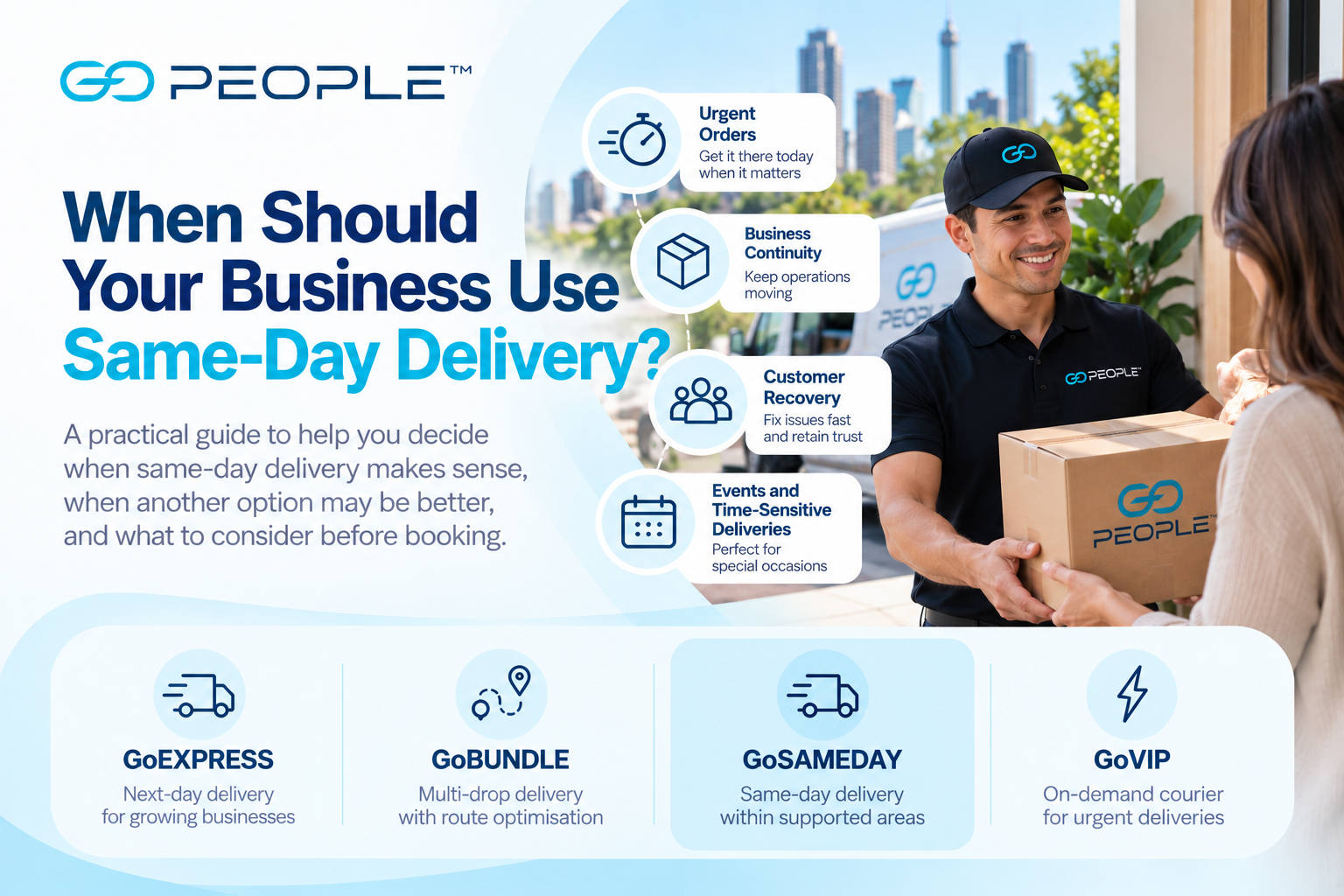
Same-day delivery can be extremely valuable when an order genuinely needs to arrive today.
But that doesn’t mean every order should be sent using a same-day service.
For businesses, the better question is not simply “Can we deliver this today?” It is “Does this order need to be delivered today, and does the value of doing so justify the service?”
Some deliveries are genuinely time-sensitive. A replacement item may be needed before a customer closes for the day. A retailer may need to recover an urgent customer order. A florist may have arrangements that need to arrive for an event. A business may need documents delivered before a deadline.
Other orders can comfortably arrive tomorrow.
Understanding the difference can help businesses balance delivery speed, cost and customer expectations.
What Is Same-Day Delivery?
Same-day delivery means an order is collected and delivered on the same day, subject to the provider’s service area, booking requirements, cut-off times and other applicable conditions.
It sits between slower scheduled delivery options and highly urgent on-demand courier services.
A typical business might use same-day delivery when:
Order ready today → Pickup today → Delivery completed today
The important characteristic is that the order needs to reach the recipient before the day ends rather than simply as quickly as physically possible.
Same-Day Delivery Doesn’t Mean Every Order Is Urgent
This distinction matters.
Consider two customers.
Customer A
Orders replacement stock at 9am because their business needs it before closing.
Customer B
Orders a normal ecommerce product at 9am and would be perfectly happy receiving it tomorrow.
Both orders could potentially be delivered the same day.
Only Customer A has a clear reason why that speed matters.
Automatically upgrading Customer B to same-day delivery may increase delivery costs without creating meaningful additional value.
Businesses should therefore match delivery speed to customer need, not simply choose the fastest service available.
When Should a Business Use Same-Day Delivery?
Same-day delivery makes the most sense when receiving the order today creates a clear customer or operational benefit.
Here are some of the strongest use cases.
1. Urgent Replacement Orders
Something has gone wrong with the customer’s original order.
Perhaps:
- the wrong product was delivered
- an item arrived damaged
- part of the order was missing
- a previous delivery failed
- the customer urgently needs a replacement
In these situations, same-day delivery can become part of the customer-recovery process.
Imagine a customer needed a product for an event that evening.
Telling them:
“We’ll send another one next week”
may not solve the problem.
If a replacement can reasonably reach them that day, faster recovery may preserve the customer relationship.
2. Time-Sensitive Business Supplies
Businesses sometimes need an item to keep operating.
Examples could include:
- replacement equipment
- components
- documents
- supplies
- samples
- stock
A delay might prevent work from being completed.
In that situation, the cost of delivery needs to be compared with the cost of waiting.
Suppose a $25 component is required to complete a $2,000 job.
The value of getting that component to the business today may be much greater than the value of the component itself.
3. Urgent Retail Orders
Retailers can use same-day delivery when customers genuinely value receiving an order quickly.
This may be particularly relevant when:
- the product is needed that evening
- a customer needs an urgent replacement
- the item is available locally
- the retailer wants to offer a premium delivery choice
But the retailer should still consider whether every product needs same-day availability.
The service may work better as an option rather than the default delivery method.
4. Flowers and Gifts
Timing can be fundamental to the value of some products.
A flower arrangement delivered the day after a birthday isn’t equivalent to one delivered on the birthday.
The same can apply to:
- gifts
- celebration products
- event items
For florists and gift businesses, same-day delivery may therefore be an important part of the service proposition.
However, businesses making many deliveries from one location should also consider whether a planned multi-drop route is more appropriate than booking every order separately.
Our guide on how to deliver flowers safely covers delivery planning for florists in more detail.
5. Cakes and Event Products
Some products have a fixed deadline.
A cake required for an event at 6pm has limited value if it arrives the following morning.
Businesses delivering:
- cakes
- event supplies
- decorations
- promotional material
- other event-specific products
may therefore have genuine same-day requirements.
Timing isn’t simply a convenience in these cases.
It is part of whether the product fulfils its purpose.
For cake businesses, see our guide on how to deliver cakes safely.
6. Important Business Documents
Although many documents are now digital, physical documents are still sometimes required.
A business might need to move:
- signed originals
- contracts
- tender documents
- legal documents
- physical records
where appropriate and permitted.
If a physical document has a genuine same-day deadline, waiting until tomorrow may not be an option.
Businesses should choose the delivery service according to the actual timing and handling requirements of the document.
7. Urgent Parts and Components
A missing component can stop a larger job.
For example:
Equipment value: $20,000
Missing component: $40
Work cannot continue without it
In this situation, evaluating delivery purely against the $40 product value misses the point.
The relevant question is:
What is the operational cost if the component doesn’t arrive today?
Same-day delivery can make commercial sense when the cost of waiting is materially greater than the additional delivery cost.
8. Stock Transfers Between Locations
A retailer may have:
Store A — product available
and:
Store B — customer waiting
Rather than losing the sale or waiting for the next scheduled stock transfer, the business may decide that same-day movement between locations is worthwhile.
This won’t make sense for every stock transfer.
But it can be useful for:
- high-value sales
- urgent customer orders
- stock imbalances
- unexpected shortages
Again, the decision should be based on the value created by faster delivery.
9. Customer-Service Recovery
Same-day delivery can sometimes be used strategically after a business has made a mistake.
For example:
Wrong product sent yesterday → Correct product delivered today
The business still needs to understand the cause of the original problem.
But resolving the issue quickly can improve the recovery experience.
A customer may remember how effectively the business solved the problem, not only that the problem occurred.
10. Unexpected Operational Requirements
Businesses don’t always know in advance when urgent deliveries will be required.
Examples might include:
- stock unexpectedly running out
- equipment failure
- a supplier error
- a customer changing requirements
- an item being left behind
- an unexpected event
Same-day delivery can provide flexibility when normal logistics processes cannot meet an unforeseen requirement.
That doesn’t mean it should replace good planning.
It means businesses have another option when circumstances change.
Same-Day Delivery for Ecommerce
Same-day delivery can be attractive in ecommerce because it creates a strong customer proposition:
Order today. Receive today.
But businesses need to examine the operational implications.
To offer same-day delivery consistently, several things need to work together:
Inventory availability → Order processing → Picking → Packing → Booking → Pickup → Delivery
If the website accepts same-day orders faster than the warehouse can prepare them, the promise becomes difficult to fulfil.
Before promoting same-day ecommerce delivery, consider:
- order cut-off
- inventory accuracy
- warehouse capacity
- pickup eligibility
- customer delivery area
- parcel requirements
- delivery cost
The checkout promise should reflect what operations can reliably support.
Same-Day Delivery for B2B
B2B same-day delivery can be particularly valuable when the delivery affects another business’s ability to operate.
Examples might include:
- replacement stock
- documents
- samples
- components
- business supplies
The value calculation can therefore differ from consumer ecommerce.
Instead of asking:
“Is this parcel worth paying extra to deliver today?”
the better question may be:
“What happens to our customer if it doesn’t arrive today?”
If the delay stops production, prevents a job from being completed or creates another significant cost, same-day delivery may be commercially justified.
Same-Day vs Next-Day Delivery
The key difference is straightforward.
Same-Day Delivery
Pickup and delivery occur on the same day, subject to service conditions.
Best suited to orders where today matters.
Next-Day Delivery
The order is collected and delivered the following day, subject to applicable service conditions.
Best suited to orders where tomorrow is sufficiently fast.
For many routine ecommerce orders, next-day delivery can provide a strong balance between speed and operational efficiency.
For genuinely time-sensitive orders, same-day may be more appropriate.
Read our full comparison of same-day vs next-day delivery.
Same-Day vs On-Demand Courier
These services can sound similar, but the customer requirement may differ.
Same-day delivery means the order needs to arrive that day.
On-demand delivery is generally better suited to an urgent job requiring a more immediate courier response.
For example:
“This needs to arrive sometime today.”
may suit same-day delivery.
Whereas:
“This needs to be picked up urgently and taken to the recipient as soon as possible.”
may be better suited to an on-demand courier service.
GoPeople’s GoVIP is designed for urgent and time-sensitive on-demand courier requirements.
Same-Day vs Multi-Drop Delivery
Consider a florist with 35 deliveries ready in the morning.
All need to arrive that day.
Does that automatically mean 35 separate same-day courier bookings?
Not necessarily.
If multiple orders originate from the same pickup point, a planned multi-drop route may be more appropriate.
GoPeople’s GoBUNDLE is designed for businesses with multiple deliveries that can be organised into a route.
The distinction is useful:
Same-day describes when the delivery needs to arrive.
Multi-drop describes how multiple deliveries can be organised operationally.
The right model depends on the delivery profile.
When NOT to Use Same-Day Delivery
Same-day delivery can be useful, but it shouldn’t become the default simply because it is faster.
Here are situations where another option may make more sense.
1. The Customer Doesn’t Need It Today
If tomorrow meets the customer’s expectations, next-day delivery may be sufficient.
Speed has little value when nobody needs it.
2. The Order Isn’t Ready
A courier cannot compensate for a warehouse that hasn’t finished picking and packing.
If fulfilment regularly runs late, fix the underlying process rather than relying on faster delivery to recover lost time.
3. You Have Many Deliveries That Can Be Consolidated
If dozens of orders leave the same warehouse for nearby destinations, consider whether a multi-drop route would be more efficient.
4. The Job Is More Urgent Than Same-Day
Sometimes “today” isn’t specific enough.
If an item needs immediate pickup and delivery, an on-demand courier may be more appropriate.
5. Same-Day Cost Exceeds the Value Created
Suppose a customer is perfectly happy receiving an inexpensive product tomorrow.
Paying significantly more to deliver it today may not create enough commercial value.
6. Your Business Cannot Reliably Support the Promise
Don’t advertise same-day delivery if your:
- inventory isn’t accurate
- warehouse can’t meet cut-offs
- pickup location isn’t eligible
- customer is outside the service area
A reliable next-day promise is better than an unreliable same-day promise.
How to Decide Whether an Order Needs Same-Day Delivery
A simple decision framework can help.
Question 1: Does the Customer Need It Today?
If no, consider next-day or another appropriate service.
If yes, continue.
Question 2: What Happens If It Arrives Tomorrow?
Consider the consequence.
Is it:
Minor inconvenience?
or:
Lost sale / stopped work / missed event / serious customer problem?
The greater the consequence, the stronger the case for same-day delivery.
Question 3: Is the Order Ready?
Same-day delivery works only if the order can be prepared within the relevant timeframe.
Question 4: Are Pickup and Destination Eligible?
Check service availability before promising the customer.
Question 5: Is It One Delivery or Many?
A single time-sensitive order may suit same-day delivery.
Many orders from one pickup point may suit a multi-drop service.
Question 6: Is It Actually Urgent?
If immediate pickup is required, consider whether an on-demand courier is more appropriate.
Question 7: Does the Commercial Value Justify the Cost?
Compare the delivery cost with the value of solving the customer’s problem today.
Consider the Total Cost, Not Just the Courier Fee
Imagine same-day delivery costs more than next-day delivery.
That doesn’t automatically make it expensive.
Suppose same-day delivery prevents:
- a cancelled order
- an unhappy high-value customer
- a business customer losing productive time
- an event product becoming useless
- an important job being delayed
The extra delivery cost may be worthwhile.
Conversely, if receiving the order tomorrow makes no meaningful difference, the premium may provide little value.
The decision should be based on total business impact.
Plan Cut-Off Times Carefully
Businesses offering same-day delivery need clear operational cut-offs.
Your customer promise needs to account for:
Order received → Payment confirmed → Pick → Pack → Ready → Courier pickup → Delivery
If orders can be placed for same-day delivery until a time the warehouse cannot realistically support, delays become likely.
Align:
- website messaging
- checkout availability
- warehouse cut-offs
- delivery-provider requirements
The customer should never be promised a service that operations cannot fulfil.
Check Service Availability Before Advertising It
Same-day delivery is usually geographically dependent.
Pickup eligibility and delivery coverage may differ.
Businesses should verify:
- pickup location
- destination
- booking time
- service requirements
before making broad promises.
GoPeople’s service eligibility checker can be used to check which GoPeople services are available for a pickup location.
Make Delivery Options Clear at Checkout
For ecommerce businesses, customers should understand what they’re choosing.
For example:
Next-day delivery — appropriate for routine orders
Same-day delivery — for orders required today
Where appropriate, pricing and timeframes should be clear before payment.
Avoid vague labels such as:
Fast
and:
Faster
if customers cannot understand the practical difference.
Don’t Make Every Delivery Free and Same-Day
“Free same-day delivery” can sound attractive in marketing.
But businesses should examine the economics carefully.
Delivery still has a cost even if the customer pays $0 at checkout.
If every low-value order is automatically upgraded to a faster service, margins can deteriorate quickly.
Where appropriate, businesses might instead use:
- paid same-day upgrades
- minimum-order thresholds
- same-day delivery for selected products
- same-day delivery within selected areas
- promotional same-day offers
The right structure depends on margins and customer demand.
Use Tracking to Support Same-Day Delivery
When the delivery window is short, visibility becomes particularly valuable.
Customers may want to know whether:
- the order has been booked
- delivery is progressing
- something has changed
- delivery has been completed
Tracking can also help business support teams respond to customer questions.
Our guide on how to track a delivery in real time explains common delivery tracking concepts.
Customer Communication Matters
Customers choosing same-day delivery usually have stronger expectations around timing.
Make sure they understand:
- what service they selected
- applicable delivery timeframe
- tracking availability
- what information they need to provide
- what happens if delivery cannot be completed
Collect accurate:
- address
- unit number
- postcode
- contact number
- access instructions
An urgent delivery with the wrong address is still likely to fail.
Measure Same-Day Delivery Performance
If same-day delivery becomes an important part of your business, measure it.
Useful metrics can include:
- same-day order volume
- successful delivery rate
- delivery-related support enquiries
- failed-delivery rate
- delivery cost per order
- customer complaints
- repeat purchase behaviour
- conversion where same-day is offered
- percentage of customers selecting the service
This helps determine whether customers genuinely value the option.
Don’t Judge Success Only by Usage
Suppose 30% of customers select same-day delivery.
That sounds positive.
But you still need to know:
- Is the service profitable?
- Are customers paying for it?
- Is it reducing cart abandonment?
- Does it increase conversion?
- Are customers satisfied?
- Can operations handle the volume?
- Are there more delivery exceptions?
Usage is only one measure.
The service should contribute positively to the overall customer and business outcome.
Build Same-Day Delivery Around Customer Need
The strongest same-day strategy isn’t:
“Deliver everything as fast as possible.”
It is:
“Make same-day delivery available when receiving the order today creates meaningful value.”
That distinction helps businesses control costs while still providing speed where customers genuinely need it.
Choosing the Right GoPeople Service
GoPeople provides several delivery options for different business requirements.
Next-Day Delivery
GoEXPRESS is designed for next-day business parcel delivery in supported locations.
Use it when tomorrow meets the delivery requirement.
Multi-Drop Delivery
GoBUNDLE is designed for businesses with multiple deliveries that can be organised into a route.
Use it when many orders leave a common pickup point.
Same-Day Delivery
GoSAMEDAY is designed for business deliveries that need to be completed on the same day within supported service areas.
Use it when the order genuinely needs to arrive today.
On-Demand Courier
GoVIP is designed for urgent and time-sensitive individual courier requirements.
Use it when the job requires a more immediate response.
Businesses can check service availability for their pickup location.
Frequently Asked Questions About Same-Day Delivery
What is same-day delivery?
Same-day delivery is a service where an order is collected and delivered on the same day, subject to the provider’s service area, booking requirements, cut-offs and other applicable conditions.
When should a business use same-day delivery?
Same-day delivery makes sense when receiving the order today creates meaningful value. Examples can include urgent replacement orders, time-sensitive business supplies, event products, stock transfers and customer-service recovery.
Is same-day delivery suitable for ecommerce?
Yes, where the business can support it operationally. Inventory accuracy, fulfilment speed, order cut-offs, pickup eligibility, destination coverage and delivery costs all need to be considered before offering same-day delivery at checkout.
What’s the difference between same-day and next-day delivery?
Same-day delivery completes the delivery on the day of booking, while next-day delivery is intended for delivery the following day, subject to the applicable service conditions. If the customer doesn’t need the order today, next-day delivery may be sufficient.
What’s the difference between same-day and on-demand delivery?
Same-day delivery is useful when an order needs to arrive sometime that day. On-demand courier delivery is generally better suited to individual jobs requiring a more immediate response.
Should businesses offer same-day delivery for free?
Not automatically. The business still incurs a delivery cost even if the customer isn’t charged. Consider product margin, order value, customer demand and the commercial benefit before subsidising same-day delivery.
How can businesses reduce failed same-day deliveries?
Collect accurate delivery addresses, unit numbers, contact information and access instructions. Set realistic cut-offs, confirm service eligibility and provide customers with useful delivery information and tracking where available.