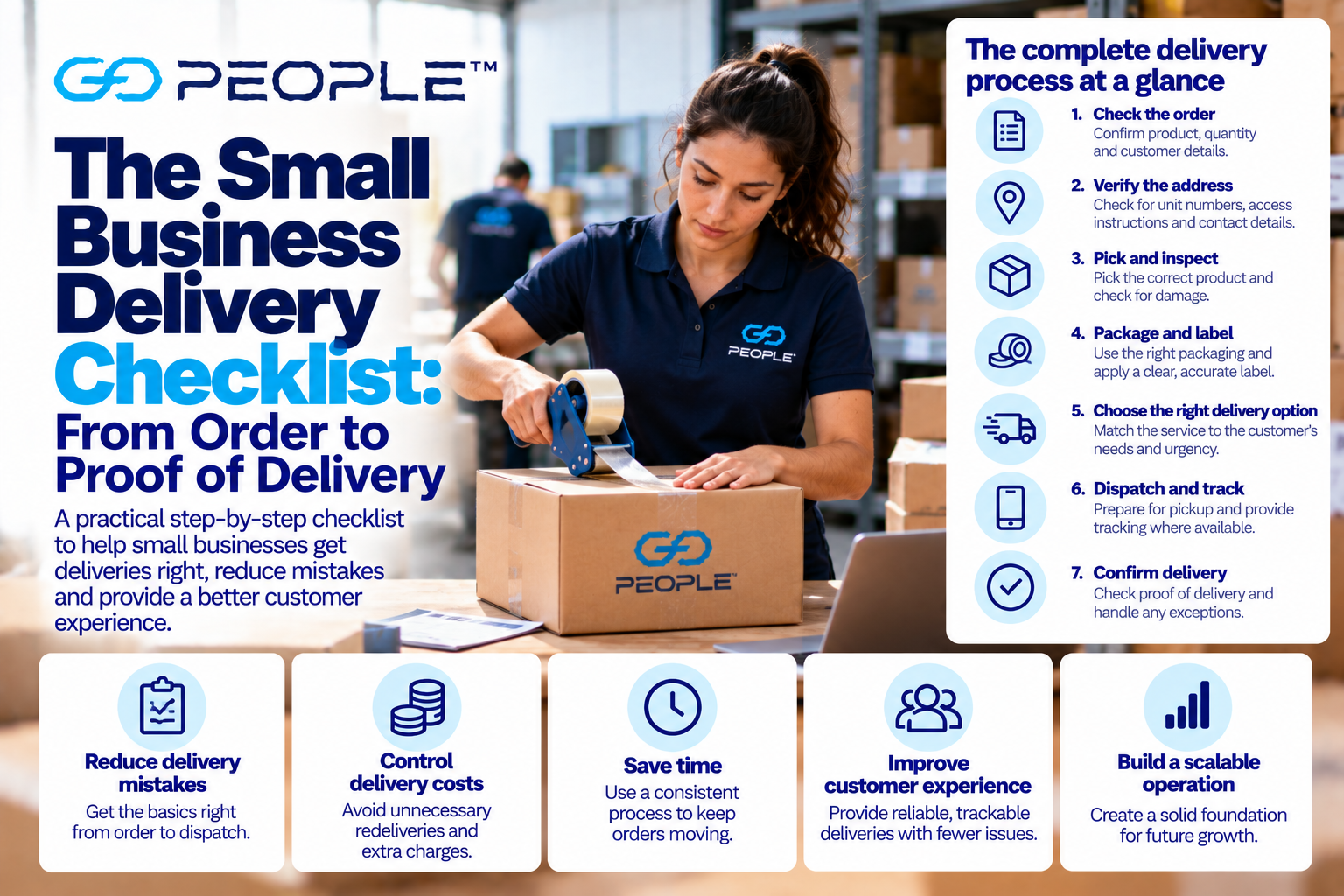
A reliable delivery starts long before a driver arrives.
For a small business, many delivery problems actually begin earlier in the process:
- the wrong address was entered;
- an apartment number was missing;
- the product was packed poorly;
- the wrong delivery service was selected;
- the parcel wasn’t ready at pickup;
- customer contact details were incomplete;
- delivery instructions were missing; or
- nobody checked what happened after dispatch.
Individually, these can look like small mistakes.
At scale, they create:
- failed deliveries;
- late orders;
- damaged products;
- customer enquiries;
- redeliveries;
- refunds;
- additional delivery costs; and
- unhappy customers.
The solution does not have to be complicated.
A consistent delivery checklist can help a small business make sure the basics are completed correctly every time.
This guide follows the delivery process from the moment an order arrives through to proof of delivery and performance review.
1. Check the Order Before Fulfilment Begins
Start with the order itself.
Before picking or packing anything, confirm:
- correct product;
- correct quantity;
- customer name;
- delivery address;
- postcode;
- contact number;
- delivery option;
- customer instructions; and
- any relevant delivery requirements.
Fixing an error at this stage is usually much easier than fixing it after dispatch.
Watch for unusual orders
Some orders deserve additional attention.
Examples include:
- unusually high-value orders;
- multiple quantities of the same product;
- large or bulky items;
- fragile products;
- unusual addresses;
- urgent delivery requests; and
- orders with detailed customer instructions.
A simple review can prevent an unusual order from being processed through an unsuitable delivery workflow.
2. Verify the Delivery Address
Address quality is one of the most important parts of successful delivery.
A valid-looking address is not necessarily a complete address.
Check for:
- street number;
- street name;
- suburb;
- state;
- postcode;
- unit or apartment number;
- building name where relevant; and
- business name where relevant.
For apartments, offices, shopping centres and other complex destinations, additional information may be important.
This could include:
- floor;
- suite;
- reception location;
- loading dock;
- access instructions;
- intercom details; or
- other appropriate delivery instructions.
Don’t rely on the postcode alone
A postcode can cover multiple locations.
The complete address should be checked.
Small address errors can lead to:
wrong location → unsuccessful delivery → customer contact → redelivery → additional cost
Address accuracy is one of the cheapest delivery problems to fix because it can often be corrected before the parcel leaves the business.
3. Check the Customer’s Contact Details
A mobile number can become important if there is an issue at delivery.
Before dispatch, check that the customer has provided a usable contact number where required.
For business deliveries, consider whether the contact should be:
- the purchaser;
- the recipient;
- reception;
- warehouse staff; or
- another appropriate contact.
The person placing the order is not always the person receiving it.
4. Pick the Correct Product
A perfectly executed delivery of the wrong product is still a failed customer experience.
Before packing, verify:
- SKU;
- product;
- variant;
- size;
- colour;
- quantity; and
- any included accessories.
For higher-volume businesses, barcode scanning or another systematic verification process can reduce picking mistakes.
For smaller operations, even a simple check against the order before sealing the parcel can help.
5. Inspect the Product Before Packing
Don’t dispatch a product that is already:
- damaged;
- leaking;
- broken;
- incomplete; or
- unsuitable for sale.
Once the parcel leaves your premises, it can become difficult to determine whether damage occurred:
before packing
or:
during delivery.
A quick inspection provides another opportunity to catch problems before the customer sees them.
6. Choose Packaging for the Product
Packaging should protect the item through:
- handling;
- loading;
- transport;
- unloading; and
- final delivery.
Consider:
- product weight;
- fragility;
- shape;
- movement inside the package;
- moisture;
- leakage;
- crushing risk; and
- temperature sensitivity where relevant.
Avoid using an unnecessarily large box simply because it is available.
Oversized packaging can:
- use more material;
- allow more internal movement;
- occupy more vehicle space; and
- potentially increase delivery costs.
Right-sized packaging is usually preferable.
7. Prevent Movement Inside the Package
Fragile products should not move freely inside the box.
Use appropriate protective material to:
- cushion the product;
- separate multiple items;
- protect vulnerable edges;
- fill unnecessary void space; and
- prevent direct contact between fragile items.
After packing, gently check whether the contents move excessively.
If they do, reconsider the internal protection before dispatch.
For fragile goods, see How to Pack and Deliver Fragile Items Safely.
8. Seal the Parcel Properly
The package should remain closed throughout normal handling and transport.
Check:
- seams;
- openings;
- tape;
- closures; and
- package condition.
Do not assume that a product’s retail packaging is automatically suitable as shipping packaging.
9. Make the Delivery Label Easy to Read
The delivery information should be:
- correct;
- clearly visible;
- firmly attached; and
- unobstructed.
Remove or cover old delivery labels when reusing packaging.
Multiple visible addresses or barcodes can create unnecessary confusion.
Before dispatch, compare the label against the order one final time.
10. Choose the Right Delivery Option
Not every order requires the same service.
The appropriate choice may depend on:
- urgency;
- customer expectation;
- number of deliveries;
- pickup location;
- destination;
- order value;
- parcel characteristics; and
- service availability.
For example, a business might have different workflows for:
| Delivery Requirement | Potential Approach |
|---|---|
| Routine parcel | Next-day or another regular parcel service |
| Customer needs it today | Same-day where eligible |
| Many destinations from one pickup | Multi-drop |
| Individual urgent requirement | On-demand |
The important point is to select the service based on the delivery requirement rather than automatically treating every order the same.
For a detailed framework, see How to Build a Flexible Delivery Strategy for Your Business.
11. Don’t Pay for Urgency the Customer Doesn’t Need
Faster delivery can be valuable.
But not every order needs the fastest available service.
Ask:
- When does the customer need the order?
- What delivery promise was made?
- Is the customer paying for premium delivery?
- Is the order genuinely urgent?
- Would another service meet the requirement at a lower cost?
The objective is not simply to minimise delivery cost.
It is to avoid paying for a service level that adds little customer value.
12. Confirm Service Eligibility
Do not promise a delivery service solely because it exists.
Check whether the actual job is eligible.
Depending on the service, this can involve:
- pickup location;
- destination;
- booking time;
- parcel requirements; and
- other service conditions.
This is especially important when offering delivery choices through an ecommerce checkout.
13. Make Sure the Order Is Ready for Pickup
A driver arriving before the parcel is ready wastes time.
Before pickup, make sure:
- picking is complete;
- packing is complete;
- labels are attached;
- parcels are staged;
- quantities are confirmed; and
- pickup staff know where the goods are.
If there are multiple parcels, organise them so the handover can happen efficiently.
14. Create a Clear Dispatch Area
Even a small warehouse or store can benefit from a dedicated dispatch area.
Separate:
orders still being prepared
from:
orders ready for collection.
This reduces the risk of:
- handing over the wrong parcel;
- missing a parcel;
- dispatching an incomplete order; or
- making the driver wait while staff search for goods.
The system does not need to be sophisticated.
It needs to be consistent.
15. Count Parcels at Handover
If a driver is collecting multiple items, confirm how many are leaving.
For example:
Expected: 37 parcels
Handed over: 37 parcels
A simple count creates a useful control point.
If only 36 parcels appear later in the delivery process, you know there was already a discrepancy at handover.
16. Record the Handover
For higher-volume operations, establish a clear handover record.
Depending on your systems, this could include:
- collection status;
- number of parcels;
- time;
- manifest;
- scan;
- booking record; or
- other appropriate confirmation.
The objective is to establish:
what left + when it left + under which delivery job
This can make later investigations much easier.
17. Give Customers Tracking Where Available
Once an order is dispatched, customers naturally want to know what is happening.
Tracking can help answer:
- Has my order been collected?
- Is it on the way?
- Has anything gone wrong?
- Has it been delivered?
Good tracking reduces uncertainty.
It can also reduce customer-service enquiries because customers can find information without contacting the business.
For more detail, see How Delivery Tracking Can Reduce Customer Service Enquiries.
18. Send Useful Delivery Notifications
Notifications should help the customer understand what is happening.
Depending on the delivery service, useful updates may relate to:
- dispatch;
- delivery progress;
- attempted delivery;
- successful delivery; or
- an exception requiring attention.
Avoid sending unnecessary messages simply because the technology allows it.
The purpose of a notification is to provide useful information.
19. Monitor Exceptions, Not Every Normal Delivery
If you send hundreds of deliveries, manually watching every parcel is not scalable.
Instead, focus operational attention on exceptions.
Examples include:
- unsuccessful delivery;
- unusual delay;
- incorrect address;
- delivery dispute;
- missing parcel;
- customer access issue; or
- other abnormal status.
Normal deliveries should ideally flow through the process without requiring manual intervention.
Your team can then focus on the small percentage that need attention.
20. Act Quickly When Something Goes Wrong
Delivery problems become more difficult when nobody owns the response.
Create an internal process for exceptions.
For example:
Issue detected
↓
Check tracking and delivery information
↓
Identify the type of problem
↓
Contact the appropriate delivery support channel
↓
Update the customer
↓
Record the outcome
↓
Review recurring causes
The exact process depends on the delivery provider and issue.
The important thing is that staff know what to do.
21. Avoid Giving Customers Information You Haven’t Confirmed
When customers ask about a delayed or unsuccessful delivery, staff may feel pressure to provide an immediate answer.
Avoid guessing.
Instead:
- check the available tracking information;
- confirm the latest known status;
- investigate if necessary;
- explain what will happen next; and
- provide realistic expectations.
An inaccurate promise can turn one delivery problem into a larger customer-service problem.
22. Check Proof of Delivery
After delivery, proof of delivery can help confirm completion.
Depending on the service, proof may include information such as:
- delivery status;
- timestamp;
- photograph;
- signature; or
- other delivery records.
Proof of delivery becomes particularly useful when a customer says:
“I haven’t received it.”
Your support team can start with evidence rather than assumptions.
For a detailed explanation, see What Is Proof of Delivery and Why Does It Matter?.
23. Don’t Ignore Completed Deliveries
A delivery being marked complete does not mean the process should never be reviewed.
Look for patterns such as:
- frequent delays;
- repeated failed deliveries;
- particular problem destinations;
- recurring address errors;
- damaged goods;
- repeated customer complaints; or
- high redelivery rates.
Individual incidents may appear random.
Patterns reveal operational problems.
24. Track Failed Deliveries
A failed delivery can create additional costs through:
- driver time;
- support;
- redelivery;
- return handling;
- customer communication; and
- potential refunds or replacements.
Track both the number and reason.
Useful categories might include:
- incorrect address;
- inaccessible location;
- recipient unavailable;
- incomplete instructions;
- delivery exception; or
- other appropriate causes.
Then address the recurring problems.
See How to Reduce Failed Deliveries and Improve First-Attempt Delivery Success.
25. Track Late Deliveries
Don’t look only at the number of late deliveries.
Understand why they were late.
The cause may be:
- late picking;
- late packing;
- missed dispatch;
- unrealistic delivery promise;
- address problems;
- routing;
- capacity;
- external disruption; or
- another operational issue.
If the warehouse repeatedly misses dispatch, changing courier providers will not necessarily fix the problem.
Separate internal fulfilment delays from delivery-network delays.
26. Track Delivery-Related Customer Enquiries
Customer service can provide valuable operational data.
Categorise enquiries such as:
- Where is my order?
- Delivery is late.
- Marked delivered but not received.
- Driver couldn’t access the property.
- Wrong address.
- Damaged item.
- Need to change delivery details.
If one category increases significantly, investigate it.
Customer-service data can reveal delivery problems before they appear clearly in financial reporting.
27. Calculate the True Cost of Delivery
The courier charge is only one component.
The true delivery cost can also include:
- packaging;
- warehouse labour;
- delivery charges;
- surcharges;
- failed deliveries;
- redeliveries;
- support time;
- replacements; and
- refunds or credits.
A low delivery rate is not necessarily inexpensive if the process creates substantial downstream costs.
For more detail, see How Businesses Can Reduce Delivery Costs Without Sacrificing Service.
28. Review Your Delivery Mix
As a business grows, one delivery service may no longer suit every order.
GoPeople’s business delivery options include:
Next-Day Delivery
For eligible business pickups in Sydney, Melbourne and Brisbane, GoEXPRESS provides next-day parcel delivery with tracking and proof of delivery.
Multi-Drop Delivery
GoBUNDLE is designed for businesses sending multiple deliveries from a pickup location, with route optimisation, tracking and digital proof of delivery.
Same-Day Delivery
GoSAMEDAY provides same-day delivery for eligible business pickups.
On-Demand Courier
GoVIP provides an on-demand option for urgent and time-sensitive delivery requirements.
The right option depends on the job and service eligibility.
A Daily Small Business Dispatch Checklist
This is the checklist worth turning into a routine.
Order
- ☐ Correct product
- ☐ Correct quantity
- ☐ Correct customer
- ☐ Correct delivery service
Address
- ☐ Street address checked
- ☐ Suburb checked
- ☐ State checked
- ☐ Postcode checked
- ☐ Unit/suite included
- ☐ Business/building information included where needed
- ☐ Customer phone number available
- ☐ Delivery instructions included
Packing
- ☐ Product inspected
- ☐ Appropriate packaging used
- ☐ Fragile goods protected
- ☐ Empty space controlled
- ☐ Parcel sealed securely
Label
- ☐ Correct recipient
- ☐ Correct address
- ☐ Label readable
- ☐ Old labels removed
- ☐ Label attached securely
Dispatch
- ☐ Correct service booked
- ☐ Service eligibility confirmed
- ☐ Parcel ready before pickup
- ☐ Parcel count confirmed
- ☐ Handover recorded
Customer Communication
- ☐ Tracking provided where available
- ☐ Relevant notifications enabled
- ☐ Customer expectations clear
Completion
- ☐ Delivery status available
- ☐ Proof of delivery available where applicable
- ☐ Exceptions investigated
- ☐ Customer issues resolved
A Weekly Delivery Operations Checklist
The daily checklist prevents individual mistakes.
The weekly checklist finds patterns.
At least once a week, review:
Delivery Volume
- How many deliveries were sent?
- Which services were used?
- Were volumes significantly different from normal?
Delivery Performance
- How many were completed successfully?
- How many were late?
- How many failed?
- What were the main reasons?
Customer Experience
- How many delivery enquiries did support receive?
- What were customers asking about?
- Were complaints concentrated around a particular problem?
Cost
- What was total delivery spend?
- Were there unusual charges?
- How much did failed deliveries or redeliveries cost?
Operations
- Were parcels ready at pickup?
- Were addresses frequently incorrect?
- Were there packing problems?
- Did any route or capacity problems occur?
Improvement
- What was the biggest delivery problem this week?
- What can we change before next week?
That final question is particularly important.
A checklist should not merely record problems.
It should help eliminate recurring ones.
A Monthly Delivery KPI Scorecard
As volume grows, add a simple scorecard.
| KPI | What It Tells You |
|---|---|
| Total deliveries | Overall volume |
| Cost per successful delivery | Delivery efficiency |
| On-time delivery rate | Reliability |
| First-attempt success | Destination/operational quality |
| Failed-delivery rate | Delivery friction |
| Redelivery rate | Additional operational cost |
| Delivery-related enquiries | Customer uncertainty |
| Delivery complaints | Customer experience |
| Damage rate | Packaging/handling quality |
| Average delivery cost | Cost trend |
You do not need dozens of metrics.
Choose a small number that help you make decisions.
Turn the Checklist Into a Standard Process
The biggest benefit comes from consistency.
A checklist used once does very little.
A checklist embedded into the workflow becomes a control system.
Where possible:
- add required fields to your ecommerce system;
- validate addresses;
- standardise packaging;
- create a dedicated dispatch area;
- automate booking;
- automate tracking notifications;
- record proof of delivery; and
- review exceptions systematically.
The objective is to make the correct process the easiest process to follow.
Assign Responsibility
Every checklist needs an owner.
For a small business, that may be one person.
For a larger operation, responsibility may be divided between:
- ecommerce;
- warehouse;
- dispatch;
- customer service; and
- operations.
Make it clear who owns:
order accuracy
packing
dispatch
delivery exceptions
customer communication
and:
performance review
Problems are harder to solve when everyone assumes somebody else is responsible.
Improve the Process as You Grow
A small business may begin with:
paper checklist + manual booking
Then progress to:
standard workflow + online booking
and eventually:
integrated systems + automated delivery rules + exception management
There is nothing wrong with starting simply.
The important thing is to build a repeatable process before volume makes inconsistency expensive.
The Best Delivery Checklist Prevents Problems Before Dispatch
Businesses naturally focus on what happens once a parcel is on the road.
But many delivery outcomes are determined earlier.
A successful delivery process starts with:
accurate order
↓
accurate address
↓
correct product
↓
appropriate packaging
↓
correct delivery service
↓
clean handover
↓
tracking and communication
↓
successful delivery
↓
proof of delivery
↓
performance review
When these steps are consistently controlled, businesses can reduce avoidable delivery problems and create a more scalable operation.
The goal is not simply to send parcels.
It is to build a delivery process that works repeatedly as the business grows.
Frequently Asked Questions
What should be included in a small business delivery checklist?
A useful checklist should cover order accuracy, customer address and contact details, picking, packaging, labelling, delivery-service selection, dispatch, parcel handover, tracking, customer communication, proof of delivery and exception handling.
How can small businesses reduce delivery mistakes?
Standardise the process. Verify orders and addresses before dispatch, use appropriate packaging, clearly label parcels, confirm parcel counts at handover and review recurring delivery problems.
What delivery KPIs should a small business track?
Useful KPIs include total delivery volume, cost per successful delivery, on-time performance, first-attempt success, failed deliveries, redeliveries, customer enquiries and delivery complaints.
How can businesses reduce failed deliveries?
Improve address quality, collect useful customer contact details, provide appropriate delivery instructions, use tracking and notifications, and analyse why previous delivery attempts failed.
Should every order use the same delivery service?
Not necessarily. Different orders may have different requirements based on urgency, volume, location and customer expectations. Businesses can create rules for selecting the appropriate service.
Why is proof of delivery important?
Proof of delivery helps businesses confirm completion and can provide useful information when investigating customer enquiries or delivery disputes.
How often should a business review its delivery process?
Operational exceptions should be handled as they occur. A simple weekly review can identify recurring problems, while a monthly KPI review can help businesses understand longer-term trends in cost and performance.