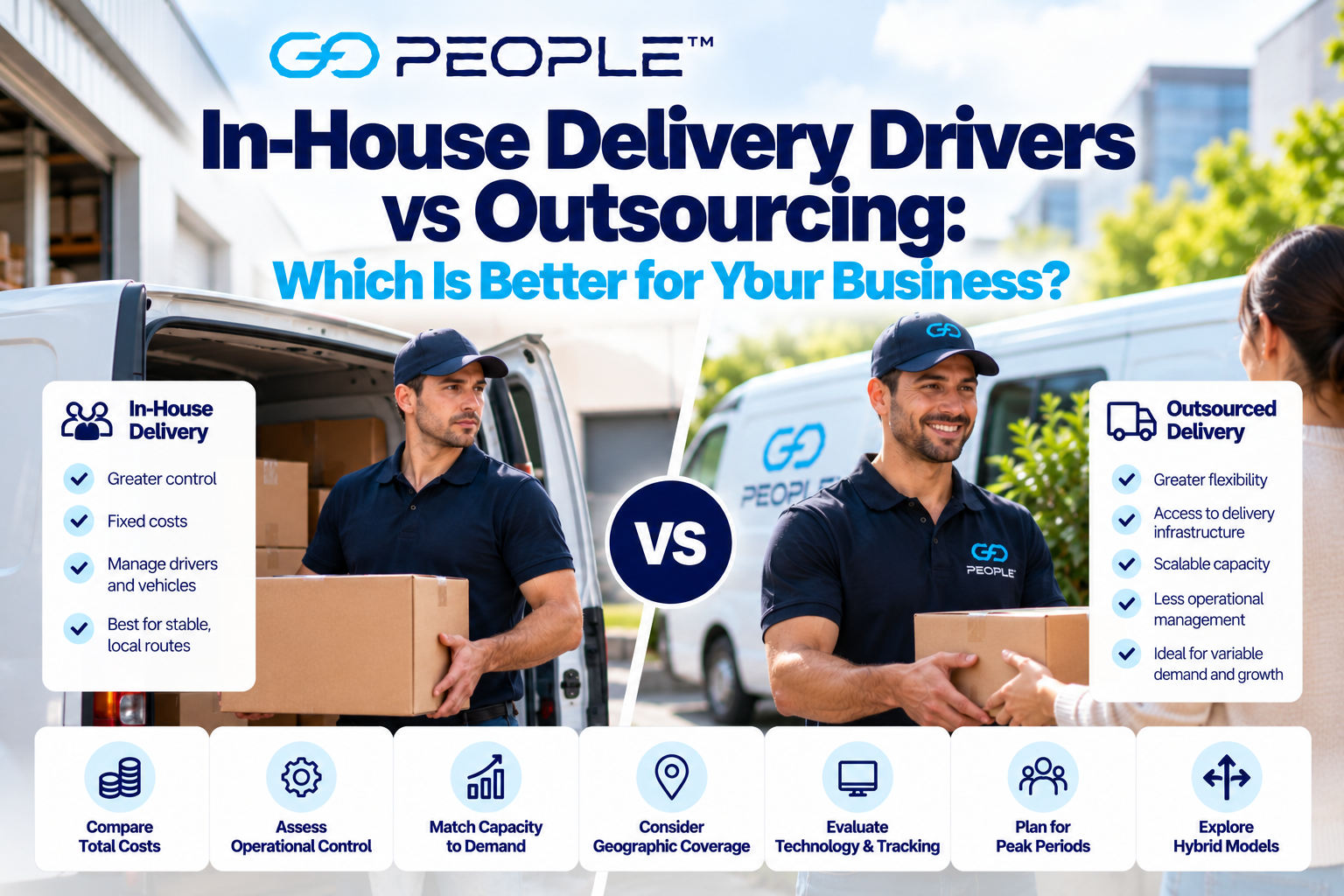
For a growing business, delivery eventually becomes a strategic decision rather than simply a transport task.
Should you employ your own delivery drivers, operate your own vehicles and manage deliveries internally?
Or should you outsource delivery to a courier or delivery provider?
There is no universal answer.
An in-house delivery operation can provide greater direct control, but it also introduces fixed costs, management responsibilities and capacity constraints. Outsourcing can provide greater flexibility and access to established delivery infrastructure, but the business gives up some direct control over the delivery process.
For some businesses, the best answer is actually a combination of both.
The right decision depends on delivery volume, geography, customer expectations, service requirements, operational capability and total cost.
This guide explains how to compare the options.
What Is In-House Delivery?
In-house delivery means the business manages some or all of its delivery operation using its own resources.
Depending on the business, this might involve:
- employing delivery drivers;
- owning or leasing vehicles;
- managing driver rosters;
- planning delivery routes;
- dispatching orders;
- communicating with customers;
- tracking deliveries;
- managing proof of delivery;
- handling failed deliveries;
- maintaining vehicles; and
- managing delivery performance.
A small florist might have one employee making local deliveries.
A larger retailer could operate a fleet of vans with dedicated dispatch staff.
Both are forms of in-house delivery.
What Is Outsourced Delivery?
Outsourced delivery means another business performs the delivery operation.
Depending on the service, the provider may handle:
- pickup;
- drivers;
- vehicles;
- route planning;
- delivery;
- tracking;
- customer notifications;
- proof of delivery; and
- delivery support.
Instead of building all of this infrastructure internally, the business purchases delivery capacity when required or under an agreed commercial arrangement.
Outsourcing can range from an individual on-demand courier job to a recurring high-volume parcel delivery operation.
In-House Delivery vs Outsourcing at a Glance
| Factor | In-House Delivery | Outsourced Delivery |
|---|---|---|
| Direct operational control | Higher | Lower |
| Fixed costs | Usually higher | Often lower |
| Driver management | Business responsibility | Provider responsibility |
| Vehicle management | Business responsibility | Usually provider responsibility |
| Capacity flexibility | Limited by own fleet | Potentially more flexible |
| Route technology | Business must provide | May be included |
| Geographic expansion | Requires additional resources | Potentially easier |
| Branding control | High | Depends on provider |
| Peak demand | Can be difficult | Additional capacity may be available |
| Delivery expertise | Must be developed internally | Access to provider expertise |
| Management workload | Higher | Lower |
| Cost predictability | Depends on utilisation | Depends on pricing model |
Neither column is automatically better.
The question is which model better fits the business.
The Biggest Mistake: Comparing Only the Driver’s Wage
Businesses sometimes compare:
Driver wage vs courier price
and conclude that an internal driver is cheaper.
That comparison is incomplete.
An employee’s wage is only one component of an in-house delivery operation.
Depending on the arrangement, the business may also need to consider:
- employment on-costs;
- recruitment;
- training;
- supervision;
- scheduling;
- vehicles;
- fuel;
- registration;
- insurance;
- servicing;
- tyres;
- repairs;
- parking;
- tolls;
- mobile devices;
- delivery software;
- route optimisation;
- customer notifications;
- proof-of-delivery systems;
- administration;
- downtime; and
- replacement capacity.
The correct comparison is:
Total cost of operating delivery internally
versus:
Total cost of purchasing the required delivery service externally
Fixed Costs vs Variable Costs
This is one of the most important differences between the two models.
In-House Delivery
Many costs exist whether the driver is fully utilised or not.
For example, if a driver works an eight-hour shift but there are only three hours of deliveries, the business still carries much of the day’s employment and vehicle cost.
Outsourced Delivery
A larger proportion of the cost may be linked to actual delivery activity, depending on the provider and commercial arrangement.
This can make outsourcing attractive when delivery demand fluctuates.
Driver Utilisation Can Change the Economics
Consider two businesses.
Business A
It has enough deliveries to keep a driver productive for most of every working day.
An internal operation may potentially make economic sense.
Business B
It needs:
- two hours of deliveries Monday;
- seven hours Tuesday;
- one hour Wednesday;
- ten hours Thursday; and
- three hours Friday.
An employee and vehicle may be significantly underutilised on some days and insufficient on others.
Outsourcing can potentially match capacity more closely to demand.
This is why utilisation matters as much as wage rates.
Calculate Cost Per Productive Delivery Hour
A useful way to think about an internal fleet is:
Total delivery operating cost ÷ productive delivery hours
Suppose a driver costs the business $X over a period.
If almost all available hours are productive delivery hours, the cost is spread efficiently.
If half of those hours involve waiting for work, the effective cost of each productive hour increases significantly.
The same principle applies to vehicles.
A van that is constantly being used creates very different economics from one sitting in the car park most of the week.
When comparing in-house delivery with outsourcing, businesses should consider more than driver wages or courier charges. Vehicle expenses, dispatch administration, failed deliveries and customer support can all affect the total cost. For a more detailed breakdown, read our guide to the hidden costs of inefficient delivery operations.
Costs of Running an In-House Delivery Fleet
Businesses considering their own fleet should model the complete operation.
Employment
Potential costs include wages and applicable employment-related costs.
Vehicles
Consider:
- purchase or lease;
- depreciation;
- registration;
- insurance;
- maintenance;
- repairs;
- tyres;
- cleaning; and
- replacement.
Vehicle Operating Costs
These can include:
- fuel or charging;
- tolls;
- parking; and
- other operating expenses.
Technology
A modern delivery operation may need:
- dispatch software;
- route optimisation;
- driver applications;
- tracking;
- customer notifications;
- proof of delivery; and
- reporting.
Management
Someone needs to:
- roster drivers;
- resolve problems;
- monitor performance;
- manage leave;
- investigate incidents; and
- deal with customer issues.
These costs should all be included when comparing delivery models.
The Cost of Driver Absence
What happens when your only driver is unavailable?
Possible causes include:
- illness;
- annual leave;
- vehicle breakdown;
- training;
- unexpected absence; or
- resignation.
A one-driver operation can suddenly become a zero-driver operation.
Businesses operating internally need contingency plans.
That may mean:
- spare drivers;
- casual capacity;
- backup vehicles; or
- an outsourced delivery provider.
Redundancy improves reliability, but it also increases cost.
Recruitment Is Part of the Delivery Operation
Drivers do not simply appear when needed.
An internal fleet may require ongoing:
- recruitment;
- screening;
- onboarding;
- training;
- performance management; and
- retention.
Driver turnover can create operational disruption.
For businesses whose core competency is retail, ecommerce, manufacturing or another industry, building expertise in driver workforce management may not be the best use of management time.
Vehicles Require Management Too
Operating delivery vehicles creates another layer of responsibility.
Businesses may need processes for:
- maintenance schedules;
- registration;
- insurance;
- breakdowns;
- damage;
- cleaning;
- fuel or charging;
- vehicle allocation; and
- replacement.
A vehicle that is unavailable can create the same capacity problem as an unavailable driver.
The business needs both at the same time:
available driver + available vehicle = delivery capacity
Outsourcing Converts Infrastructure Into a Service
One attraction of outsourcing is that the business does not need to build every delivery capability itself.
Instead of asking:
How many drivers and vans should we employ?
the business can ask:
How much delivery capacity do we need?
That can be especially valuable for businesses where delivery demand changes frequently.
However, outsourcing does not remove all management responsibility.
The business still needs to:
- select the right provider;
- provide accurate delivery information;
- prepare orders correctly;
- monitor performance;
- manage customer expectations; and
- resolve exceptions.
Outsourcing changes the operating model. It does not make delivery management disappear.
Control Is the Strongest Argument for In-House Delivery
Internal drivers are directly integrated into the business.
That can provide greater control over:
- presentation;
- customer interaction;
- delivery procedures;
- handling;
- scheduling;
- training; and
- brand experience.
For businesses where delivery is deeply connected to the customer experience, this can be valuable.
Examples might include businesses where staff need to:
- install a product;
- explain its use;
- collect something from the customer;
- perform a specialist handover; or
- represent the brand in a very particular way.
In these cases, the “driver” may actually be performing a broader customer-service role.
But Control Has a Cost
Greater control also means greater responsibility.
If your own driver:
- is late;
- calls in sick;
- damages a vehicle;
- cannot find an address;
- misses a delivery;
- needs support; or
- has too many deliveries,
the business must solve the problem.
With an outsourced model, some of these operational responsibilities sit with the provider.
The value of outsourcing therefore includes not only transport but also operational management.
Capacity Is One of the Biggest Differences
Imagine your business normally completes 40 deliveries per day.
You employ enough drivers and vehicles for approximately 45.
Then a successful campaign generates 120 deliveries.
Your internal operation now has a problem.
You cannot instantly create:
- additional trained drivers;
- additional vehicles;
- additional dispatch capacity; and
- additional route capacity.
This is the challenge of fixed infrastructure.
Outsourcing Can Help With Variable Demand
An outsourced model may provide more flexibility when volume changes.
This can be useful during:
- Christmas;
- Black Friday;
- promotions;
- product launches;
- seasonal peaks;
- unexpected demand; and
- rapid business growth.
That does not mean unlimited capacity is always available.
Businesses should still forecast major volume increases and communicate requirements appropriately.
But they may not need to permanently own enough infrastructure to handle their highest day of the year.
Don’t Build Your Fleet Around the Peak
Suppose average volume requires:
3 drivers
but Christmas requires:
8 drivers
Maintaining eight drivers all year purely for a short peak may create substantial underutilisation.
A business might instead operate:
3 internal drivers + outsourced peak capacity
This is an example of a hybrid model.
For many businesses, this can provide a useful balance between control and flexibility.
Geographic Coverage Matters
An internal fleet is naturally constrained by geography.
If your drivers operate from Sydney, expanding delivery into another city requires additional infrastructure.
Potential requirements include:
- drivers;
- vehicles;
- management;
- parking;
- dispatch;
- local knowledge; and
- technology.
Outsourcing can make geographic expansion easier where an appropriate provider already operates in the required area.
This can be particularly relevant for ecommerce businesses whose customers are not concentrated near the warehouse.
Route Density Matters
The economics of in-house delivery can improve when deliveries are geographically dense.
Consider:
Route A
30 deliveries within a compact group of suburbs.
Route B
30 deliveries scattered across an entire metropolitan area.
Both contain 30 deliveries.
But Route B may require significantly more:
- driving time;
- distance;
- fuel;
- driver hours; and
- vehicles.
Delivery volume alone therefore does not determine whether an internal fleet makes sense.
You also need to understand where those deliveries go.
Route Optimisation Becomes Important as Volume Grows
A driver making five deliveries may be able to plan a reasonable sequence manually.
A business managing dozens or hundreds of stops faces a more complex problem.
Route planning may need to account for:
- distance;
- traffic;
- delivery windows;
- vehicle capacity;
- pickup requirements;
- business opening hours; and
- delivery priorities.
If operating internally, the business may need suitable routing technology and someone capable of managing it.
For more detail, see Route Optimisation for Delivery: How Businesses Can Plan More Efficient Routes.
Tracking Is Now Part of the Customer Experience
Modern customers increasingly expect visibility.
A delivery operation may need to provide:
- delivery status;
- tracking;
- notifications;
- estimated arrival information;
- proof of delivery; and
- support when something goes wrong.
If operating an internal fleet, the business needs to determine how these capabilities will be provided.
Without technology, customers may resort to calling:
“Where is my order?”
Those enquiries create additional support costs.
An outsourced provider may already have delivery technology available, although capabilities vary significantly between providers.
Proof of Delivery Matters
Businesses should also consider how delivery completion is recorded.
Proof of delivery may help:
- confirm completion;
- investigate customer enquiries;
- resolve disputes;
- support internal operations; and
- maintain delivery records.
An internal fleet needs an appropriate process for capturing and storing that information.
An outsourced service may include digital proof of delivery depending on the provider and service.
See What Is Proof of Delivery and Why Does It Matter? for a detailed explanation.
Customer Support Is Part of the Cost
Imagine a customer contacts your team because a delivery is late.
If you operate internally, your staff may need to:
- contact the driver;
- determine their location;
- investigate the delay;
- estimate arrival;
- update the customer; and
- document the issue.
Repeat that across dozens of deliveries and support workload can become substantial.
When evaluating delivery models, ask:
Who handles delivery exceptions, and how much internal time does it consume?
That cost is often overlooked.
Compare Delivery Reliability, Not Just Cost
The cheapest delivery model is not necessarily the most economical.
Suppose one model costs less per parcel but produces more:
- late deliveries;
- failed deliveries;
- support enquiries;
- redeliveries;
- refunds; and
- lost customers.
The true cost may be higher.
A useful comparison is:
**Direct delivery cost
- management cost
- technology cost
- failure cost
- customer support cost
= total delivery cost**
Our guide How Businesses Can Reduce Delivery Costs Without Sacrificing Service explores this in more detail.
In-House Delivery Can Make Sense When Volume Is Stable
An internal fleet becomes more attractive when delivery demand is:
- predictable;
- consistent;
- geographically concentrated;
- large enough to utilise drivers efficiently; and
- strategically important to the customer experience.
For example, a business with several highly efficient recurring local routes may be able to keep drivers and vehicles productive throughout the day.
The key word is utilisation.
Owning delivery capacity makes more economic sense when that capacity is consistently used.
Outsourcing Can Make Sense When Demand Is Variable
Outsourcing may be attractive when:
- delivery volume fluctuates;
- destinations change frequently;
- the business is growing;
- demand is seasonal;
- geographic coverage is broad;
- the business lacks delivery technology;
- management does not want to operate a fleet; or
- additional capacity is frequently required.
It can also allow management to focus resources on the company’s core operation rather than building a transport function.
The Hybrid Model
The choice does not have to be:
100% in-house
or:
100% outsourced
Many businesses can use both.
For example:
Internal Drivers
Handle:
- recurring local routes;
- specialist customers;
- installations;
- predictable high-density areas.
Outsourced Delivery
Handles:
- overflow;
- peak periods;
- urgent jobs;
- additional suburbs;
- next-day parcels;
- changing routes; or
- capacity gaps.
This allows the business to maintain internal capability without building enough permanent infrastructure for every possible delivery requirement.
Hybrid Delivery Can Reduce Capacity Risk
Suppose a retailer operates two vans internally.
On a normal day, they handle all deliveries.
On a busy day, additional orders are outsourced.
This means the retailer does not need to purchase a third van simply to cover occasional peaks.
The outsourced provider effectively becomes flexible capacity.
The same model can help when:
- a driver is absent;
- a vehicle breaks down;
- an urgent delivery appears;
- the normal route is full; or
- demand unexpectedly increases.
Same-Day Delivery: Internal or Outsourced?
Same-day delivery can create significant operational pressure because fulfilment, pickup and delivery all occur within a shorter timeframe.
An internal fleet may work where:
- delivery volume is predictable;
- geographic coverage is manageable; and
- sufficient capacity is available.
Outsourcing can help where demand is variable or the business does not want to maintain idle same-day capacity.
GoSAMEDAY provides same-day delivery for eligible business pickups.
Multi-Drop Delivery: Internal or Outsourced?
Businesses making many local deliveries often face the classic fleet decision.
Should they employ drivers to run the routes?
Or outsource those routes?
Important factors include:
- number of stops;
- delivery density;
- daily variability;
- driver utilisation;
- route complexity;
- technology;
- management cost; and
- required flexibility.
GoBUNDLE provides multi-drop delivery for businesses sending multiple deliveries from a pickup location, with route optimisation, live tracking and digital proof of delivery.
Next-Day Parcel Delivery: Internal or Outsourced?
Running a next-day parcel network internally is a very different proposition from making local deliveries.
It can involve:
- warehouse pickup;
- parcel processing;
- sortation;
- routing;
- delivery capacity;
- tracking;
- proof of delivery; and
- exception management.
For most retailers and ecommerce businesses, building this entire capability solely for their own parcels may not make economic sense.
GoEXPRESS provides next-day parcel delivery for eligible business pickups in Sydney, Melbourne and Brisbane.
Urgent Deliveries and Capacity Gaps
Even businesses with their own fleet can occasionally face a delivery that does not fit the normal operation.
For example:
- an urgent document;
- a missed internal run;
- a critical replacement;
- an unexpected customer requirement; or
- an order that cannot wait for the next scheduled route.
An on-demand courier can provide a useful backup.
GoVIP is designed for urgent and time-sensitive individual delivery requirements.
How to Calculate the Break-Even Point
A useful way to compare the models is to estimate total monthly cost.
In-House Model
Include:
**Driver employment costs
- vehicle costs
- fuel/charging
- insurance
- maintenance
- tolls/parking
- software
- management
- administration
- contingency capacity**
Then divide by productive delivery volume.
Outsourced Model
Include:
**Delivery charges
- surcharges where applicable
- internal administration
- integration/technology costs if applicable
- failure/recovery costs**
Then compare the two.
But don’t stop at the average cost per delivery.
Also compare:
- capacity;
- reliability;
- flexibility;
- geographic coverage; and
- customer experience.
Example: Why Volume Alone Can Be Misleading
Consider two businesses that each complete 100 deliveries per day.
Business A
Its deliveries are concentrated around a small metropolitan area and volume is almost identical every weekday.
Business B
Its customers are spread across a large region and daily volume ranges from 40 to 180.
Business A may have a stronger case for internal delivery.
Business B may value outsourced flexibility much more highly.
Same volume.
Very different delivery economics.
Questions to Ask Before Building an In-House Fleet
Before hiring drivers, ask:
- How many deliveries do we make each day?
- How variable is that number?
- Where are customers located?
- How many productive hours will each driver have?
- How many vehicles will we need?
- What happens when a driver is absent?
- What happens when a vehicle breaks down?
- How will we optimise routes?
- How will customers track deliveries?
- How will we capture proof of delivery?
- Who manages driver performance?
- How will we handle peak periods?
- What is the complete cost?
- Is delivery a core capability we genuinely want to build?
If several answers are unclear, calculate them before committing to the infrastructure.
Questions to Ask an Outsourced Delivery Provider
When comparing providers, consider:
- What services do they provide?
- Where do they operate?
- What pickup arrangements are available?
- How is pricing calculated?
- How does tracking work?
- Is proof of delivery available?
- How are customers notified?
- What happens after a failed delivery?
- How are delivery problems escalated?
- Can capacity scale with your business?
- Are integrations available?
- What reporting can you access?
- What are the relevant cut-offs?
- What support is available?
Price should be one part of the decision rather than the entire decision.
For a broader comparison framework, see How to Choose a Courier Service for Your Business.
A Simple Decision Matrix
| Business Situation | In-House | Outsourced | Hybrid |
|---|---|---|---|
| Stable local routes | ✓✓ | ✓ | ✓✓ |
| Highly variable volume | △ | ✓✓ | ✓✓ |
| Strong brand handover requirement | ✓✓ | △ | ✓ |
| Seasonal peaks | △ | ✓✓ | ✓✓ |
| Broad geographic coverage | △ | ✓✓ | ✓ |
| Specialist installation required | ✓✓ | △ | ✓ |
| Urgent occasional jobs | △ | ✓✓ | ✓✓ |
| Limited delivery-management resources | △ | ✓✓ | ✓ |
| Existing efficient fleet | ✓✓ | ✓ | ✓✓ |
| Rapidly growing ecommerce operation | △ | ✓✓ | ✓✓ |
✓✓ = potentially strong fit
✓ = potentially suitable
△ = requires careful assessment
This is a starting point rather than a universal rule.
When In-House Delivery Is Often the Better Fit
Consider internal delivery when:
- delivery is central to your product or customer experience;
- drivers perform more than transportation;
- routes are predictable;
- volume is stable;
- destinations are concentrated;
- driver utilisation can remain high;
- you already have management capability;
- you require significant direct control; and
- the economics remain attractive after including all costs.
When Outsourcing Is Often the Better Fit
Consider outsourcing when:
- delivery demand fluctuates;
- maintaining vehicles is unattractive;
- destinations vary;
- additional capacity is frequently required;
- the business is expanding geographically;
- delivery technology would otherwise need to be built or purchased;
- peak periods are substantially busier than normal periods;
- management wants to focus on core operations; or
- an external provider can deliver the required service more efficiently.
When a Hybrid Model May Be Best
Consider using both when:
- your internal fleet works well at normal volume but struggles during peaks;
- certain routes are efficient internally while others are not;
- some deliveries require specialist staff;
- you need emergency backup capacity;
- geographic expansion would make internal routes inefficient; or
- you want to maintain control over key deliveries without operating the entire delivery network.
The hybrid approach can prevent businesses from treating delivery strategy as an all-or-nothing decision.
Review the Decision as Your Business Changes
The correct delivery model today may not be correct two years from now.
A startup may initially outsource everything.
As volume increases, some routes may become efficient enough to bring in-house.
Alternatively, a business with its own fleet may expand nationally and find that outsourcing more deliveries becomes more efficient.
Review the decision when there are material changes in:
- delivery volume;
- geographic coverage;
- customer expectations;
- labour costs;
- vehicle costs;
- service requirements;
- technology; or
- business strategy.
Delivery strategy should evolve with the business.
Focus on the Outcome, Not Who Drives the Van
The objective is not to own a fleet.
It is not to outsource everything either.
The objective is to build a delivery operation that provides the right combination of:
reliability + customer experience + capacity + flexibility + cost
For some businesses, that means employing drivers.
For others, it means outsourcing.
And for many growing businesses, the most practical answer may be a carefully designed combination of both.
Make the decision using the total economics and operational requirements, rather than comparing a driver’s hourly wage with a courier quote.
That provides a much more realistic picture of what delivery actually costs.
Frequently Asked Questions
Is it cheaper to hire a delivery driver or outsource deliveries?
It depends on utilisation, delivery volume, geography and the complete operating cost. An internal driver may be economical when consistently productive, while outsourcing can be more efficient when volume is variable or capacity would otherwise sit idle.
What costs should I include when calculating an in-house delivery fleet?
Consider employment costs, vehicles, fuel or charging, registration, insurance, maintenance, tolls, parking, software, route planning, management, administration and backup capacity.
What are the main advantages of outsourcing delivery?
Potential advantages include flexible capacity, less fleet management, access to delivery technology, easier geographic expansion and reduced internal operational workload.
What are the advantages of using your own delivery drivers?
In-house drivers can provide greater direct control over scheduling, training, presentation, handling and customer interaction.
Can a business use both its own drivers and a courier company?
Yes. A hybrid model can use internal drivers for predictable or specialist routes and outsourced delivery for overflow, peaks, urgent jobs or broader geographic coverage.
When should a business consider outsourcing delivery?
Outsourcing can be worth considering when delivery demand is variable, destinations change frequently, peak capacity is difficult to manage or the business does not want to build and manage its own fleet infrastructure.
How should I compare delivery providers?
Compare service suitability, coverage, pickup arrangements, reliability, tracking, proof of delivery, support, capacity, technology and total cost—not simply the headline delivery rate.