Businesses often ask a simple delivery question:
Which courier service should we use?
But for many businesses, that is the wrong question.
A better question is:
Which delivery option should we use for each type of order?
Not every delivery has the same requirements.
A routine ecommerce parcel does not necessarily need the same service as an urgent replacement product.
A business sending 40 parcels from one location has different requirements from a business sending one time-critical document.
A customer willing to wait until tomorrow may care more about cost, while another customer may genuinely need the order today.
Trying to force every delivery through one service can therefore create unnecessary cost, operational complexity or a poor customer experience.
A more flexible delivery strategy matches the delivery service to the actual requirement.
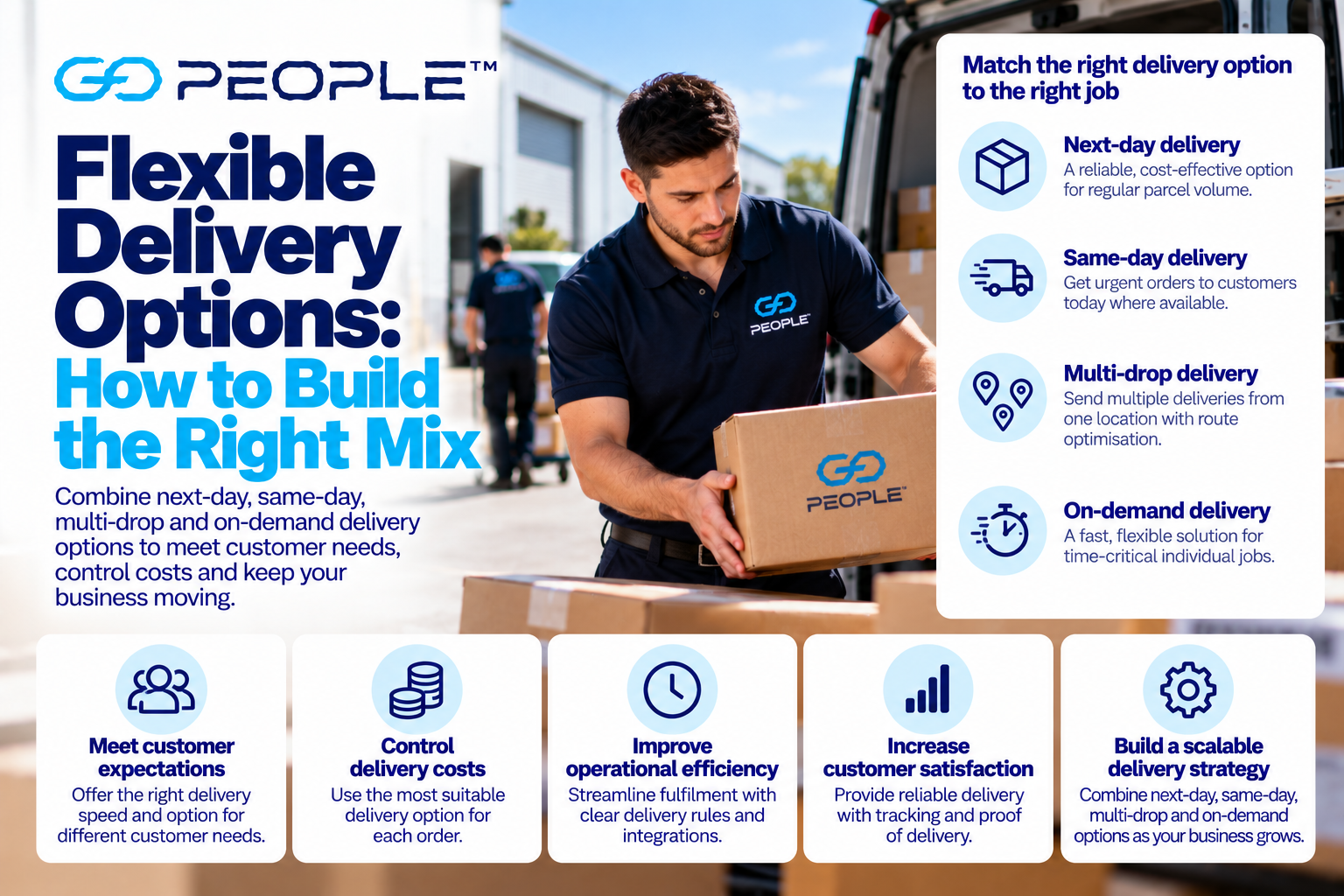
That might mean combining:
- next-day delivery;
- same-day delivery;
- multi-drop delivery;
- on-demand courier services; and
- other appropriate delivery methods
depending on the order.
This guide explains how businesses can build that delivery mix.
What Are Flexible Delivery Options?
Flexible delivery means having more than one way to fulfil delivery requirements.
Instead of automatically sending every order through the same service, the business considers factors such as:
- urgency;
- destination;
- customer expectation;
- parcel type;
- order value;
- delivery volume;
- pickup location;
- number of destinations;
- delivery cost; and
- operational requirements.
The appropriate delivery option is then selected.
The objective is not to offer customers dozens of choices.
It is to have enough flexibility behind the scenes to use the right delivery model for different situations.
Why One Delivery Service Rarely Fits Every Order
Consider an online retailer that receives these four orders.
Order A
A normal ecommerce order placed Monday afternoon.
The customer is happy to receive it tomorrow.
Order B
A customer needs an item later today.
Order C
The business needs to send 35 local deliveries from its warehouse.
Order D
A critical replacement item needs to go directly to one customer as soon as possible.
All four are deliveries.
But operationally, they are very different.
Sending them all through the same delivery service may mean:
- paying too much for routine orders;
- providing insufficient speed for urgent orders;
- inefficiently handling multiple destinations; or
- failing to meet customer expectations.
A flexible strategy recognises those differences.
Start With Customer Requirements
Before selecting delivery services, understand what customers actually need.
Businesses sometimes assume:
Faster is always better.
It isn’t always.
Customers may prioritise different things.
Some want:
- the lowest delivery cost;
- next-day arrival;
- same-day delivery;
- a predictable timeframe;
- real-time tracking;
- proof of delivery; or
- urgent point-to-point service.
The right delivery strategy depends on the customer and the order.
Speed Is Only One Part of Delivery
Delivery decisions often focus heavily on speed.
But customers may also care about:
- reliability;
- cost;
- visibility;
- communication;
- convenience;
- successful first-attempt delivery; and
- knowing what happens if something goes wrong.
A service that is theoretically faster but unreliable may create a worse experience than a slightly slower service that consistently meets expectations.
For a deeper discussion, see Why Fast Delivery Matters to Customers and Businesses.
Understand Your Different Order Types
The first practical step is to segment your deliveries.
Don’t treat all orders as identical.
A business might create groups such as:
Routine Ecommerce Orders
Regular parcels where next-day delivery is appropriate.
Same-Day Customer Orders
Orders where customers genuinely value receiving the product today.
Multi-Drop Runs
Multiple deliveries leaving the same location.
Urgent Individual Jobs
Time-sensitive deliveries requiring an on-demand service.
Business-to-Business Deliveries
Deliveries where business hours, reception access or operational deadlines matter.
Returns
Products moving back from the customer.
Once orders are segmented, delivery rules become easier to design.
Next-Day Delivery for Regular Parcel Volume
For many ecommerce businesses, next-day delivery can provide a useful balance between:
speed + cost + operational efficiency
The business has time to:
- receive orders;
- pick products;
- pack parcels;
- prepare dispatch;
- organise pickup; and
- move parcels through a delivery network.
Customers still receive a relatively fast service without every order becoming an urgent courier job.
For eligible business pickups in Sydney, Melbourne and Brisbane, GoEXPRESS provides next-day parcel delivery with tracking and proof of delivery.
When Next-Day Delivery Makes Sense
Next-day can be suitable when:
- the customer does not need the product immediately;
- regular parcel volumes are being dispatched;
- orders can be prepared before pickup;
- the destination is within the available service area; and
- the business wants a repeatable parcel-delivery process.
It can be particularly useful for ecommerce businesses that need something faster than slower standard options without using same-day delivery for every order.
Same-Day Delivery for Genuine Urgency
Same-day delivery is valuable when receiving the product today creates meaningful value.
Examples may include:
- urgent customer orders;
- replacement products;
- forgotten items;
- event-related purchases;
- important business materials; or
- orders where the delivery date affects whether the customer purchases.
For eligible business pickups, GoSAMEDAY provides a same-day delivery option.
The important word is eligible.
Service availability depends on the pickup and delivery requirements, so businesses should confirm eligibility rather than assuming every location is covered.
Don’t Make Every Order Same-Day
Same-day delivery can be attractive.
But using it indiscriminately can increase cost and operational pressure.
Ask:
- Does the customer actually need it today?
- Is the customer willing to pay for the additional speed?
- Does faster delivery improve conversion?
- Can the warehouse fulfil the order quickly enough?
- Is same-day available for the relevant location?
- Is another service more economical?
Same-day works best when it solves a real problem.
For a more detailed framework, see When to Use Same-Day Delivery for Your Business.
Multi-Drop Delivery for Multiple Destinations
Now consider a different situation.
A business has:
40 deliveries
leaving from:
one warehouse
and going to:
40 local destinations.
Booking 40 unrelated point-to-point courier jobs may not be the most efficient approach.
This is where multi-drop delivery becomes relevant.
GoBUNDLE is designed for businesses sending multiple deliveries from a pickup location, combining dedicated delivery runs with route optimisation, tracking and digital proof of delivery.
Why Multi-Drop Is Different
Multi-drop delivery focuses on the route as a whole.
Instead of thinking:
Parcel A → Destination A
then separately:
Parcel B → Destination B
the business considers:
Pickup → Destination A → Destination B → Destination C → …
The objective is to organise multiple stops efficiently.
This can suit businesses where:
- many deliveries leave together;
- destinations change regularly;
- route planning would otherwise be manual;
- delivery visibility is important; and
- the business wants a coordinated delivery run.
For more detail, see Multi-Drop Delivery in Australia: A Practical Guide for Businesses.
On-Demand Delivery for Time-Critical Jobs
Some deliveries cannot wait for the normal fulfilment schedule.
Examples might include:
- urgent documents;
- critical replacement items;
- forgotten goods;
- last-minute business requirements; or
- unexpected customer needs.
For these situations, GoVIP provides an on-demand courier option.
The value of on-demand delivery is not that every parcel should use it.
It is that the business has an option when a genuinely urgent requirement appears.
Build a Delivery Ladder
A useful way to think about delivery is as a ladder.
Different orders move to different levels depending on urgency and operational requirements.
| Delivery Need | Potential Approach |
|---|---|
| Routine parcel | Next-day |
| Customer needs it today | Same-day |
| Many deliveries from one location | Multi-drop |
| Urgent individual requirement | On-demand |
This is not a universal rule.
The appropriate service also depends on:
- geography;
- product;
- parcel size;
- service availability;
- customer requirements; and
- business operations.
But the framework prevents every delivery from automatically becoming an urgent job.
Use Urgency as a Routing Rule
Businesses can classify orders by urgency.
For example:
Low Urgency
Customer does not require immediate delivery.
Use the most appropriate routine delivery method.
Medium Urgency
Customer wants faster delivery and next-day meets the requirement.
Use an eligible next-day service.
High Urgency
Customer needs the order today.
Check same-day eligibility.
Critical
A single time-sensitive delivery requires immediate action.
Consider an appropriate on-demand option.
This turns delivery selection into a repeatable business rule.
Use Order Volume as Another Rule
Urgency is not the only factor.
Volume matters.
Suppose a warehouse needs to send:
1 urgent parcel
versus:
70 local deliveries.
Even if both need to move today, the operational solution may be very different.
One may suit an on-demand courier.
The other may suit a planned multi-drop run.
Delivery strategy should therefore consider both:
urgency + volume
Geography Changes the Decision
A service may be ideal operationally but unavailable for a particular pickup or destination.
Businesses should understand:
- pickup coverage;
- delivery coverage;
- service areas;
- relevant cut-offs; and
- geographic limitations.
This is particularly important for businesses operating across multiple Australian cities.
Don’t build checkout promises around a delivery service until you know the order is eligible.
Separate Pickup Coverage From Delivery Coverage
These are not necessarily the same thing.
A service may have:
- a defined pickup area; and
- a wider delivery area.
That distinction matters when building delivery rules.
For example, the customer’s destination may be serviceable, but the warehouse pickup location may not be eligible for that particular service.
Delivery logic should consider both sides of the journey.
B2C and B2B Deliveries Can Have Different Priorities
Consumer deliveries often emphasise:
- convenience;
- tracking;
- notifications;
- delivery timing; and
- customer experience.
Business deliveries may place greater emphasis on:
- reception hours;
- loading docks;
- business closing times;
- named recipients;
- scheduled operations;
- documentation; and
- reliable delivery before a deadline.
A flexible delivery strategy should recognise these differences.
Order Value Can Influence Delivery Choice
Consider two orders:
Order A: $20
Order B: $1,500
Using an expensive premium delivery service for Order A may make little commercial sense.
For Order B, the economics may be different.
Businesses can consider:
- gross margin;
- order value;
- customer value;
- delivery cost; and
- urgency
when determining which options to subsidise or offer.
Delivery Cost Should Be Compared With Customer Value
The cheapest delivery option is not always the best.
The fastest is not always the best either.
The objective is to find the best commercial outcome.
A faster service may cost more but:
- increase conversion;
- protect an important customer relationship;
- solve an urgent problem;
- reduce cancellation risk; or
- support a premium customer experience.
Conversely, paying for premium delivery when the customer does not value the speed simply reduces margin.
Create Delivery Rules Instead of Making Manual Decisions
As order volume grows, employees should not need to manually decide the delivery service for every order.
Businesses can create rules.
For example:
If: routine ecommerce order + eligible metro location
Then: next-day delivery.
If: customer selects eligible same-day option
Then: same-day workflow.
If: 20+ local deliveries ready together
Then: evaluate multi-drop.
If: urgent individual delivery
Then: evaluate on-demand.
The actual rules will vary.
The important thing is to make delivery selection systematic.
Build Rules Around What You Can Reliably Fulfil
A delivery provider can only collect an order after the business has prepared it.
If your warehouse cannot pick and pack an order until tomorrow, offering same-day delivery today does not solve the problem.
Delivery promises should consider:
Order received
↓
Payment confirmed
↓
Pick
↓
Pack
↓
Ready for dispatch
↓
Pickup
↓
Delivery
The whole chain determines the customer experience.
Use Cut-Off Times Carefully
Cut-off times can help businesses determine which delivery options remain available.
For example:
- orders before a certain point may qualify for one service;
- later orders may move to another;
- urgent exceptions may require on-demand delivery.
But cut-offs should reflect actual operational capability.
A cut-off that looks attractive on a website but cannot be consistently supported will create customer dissatisfaction.
Make Checkout Options Understandable
Customers do not need to understand your entire logistics network.
They need to understand the choice.
Instead of exposing internal terminology, checkout might communicate:
- expected delivery timing;
- delivery price;
- eligibility; and
- any important conditions.
The customer should be able to answer:
When will I get it?
and:
What will it cost?
Avoid Too Many Delivery Choices
Flexibility does not mean presenting customers with ten options.
Too much choice can create confusion.
A business may have several delivery services behind the scenes while presenting only a few customer-friendly options.
For example:
Standard
Next-Day
Same-Day where available
The operational system can determine which provider or service fulfils each option.
Don’t Promise a Service Before Checking Eligibility
A customer should not reach the end of checkout and discover that the delivery option they selected cannot actually be provided.
Where possible, eligibility should be determined using information such as:
- pickup location;
- destination;
- order time;
- parcel requirements; and
- service availability.
This becomes increasingly important as delivery options become more sophisticated.
Use Delivery Options to Reduce Cart Abandonment
Delivery can influence checkout conversion.
Customers may abandon an order if:
- delivery is too slow;
- delivery costs are unexpected;
- the required option is unavailable;
- timing is unclear; or
- they cannot receive the product when needed.
Offering an appropriate range of delivery options may help address some of these concerns.
For more detail, see How to Reduce Cart Abandonment in Ecommerce.
Use Premium Delivery Selectively
Premium delivery options do not necessarily need to be free.
Customers with genuine urgency may be willing to pay more.
This allows businesses to offer speed without absorbing the full cost for every order.
Possible approaches include:
- customer-paid premium delivery;
- free premium delivery above an order threshold;
- premium delivery for loyalty members;
- selective free upgrades; or
- business-funded premium delivery for service recovery.
The economics should be tested rather than assumed.
Use Delivery as a Service-Recovery Tool
Sometimes something goes wrong.
For example:
- original parcel is damaged;
- wrong product is sent;
- important customer order is delayed;
- fulfilment mistake occurs.
A faster replacement delivery may help resolve the problem.
This is a different use case from routinely offering fast delivery.
Premium delivery can become a customer recovery tool when the value of protecting the relationship exceeds the additional logistics cost.
Plan for Peak Periods
A delivery strategy that works in an ordinary week may struggle during:
- Black Friday;
- Cyber Monday;
- Christmas;
- major promotions;
- product launches; or
- seasonal sales.
Flexible delivery options can help businesses respond to changing volume.
For example:
- routine orders may use one service;
- urgent orders another;
- concentrated local volumes may move to multi-drop;
- exceptional jobs may use on-demand.
The key is to plan these rules before the peak arrives.
See How to Manage Delivery Delays During Peak Seasons.
Build Capacity Before You Need It
Don’t wait until your primary delivery process is overwhelmed before considering alternatives.
Understand in advance:
- which services are available;
- how bookings work;
- pickup requirements;
- coverage;
- tracking;
- support; and
- operational cut-offs.
Then if volume changes unexpectedly, the business has options.
Flexible Delivery Can Improve Business Continuity
Delivery disruptions can happen because of:
- traffic;
- road closures;
- weather;
- capacity constraints;
- operational incidents; or
- unexpected demand.
A business completely dependent on one delivery model may have fewer alternatives when conditions change.
A flexible strategy can make it easier to determine whether certain deliveries should move to another appropriate option.
For more detail, see How to Manage Unexpected Delivery Route Disruptions.
Tracking Should Be Consistent Across the Delivery Mix
Using multiple delivery options can create a new problem:
fragmented visibility.
Customers should not need to become logistics experts simply because the business uses different services.
Where possible, maintain a consistent customer experience around:
- tracking access;
- delivery notifications;
- status information;
- proof of delivery; and
- support.
Operational flexibility should not create customer confusion.
Proof of Delivery Matters Across Different Services
Whatever delivery model is used, businesses often need to know whether delivery was completed.
Proof of delivery can help with:
- customer enquiries;
- delivery disputes;
- internal records;
- investigations; and
- service performance.
Depending on the delivery service, proof may include information such as a timestamp, photograph, signature or other completion record.
See What Is Proof of Delivery and Why Does It Matter?.
Use Technology to Select Delivery Options
As delivery complexity grows, manual selection becomes harder.
Businesses may use:
- ecommerce integrations;
- delivery platforms;
- APIs;
- order-management systems;
- warehouse systems; or
- internal rules
to determine how orders should be fulfilled.
The objective is to move from:
“Someone decides what to do with every order.”
to:
“The system applies agreed delivery rules and flags exceptions.”
Automation Should Handle the Routine Cases
A good rule-based delivery system should automate predictable decisions.
For example:
- eligible routine order → standard delivery workflow;
- eligible next-day order → next-day workflow;
- eligible same-day selection → same-day workflow.
Human intervention can then focus on exceptions such as:
- unusual parcel;
- unsupported destination;
- urgent customer request;
- address issue; or
- special handling requirement.
Automation should reduce repetitive decision-making, not remove appropriate oversight.
Route Optimisation Matters for Multi-Drop Delivery
When multiple deliveries leave from the same location, route planning becomes important.
The objective is not simply to arrange addresses in a list.
Route optimisation can consider factors such as:
- stop locations;
- travel distance;
- route sequence;
- delivery constraints; and
- operational efficiency.
For a detailed explanation, see Route Optimisation for Delivery: How Businesses Can Plan More Efficient Routes.
Measure Which Delivery Options Customers Actually Use
Don’t maintain delivery options simply because they sound useful.
Measure adoption.
For example:
| Delivery Option | Orders | Share of Eligible Orders |
|---|---|---|
| Routine / Standard | 6,500 | 65% |
| Next-Day | 2,500 | 25% |
| Same-Day | 800 | 8% |
| Other/Urgent | 200 | 2% |
The actual categories will vary.
The point is to understand customer behaviour.
If almost nobody chooses a premium option, investigate why.
Measure Profitability by Delivery Option
A delivery option may generate sales while losing money.
Track:
- customer delivery charge;
- actual delivery cost;
- fulfilment cost;
- failed-delivery cost;
- support cost;
- refunds/credits; and
- contribution margin.
This provides a clearer view of whether each delivery option is commercially sustainable.
Measure On-Time Performance
Offering multiple services is only useful if each service meets the expectation attached to it.
Track:
On-time deliveries ÷ total completed deliveries × 100
Segment by delivery option.
For example:
- next-day;
- same-day;
- multi-drop;
- urgent/on-demand.
This helps identify whether the business is making realistic promises.
Measure Failed Deliveries
Fast delivery that fails at the destination is not a good customer experience.
Track unsuccessful delivery rates by:
- service;
- destination type;
- city;
- customer;
- address type; and
- cause.
A particular service may appear fast but generate additional cost through redelivery.
For prevention strategies, see How to Reduce Failed Deliveries and Improve First-Attempt Delivery Success.
Measure Customer Support Demand
Different delivery options may generate different levels of customer enquiries.
Track questions such as:
- Where is my order?
- When will it arrive?
- Why is it delayed?
- Why did delivery fail?
- Where was it delivered?
A slightly more expensive delivery service that substantially reduces support workload may have a different total cost than the courier fee suggests.
Measure Repeat Purchase Behaviour
Businesses can also investigate whether delivery experience affects customer retention.
For example:
Do customers who receive their preferred delivery option purchase again more frequently?
Do customers experiencing failed or late deliveries have lower repeat rates?
Does same-day availability improve retention for particular segments?
These questions help connect logistics decisions to commercial outcomes.
Create a Delivery Decision Matrix
A simple matrix can help teams choose the appropriate service.
| Requirement | Routine Parcel | Multi-Drop | Same-Day | On-Demand |
|---|---|---|---|---|
| Regular parcel volume | Strong fit | Sometimes | Selective | Usually unnecessary |
| Many destinations from one pickup | Limited | Strong fit | Depends | Inefficient at scale |
| Customer needs it today | No | Possible | Strong fit | Strong fit |
| One highly urgent delivery | No | No | Possible | Strong fit |
| Route optimisation important | Limited | Strong fit | Depends | Limited |
| Premium urgency | Low | Medium | High | Very high |
This is only a conceptual framework.
Actual suitability depends on the service, locations and delivery requirements.
Review the Mix Regularly
A delivery strategy should evolve.
A business may change because:
- order volume grows;
- warehouses move;
- customer locations change;
- new products launch;
- average order value changes;
- new delivery services become available; or
- customer expectations shift.
Review the delivery mix periodically.
Ask:
- Which services are growing?
- Which are rarely used?
- Which are profitable?
- Which create complaints?
- Which produce failed deliveries?
- Which customers value most?
- Where are we paying for speed nobody needs?
The answers may change over time.
A Practical Framework for Building Your Delivery Strategy
Businesses can work through these steps.
Step 1 — Analyse Your Orders
Understand volume, locations, urgency, parcel characteristics and customer types.
Step 2 — Segment Delivery Requirements
Separate routine parcels, multi-drop runs, same-day orders and urgent individual jobs.
Step 3 — Map Available Services
Identify which delivery options can serve each requirement.
Step 4 — Understand Coverage
Confirm pickup and delivery eligibility.
Step 5 — Define Customer Options
Decide what customers should see at checkout.
Step 6 — Create Operational Rules
Determine how orders are assigned to delivery services.
Step 7 — Integrate Where Practical
Reduce unnecessary manual booking and data entry.
Step 8 — Provide Tracking
Maintain visibility across delivery types.
Step 9 — Measure Performance and Cost
Track adoption, reliability, failed deliveries and profitability.
Step 10 — Refine the Mix
Adjust based on actual customer behaviour and operational results.
What a Flexible Delivery Strategy Might Look Like
Consider an ecommerce retailer with a warehouse in Sydney.
Its delivery rules might look something like:
Routine Eligible Parcel Orders
Use next-day delivery.
Eligible Customers Who Need the Order Today
Offer a same-day option.
Large Batch of Local Deliveries
Evaluate a multi-drop run.
One Urgent Replacement
Use an on-demand courier where appropriate.
Unsupported Locations
Use another suitable delivery method.
The retailer is not choosing one “best courier”.
It is building a delivery system.
That is the important distinction.
Flexibility Should Reduce Complexity, Not Create It
Adding more delivery services can create operational complexity if implemented badly.
Businesses should avoid:
- staff manually choosing between many services;
- different tracking experiences with no explanation;
- inconsistent customer promises;
- unclear delivery pricing;
- overlapping service rules; and
- unsupported checkout options.
The goal is:
more flexibility for the business
while creating:
a simpler experience for the customer.
Good systems and clear rules make that possible.
The Right Delivery Option Depends on the Job
There is no single delivery service that is best for every business order.
The right choice depends on:
urgency
volume
geography
customer expectation
delivery cost
operational capability
A routine parcel may suit next-day delivery.
A customer who needs something today may require same-day.
A warehouse sending dozens of local deliveries may benefit from multi-drop.
A single urgent item may need on-demand delivery.
The strongest delivery strategy is therefore not necessarily the fastest or cheapest.
It is the one that can consistently match each order with an appropriate delivery service.
That creates a better balance between customer experience, operational efficiency and delivery cost.
Frequently Asked Questions
What are flexible delivery options?
Flexible delivery means using different delivery services depending on factors such as urgency, volume, destination, customer expectations and cost instead of forcing every order through the same delivery method.
Should a business offer multiple delivery options?
Often, yes, if customers have different delivery requirements. However, businesses do not need to expose every operational service at checkout. A simple customer-facing set of options can sit on top of a more flexible delivery system.
When should a business use same-day delivery?
Same-day delivery is most useful when receiving the order today creates meaningful value for the customer and the business can reliably fulfil the order within the available service requirements.
What is the difference between multi-drop and on-demand delivery?
Multi-drop delivery is designed around multiple deliveries from a pickup location and efficient route planning. On-demand delivery is generally better suited to an individual urgent or time-sensitive delivery.
Is next-day delivery suitable for ecommerce?
It can be a strong option for eligible ecommerce businesses because it balances relatively fast delivery with a more structured fulfilment process. Suitability depends on location, parcel requirements and service availability.
How should businesses choose which delivery service to use?
Consider urgency, number of deliveries, pickup and destination locations, customer expectations, parcel requirements, cost and operational capability. Businesses can then create rules that assign orders to appropriate services.
How can businesses tell whether their delivery options are working?
Measure customer adoption, delivery cost, on-time performance, failed deliveries, support enquiries, profitability and customer behaviour. Use those results to refine the delivery mix over time.