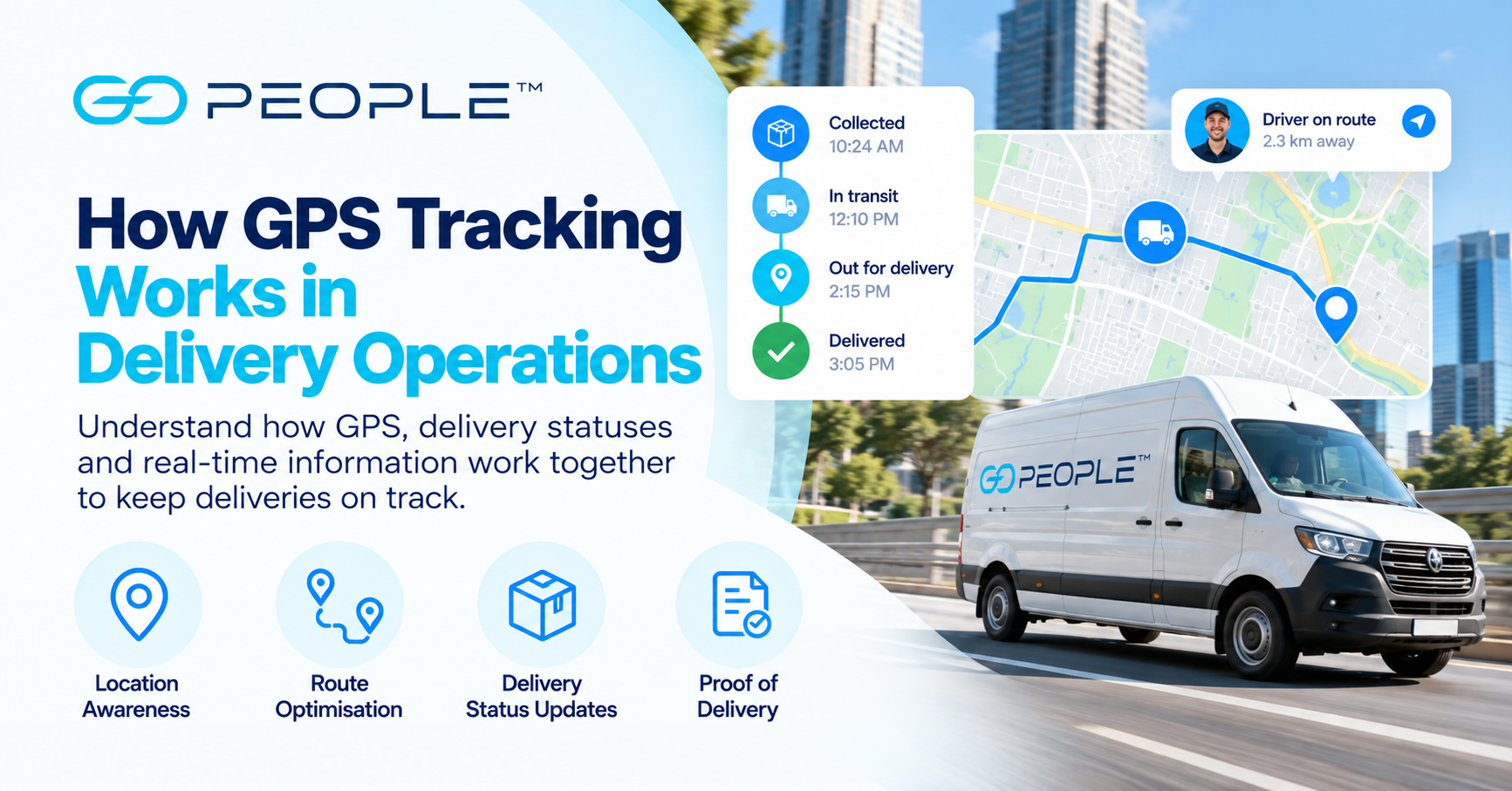
GPS technology has changed how businesses manage deliveries.
Location information can help delivery platforms understand where drivers are, organise routes and provide better visibility as deliveries move from pickup to completion.
But GPS tracking and delivery tracking aren’t exactly the same thing.
A driver’s location is only one piece of information.
For businesses and customers, the more useful question is usually:
What’s happening with my delivery?
Modern delivery technology combines location information where appropriate with delivery statuses, recorded events, customer notifications and proof of delivery to provide a clearer picture of the delivery journey.
What Is GPS Tracking?
GPS, or Global Positioning System, uses satellite signals to help determine the location of a compatible device.
In delivery operations, location information may be generated through technology used by drivers or delivery platforms.
Depending on the system, this information can help support:
- driver location awareness;
- route planning;
- delivery allocation;
- operational visibility; and
- delivery progress.
However, GPS location by itself doesn’t explain everything happening with a delivery.
That’s where delivery tracking becomes important.
GPS Tracking vs Delivery Tracking
The distinction is simple but important.
GPS Tracking
GPS tracking relates primarily to location.
It may help a delivery platform understand where a driver or compatible device is during relevant stages of a delivery operation.
Delivery Tracking
Delivery tracking relates to the delivery journey.
It can include events such as:
Collected → In Transit → Out for Delivery → Delivered
It may also include information about unsuccessful delivery attempts, exceptions or other events affecting the delivery.
For most customers, these delivery events are more useful than simply seeing a driver’s location.
Why a Driver’s Location Doesn’t Tell the Whole Story
Imagine a tracking map shows a delivery driver only two kilometres from your address.
Does that mean your parcel will arrive in five minutes?
Not necessarily.
The driver may:
- have other deliveries to complete first;
- be following an optimised route;
- need to complete a collection;
- encounter traffic or access problems; or
- have another operational requirement before reaching your address.
This is why businesses should be careful about treating a moving vehicle icon as an exact delivery estimate.
Location is useful context. It isn’t the entire delivery story.
How GPS Can Support Route Optimisation
Location information can also support route planning.
When a driver has multiple deliveries, simply completing them in the order they were received may not be efficient.
Delivery technology can consider factors such as:
- pickup and delivery locations;
- the number of stops;
- delivery requirements;
- route distance; and
- other relevant operational information.
Route optimisation can then help organise deliveries into a more efficient sequence.
This becomes particularly valuable for businesses completing many deliveries as part of a single run.
For businesses with multiple delivery destinations, GoBUNDLE combines multi-drop delivery with route optimisation, tracking and digital proof of delivery.
See our Multi-Drop Delivery Guide for more.
Delivery Statuses Provide Context
GPS location becomes much more useful when combined with delivery statuses.
A delivery platform might record stages such as:
Collected
The delivery has been collected and entered the delivery process.
In Transit
The parcel is progressing through the delivery operation.
Out for Delivery
The parcel has entered the final delivery stage.
This doesn’t necessarily mean the recipient is the driver’s next stop.
Delivered
The delivery has been completed.
Other events may also appear when something affects the normal delivery process.
These statuses help businesses and customers understand what is happening, rather than relying solely on location.
Delivery Events Create a Useful Timeline
Recorded delivery events can also create a history of the delivery.
This becomes particularly useful when something doesn’t go according to plan.
For example, a business investigating a customer enquiry may want to understand:
- when the parcel was collected;
- when it entered the delivery stage;
- whether delivery was attempted;
- whether an exception occurred; and
- when delivery was completed.
That timeline can provide much more useful operational information than GPS coordinates alone.
Customer Tracking and Notifications
Delivery technology isn’t only useful for operations teams.
Customers also want useful information about their deliveries.
Tracking can help recipients understand whether an order:
- has been collected;
- is progressing;
- is out for delivery; or
- has been delivered.
Notifications can provide relevant updates without requiring customers to repeatedly contact the retailer or delivery provider.
This is particularly important for ecommerce businesses.
See Why Real-Time Tracking Matters for Online Shopping for more.
Digital Proof of Delivery
The delivery journey doesn’t finish when the driver reaches the destination.
Businesses also need confirmation that the delivery has been completed.
Digital proof of delivery can provide a record of completion and help businesses respond to customer enquiries.
Depending on the delivery service, relevant completion information may be made available after delivery.
Together, these technologies create a more complete delivery record:
Location information + Delivery statuses + Delivery events + Customer updates + Proof of delivery
That’s far more useful than GPS alone.
GPS and Multi-Drop Deliveries
Location and route technology become particularly useful when one driver is completing many deliveries.
Imagine a business has 30 orders going to different customers.
Without route planning, those deliveries could be organised inefficiently.
With appropriate delivery technology, the run can be organised around the required stops and delivery information.
The business can then monitor how the delivery run progresses rather than manually checking every job.
For regular multi-drop requirements, GoBUNDLE is GoPeople’s multi-drop delivery service.
GPS and Same-Day Delivery
Same-day delivery happens within a relatively short timeframe.
That makes useful delivery visibility particularly important.
Businesses may need to understand whether an order has been collected, whether it’s progressing through delivery and whether delivery has been completed.
For suitable business deliveries, GoSAMEDAY provides same-day delivery in supported areas.
Tracking Urgent Deliveries
When something needs to move urgently, businesses often want visibility without repeatedly contacting the courier.
Tracking information can help businesses understand how an urgent delivery is progressing.
For individual time-sensitive delivery requirements, GoVIP provides an on-demand courier option in supported locations.
Tracking Next-Day Deliveries
GPS and delivery technology aren’t only relevant to urgent courier jobs.
Businesses sending ecommerce and parcel volumes also need visibility across the delivery process.
For next-day parcel delivery from customer warehouses in Sydney, Melbourne and Brisbane, GoEXPRESS provides tracking and digital delivery information as part of the delivery process.
What Businesses Should Look for in Delivery Technology
When comparing delivery providers, don’t judge the technology purely by whether there’s a map.
Look at the broader delivery experience.
Useful Delivery Statuses
Can your team understand what’s happening without interpreting complicated internal codes?
Customer Tracking
Can recipients access appropriate information about their delivery?
Notifications
Can customers receive useful delivery updates?
Route Optimisation
Can multiple deliveries be organised efficiently?
Proof of Delivery
Can your team confirm delivery completion?
Delivery History
Can previous delivery events be reviewed when something needs investigating?
Integrations
Can delivery workflows connect with relevant business systems where required?
The objective should be useful delivery visibility, not simply the largest possible amount of location data.
GPS Tracking and Driver Privacy
Businesses should also recognise that delivery technology needs to balance operational visibility with appropriate handling of driver information.
The purpose of location technology should be to support legitimate delivery operations.
Customers generally don’t need unrestricted access to every movement a driver makes.
Instead, customer-facing tracking should provide the information needed to understand the delivery.
This distinction helps create a better balance between operational visibility and appropriate use of location information.
How GoPeople Uses Delivery Technology
GoPeople uses technology to help businesses manage deliveries from booking through to completion.
Depending on the service and delivery stage, this can include delivery tracking, status information, route optimisation, customer updates and digital proof of delivery.
GoPeople provides four business delivery services:
GoEXPRESS — Next-Day Delivery
GoBUNDLE — Multi-Drop Delivery
GoSAMEDAY — Same-Day Delivery
GoVIP — On-Demand Courier
Businesses can also check GoPeople service availability for their location.
For a business-focused guide to delivery visibility, see Track Your Delivery Drivers: A Guide for Businesses.
Frequently Asked Questions
What is GPS tracking in delivery?
GPS tracking uses location technology to help determine the position of a compatible device. In delivery operations, location information can support routing, driver visibility and other delivery-management functions.
Is GPS tracking the same as parcel tracking?
No. GPS primarily relates to location, while parcel tracking provides information about the progress of a particular delivery through recorded statuses and events.
Can GPS tell me exactly when my parcel will arrive?
A driver’s location alone doesn’t provide an exact delivery time. The driver may have other stops or operational requirements before reaching your address.
Does “out for delivery” mean the driver is coming directly to me?
Not necessarily. It generally means the parcel has entered the delivery stage. The driver may have multiple deliveries to complete as part of the route.
How does GPS help with route optimisation?
Location information can form part of the data used to organise delivery routes. Route optimisation may also consider delivery locations, stops and other operational requirements.
Can customers see the driver’s exact location?
The information available depends on the delivery platform and service. Customers shouldn’t assume that every delivery service provides continuous or precise driver-location information.
Why are delivery statuses important if GPS is available?
Statuses provide context. Knowing that a driver is nearby doesn’t tell you whether your parcel has been collected, whether you’re the next stop or whether a delivery exception has occurred.
What is more important: GPS tracking or proof of delivery?
They serve different purposes. GPS can support location visibility during delivery, while proof of delivery helps confirm completion. A useful delivery platform can combine several types of information.
GPS Is Only One Part of Delivery Visibility
GPS technology can play an important role in modern delivery operations.
But location alone doesn’t answer the questions businesses and customers actually care about.
Has the parcel been collected?
Is it progressing?
Is it out for delivery?
Has something gone wrong?
Has it been delivered?
That’s why modern delivery visibility combines location information where appropriate with delivery statuses, recorded events, customer communication and proof of delivery.
GPS tells you something about where.
A good delivery platform also helps you understand what’s happening.