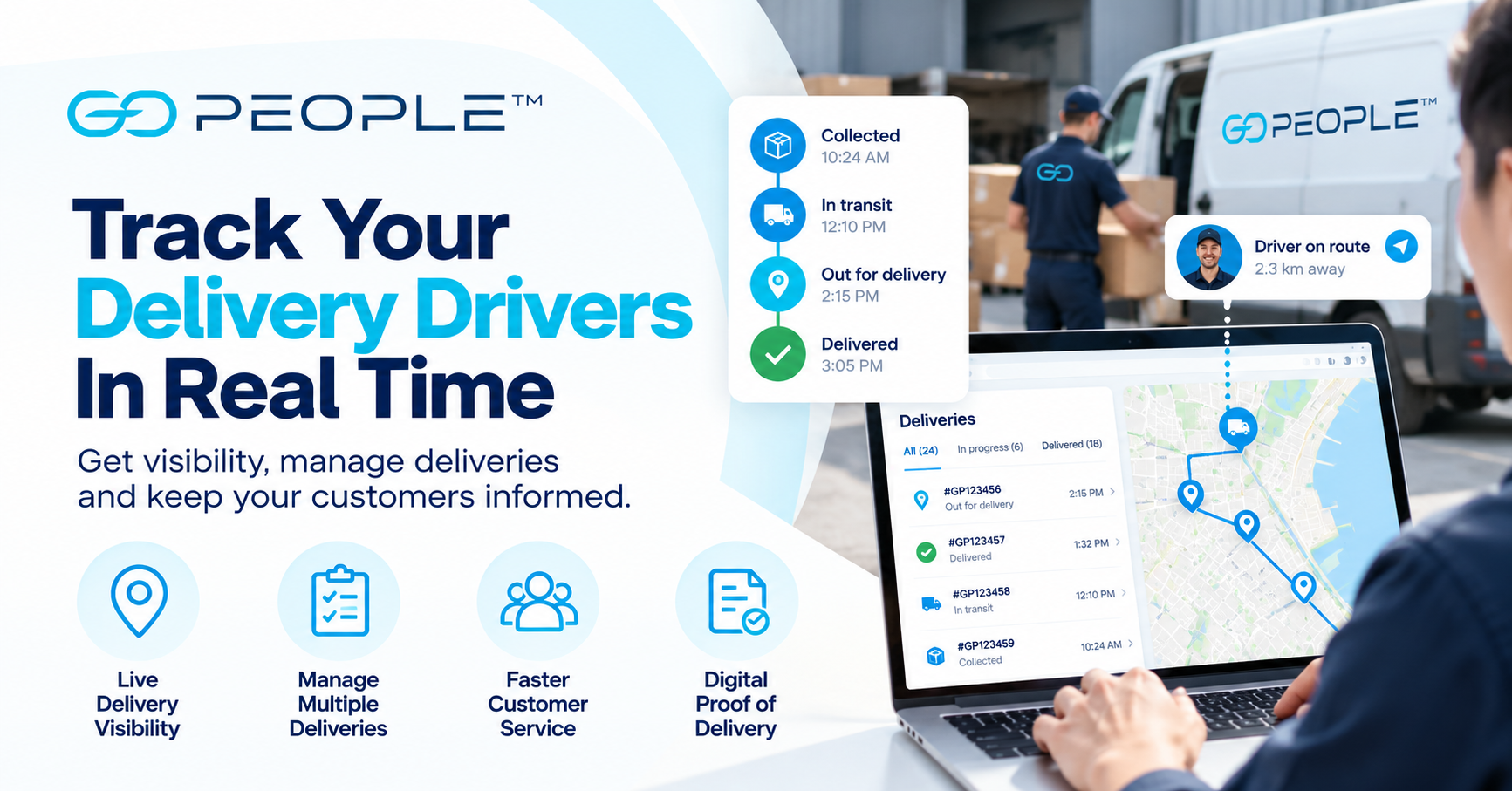
When a business manages multiple deliveries, knowing what’s happening after parcels leave the warehouse can be just as important as knowing when they were dispatched.
Without useful delivery visibility, operations teams may find themselves asking:
Has the driver collected the order?
Is the delivery progressing?
Has the customer received it?
Was there a problem completing the delivery?
Delivery tracking helps businesses answer these questions without relying entirely on phone calls, spreadsheets or manual updates.
But effective driver and delivery tracking is about more than watching a vehicle move on a map.
Here’s what businesses should look for.
What Is Delivery Driver Tracking?
Delivery driver tracking uses delivery technology to provide visibility into the progress of deliveries while they’re being completed.
Depending on the delivery platform and service, businesses may have access to information such as:
- collection status;
- delivery progress;
- recorded delivery events;
- delivery-status updates;
- completed deliveries; and
- proof of delivery.
Some delivery systems may also provide location information during relevant stages of the delivery.
The exact information available varies between platforms.
Driver Tracking vs Parcel Tracking
These terms are often used interchangeably, but they can serve different purposes.
Parcel Tracking
Parcel tracking is generally focused on an individual shipment.
A customer enters a tracking number and sees recorded events such as:
Collected → In transit → Out for delivery → Delivered
Driver Tracking
Driver tracking is more operational.
For a business managing deliveries, the objective may be to understand:
- which deliveries have been collected;
- which jobs are still outstanding;
- how a delivery run is progressing;
- whether an exception has occurred; and
- which deliveries have been completed.
For businesses handling multiple deliveries, that broader operational view can be particularly valuable.
Why Businesses Track Their Deliveries
1. Better Operational Visibility
Once an order leaves the warehouse, businesses still need to know what is happening.
Delivery visibility can help operations teams understand whether jobs are progressing as expected.
Instead of repeatedly contacting drivers, staff can use available delivery information as their first source of information.
2. Faster Customer Service
A customer may call and ask:
“Where is my order?”
Without tracking, the support team may need to contact the warehouse, dispatcher or driver before responding.
With useful delivery information, staff may be able to see the latest recorded status immediately.
That can make customer enquiries easier to manage.
3. Delivery Exception Management
Tracking is particularly useful when something doesn’t go according to plan.
For example:
- a delivery attempt is unsuccessful;
- access to the property is unavailable;
- delivery information is incorrect;
- the recipient cannot be reached; or
- another exception affects the delivery.
The objective isn’t merely to know that something went wrong.
It’s to understand what happens next.
4. Proof of Delivery
Businesses also need confirmation when deliveries are completed.
Digital proof of delivery can provide a clearer completion record for operations and customer-service teams.
Depending on the service, the available delivery information may include relevant completion details.
5. Fewer Manual Status Checks
A delivery operation shouldn’t depend on repeatedly calling drivers to ask where they are.
That interrupts both the operations team and the person completing the delivery.
Useful tracking allows staff to check available delivery information first and escalate only when something genuinely requires attention.
What Should a Business Delivery Tracking System Show?
Not every business needs exactly the same features, but useful delivery technology can include several capabilities.
Delivery Status
The platform should clearly show the current stage of the delivery.
Avoid systems that require staff to interpret unclear internal terminology.
Delivery Events
Recorded events help create a timeline of what’s happened to a delivery.
That can be particularly useful when investigating a customer enquiry.
Customer Tracking
Where appropriate, customers should have access to useful information about their own delivery without needing access to the business’s internal delivery system.
Notifications
Relevant delivery updates can help keep recipients informed as the delivery progresses.
Proof of Delivery
Completion information should be accessible when the business needs to confirm that a delivery was completed.
Delivery History
Businesses handling regular deliveries may also benefit from being able to review historical delivery information.
Don’t Treat a Driver Map as the Entire Tracking System
A moving vehicle icon looks impressive, but it doesn’t answer every delivery question.
For example, knowing a driver’s approximate location doesn’t necessarily tell you:
- whether your parcel is the next delivery;
- when a particular delivery will be completed;
- whether the recipient can be reached;
- whether access to the property is available; or
- whether an exception has occurred.
A useful delivery system combines appropriate location information with delivery statuses, events, notifications and proof of delivery.
That’s much more valuable than simply watching a dot move across a map.
Tracking Multi-Drop Delivery Runs
Driver and delivery visibility becomes particularly important when one driver is completing multiple deliveries.
A business may need to understand:
- how many deliveries are in the run;
- which deliveries have been completed;
- which jobs remain;
- whether unsuccessful deliveries have occurred; and
- whether the overall run is progressing.
Route optimisation can also help organise the sequence of multiple deliveries.
For businesses regularly sending many orders to different customers, GoBUNDLE provides multi-drop delivery with route optimisation, tracking and digital proof of delivery.
See our Multi-Drop Delivery Guide for more.
Tracking Ecommerce Deliveries
Ecommerce businesses have another consideration: the customer.
Once an order leaves the warehouse, customers increasingly expect useful information about what happens next.
Delivery tracking can help provide visibility between dispatch and completion.
For ecommerce businesses, this can reduce uncertainty around questions such as:
- Has my order been collected?
- Is it progressing?
- Is it out for delivery?
- Has delivery been completed?
For more, see Why Real-Time Tracking Matters for Online Shopping.
Tracking Same-Day Deliveries
Same-day deliveries happen over a relatively short timeframe, making useful status information particularly valuable.
Businesses may want visibility from booking and collection through to delivery completion.
For suitable business deliveries, GoSAMEDAY provides a same-day delivery option in supported areas.
Tracking Urgent Deliveries
When a delivery is genuinely urgent, businesses often want to know what’s happening without repeatedly contacting the courier.
For time-sensitive individual delivery requirements, GoVIP provides an on-demand courier option in supported locations.
Tracking Next-Day Deliveries
For ecommerce retailers, 3PLs and other businesses sending parcel volumes, visibility remains important even when the delivery isn’t same-day.
Businesses need to understand whether orders are moving through the delivery process and when completion is recorded.
GoEXPRESS provides next-day parcel delivery from customer warehouses in Sydney, Melbourne and Brisbane.
Tracking Your Own Drivers vs Using a Delivery Provider
Some businesses operate their own delivery fleet.
Others outsource deliveries to a delivery provider.
And some use a combination of both.
If You Operate Your Own Fleet
You may need technology that supports:
- driver allocation;
- route planning;
- job status;
- driver location;
- customer notifications;
- proof of delivery; and
- operational reporting.
If You Outsource Delivery
The delivery provider should give your business enough visibility to understand what is happening without requiring you to manage the driver’s every movement.
The question becomes less:
“Where is the driver?”
and more:
“What is happening with our deliveries?”
That’s usually the more useful business question.
Tracking Should Help You Improve Delivery Operations
Tracking data shouldn’t only be used when a customer complains.
Over time, delivery information can help businesses identify recurring operational problems.
For example:
- Where do unsuccessful deliveries occur most often?
- Are incorrect addresses causing delays?
- Are particular delivery types generating more exceptions?
- Are customers regularly contacting support about the same issue?
- Are deliveries being prepared too late?
These insights can help businesses improve the broader delivery process.
See 10 Ways to Improve Your Delivery Process for practical ideas.
How GoPeople Supports Delivery Visibility
GoPeople’s delivery services are designed to give businesses and recipients useful information as deliveries progress.
Depending on the service and delivery stage, this can include tracking information, delivery-status updates and digital proof of delivery.
GoPeople provides four business delivery options:
GoEXPRESS — Next-Day Delivery
GoBUNDLE — Multi-Drop Delivery
GoSAMEDAY — Same-Day Delivery
GoVIP — On-Demand Courier
Businesses can also check GoPeople service availability for their location.
Frequently Asked Questions
What is delivery driver tracking?
Delivery driver tracking uses delivery technology to provide visibility into the progress of deliveries. Depending on the platform, this may include delivery statuses, recorded events, location information, notifications and proof of delivery.
Can businesses track delivery drivers in real time?
Some delivery platforms provide location information during relevant stages of delivery. The exact visibility available depends on the provider and service. Businesses should not assume that every tracking system provides a driver’s precise location continuously.
What’s the difference between driver tracking and parcel tracking?
Parcel tracking generally focuses on the progress of an individual shipment. Driver tracking can provide a broader operational view for businesses managing drivers, routes or multiple deliveries.
Why is proof of delivery important?
Proof of delivery provides a record that the delivery has been completed and can help businesses respond to customer enquiries or investigate delivery issues.
Can customers track their own deliveries?
Many delivery platforms provide customer-facing tracking. The information available depends on the service being used.
Does tracking improve delivery speed?
Tracking itself doesn’t make a vehicle travel faster. Its value is visibility: it helps businesses and customers understand delivery progress and can make exceptions easier to identify and manage.
Should businesses track every movement of a delivery driver?
The more useful objective is generally to have enough delivery visibility to manage jobs effectively. Delivery statuses, events and proof of delivery can be more operationally useful than continuously monitoring every movement.
Better Tracking Means Better Delivery Visibility
The goal of delivery tracking isn’t simply to put a moving vehicle on a map.
Businesses need useful answers.
Has the order been collected?
Is the delivery progressing?
Has something gone wrong?
Has the customer received it?
A good delivery system makes those answers easier to find.
That gives operations teams better visibility, customer-service teams better information and customers a clearer understanding of what’s happening with their delivery.