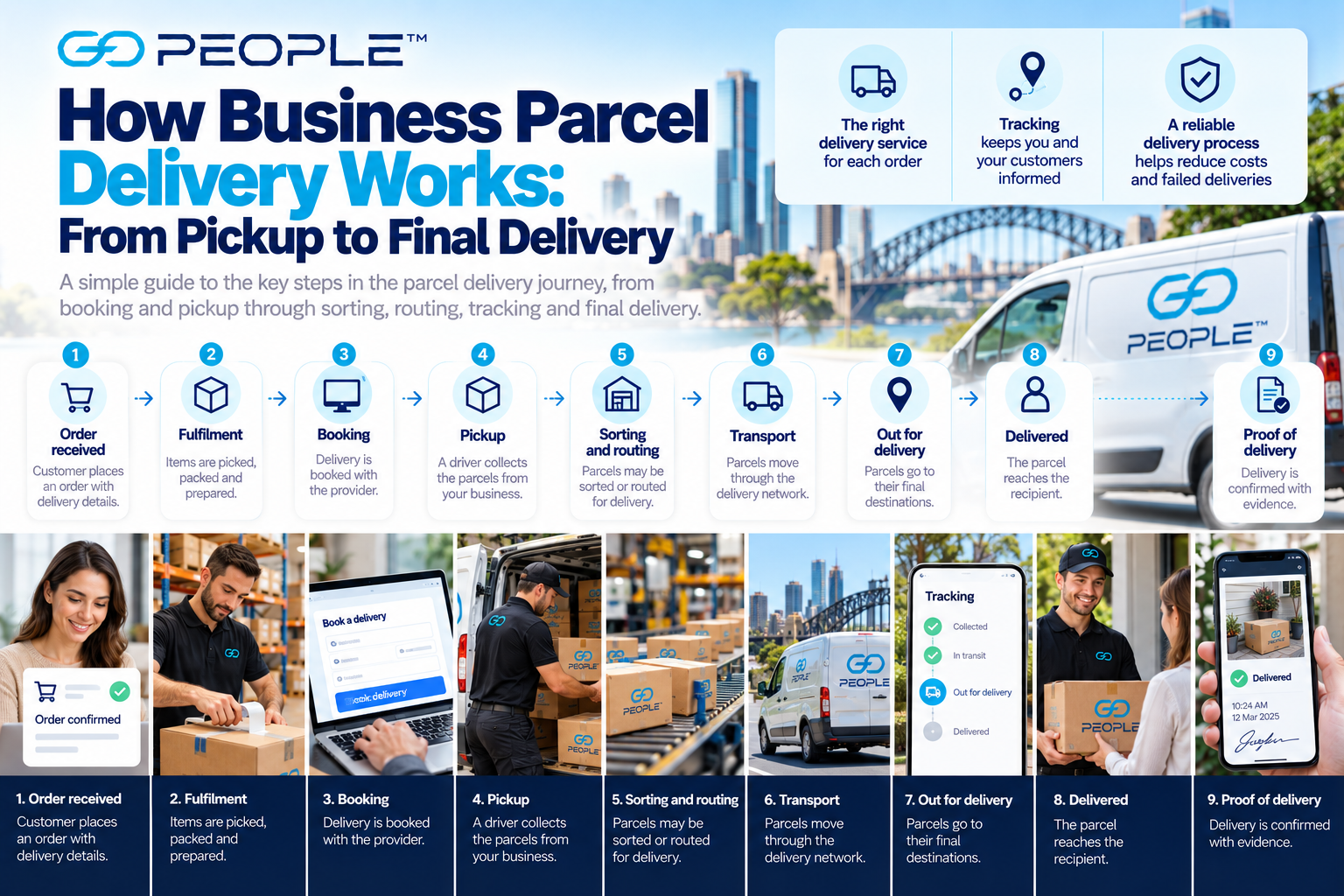
A parcel delivery can look simple from the customer’s perspective: place an order, receive a tracking update and wait for the parcel to arrive.
Behind that journey, however, there can be several operational steps involving booking, pickup, sorting, route planning, tracking, delivery and proof of delivery.
For businesses sending parcels regularly, understanding this process is useful because problems at any stage can affect delivery speed, cost and customer experience.
An incorrect address entered during booking can cause a failed delivery later. A parcel that is not ready when the driver arrives can delay pickup. Poor tracking can generate unnecessary customer enquiries even when the parcel itself is moving normally.
Understanding the complete delivery journey makes it easier to identify these problems and improve the process.
This guide explains how business parcel delivery works from the moment an order is ready to leave your business through to final delivery.
The Business Parcel Delivery Journey
Although the exact process varies between delivery providers and services, a typical parcel journey can be represented as:
Order received → Fulfilment → Booking → Packaging → Pickup → Sorting or routing → Transport → Final delivery → Proof of delivery
Some delivery models include every stage.
Others are much more direct.
For example, a next-day parcel may move through a warehouse or sorting operation before final delivery, while an urgent courier job may travel much more directly from the pickup location to the recipient.
Understanding these differences helps businesses choose the right delivery model for each order.
Step 1: The Customer Places an Order
For ecommerce businesses, the delivery process begins before the parcel reaches the carrier.
It starts when the customer places an order.
The business captures information such as:
- customer name;
- delivery address;
- mobile number;
- email address;
- products ordered;
- delivery option;
- delivery instructions; and
- sometimes a requested delivery date or timeframe.
Accuracy at this stage matters.
A small error can create a much larger problem later.
For example:
12 Smith Street, Richmond
and
12 Smith Street, Richmond, NSW
could potentially send a delivery in a completely different direction from:
12 Smith Street, Richmond, VIC
Unit numbers, building names and access instructions can be equally important.
Businesses should therefore treat delivery information as operational data rather than simply checkout information.
Step 2: The Order Enters Fulfilment
Once the order has been accepted, it needs to be prepared for dispatch.
Depending on the business, fulfilment may happen in a:
- warehouse;
- retail store;
- distribution centre;
- office;
- dark store;
- third-party logistics facility; or
- other business location.
The fulfilment team typically needs to:
- locate the ordered products;
- pick the correct items;
- verify quantities;
- pack the order;
- generate any required labels or documentation; and
- move the completed parcel into the dispatch area.
Delivery performance therefore depends partly on fulfilment performance.
If the carrier is ready at 3 pm but the warehouse doesn’t finish packing until 4 pm, the problem isn’t necessarily transportation.
This is why businesses should evaluate the entire order-to-delivery process, rather than delivery in isolation.
Step 3: The Delivery Is Booked
The parcel then needs to enter the delivery provider’s system.
Depending on the provider and the business’s setup, this might happen through:
- an online booking platform;
- ecommerce integration;
- API;
- warehouse-management integration;
- bulk upload; or
- another automated workflow.
The booking generally provides the carrier with the information needed to complete the delivery.
This can include:
- pickup location;
- delivery address;
- recipient details;
- parcel information;
- delivery instructions;
- required service; and
- relevant reference numbers.
For businesses sending only a few deliveries, manual booking may be manageable.
As volume grows, automation becomes increasingly important.
Manually entering 10 deliveries is very different from manually entering 500.
Step 4: The Appropriate Delivery Service Is Selected
Not every parcel needs the same delivery speed or delivery model.
Businesses should match the service to the actual requirement.
For example:
| Requirement | Possible delivery model |
|---|---|
| Regular ecommerce parcels required the following day | Next-day delivery |
| Many local orders leaving one location | Multi-drop delivery |
| Customer needs the order later that day | Same-day delivery |
| One urgent or time-sensitive item | On-demand courier |
Using the fastest available service for every order can increase costs unnecessarily.
Using a slower service when an order is genuinely urgent can damage the customer experience.
A better approach is to establish rules based on factors such as:
- customer promise;
- order urgency;
- destination;
- order value;
- parcel type;
- delivery cost; and
- available service coverage.
This allows the business to select the most appropriate service rather than defaulting to one option for every order.
Step 5: The Parcel Is Packaged for Delivery
Packaging has several jobs.
It needs to:
- protect the product;
- contain the contents;
- survive normal handling;
- make the parcel practical to transport; and
- provide the information required for delivery.
The right packaging depends on the item.
A book, bottle, electronic device, cake and piece of clothing all have different requirements.
However, some principles apply broadly.
Use an appropriately sized package
A box that is unnecessarily large can:
- waste packaging material;
- increase movement inside the parcel;
- occupy more vehicle space; and
- potentially affect delivery cost.
Protect the contents
Fragile products may require cushioning or additional protection.
See How to Pack and Deliver Fragile Items Safely for more detail.
Seal the parcel properly
Packaging should remain secure through the normal delivery process.
Make delivery information clear
Where labels are required, they should be readable and securely attached.
Good packaging reduces the chance that a perfectly planned delivery becomes a damaged-product complaint.
Step 6: The Parcel Is Prepared for Pickup
Before the driver arrives, parcels should ideally be:
- completely packed;
- correctly labelled;
- grouped appropriately;
- placed in an accessible dispatch area; and
- ready to hand over.
This is particularly important for businesses sending many parcels.
Imagine a warehouse with 150 parcels scheduled for collection.
If they are packed, organised and ready when the driver arrives, pickup can proceed efficiently.
If staff are still:
- printing labels;
- searching for orders;
- sealing cartons; or
- moving stock,
the collection can take significantly longer.
Repeated pickup delays can affect the rest of the delivery operation.
Step 7: The Driver Collects the Parcels
The pickup connects the business’s fulfilment operation with the delivery network.
Depending on the service, the driver may collect:
- one parcel;
- several parcels;
- a complete multi-drop run; or
- a larger batch of ecommerce orders.
The next stage depends on the delivery model.
A parcel might travel:
directly to the recipient
or:
to a warehouse or sorting location
or:
onto a multi-drop route with several destinations
This is one reason the word “courier” can describe several very different operations.
Step 8: Parcels May Be Sorted
Some delivery models require parcels to be sorted before final delivery.
Sorting may group parcels according to factors such as:
- destination;
- postcode;
- delivery area;
- route;
- service type; or
- delivery timeframe.
This allows large numbers of parcels to be organised into practical delivery runs.
For a next-day delivery network, the journey might look broadly like:
Business warehouse → pickup → delivery facility → sorting → delivery route → recipient
This differs from an urgent courier model, where the journey may be closer to:
Business → driver → recipient
Neither approach is inherently better.
They solve different delivery problems.
Step 9: Delivery Routes Are Planned
Once the parcels that need to be delivered together are known, the delivery route can be planned.
Route planning is more complicated than simply visiting addresses in the order they appear on a list.
Factors can include:
- geographic location;
- distance;
- traffic;
- delivery windows;
- business opening hours;
- apartment access;
- parcel volume;
- driver capacity; and
- delivery priority.
For multi-drop operations, route optimisation becomes particularly important.
Consider 40 deliveries leaving the same warehouse.
A poorly planned sequence can create unnecessary kilometres, driving time and cost.
A better sequence can reduce duplicated travel while helping deliveries progress more efficiently.
See Route Optimisation for Delivery: How Businesses Can Plan More Efficient Routes for a more detailed explanation.
Step 10: The Parcel Moves Through the Delivery Network
Once collected and routed, the parcel is in transit.
Depending on the service, this could involve:
- transport between facilities;
- movement within a metropolitan delivery network;
- transfer to a delivery route;
- direct courier transport; or
- several operational stages.
From the recipient’s perspective, tracking may simply show a status such as:
In Transit
That doesn’t necessarily mean the parcel is continuously travelling in one vehicle.
It generally indicates that the parcel is progressing through the delivery process toward its destination.
For more detail, see What Does “In Transit” Mean?.
Step 11: Tracking Provides Visibility
Modern parcel delivery isn’t only about physically moving the parcel.
Information needs to move too.
Tracking can give businesses and customers visibility into important delivery events.
Depending on the delivery provider and service, this may include statuses such as:
- booked;
- awaiting pickup;
- collected;
- in transit;
- out for delivery;
- delivery attempted; and
- delivered.
This visibility has two important audiences.
The customer
Customers want to know:
Where is my parcel?
Is it coming today?
Has something gone wrong?
Has it been delivered?
The business
Customer-service and operations teams need to know:
Has this order been collected?
Why hasn’t it been delivered?
Was delivery attempted?
What happened at the address?
Without good tracking, both sides may need to manually investigate routine delivery questions.
See How to Track Your Delivery in Real Time for more information.
Step 12: The Customer Receives Delivery Updates
Tracking is most useful when important information reaches the customer at the right time.
Depending on the service, customers may receive updates through channels such as:
- SMS;
- email;
- tracking page; or
- retailer communications.
Useful updates can include:
- parcel collected;
- parcel out for delivery;
- delivery attempted;
- delivery completed; or
- another significant status change.
The goal is not to send as many notifications as possible.
It is to reduce uncertainty.
A customer who knows what is happening is less likely to contact the retailer simply to ask:
“Where is my order?”
Step 13: The Parcel Reaches the Final Delivery Stage
The last part of the journey is often called last-mile delivery.
This is the stage where the parcel moves toward its final recipient.
It can also be one of the most operationally complex stages because every destination is different.
A driver may encounter:
- houses;
- apartment buildings;
- office towers;
- shopping centres;
- schools;
- hospitals;
- warehouses;
- gated properties; and
- businesses with restricted opening hours.
Traffic and access conditions can also change throughout the day.
This is why the final delivery stage can require significantly more coordination than simply transporting parcels between two facilities.
Step 14: The Driver Attempts Delivery
When the driver reaches the destination, several outcomes are possible.
Successful handover
The parcel is handed to the recipient or another appropriate person.
Authority to leave
Where permitted and appropriate under the applicable delivery instructions, the parcel may be left at the destination.
Access problem
The driver may be unable to enter:
- an apartment building;
- gated property;
- secure office;
- shopping centre;
- loading area; or
- another restricted location.
Recipient unavailable
The delivery may require a recipient who isn’t present.
Address problem
The address may be incomplete, incorrect or difficult to locate.
These situations are why accurate addresses and delivery instructions matter long before the driver reaches the destination.
Step 15: Proof of Delivery Is Recorded
Once delivery is completed, the delivery record may include proof of delivery.
Depending on the service and circumstances, this could include:
- completion status;
- timestamp;
- photograph;
- signature where applicable; or
- other delivery information.
Proof of delivery can help answer questions such as:
Was the parcel delivered?
When was it delivered?
What happened at the destination?
Is there evidence available to help investigate a dispute?
For businesses, this information is particularly useful when customer service needs to investigate an order after delivery.
Step 16: What Happens When Delivery Fails?
Not every parcel can be successfully delivered on the first attempt.
Common causes include:
- wrong address;
- missing unit number;
- locked building;
- recipient unavailable;
- unclear access instructions;
- business closed; and
- unsuitable delivery conditions.
What happens next depends on the provider, service and circumstances.
Possible outcomes may include:
- another delivery attempt;
- return to a facility;
- redelivery process;
- return to sender; or
- another service-specific resolution.
Businesses should understand these processes before choosing a delivery provider.
Failed deliveries can create:
- additional delivery costs;
- customer-service enquiries;
- refunds;
- replacements;
- redelivery work; and
- dissatisfied customers.
Our guide to reducing failed deliveries explains how businesses can improve first-attempt delivery success.
Where Parcel Delivery Problems Usually Begin
A delivery problem that appears at the customer’s door may actually have started much earlier.
Incorrect customer data
A wrong postcode entered during checkout can cause problems much later in the journey.
Slow fulfilment
A parcel that misses pickup because it wasn’t packed in time may miss the intended delivery cycle.
Poor packaging
Damage may occur because the product was inadequately protected before collection.
Wrong service selection
An order promised for today may have been booked using a service that does not match that requirement.
Missing delivery instructions
The driver reaches a secure building but has no information about how to gain access.
Poor communication
The delivery may be progressing normally, but the customer assumes something is wrong because they have received no updates.
Improving parcel delivery therefore requires more than simply asking drivers to move faster.
How Businesses Can Improve the Parcel Delivery Process
1. Improve address quality
Validate customer addresses before dispatch wherever practical.
Pay particular attention to:
- postcode;
- suburb;
- state;
- street number;
- unit number;
- building name; and
- access information.
2. Set realistic order cut-offs
Work backwards from pickup times and fulfilment requirements.
If orders cannot realistically be packed before the carrier arrives, the customer-facing cut-off needs adjustment.
3. Match the service to the order
Use different delivery models for different requirements rather than paying for unnecessary urgency.
4. Prepare parcels before pickup
Drivers should not need to wait for routine packing and labelling.
5. Improve packaging
Use appropriately sized packaging and sufficient protection.
6. Provide tracking
Give customers access to useful delivery information.
7. Communicate important changes
Proactive information is generally better than waiting for the customer to ask.
8. Capture useful delivery instructions
Apartment access, reception details and other location-specific information can help reduce unsuccessful attempts.
9. Review failed deliveries
Look for patterns rather than treating every failed delivery as an isolated event.
10. Measure the whole process
Track operational metrics such as:
- on-time delivery;
- failed deliveries;
- first-attempt success;
- support enquiries;
- redelivery;
- delivery cost; and
- customer complaints.
How Different GoPeople Delivery Services Fit Into the Journey
GoPeople offers different delivery models for different business requirements.
Next-Day Delivery
GoEXPRESS is GoPeople’s next-day business parcel delivery service for eligible pickups in Sydney, Melbourne and Brisbane.
This model is suited to businesses sending regular parcel volumes where next-day delivery fits the customer promise.
Multi-Drop Delivery
GoBUNDLE is designed for businesses that need multiple deliveries collected from one location and delivered across an optimised route.
This can suit businesses with many local deliveries whose destination addresses change from day to day.
Same-Day Delivery
GoSAMEDAY provides same-day delivery for eligible business pickups.
It can suit orders that genuinely need to reach customers on the same day.
On-Demand Courier
GoVIP is designed for urgent, individual and time-sensitive courier requirements.
Rather than assuming one delivery model is appropriate for everything, businesses can choose a service based on each delivery requirement.
From Delivery Transaction to Delivery System
For a small business sending one parcel, delivery can feel like a transaction:
Book → collect → deliver.
As volume increases, delivery becomes a system.
The business needs to coordinate:
Orders → fulfilment → packaging → booking → pickup → routing → tracking → delivery → exceptions → reporting
At that point, improvements in seemingly small areas can have significant effects.
For example:
- better address data can reduce failed deliveries;
- earlier fulfilment can improve pickup reliability;
- route optimisation can reduce unnecessary travel;
- tracking can reduce customer enquiries;
- appropriate service selection can control costs;
- proof of delivery can simplify investigations.
The objective isn’t simply to make one parcel move faster.
It is to build a delivery process that remains manageable as order volume grows.
Frequently Asked Questions
How does parcel delivery work?
A typical parcel delivery starts with booking and preparation, followed by pickup. Depending on the delivery service, the parcel may then be sorted or routed before moving through the delivery network to the recipient. Tracking records important events, and proof of delivery may be captured when the delivery is completed.
What happens after a parcel is picked up?
The next step depends on the service. Some parcels move to a facility for sorting before final delivery, while other courier or multi-drop services may move more directly onto a delivery route.
What does “in transit” mean?
“In transit” generally means the parcel is progressing through the delivery process toward its destination. It does not necessarily mean the parcel is continuously moving in a vehicle.
Why do parcel deliveries fail?
Common causes include incorrect addresses, missing unit numbers, restricted building access, unavailable recipients, unclear delivery instructions and businesses being closed when delivery is attempted.
What is proof of delivery?
Proof of delivery is information recorded when a delivery is completed. Depending on the service, this may include a timestamp, photograph, signature or another form of delivery confirmation.
How can businesses reduce failed deliveries?
Businesses can improve address accuracy, collect useful delivery instructions, provide customers with tracking and notifications, set realistic delivery expectations and analyse recurring reasons for unsuccessful attempts.
What delivery service should a business use?
It depends on the order. Regular ecommerce parcels may suit next-day delivery, multiple local orders may suit multi-drop delivery, orders needed that day may suit same-day delivery, and urgent individual items may suit an on-demand courier.