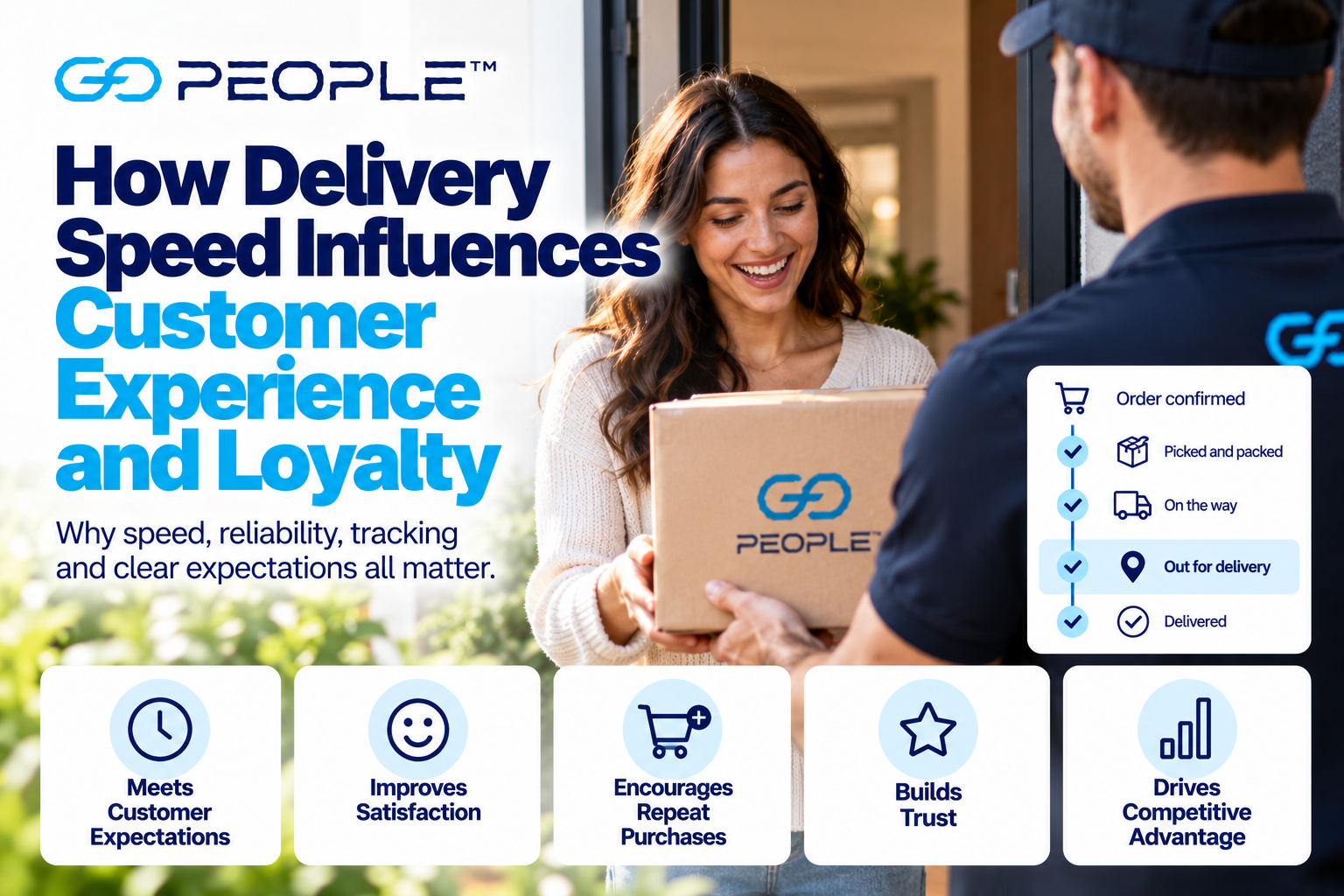
Delivery speed has become an important part of the ecommerce customer experience.
When customers place an order online, they are not only buying a product. They are also buying into an expectation about when they will receive it.
For some purchases, waiting several days is perfectly acceptable. For others, customers may value same-day or next-day delivery enough to choose one retailer over another.
This is often explained through the idea of instant gratification: people generally like receiving the benefits of a purchase sooner rather than later.
But the relationship between delivery speed and customer loyalty is more complicated than simply:
Faster delivery = happier customer.
A fast delivery that arrives late, provides poor tracking or creates uncertainty can produce a worse experience than a slightly slower service that performs exactly as promised.
For businesses, the real objective is therefore not maximum speed.
It is finding the right combination of:
speed + reliability + visibility + convenience + realistic expectations
That combination can influence whether customers feel confident ordering from the business again.
Why Delivery Feels Different From the Rest of Ecommerce
Most of the ecommerce purchase journey happens almost instantly.
A customer can:
- search for a product;
- compare alternatives;
- read reviews;
- add something to the cart;
- pay; and
- receive an order confirmation
within minutes.
Then something changes.
They have to wait.
The digital part of the transaction may be immediate, but the physical product still needs to move from the business to the customer.
That gap between purchase and possession is where delivery becomes psychologically important.
What Is Instant Gratification?
Instant gratification generally describes the preference for receiving a reward sooner rather than waiting for it.
Online shopping can reinforce this behaviour.
Customers can discover a product, purchase it and complete payment almost immediately.
But unless the product is digital, they still cannot use it until it arrives.
Faster delivery reduces that delay.
This can make the overall shopping experience feel more immediate, particularly when the purchase is:
- urgent;
- exciting;
- spontaneous;
- replacing something needed quickly;
- intended for an event; or
- connected to a specific deadline.
However, not every purchase creates the same sense of urgency.
That distinction matters.
Delivery Speed Is Part of Perceived Value
Two retailers may sell an identical product at the same price.
Retailer A says:
Delivery in several days
Retailer B offers:
Next-day delivery
or an eligible same-day option.
For a customer who wants the product quickly, Retailer B may provide greater overall value even though the product itself is identical.
This is because customers evaluate more than the item.
They may also consider:
- price;
- availability;
- delivery cost;
- delivery speed;
- convenience;
- trust;
- returns;
- tracking; and
- previous experience.
Delivery is therefore part of the total value proposition.
But Customers Don’t Always Want the Fastest Option
Speed is important, but it should not be confused with universal urgency.
Consider these purchases:
Replacement Phone Charger
The customer may want it today.
Birthday Gift Needed Tomorrow
Delivery timing may strongly influence the retailer selected.
Routine Household Product
The customer may happily wait several days if delivery is cheaper.
Expensive Furniture
The customer may care more about scheduling and reliability than raw speed.
Business-Critical Component
The value of receiving it quickly may significantly exceed the additional delivery cost.
Different orders create different delivery priorities.
The best delivery strategy gives customers appropriate options rather than assuming every parcel must arrive as quickly as physically possible.
The Psychology of Waiting
Waiting feels different depending on how much information the customer has.
Compare these experiences.
Experience A
Your order has been shipped.
Nothing else happens for two days.
The customer does not know:
- where the parcel is;
- whether it is moving;
- when it will arrive; or
- whether there is a problem.
Experience B
The customer can see:
- order confirmed;
- parcel collected;
- delivery status;
- expected delivery information; and
- delivery completion.
Even if both parcels take the same amount of time, Experience B may feel better because there is less uncertainty.
This is why delivery speed and delivery visibility should be considered together.
Uncertainty Can Make Waiting Feel Worse
Customers often tolerate waiting better when they know what to expect.
A clear message such as:
Expected delivery Wednesday
gives the customer something concrete to plan around.
A vague message such as:
Your order is on its way
provides much less certainty.
Businesses should therefore think about two separate questions:
- How long does delivery take?
- How well does the customer understand what is happening?
Improving the second can sometimes improve customer experience without making the delivery itself any faster.
Tracking Helps Close the Information Gap
Real-time delivery tracking can provide visibility between dispatch and delivery.
Depending on the delivery service, tracking may help customers understand:
- whether the parcel has been collected;
- its current delivery status;
- whether delivery is in progress;
- when delivery has been completed; and
- whether an exception has occurred.
This reduces the information gap that exists after checkout.
For more detail, see Why Real-Time Tracking Matters for Online Shopping.
Faster Delivery Can Increase Excitement
Some purchases create anticipation.
Examples include:
- fashion;
- electronics;
- gifts;
- beauty products;
- hobby purchases;
- event-related products; and
- spontaneous purchases.
When the gap between purchase and receipt is short, the excitement created at checkout may still be strong when the parcel arrives.
A long delay can allow that excitement to fade.
This does not mean every retailer needs same-day delivery.
It means delivery speed can form part of the emotional experience surrounding certain purchases.
Urgency Changes the Value of Speed
The value of faster delivery rises dramatically when the customer has a deadline.
Imagine a customer needs an item for tomorrow.
A retailer offering delivery in three to five days is effectively unavailable to that customer.
The relevant competitors are only those capable of meeting the required timeframe.
In this situation, faster delivery does more than improve convenience.
It can determine whether the sale occurs at all.
Delivery Speed Can Affect Conversion
Delivery information can influence the purchase decision before checkout is completed.
Customers may abandon or reconsider an order if:
- delivery takes too long;
- delivery timing is unclear;
- shipping cost appears unexpectedly;
- the required delivery date is unavailable; or
- another retailer offers a more suitable option.
This is why delivery information should not be treated solely as a post-purchase concern.
Where practical, customers should understand the relevant delivery options before committing to the order.
For a broader checkout discussion, see How to Reduce Cart Abandonment in Ecommerce.
Speed Can Influence the First Purchase
A customer may initially choose a retailer because it offers a faster delivery option.
But speed alone does not create loyalty.
The first order creates an opportunity.
What happens next determines whether the business earns trust.
If the retailer promises same-day delivery and the order arrives as expected, the customer has evidence that the retailer can fulfil that promise.
If the retailer repeatedly provides a reliable experience, confidence can grow.
That confidence may influence future purchasing decisions.
Reliability Is More Important Than an Aggressive Promise
Consider two retailers.
Retailer A
Promises same-day delivery but frequently misses the expected timeframe.
Retailer B
Promises next-day delivery and consistently delivers as expected.
Which creates more trust?
For many customers, Retailer B may provide the better experience.
This illustrates an important principle:
A reliable promise is more valuable than an impressive promise that cannot consistently be kept.
Businesses should therefore avoid treating delivery speed purely as a marketing claim.
The fulfilment and delivery operation must be able to support it.
The Expectation Gap
Customer dissatisfaction often comes from the gap between:
what was promised
and:
what actually happened
Suppose a customer expects delivery on Friday.
Delivered Thursday
Potentially positive surprise.
Delivered Friday
Expectation met.
Delivered Saturday
Expectation missed.
The same Saturday delivery might have been perfectly acceptable if Saturday had been communicated from the beginning.
Expectation management therefore has a major influence on perceived delivery quality.
Under-Promising Isn’t the Answer Either
Businesses sometimes respond by giving extremely conservative delivery estimates.
That reduces the risk of being late, but it can also make the offer less competitive.
The goal should be:
the most attractive delivery promise the operation can reliably support
That requires understanding actual performance.
Track:
- order processing time;
- dispatch time;
- pickup reliability;
- delivery time;
- on-time performance;
- failed deliveries; and
- exception rates.
Delivery promises should come from operational data.
Same-Day Delivery and Customer Psychology
Same-day delivery compresses the time between purchase and receipt.
This can be particularly valuable when the customer:
- needs the item urgently;
- wants immediate convenience;
- is buying for an event;
- is replacing a missing or damaged item;
- has made a spontaneous purchase; or
- places high value on receiving the product quickly.
For eligible business pickups, GoSAMEDAY provides a same-day delivery option.
But same-day should be offered where it solves a genuine customer problem—not simply because “faster” sounds better.
Same-Day Delivery Is Not Automatically the Best Option
Same-day delivery can introduce additional operational constraints.
Orders need to be:
- received;
- processed;
- picked;
- packed;
- ready for pickup; and
- delivered
within a shorter period.
That may require:
- earlier cut-offs;
- faster fulfilment;
- suitable delivery capacity;
- tighter service areas; and
- higher delivery costs.
If customers are not willing to pay for or do not meaningfully value the additional speed, another service may be more appropriate.
See When to Use Same-Day Delivery for Your Business for a more detailed decision framework.
Next-Day Delivery Can Be the Better Balance
For many ecommerce orders, next-day delivery can provide a useful balance between speed and operational efficiency.
Customers still receive the product quickly, while the business has more time to:
- consolidate orders;
- prepare parcels;
- organise pickup;
- sort deliveries; and
- plan delivery routes.
GoEXPRESS provides next-day parcel delivery for eligible business pickups in Sydney, Melbourne and Brisbane.
The right service depends on what customers need rather than simply choosing the fastest available option.
On-Demand Delivery for Genuine Urgency
Some deliveries do not fit neatly into a scheduled same-day or next-day process.
Examples might include:
- urgent documents;
- critical replacement items;
- forgotten goods;
- time-sensitive business items; or
- unexpected delivery requirements.
For these cases, an on-demand courier may be more appropriate.
GoVIP provides an on-demand option for urgent and time-sensitive delivery requirements.
This is another reason businesses should avoid using one delivery model for every order.
Customer Choice Can Be More Valuable Than Maximum Speed
Imagine a retailer offers:
Option A — lower-cost delivery
Option B — next-day delivery
Option C — eligible same-day delivery
Customers can then choose based on their own priorities.
One customer may value price.
Another may value speed.
Another may need the item urgently.
Providing suitable choices can allow customers to decide what convenience is worth to them.
Delivery Cost Changes How Customers Value Speed
Customers do not evaluate speed in isolation.
They consider:
How much faster is it?
and:
How much more does it cost?
Suppose a faster service saves several days but costs substantially more.
For an urgent order, the premium may feel worthwhile.
For a routine purchase, it may not.
Businesses should analyse actual customer behaviour rather than assuming that customers will always choose the fastest option.
Free Delivery Can Compete With Fast Delivery
Sometimes customers face a choice between:
free slower delivery
and:
paid faster delivery
Different customers will make different decisions.
This suggests a useful ecommerce strategy:
Don’t necessarily force every order into the same delivery model.
Where operationally practical, offer options that reflect different customer priorities.
Convenience Can Matter More Than Speed
Imagine a parcel arrives very quickly but:
- the customer receives no warning;
- nobody is home;
- building access fails; and
- the delivery needs another attempt.
Was that really a convenient delivery?
Now compare a slightly slower delivery where the customer receives:
- a clear expected timeframe;
- tracking;
- useful notifications; and
- successful first-attempt delivery.
The second experience may be much better.
Customer experience depends on the entire delivery journey.
First-Attempt Delivery Success Matters
Speed loses much of its value if the first attempt fails.
Businesses should therefore consider:
- address accuracy;
- apartment/unit details;
- contact information;
- delivery instructions;
- customer availability;
- building access; and
- appropriate delivery options.
Improving first-attempt success can create more customer value than simply trying to make every route faster.
See How to Reduce Failed Deliveries and Improve First-Attempt Delivery Success.
Communication Shapes the Delivery Experience
A good communication journey might include:
Order confirmed
↓
Order prepared
↓
Parcel collected
↓
Delivery underway
↓
Useful tracking or ETA information
↓
Delivered
The customer should not need to repeatedly contact support to understand what is happening.
Good communication reduces uncertainty and can make the overall experience feel more controlled.
Silence Makes Delays Worse
A delay is frustrating.
An unexplained delay can be much worse.
Suppose an order expected Tuesday will now arrive Wednesday.
Experience A
Nothing happens. The customer waits, becomes concerned and contacts support.
Experience B
The customer receives a useful update explaining that the expected delivery timing has changed.
The delivery is still late in both cases.
But the second experience provides more certainty.
Businesses should therefore design communication for exceptions, not only successful deliveries.
Delivery Problems Can Affect Trust
A single delivery problem does not necessarily destroy customer loyalty.
How the business responds matters.
If something goes wrong:
- acknowledge the issue;
- provide useful information;
- avoid unrealistic promises;
- explain the next step;
- resolve the problem where possible; and
- investigate recurring causes.
Customers often judge businesses not only by whether problems happen, but also by how effectively those problems are handled.
See How to Repair Customer Trust After Delivery Problems for a detailed recovery framework.
Repeated Reliability Builds Confidence
Imagine a customer places five orders.
Every time:
- the delivery timeframe is clear;
- tracking works;
- the parcel arrives as expected; and
- proof of delivery is available.
By the sixth purchase, the customer has evidence that the retailer’s delivery promise is credible.
That confidence reduces perceived risk.
This is one way delivery can contribute to repeat purchasing.
The customer is not necessarily loyal because the parcel was fast.
They may be loyal because the entire experience became predictable and trustworthy.
Delivery Becomes Part of the Brand
Customers may not distinguish between:
- retailer;
- warehouse;
- courier;
- delivery platform; and
- driver.
They bought from the retailer.
So if the parcel arrives late, the customer may simply think:
“That retailer’s delivery is unreliable.”
From the customer’s perspective, delivery is part of the brand experience.
Businesses should therefore treat delivery performance as a customer-experience metric, not merely a logistics metric.
Fast Delivery Can Create Competitive Differentiation
When competitors sell similar products at similar prices, delivery can become a differentiator.
A retailer may compete through:
- faster delivery;
- more predictable delivery;
- better tracking;
- lower delivery cost;
- more delivery choices;
- easier returns; or
- better communication.
The strongest proposition depends on the customer segment.
For some customers, speed wins.
For others, convenience or price matters more.
Speed Can Also Become an Expectation
There is a downside to consistently offering very fast delivery.
Customers can begin to treat it as normal.
Once the expectation is established, reducing service levels may create dissatisfaction.
Businesses should therefore be careful about making delivery promises they cannot sustainably support.
A temporary promotional capability should not accidentally become a permanent customer expectation unless the operation can maintain it.
Don’t Promise Speed You Cannot Scale
A business may successfully provide same-day delivery at:
20 orders per day
but struggle at:
200 orders per day.
Growth can change:
- warehouse workload;
- picking time;
- packing time;
- pickup requirements;
- route density;
- driver capacity; and
- customer-support volume.
Delivery strategy should be designed for realistic future volume, not just today’s order count.
Peak Periods Change Customer Expectations
During major shopping periods, customers may understand that networks are busier.
But they still expect accurate information.
Businesses should review delivery promises around:
- Black Friday;
- Cyber Monday;
- Christmas;
- promotional campaigns;
- product launches; and
- seasonal peaks.
It may be better to communicate a realistic longer timeframe than continue advertising a faster service that cannot be consistently achieved.
See How to Manage Delivery Delays During Peak Seasons.
Measure Whether Faster Delivery Actually Changes Behaviour
Businesses should avoid assuming that faster delivery automatically creates loyalty.
Measure it.
Compare customer behaviour based on delivery experience.
Useful metrics may include:
Conversion Rate
Do customers convert more often when faster delivery is available?
Delivery Option Selection
How many customers choose faster options?
Repeat Purchase Rate
Do customers who receive faster delivery return more frequently?
On-Time Delivery Rate
Are fast-delivery promises actually being achieved?
Failed Delivery Rate
Does the faster service create more or fewer unsuccessful attempts?
Customer Support Contacts
Are customers asking fewer “where is my order?” questions?
Refunds and Credits
Are delivery-related complaints increasing or decreasing?
Customer Satisfaction
How do customers rate the delivery experience?
These measures help distinguish perceived benefits from actual customer behaviour.
Compare Speed With Reliability
A particularly useful analysis is to segment orders by:
delivery speed + on-time performance
For example:
| Delivery Experience | Likely Customer Perception |
|---|---|
| Fast + on time | Strong |
| Fast + late | Disappointing |
| Moderate speed + on time | Reliable |
| Slow + on time | Acceptable depending on expectation |
| Slow + late | Poor |
This highlights why speed cannot be evaluated by itself.
A faster service that regularly misses its promise may underperform a slower but highly reliable service.
Track the Cost of Speed
Faster delivery can require:
- more drivers;
- less route consolidation;
- earlier cut-offs;
- additional warehouse labour;
- premium delivery services; and
- more operational coordination.
Businesses should compare:
incremental delivery cost
against:
incremental customer value
For example:
Does same-day availability improve conversion enough to justify the additional cost?
Do customers pay a premium for it?
Does it improve repeat purchasing?
Does it reduce cart abandonment?
These are commercial questions, not just logistics questions.
Segment Customers Instead of Treating Everyone the Same
Different customer groups may value delivery differently.
A business might discover:
Segment A
Highly price-sensitive and happy to wait.
Segment B
Values next-day delivery.
Segment C
Occasionally needs same-day.
Segment D
Business customers who care more about predictable delivery windows than maximum speed.
This information can guide the delivery options offered at checkout.
Segment Orders Too
Customer preferences are only one side.
The order itself also matters.
Consider:
- product value;
- product type;
- margin;
- destination;
- urgency;
- parcel size;
- delivery cost;
- inventory location; and
- customer lifetime value.
A $15 low-margin product may not economically support the same delivery strategy as a $500 order.
Delivery options should make commercial sense for the order.
Build a Delivery Ladder
Rather than treating delivery as a single service, businesses can think in terms of a delivery ladder.
For example:
Economy
For price-sensitive, non-urgent orders.
Standard / Next-Day
For customers wanting a balance of speed and cost.
Same-Day
For eligible urgent orders where additional speed provides value.
On-Demand
For genuinely time-critical individual requirements.
The exact structure depends on the business and available services.
The principle is to match the delivery model to the customer’s actual need.
Avoid Turning Every Order Into an Emergency
If everything is urgent, nothing is prioritised.
Businesses can accidentally create unnecessary cost by treating all orders as requiring maximum speed.
Instead, determine:
- which customers value speed;
- which products need speed;
- which orders can support the cost; and
- which locations can be served reliably.
This allows premium capacity to be used where it creates the most value.
Fast Delivery Works Best When the Entire Operation Is Fast
A courier cannot compensate for a warehouse that takes two days to dispatch an order.
Total delivery experience includes:
Order received
↓
Payment confirmed
↓
Pick
↓
Pack
↓
Ready for dispatch
↓
Pickup
↓
Transport
↓
Final delivery
If the business wants to improve customer delivery speed, it should measure the entire journey.
Sometimes the biggest opportunity is inside the warehouse rather than on the road.
The Best Delivery Promise Is Customer-Centric and Operationally Realistic
Businesses should avoid two extremes.
Extreme 1: Slow Because It Is Easier Operationally
This ignores customer expectations.
Extreme 2: Promise Maximum Speed Everywhere
This can create unnecessary cost and unreliable performance.
A better approach is to ask:
- What do customers actually value?
- How quickly can we reliably fulfil orders?
- Which delivery services fit those requirements?
- What are customers willing to pay?
- What is the total cost?
- Can the service scale?
- Are we meeting the promise consistently?
The answer may differ by product, customer, location and order.
Delivery Loyalty Is Really About Trust
Fast delivery can attract attention.
It can help win a purchase.
It can make an order feel more convenient.
And for urgent purchases, it can be extremely valuable.
But loyalty requires something more durable.
Customers need confidence that the business will do what it says.
That means:
- realistic delivery promises;
- reliable fulfilment;
- appropriate speed;
- useful tracking;
- proactive communication;
- successful delivery; and
- effective problem resolution.
The goal should therefore not be:
Make every delivery as fast as possible.
A stronger goal is:
Give each customer the delivery experience that best matches their needs—and deliver it reliably.
When customers repeatedly receive the experience they were promised, delivery can become an important reason to buy from the business again.
Frequently Asked Questions
Does faster delivery increase customer loyalty?
It can contribute to a better customer experience, particularly when customers value speed, but speed alone does not guarantee loyalty. Reliability, communication, tracking, price, product quality and the overall shopping experience also matter.
Why do customers value fast delivery?
Fast delivery reduces the time between purchase and receiving the product. It can be particularly valuable for urgent, spontaneous or time-sensitive purchases.
Is same-day delivery better than next-day delivery?
Not always. Same-day delivery is useful when customers genuinely need the additional speed. Next-day delivery may provide a better balance of speed, cost and operational efficiency for many ecommerce orders.
Is delivery reliability more important than speed?
Both matter, but a realistic delivery promise that is consistently achieved can create more trust than a faster promise that is frequently missed.
How does tracking affect customer satisfaction?
Tracking can reduce uncertainty by helping customers understand delivery progress and what is expected to happen next. This can improve the experience even when the physical delivery speed remains unchanged.
Should every ecommerce business offer same-day delivery?
No. Businesses should consider customer demand, fulfilment capability, service availability, geography, delivery costs and whether customers value the additional speed enough to justify it.
How can businesses measure whether fast delivery is worthwhile?
Track delivery-option selection, conversion, repeat purchases, on-time performance, failed deliveries, support enquiries, customer satisfaction and the incremental cost of providing faster delivery.