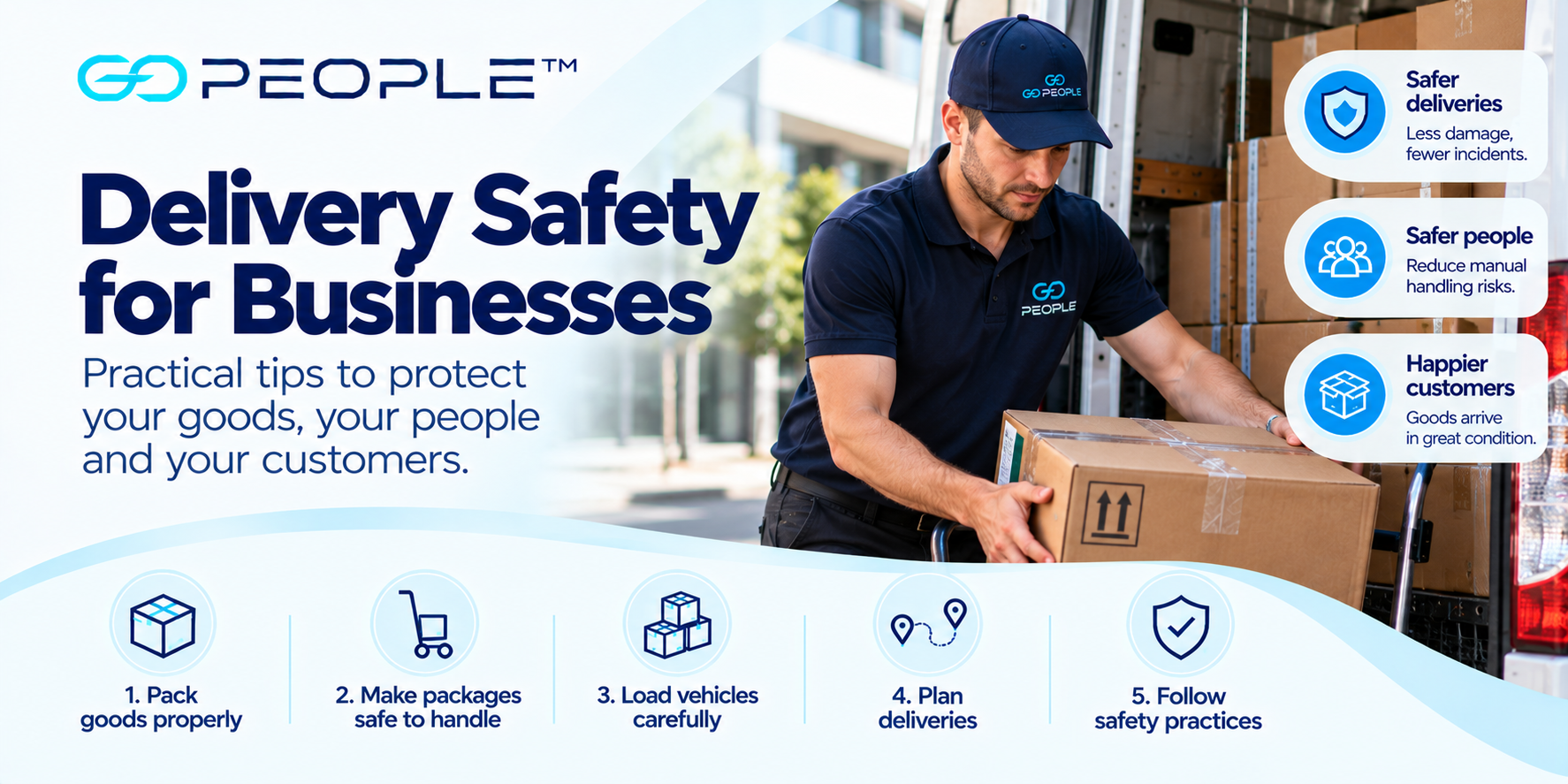
 Safe delivery starts long before a driver reaches the customer’s address.
Products need to be packed appropriately, loaded securely and transported in a way that reduces the risk of damage or injury. Drivers also need to deal with loading areas, traffic, apartment buildings, commercial premises and other environments where deliveries take place.
For businesses making regular deliveries, these aren’t isolated considerations. They should form part of the everyday delivery process.
This guide covers practical ways businesses can improve safety from the warehouse through to the final handover.
Why Delivery Safety Matters
Delivery involves people, vehicles and goods moving through different environments.
Problems can result in:
- damaged products
- injured workers or drivers
- damaged vehicles
- unsafe loading or unloading
- failed deliveries
- customer complaints
- replacement orders
- operational delays
Good delivery procedures help reduce these risks while making the operation more consistent.
1. Package Goods for the Journey
Packaging shouldn’t be designed only to make a product look presentable.
It needs to protect the item throughout the delivery journey.
Before dispatch, consider:
- product weight
- dimensions
- fragility
- sharp or protruding components
- liquids
- temperature sensitivity
- how the package will be handled
- how far it will travel
Choose packaging appropriate to the product rather than simply using whatever box happens to be available.
Prevent Movement Inside the Package
Products that move freely inside a box can be damaged during normal transport.
Use appropriate inserts, cushioning or dividers to keep products secure.
Multiple products should also be separated where necessary so they cannot damage one another.
For particularly delicate products, see our guide to packing and delivering fragile items safely.
2. Make Packages Safe to Handle
Think about the person who needs to lift and move the package.
A box may be physically strong enough to contain an item while still being difficult or unsafe for one person to handle.
Consider:
Weight: Is the package too heavy for normal manual handling?
Shape: Is it awkward or difficult to grip?
Size: Does its size prevent the person carrying it from seeing where they’re walking?
Stability: Could the contents suddenly move while the package is being carried?
Edges: Are there sharp or exposed parts?
Large, unusually heavy or awkward goods may require different equipment or specialist transport arrangements.
3. Don’t Overload Boxes
A common mistake is putting too much weight into one package.
Overloaded boxes can:
- split
- collapse
- become difficult to lift
- damage other parcels
- create manual-handling risks
Use packaging that is rated appropriately for the contents.
If necessary, divide an order into multiple manageable packages rather than forcing everything into one container.
4. Seal Packages Securely
A package needs to remain closed while being carried, loaded and transported.
Check:
- bottom seams
- top seams
- closures
- tape
- lids
- straps where appropriate
Pay particular attention to heavy goods.
If the bottom of a box fails while somebody is carrying it, the result can be both product damage and injury.
5. Label Packages Clearly Where Necessary
Useful labels can communicate information about how an item should be handled.
Examples can include:
- fragile
- orientation indicators
- package identification
- relevant handling information
But labels don’t replace appropriate packaging.
Writing FRAGILE on an inadequately protected product doesn’t make the package safe.
The physical packaging should be able to withstand the normal delivery journey.
6. Load Vehicles Carefully
How goods are arranged inside the vehicle matters.
Packages should be loaded so they are unlikely to:
- slide excessively
- fall
- tip over
- be crushed
- damage other goods
- interfere with safe vehicle operation
Heavier items generally need particular attention because their movement can create greater forces.
A vehicle should also not be loaded beyond its applicable capacity.
7. Think About the Order of Deliveries
Vehicle loading and route planning can affect each other.
If the first delivery is buried underneath everything else, the driver may need to repeatedly move packages to reach it.
That creates unnecessary handling.
For multi-drop delivery runs, organising both the route and the load can make the delivery process more efficient.
GoBUNDLE combines multi-drop delivery with route optimisation for eligible business deliveries.
8. Keep the Driver’s View Clear
Goods should never obstruct the driver’s ability to operate the vehicle safely.
Packages shouldn’t interfere with:
- mirrors
- windows
- controls
- access to safety equipment
- safe entry or exit
Delivery efficiency never takes priority over safe vehicle operation.
9. Use Safe Loading and Unloading Areas
The pickup and destination can create risks of their own.
Drivers may encounter:
- busy roads
- loading zones
- car parks
- loading docks
- pedestrian areas
- apartment buildings
- stairs
- restricted-access premises
Where possible, businesses should provide clear information about appropriate pickup and delivery access.
Drivers should follow applicable road, parking and site requirements rather than creating an unsafe situation simply to save time.
10. Provide Accurate Delivery Information
Incorrect delivery details can create unnecessary risk.
A driver sent to the wrong location may need to stop, reposition the vehicle, search for an entrance or carry goods further than expected.
Before dispatch, check:
- street address
- unit or suite number
- recipient contact details
- building access
- appropriate delivery instructions
Accurate information makes deliveries both easier and safer to complete.
11. Plan for Difficult Delivery Locations
Not every destination is straightforward.
A business delivery might involve:
- a shopping centre
- loading dock
- hospital
- school
- office tower
- apartment building
- construction site
- restricted-access property
If there are known access requirements, provide them before the driver arrives.
This can reduce unnecessary waiting, unsafe parking and repeated handling.
12. Don’t Rush Manual Handling
Delivery schedules matter, but rushing physical handling increases risk.
For heavier or awkward packages, appropriate handling procedures may include:
- assessing the load before lifting
- using suitable handling equipment
- getting assistance where required
- avoiding unstable loads
- keeping walking paths clear
Businesses should follow applicable workplace health and safety requirements and ensure their own staff are appropriately trained for the work they perform.
13. Consider Weather Conditions
Weather can affect delivery safety.
Rain can create slippery surfaces and expose packages to moisture.
Extreme heat can affect certain products and create additional risks for people working outdoors.
Businesses should consider whether products require additional protection and whether delivery arrangements remain appropriate for the conditions.
14. Match the Delivery Service to the Goods
Not every product belongs in every delivery network.
Before booking, consider whether the item is:
- unusually heavy
- oversized
- highly fragile
- dangerous
- temperature-sensitive
- high-value
- otherwise subject to special transport requirements
Specialist products may require specialist transport.
Businesses should confirm that their goods are suitable for the chosen delivery service rather than assuming any courier can transport any item.
15. Review Delivery Incidents
When something goes wrong, use it as information.
If products are repeatedly being damaged or drivers regularly encounter the same problem, investigate why.
Look for patterns involving:
- packaging
- particular products
- loading
- addresses
- delivery locations
- failed deliveries
- handling
- delivery instructions
Repeated incidents often indicate a process that can be improved.
Delivery Safety and GoPeople
GoPeople provides different delivery services for eligible business requirements.
GoEXPRESS provides next-day parcel delivery from customer warehouses in Sydney, Melbourne and Brisbane.
GoBUNDLE provides multi-drop delivery with route optimisation.
GoSAMEDAY provides same-day delivery within supported areas.
GoVIP provides an on-demand option for urgent delivery requirements.
Businesses should ensure their goods are appropriately packaged and suitable for the relevant service before booking.
You can check GoPeople service availability for your pickup location.
Frequently Asked Questions About Delivery Safety
How should goods be packed for delivery?
Goods should be packed according to their weight, size, fragility and expected delivery journey.
The product should be protected from normal handling and prevented from moving excessively inside the package. The outer packaging should also be strong enough to support the contents.
How can businesses prevent products from being damaged during delivery?
Start with appropriate packaging and internal protection.
Businesses should also consider vehicle loading, product movement, package weight and the delivery method being used.
Regularly reviewing damaged deliveries can help identify recurring packaging or fulfilment problems.
Should fragile labels be used on deliveries?
Fragile labels can provide useful handling information, but they should not replace proper packaging.
A fragile item should still be packaged to withstand the normal handling involved in its delivery journey.
How should heavy packages be handled?
Heavy or awkward packages may require appropriate handling equipment, assistance or different transport arrangements.
Businesses should follow applicable workplace safety requirements and avoid creating packages that cannot be handled safely.
How can businesses make multi-drop deliveries safer?
Planning the delivery route and vehicle load together can reduce unnecessary handling.
Packages needed earlier in the run should be reasonably accessible, while goods should remain secure during transport.
Can any item be sent through a standard courier service?
No.
Some goods may be unsuitable because of their size, weight, fragility, contents or special transport requirements.
Businesses should check the applicable service requirements before booking unusual or specialist goods.
Does GoPeople transport fragile or specialist goods?
Suitability depends on the item and the GoPeople service being used.
Businesses should confirm the applicable requirements before sending unusually fragile, oversized, heavy, temperature-sensitive or specialist goods rather than assuming a standard delivery service is appropriate.
Safer Delivery Starts Before Dispatch
Safe delivery isn’t something that begins when the driver starts the vehicle.
It begins with how the product is packed, how the delivery is planned, how the vehicle is loaded and what information the driver receives.
Businesses that build those considerations into their normal fulfilment process can reduce avoidable damage and create a safer, more consistent delivery operation.