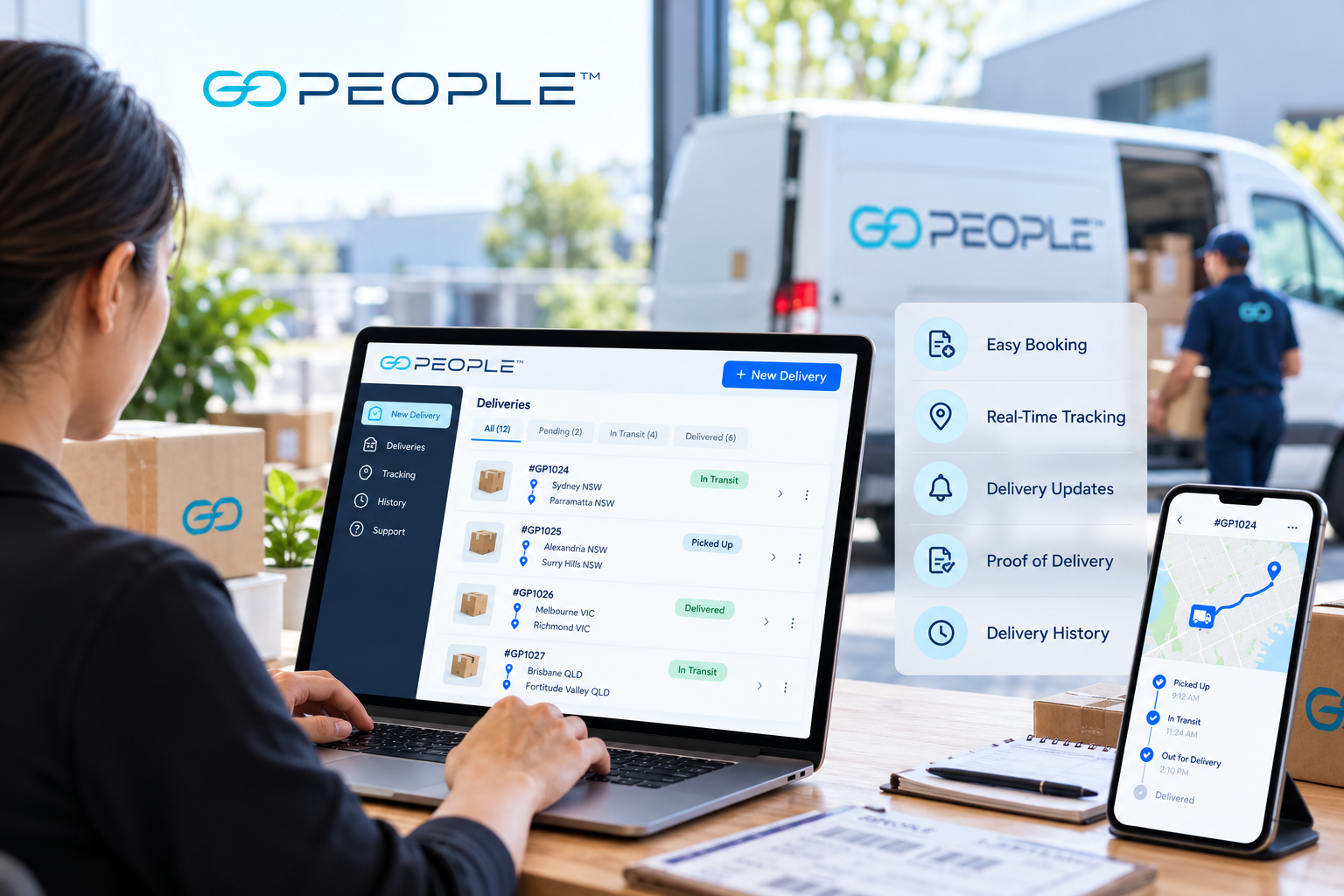
Courier apps have changed how businesses organise and manage deliveries. Instead of relying on phone calls, spreadsheets and manual updates, businesses can increasingly manage delivery bookings, tracking, customer communication and proof of delivery through a digital platform.
For a business sending parcels regularly, however, a courier app needs to do more than simply provide a button for booking a driver.
The most useful platforms help businesses manage the entire delivery process: choosing the right delivery option, entering accurate job information, monitoring progress, keeping customers informed and confirming that an item has reached its destination.
Understanding what these systems can do — and which features actually matter — can help businesses choose a delivery solution that fits their operations.
What Is a Courier App?
A courier app is a digital platform used to organise and manage deliveries.
Depending on the provider, it may allow a business to:
- book a delivery
- enter pickup and delivery details
- select a delivery service
- receive delivery status updates
- track delivery progress
- access proof of delivery
- manage multiple delivery jobs
- review previous deliveries
Some courier apps are designed primarily for individuals sending occasional parcels. Others form part of a broader delivery management platform intended for businesses handling deliveries regularly.
That distinction matters.
A business making dozens or hundreds of deliveries has very different requirements from someone sending a single parcel across town.
Why Businesses Use Courier Apps
The main advantage of a courier app is visibility and control.
Without a central delivery system, information can become fragmented. Orders may originate in an ecommerce platform, addresses may be copied into spreadsheets, delivery instructions may be sent separately, and staff may need to contact drivers or courier companies manually when customers ask for updates.
A good courier platform can bring much of that information together.
This can make delivery operations easier to manage and reduce the amount of manual administration required from staff.
For businesses reviewing their broader technology requirements, our guide to delivery management software for small businesses explains the wider features worth considering.
1. Faster and Easier Delivery Booking
One of the most basic functions of a courier app is making delivery booking easier.
Instead of calling a courier company each time a parcel needs to be sent, staff can enter the required information digitally.
Depending on the delivery service, this may include:
- pickup address
- destination address
- recipient contact details
- parcel information
- delivery instructions
- access information
- requested delivery service
For businesses sending deliveries frequently, reducing repetitive manual work can become increasingly important.
The booking process should also make it easy for staff to provide accurate information. Incorrect addresses, missing unit numbers and incomplete recipient details can contribute to avoidable delivery problems.
Our guide to reducing failed deliveries explains why getting this information right before dispatch matters.
2. Real-Time Delivery Visibility
Once a parcel leaves the business, visibility becomes one of the most important features of a delivery platform.
Traditional delivery processes can create an information gap between dispatch and arrival. Staff know the parcel has left, but they may have limited information about what is happening next.
Digital tracking can reduce that uncertainty.
Where tracking is available, businesses can monitor delivery progress without repeatedly contacting the courier or driver.
This is particularly valuable when customers contact the business asking:
“Where is my order?”
Instead of starting a manual investigation every time, staff can use the available tracking information to understand the delivery status.
For a deeper explanation, see our guide to real-time delivery tracking.
3. Better Information for Customers
Tracking isn’t only useful internally.
Customers increasingly want visibility after placing an order. Once an item has been dispatched, uncertainty about its location or arrival can quickly create customer-service enquiries.
Providing useful delivery information helps customers understand what is happening without needing to contact the business.
Depending on the delivery platform and service being used, communication may include delivery updates, tracking information or confirmation after delivery.
This can reduce the information gap between the business, delivery provider and recipient.
We’ve looked at this relationship in more detail in how delivery tracking can reduce customer service enquiries.
4. Proof of Delivery
Tracking tells a business what is happening during delivery.
Proof of delivery helps establish what happened at the end.
Depending on the delivery service, digital proof of delivery may record information confirming that a delivery was completed.
This can be particularly useful when a customer reports that an order has not arrived or when staff need to investigate a delivery.
Rather than relying entirely on memory, phone calls or handwritten records, businesses have digital information available to help review what occurred.
For businesses handling substantial delivery volumes, this becomes increasingly valuable because individual deliveries can otherwise be difficult to investigate after the event.
Read our guide to proof of delivery for more information.
5. Managing Multiple Deliveries
The requirements become more complex when a business needs to send many deliveries rather than one parcel.
For example, a retailer may have numerous customer orders ready for dispatch from the same location. Sending each delivery as a completely independent job may not always be the most practical approach.
Businesses handling multiple stops should consider whether their delivery platform can support a multi-drop delivery model.
This is where route planning and delivery grouping become important.
GoPeople’s GoBUNDLE service is designed for businesses managing multiple deliveries in a delivery run.
Businesses interested in this model can also read our guide to multi-drop delivery in Australia.
6. Choosing the Right Delivery Service
A useful courier platform shouldn’t force every delivery into exactly the same service model.
Businesses can have very different requirements depending on what is being sent, when it needs to arrive and how their fulfilment operation works.
An ecommerce retailer sending regular parcel volumes from a warehouse has different requirements from a business needing an urgent document delivered across a city.
GoPeople provides several delivery options for different business requirements.
GoEXPRESS is GoPeople’s next-day delivery service for business parcel deliveries from customer warehouses in Sydney, Melbourne and Brisbane.
GoBUNDLE is designed for businesses with multiple deliveries that can be organised into a delivery run.
GoSAMEDAY provides same-day business delivery within supported service areas.
GoVIP provides an on-demand option for urgent and time-sensitive delivery requirements.
The important point is that the technology should support the delivery model rather than becoming the delivery model itself.
7. Reducing Manual Delivery Administration
Delivery administration can consume more staff time than businesses realise.
Consider what happens when a delivery problem occurs.
Someone may need to:
- identify the order
- find the courier booking
- determine the latest status
- contact the delivery provider
- update the customer
- record what happened
- arrange further action if necessary
If information is scattered across different systems, every step takes longer.
A courier platform that centralises useful delivery information can make exception management more efficient.
This becomes increasingly important as order volumes grow.
At low volumes, staff may be able to manage deliveries manually. At higher volumes, the same process can become a significant operational burden.
8. Delivery History and Accountability
Another useful feature is access to previous delivery information.
Businesses may need historical records for several reasons:
- investigating customer enquiries
- reviewing failed deliveries
- confirming completed deliveries
- understanding recurring delivery problems
- comparing operational performance
- reviewing delivery costs
- handling internal reporting
A searchable delivery history makes this much easier than maintaining separate spreadsheets, emails and handwritten records.
It also gives managers a better foundation for analysing delivery performance over time.
9. Delivery Data Can Help Identify Problems
Courier apps shouldn’t only help businesses manage today’s deliveries.
The information generated through delivery operations can also help identify patterns.
For example, a business might monitor:
| Metric | Why it matters |
|---|---|
| Successful deliveries | Shows overall delivery completion |
| Failed deliveries | Highlights avoidable delivery problems |
| Redeliveries | Can indicate address, access or recipient issues |
| Delivery-related enquiries | Shows how much support work delivery creates |
| Delivery exceptions | Helps identify recurring operational problems |
| Delivery costs | Helps businesses understand overall delivery spend |
The objective isn’t simply to collect more data.
It is to identify where delivery operations are creating unnecessary cost, customer frustration or staff workload.
Businesses experiencing recurring problems may also benefit from our guide on how to improve your delivery process.
10. Integration With Existing Business Systems
A courier app does not operate in isolation.
Businesses may already use ecommerce platforms, warehouse systems, order-management systems or other software to manage customer orders.
As delivery volumes increase, repeatedly transferring information manually between these systems becomes less practical.
When evaluating a delivery platform, businesses should therefore consider how delivery fits into the rest of their workflow.
Questions worth asking include:
- How are orders entered into the delivery system?
- Does staff need to re-enter information manually?
- Can delivery information be connected to existing systems?
- How are tracking details passed back to the business?
- Can staff easily find the delivery associated with an order?
- What happens when order volumes increase?
The best setup depends on the business, but reducing unnecessary manual data entry can improve both efficiency and accuracy.
Courier App vs Delivery Management Software
The terms courier app and delivery management software are sometimes used interchangeably, but they can describe different things.
A courier app is often centred around interacting with a particular delivery provider: booking a job, tracking it and reviewing the result.
Delivery management software may have a broader operational role, potentially covering areas such as dispatch, route planning, fleet management, driver management and delivery analytics.
A business doesn’t necessarily need every feature available.
The right choice depends on the delivery model.
A company outsourcing deliveries to a courier provider may primarily need easy booking, visibility and proof of delivery.
A company operating its own fleet may require much more extensive driver, routing and dispatch functionality.
What Should Businesses Look for in a Courier App?
A long feature list isn’t necessarily a sign of a good platform.
Businesses should focus on whether the system solves their actual delivery problems.
A useful evaluation checklist includes:
- Easy booking: Can staff create deliveries without unnecessary steps?
- Delivery visibility: Can staff see useful delivery status information?
- Customer communication: Can recipients receive appropriate delivery information?
- Proof of delivery: Is there a clear digital record after completion?
- Multiple delivery support: Can the system handle the business’s typical delivery volume?
- Delivery history: Can previous jobs be found easily?
- Exception management: Is it clear what happened when a delivery does not go to plan?
- Service flexibility: Are suitable delivery options available for different requirements?
- Scalability: Will the process still work when order volumes increase?
- Support: Is help available when technology alone cannot resolve a delivery issue?
Businesses should test the workflow from the perspective of the people who will actually use it.
A platform may appear impressive in a demonstration but still create unnecessary work if everyday tasks are difficult to complete.
Technology Doesn’t Replace Delivery Reliability
This is an important distinction.
A sophisticated courier app cannot compensate for consistently poor delivery execution.
Customers ultimately care about whether their order arrives successfully.
Technology should make the physical delivery operation more transparent and manageable. It should help businesses understand what is happening, communicate effectively and resolve exceptions.
But businesses should still assess the underlying courier service itself.
That means considering factors such as delivery performance, tracking, communication, exception handling, support and capacity.
Our guide on how to tell if a courier service is reliable covers these factors in more detail.
When Does a Business Need a Better Delivery Platform?
There isn’t a specific order volume at which every business suddenly needs more advanced delivery technology.
Instead, look for operational warning signs.
A business may have outgrown its existing process if:
- staff spend too much time booking deliveries manually
- customers regularly contact support asking for delivery updates
- tracking information is difficult to locate
- failed deliveries take too long to investigate
- proof of delivery is difficult to retrieve
- delivery information is scattered across spreadsheets and emails
- increasing order volumes are creating more administration
- managers cannot easily measure delivery performance
These problems often become more visible as a business grows.
The goal isn’t necessarily to introduce more technology. It is to remove unnecessary work and make delivery operations easier to control.
How GoPeople Uses Technology in Business Delivery
GoPeople combines delivery services with digital tools designed to provide businesses with greater visibility over their deliveries.
The appropriate service depends on the delivery requirement.
A business may need next-day parcel delivery, a multi-drop delivery run, same-day delivery or an urgent on-demand courier.
Rather than choosing a courier app based only on its interface, businesses should consider the complete delivery workflow: booking, pickup, tracking, delivery and proof of delivery.
You can see an overview of that process on How GoPeople Works.
Frequently Asked Questions
What is a courier app?
A courier app is a digital platform used to book and manage deliveries. Depending on the provider, features can include delivery booking, tracking, status updates, delivery history and proof of delivery.
Are courier apps only for small businesses?
No. Courier technology can be useful at many different delivery volumes. The features required will depend on how many deliveries a business manages and how complex its delivery operation is.
Can courier apps track deliveries?
Many courier platforms provide delivery status or tracking functionality. The exact information available depends on the provider and delivery service.
What is proof of delivery?
Proof of delivery is information used to confirm that a delivery was completed. The format varies between delivery providers and services.
What’s the difference between a courier app and route optimisation software?
A courier app generally helps a customer interact with a delivery service. Route optimisation software is more specifically focused on planning efficient routes across multiple delivery stops. Some delivery platforms can incorporate both types of functionality.
Can a courier app reduce customer service enquiries?
Better delivery visibility can help staff and customers understand delivery progress without requiring as many manual status checks. The impact depends on how effectively tracking and delivery updates are implemented.
Which courier app should a business choose?
Start with the delivery requirement rather than the software. Consider service availability, delivery reliability, tracking, proof of delivery, multi-delivery requirements, integration, support and how easily the platform fits into existing operations.