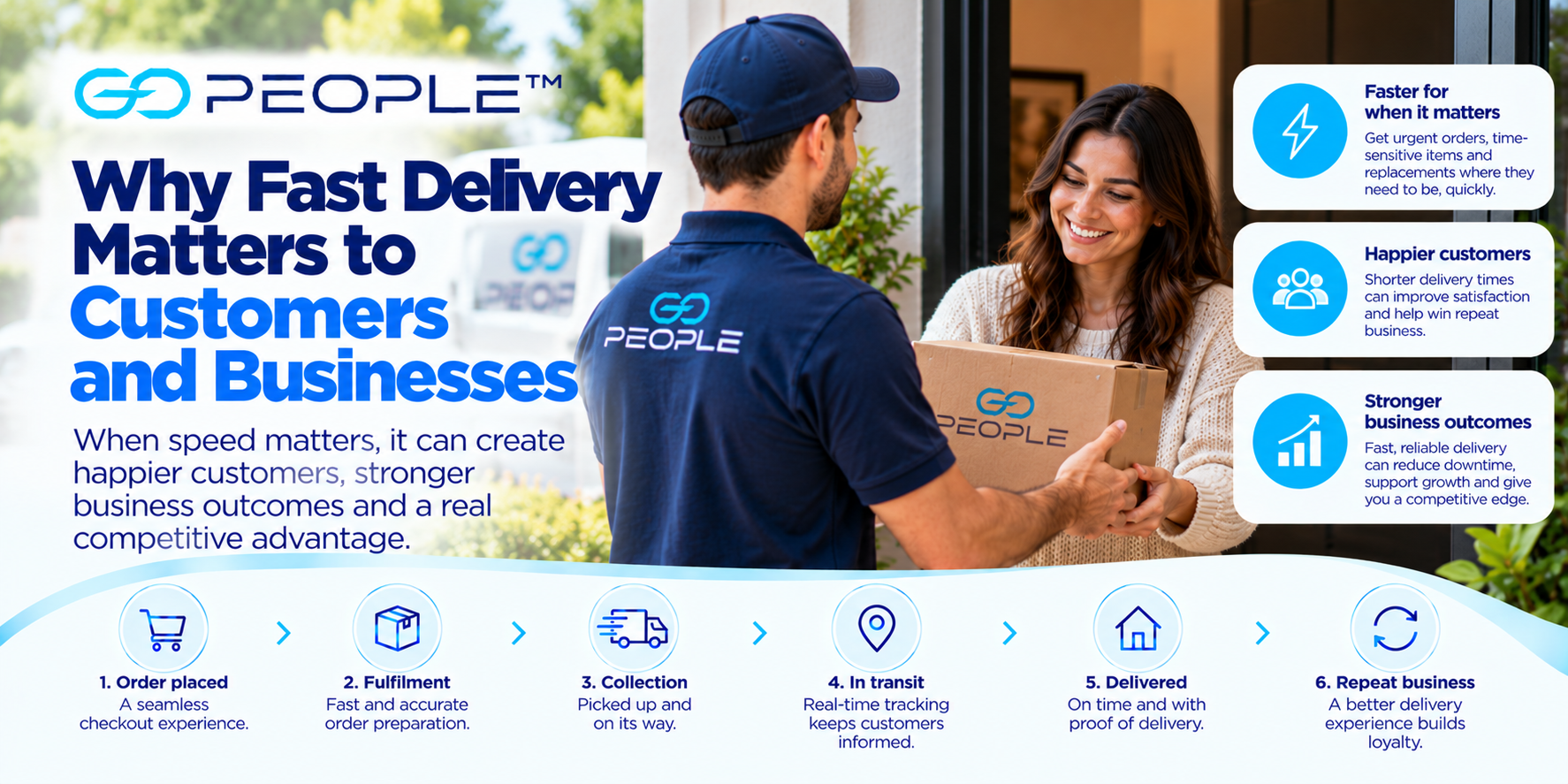
Speed has become an important part of the delivery experience.
Customers can browse products, compare prices and complete a purchase in minutes. Once the order is placed, waiting several days for the physical product can feel very different from the speed of the online shopping experience that came before it.
That doesn’t mean every order needs to arrive immediately.
For businesses, the more useful question is:
How fast does this particular delivery actually need to be?
Sometimes the answer is today.
Sometimes tomorrow is perfectly suitable.
Sometimes customers care less about maximum speed than knowing exactly when their order will arrive.
A good delivery strategy therefore isn’t simply about making every delivery as fast as possible. It is about balancing speed, reliability, cost and customer expectations.
This guide explains when fast delivery creates real value, when it doesn’t, and how businesses can choose an appropriate delivery speed for different orders.
What Does “Fast Delivery” Actually Mean?
There is no universal definition of fast delivery.
Depending on the customer and the order, it could mean:
- delivery within hours
- same-day delivery
- next-day delivery
- delivery within a clearly communicated timeframe
Context matters.
A customer urgently replacing a failed piece of equipment may consider a few hours important.
Someone ordering ordinary household products may be perfectly satisfied with next-day delivery.
A business customer ordering supplies for next week may care much more about reliability than receiving them today.
So rather than defining fast delivery with one number, think of it as:
A delivery timeframe that meets the customer’s genuine need without introducing unnecessary cost or operational complexity.
Why Has Delivery Speed Become More Important?
Ecommerce has changed how customers experience shopping.
In a physical store, purchasing and receiving the product happen at essentially the same time.
Online shopping separates those events.
The customer:
Finds product → Purchases → Pays → Waits
Delivery fills the gap between the digital purchase and the physical product.
The shorter and more predictable that gap becomes, the sooner the transaction feels complete.
But speed is only one part of that experience.
Fast Delivery Can Reduce the Gap Between Purchase and Satisfaction
Immediately after making a purchase, customer interest is often high.
They have selected the product, paid for it and want to receive it.
A shorter delivery timeframe can reduce the period between:
“I bought it”
and
“I have it.”
That can be particularly valuable for:
- urgent purchases
- gifts
- replacement products
- time-sensitive business supplies
- event-related purchases
- products needed for a particular occasion
For those orders, speed can be part of the product’s overall value.
Speed Can Influence Which Retailer a Customer Chooses
Imagine two retailers sell the same product at similar prices.
Retailer A: delivery expected tomorrow.
Retailer B: delivery expected several days later.
If the customer wants the product quickly, delivery can become part of the buying decision.
This means businesses don’t compete only on:
- product
- price
- website
- promotion
They can also compete on:
- delivery availability
- delivery speed
- delivery visibility
- reliability
However, this does not mean every business should simply promise the fastest delivery available.
The promise still needs to be commercially and operationally sustainable.
Fast Delivery Can Be Particularly Important for Urgent Orders
Some deliveries have genuine urgency.
For example, a business might need:
- an important document
- a replacement component
- forgotten equipment
- stock for a customer
- a time-sensitive item
In these situations, the value of delivery isn’t simply moving the item.
It is solving a problem quickly.
A customer may therefore be willing to choose a faster service and potentially pay more for it.
This is where same-day and on-demand delivery can have particular value.
But Not Every Order Is Urgent
This distinction is important.
Consider an ecommerce business dispatching hundreds of ordinary orders every day.
Do all of those customers genuinely need an individual urgent courier?
Probably not.
Using an urgent delivery model for every order can increase costs without creating equivalent customer value.
Many customers may be perfectly satisfied with a reliable next-day service.
Businesses should therefore distinguish between:
Routine orders
and
Urgent orders
rather than treating every delivery as an emergency.
Speed vs Reliability
Fast delivery attracts attention.
Reliability builds confidence.
Imagine two delivery propositions.
Option A
“Your order could arrive extremely quickly.”
But delivery times vary substantially.
Option B
“Your order is expected tomorrow.”
And that expectation is consistently met.
Many customers may prefer the second experience.
That’s because customers plan around expectations.
If a business communicates a delivery timeframe, the customer expects it to be meaningful.
The Fastest Promise Isn’t Always the Best Promise
A business may be tempted to advertise an aggressive delivery timeframe because it sounds competitive.
But that promise depends on the entire operation.
For example:
Order received
↓
Payment processed
↓
Stock located
↓
Order picked
↓
Order packed
↓
Delivery booked
↓
Courier collects
↓
Delivery completed
If the warehouse regularly takes a day to prepare the order, paying for an extremely fast courier after dispatch won’t solve the overall customer wait.
Delivery speed needs to be considered as part of the full fulfilment process.
Fast Dispatch and Fast Delivery Are Different
These terms are often confused.
Dispatch time is how long the business takes to prepare and hand the order to the delivery provider.
Delivery time is the period required to move the shipment after collection.
Suppose:
- order placed Monday morning
- warehouse dispatches Wednesday afternoon
- courier delivers Thursday morning
The courier portion may have been fast.
But from the customer’s perspective, the order took three days.
Businesses should measure the complete journey rather than focusing only on courier transit time.
When Does Fast Delivery Matter Most?
The value of speed varies according to the situation.
Replacement Products
A customer receives a faulty product or needs an urgent replacement.
Faster delivery can help resolve the problem quickly.
Business-Critical Items
A missing component, document or supply may prevent work from continuing.
In this situation, the commercial value of receiving the item quickly may be far greater than the delivery fee.
Gifts and Events
Products needed for:
- birthdays
- events
- celebrations
- presentations
may lose much of their value if they arrive after the relevant date.
Time-Sensitive Retail Purchases
Sometimes the customer simply needs the product today.
Offering a same-day option can allow that customer to choose the service that matches their requirement.
Forgotten or Unexpected Items
An on-demand courier can be useful when something unexpected needs to move quickly between locations.
When Speed Matters Less
Other orders are much less time-sensitive.
Examples might include:
- routine replenishment
- ordinary ecommerce purchases
- planned business supplies
- non-urgent documents
- repeat purchases made well in advance
For these orders, customers may prioritise:
- predictable arrival
- lower delivery cost
- tracking
- convenient delivery
- reliable service
Businesses shouldn’t pay for urgency that the customer doesn’t value.
Fast Delivery vs Next-Day Delivery
Next-day delivery can provide a useful middle ground.
It gives customers a relatively fast delivery experience without treating every parcel as an individual urgent courier job.
For regular ecommerce and business parcel volumes, this can be particularly relevant.
For eligible business parcel volumes from warehouses in Sydney, Melbourne and Brisbane, GoEXPRESS provides next-day delivery.
Next-day delivery may suit businesses where:
- orders are dispatched regularly
- customers expect relatively fast delivery
- shipments can be planned
- same-day urgency isn’t required for every order
When Same-Day Delivery Makes Sense
Same-day delivery becomes relevant when waiting until tomorrow would materially reduce the value of the order.
Examples might include:
- customer needs the product today
- urgent replacement
- time-sensitive business requirement
- same-day retail order
For eligible deliveries within supported areas, GoSAMEDAY provides same-day delivery.
Businesses should still consider whether the customer genuinely needs the speed.
Same-day delivery should solve a requirement rather than simply exist because it sounds attractive.
When On-Demand Delivery Makes Sense
Some deliveries are less predictable.
An urgent requirement arises and the business needs to arrange an individual courier.
This is where on-demand delivery can fit.
GoVIP provides an on-demand courier option for urgent and time-sensitive jobs within supported areas.
Examples might include:
- urgent documents
- forgotten items
- unexpected stock requirements
- replacement products
- business-critical deliveries
The defining characteristic is the need for an urgent delivery arranged as required, rather than routine parcel volume.
What About Multiple Deliveries?
Speed isn’t only about how fast a vehicle travels.
Efficiency matters too.
A business may have 30, 50 or 100 deliveries leaving from the same location.
Booking each one independently may not be the most efficient approach.
Multi-drop delivery organises multiple destinations into a delivery run.
GoBUNDLE provides multi-drop delivery with route optimisation.
This can be relevant where businesses have many deliveries leaving from one pickup point and destination addresses vary.
Route planning can help make better use of the available delivery operation.
Delivery Speed Has a Cost
Faster delivery can require additional resources.
Depending on the service, that may include:
- dedicated capacity
- tighter collection windows
- more direct routing
- faster handling
- less consolidation
Businesses therefore need to understand the relationship between urgency and cost.
Suppose a business has 100 daily orders.
If five genuinely need same-day delivery but the remaining 95 are routine, providing the most urgent service for all 100 may create substantial unnecessary cost.
A better strategy might be:
95 regular orders → planned delivery service
5 urgent orders → faster delivery service
This allows delivery spending to reflect customer need.
Give Customers a Choice
Where appropriate, ecommerce businesses can allow customers to choose between delivery speeds.
For example:
| Delivery Option | Best Suited To |
|---|---|
| Next-day | Regular orders |
| Same-day | Orders needed today |
| On-demand | Urgent/time-sensitive requirements |
| Multi-drop | Multiple business deliveries from one pickup |
The exact options depend on service availability and the business model.
Giving customers appropriate choices can prevent the retailer from subsidising premium speed for customers who don’t need it.
Should Businesses Charge More for Faster Delivery?
Potentially.
If faster delivery costs the business more, it can be reasonable to offer it as a premium option.
For example:
Regular delivery — standard price
Faster delivery — additional charge
This allows customers who value urgency to pay for it.
Another strategy is to provide free or lower-cost regular delivery above a threshold while charging separately for premium delivery.
We discuss those economics in Should Your Business Offer Free Delivery?.
Fast Delivery Doesn’t Fix Poor Fulfilment
Businesses sometimes try to solve fulfilment problems by purchasing faster transport.
Consider an order that spends:
24 hours waiting to be picked
then:
6 hours waiting to be packed
and finally:
2 hours being delivered.
Making the final two hours even faster won’t dramatically improve the overall customer experience.
Before paying for faster delivery, examine:
- order processing
- picking
- packing
- dispatch cut-offs
- warehouse staffing
- inventory accuracy
- courier collection timing
The entire operation determines how quickly the customer receives the order.
Route Optimisation Can Improve Delivery Efficiency
For multi-drop operations, route planning can influence how efficiently deliveries are completed.
The shortest straight-line distance isn’t necessarily the most efficient route.
Planning may need to consider:
- delivery locations
- number of stops
- route sequence
- available time
- operational requirements
Route optimisation can help organise those stops more efficiently.
See our guide to delivery route optimisation for a deeper explanation.
Tracking Matters Even When Delivery Is Fast
A fast delivery with poor visibility can still create uncertainty.
Imagine being told:
“It will arrive today.”
The customer may still wonder:
When today?
Has it been dispatched?
Is it actually moving?
Was delivery attempted?
Tracking helps customers understand what is happening after dispatch.
This can be valuable even when the total delivery timeframe is short.
For more detail, see Why Real-Time Tracking Is a Must for Online Shopping.
Communication Can Matter as Much as Speed
Consider two delayed deliveries.
Delivery A
The customer receives no useful information and has to contact support repeatedly.
Delivery B
The customer receives a clear status update and understands what happens next.
Both orders may technically be late.
But the customer experience can be very different.
Businesses shouldn’t assume speed eliminates the need for communication.
Customers still value visibility.
Proof of Delivery Completes the Journey
The objective isn’t simply to move the parcel quickly.
It is to complete the delivery successfully.
Depending on the delivery service, proof of delivery may provide information such as:
- delivery completion
- timestamp
- photo
- signature
- relevant delivery details
This becomes particularly useful when a customer says:
“My tracking says delivered, but I can’t find the parcel.”
Fast delivery without a clear completion record can create unnecessary support problems.
Fast Delivery and Customer Satisfaction
Delivery speed can influence customer satisfaction, particularly when the customer values urgency.
But speed isn’t the only factor.
Customers can also care about:
- reliability
- communication
- tracking
- condition of the product
- successful first delivery
- convenient handover
- problem resolution
We’ve explored this broader relationship in How Fast Deliveries Can Improve Customer Satisfaction.
The distinction between the two topics is important:
This guide: how businesses should decide how fast delivery needs to be.
Customer satisfaction guide: how delivery speed contributes to the customer experience.
Don’t Sacrifice Accuracy for Speed
Pressure to deliver quickly can create mistakes elsewhere.
Businesses should still verify:
- correct product
- correct quantity
- correct address
- correct recipient details
- appropriate packaging
- correct delivery service
Sending the wrong product extremely quickly isn’t a successful delivery.
Neither is sending the correct product to the wrong address.
Speed should come after basic fulfilment accuracy.
Packaging Still Matters
Fast delivery doesn’t remove the need for proper packaging.
Products still need protection against:
- movement
- impacts
- loading
- unloading
- contact with other items
This is particularly important for fragile goods.
See our guide to packing and delivering fragile items safely.
Fast Delivery Shouldn’t Create Unsafe Delivery
No delivery timeframe is worth compromising safety.
Businesses should provide accurate information about:
- parcel dimensions
- weight
- handling requirements
- access
- special requirements
An item requiring specialist equipment shouldn’t be forced into an unsuitable courier service simply because the customer wants it quickly.
Our delivery safety guide covers these considerations in more detail.
Measure Whether Customers Actually Value Faster Delivery
Don’t assume customers want the fastest possible option.
Measure behaviour.
Useful data can include:
Delivery Option Selection
What percentage of customers choose faster delivery when given the choice?
Conversion Rate
Does offering a faster option improve checkout conversion?
Average Order Value
Do customers selecting faster delivery behave differently?
Delivery Cost
How much additional cost does the faster service create?
Customer Complaints
Are delivery-speed complaints actually common?
Repeat Purchase
Do customers using faster delivery return more frequently?
The answer may vary by product category.
Customers purchasing gifts may behave differently from customers purchasing routine household products.
Segment Customers and Orders
One overall delivery strategy may hide important differences.
Analyse orders by:
- product category
- customer type
- location
- order value
- urgency
- business vs residential destination
- new vs returning customer
You may discover that only a particular group strongly values faster delivery.
That can help you offer premium speed where it creates the most value.
A Practical Delivery-Speed Framework
Businesses can use four questions when selecting a delivery speed.
1. When Does the Customer Need It?
Today?
Tomorrow?
Later this week?
This is the most important question.
2. What Is the Commercial Value of Speed?
Would faster delivery:
- solve an urgent problem?
- help win the order?
- protect an important customer relationship?
- reduce downtime?
- meet a time-sensitive requirement?
If not, premium speed may provide little additional value.
3. What Does Faster Delivery Cost?
Compare the additional delivery cost with the value created.
Don’t automatically pay for the fastest service.
4. Can Operations Support the Promise?
Can your warehouse:
- process the order
- pick it
- pack it
- dispatch before cut-off
in time?
If not, the delivery promise needs to change or the fulfilment process needs improvement.
Delivery Speed Decision Table
| Customer Requirement | Delivery Approach to Consider |
|---|---|
| Regular ecommerce order | Next-day |
| Needs to arrive today | Same-day |
| Unexpected urgent requirement | On-demand |
| Multiple destinations from one pickup | Multi-drop |
| Specialist/heavy freight | Appropriate specialist provider |
| No genuine urgency | Planned delivery rather than premium speed |
This isn’t a substitute for checking actual service eligibility.
It is a useful starting point for deciding what type of delivery operation fits the requirement.
Businesses can check GoPeople service availability for their pickup location.
Frequently Asked Questions About Fast Delivery
Why is fast delivery important to customers?
Fast delivery can reduce the time between purchasing and receiving a product.
It is particularly valuable when the product is urgent, time-sensitive or needed for a specific event.
However, different customers place different value on speed.
Does faster delivery improve customer satisfaction?
It can, particularly when speed matters to the customer.
But satisfaction also depends on reliability, communication, tracking, product condition and how delivery problems are handled.
Fast but unreliable delivery isn’t necessarily a better experience.
Is same-day delivery better than next-day delivery?
Not automatically.
Same-day delivery is useful when an order genuinely needs to arrive today.
For routine orders, next-day delivery may provide an appropriate balance between speed and operational efficiency.
The right choice depends on the customer’s requirement.
What is the difference between same-day and on-demand delivery?
Same-day delivery is intended for orders that need to be delivered within the same day.
On-demand delivery is generally used for urgent individual courier requirements arranged as needed.
Exact service structures and coverage vary by provider.
Should ecommerce businesses offer multiple delivery speeds?
Where operationally appropriate, offering different delivery options can allow customers to choose according to urgency and price.
This can prevent businesses from paying for premium delivery on orders that don’t require it.
Is fast delivery more expensive?
Faster delivery can cost more because it may require greater urgency, dedicated capacity or less opportunity to consolidate deliveries.
Actual pricing depends on the provider, service, shipment and location.
Businesses should compare the additional cost with the value created by faster delivery.
How can businesses make deliveries faster?
Look beyond the courier.
Review the entire process, including inventory availability, order processing, picking, packing, dispatch cut-offs, collection and delivery.
Improving warehouse and fulfilment processes may sometimes reduce total customer wait more effectively than simply purchasing a faster courier service.
The Goal Isn’t Maximum Speed—It’s the Right Speed
Fast delivery can create real value.
It can help customers receive urgent products, allow businesses to solve time-sensitive problems and make ecommerce purchases more convenient.
But faster is not automatically better.
A strong delivery strategy asks:
How quickly does this order actually need to arrive?
Then it selects a service that balances:
Speed.
Reliability.
Visibility.
Cost.
Customer expectations.
For some orders, that means same-day or on-demand delivery.
For many others, reliable next-day delivery may be exactly what the customer needs.
The objective shouldn’t be to make every parcel move at maximum speed.
It should be to provide the right delivery speed for the right order—and then deliver reliably against the expectation you’ve set.