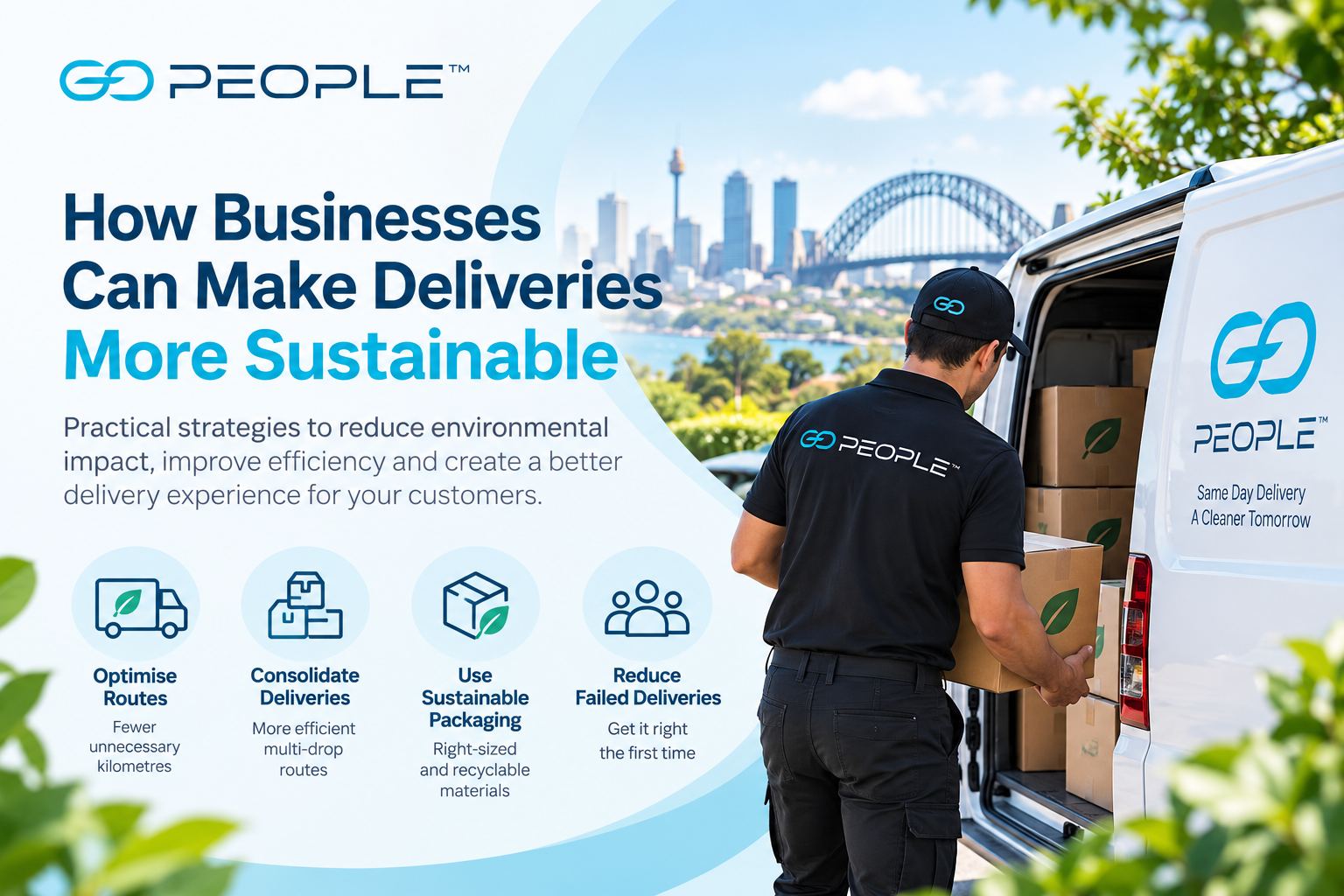
 Small businesses are under growing pressure to make their operations more sustainable. Customers are paying greater attention to packaging, waste, transport and the environmental impact of the businesses they buy from.
Delivery is an important part of that conversation.
But sustainable delivery is not simply about replacing every vehicle or putting a “green delivery” badge on the checkout page.
For many businesses, some of the most practical improvements come from making the delivery operation itself more efficient: fewer unnecessary kilometres, better-planned routes, consolidated deliveries, appropriate packaging and fewer failed delivery attempts.
A more efficient delivery network can potentially reduce waste while also improving cost and customer experience.
This guide looks at practical ways businesses can make their delivery operations more sustainable without losing sight of reliability, speed or commercial reality.
What Is Sustainable Delivery?
Sustainable delivery is an approach to transporting goods that aims to reduce unnecessary environmental impact while still meeting the needs of customers and businesses.
It can involve changes across the entire delivery process, including:
- packaging
- order fulfilment
- vehicle utilisation
- route planning
- delivery frequency
- failed-delivery prevention
- customer communication
- service selection
- returns
Electric vehicles can be part of the solution, but sustainable delivery is much broader than the type of vehicle being used.
A delivery operation that sends half-empty vehicles along inefficient routes, creates unnecessary packaging waste and repeatedly attempts failed deliveries can still be inefficient regardless of the vehicle technology involved.
The starting point should therefore be:
How can we remove unnecessary activity from the delivery process?
Why Delivery Efficiency and Sustainability Often Work Together
Many sustainability improvements have something in common:
They reduce waste.
That waste might be:
- unnecessary kilometres
- unused vehicle capacity
- oversized packaging
- repeat delivery attempts
- unnecessary urgent deliveries
- inefficient routes
- avoidable returns
- unnecessary handling
Reducing these inefficiencies can potentially produce both environmental and commercial benefits.
For example, if a business can deliver 30 orders using a well-planned route instead of treating them as 30 unrelated delivery movements, it may reduce unnecessary travel while also improving operational efficiency.
That makes sustainability more practical.
Rather than treating it purely as an environmental initiative, businesses can incorporate it into normal delivery optimisation.
1. Consolidate Deliveries Where Possible
One of the most practical changes is to reduce unnecessary individual delivery movements.
Imagine a retailer has 25 local orders ready for delivery.
Sending those orders independently without considering their relationship to one another can create unnecessary travel.
An alternative is to consolidate compatible orders into a planned delivery run.
This is particularly relevant for businesses such as:
- florists
- bakeries
- retailers
- pharmacies where appropriate delivery requirements can be met
- wholesalers
- ecommerce businesses
- local suppliers
- professional services
- businesses delivering regularly to multiple customers
Consolidation won’t suit every order.
Urgent deliveries may still need to move immediately.
But where orders can reasonably be grouped, consolidation can improve vehicle utilisation and reduce duplicated travel.
2. Use Multi-Drop Delivery for Multiple Destinations
Businesses making many deliveries from the same pickup point should consider whether a multi-drop model is more appropriate.
Instead of:
Pickup → Customer A
followed by another independent trip:
Pickup → Customer B
and another:
Pickup → Customer C
a multi-drop route can be organised as:
Pickup → Customer A → Customer B → Customer C → Customer D
with the route planned around all destinations.
GoPeople’s GoBUNDLE multi-drop delivery is designed for businesses that need to deliver multiple orders from a common pickup point.
The sustainability benefit doesn’t come merely from calling something “multi-drop”.
It comes from improving how deliveries are grouped and routed.
3. Optimise Delivery Routes
The shortest route between two points is easy to understand.
Planning the best sequence for dozens of destinations is much more complicated.
A delivery route may need to consider:
- destination locations
- delivery windows
- business opening hours
- school or office requirements
- traffic
- route sequence
- vehicle capacity
- pickup location
- priority deliveries
Poor route planning can create unnecessary kilometres and wasted time.
Route optimisation attempts to organise deliveries into a more efficient sequence.
For businesses making multiple deliveries, this can help reduce unnecessary backtracking and improve overall utilisation.
Our delivery route optimisation guide explains this in more detail.
4. Avoid Automatically Choosing the Fastest Delivery
Faster isn’t always better.
Some orders are genuinely urgent.
Others aren’t.
If a customer needs a replacement component immediately, an urgent delivery may be appropriate.
If an ecommerce customer simply needs an order tomorrow, a next-day service may be sufficient.
If a business has 40 local orders that can be delivered together, a multi-drop service may make more operational sense.
Businesses should therefore match delivery speed to the actual requirement.
Depending on location and eligibility, GoPeople offers different business delivery models:
- GoEXPRESS — next-day delivery
- GoBUNDLE — multi-drop delivery
- GoSAMEDAY — same-day delivery
- GoVIP — on-demand courier
Choosing an appropriate service can help avoid paying for — and operationally creating — urgency that the order doesn’t actually require.
5. Reduce Failed Delivery Attempts
A failed delivery can create more than customer frustration.
It may also create additional activity.
Depending on the delivery arrangement, the item might need to be:
- returned
- stored
- handled again
- rebooked
- sent out for another delivery attempt
That can mean additional transport and operational work for a parcel that could potentially have been delivered successfully the first time.
Businesses can reduce preventable failures by collecting accurate information before dispatch.
That includes:
- full street address
- unit or suite number
- correct postcode
- recipient phone number
- appropriate access instructions
- relevant business opening information
Good customer communication matters too.
If customers know a delivery is coming, they may be better prepared to receive it.
Real-time tracking and delivery notifications can therefore contribute to operational efficiency as well as customer experience.
6. Improve Address Quality
A surprisingly simple sustainability measure is improving delivery data.
Incorrect or incomplete addresses can lead to:
- extra driving
- delays
- customer support contacts
- unsuccessful delivery attempts
- redelivery
- returns
Businesses should validate important delivery information as early as possible.
For ecommerce businesses, that can start at checkout.
For B2B businesses, it may involve maintaining accurate customer delivery records.
Useful information might include:
Business name
Recipient name
Street address
Unit / level / suite
Suburb
Postcode
Phone number
Access instructions
Cleaner data can make the entire delivery process more efficient.
7. Use Right-Sized Packaging
A small product doesn’t always need a large box.
Oversized packaging can create unnecessary:
- cardboard
- filler material
- package volume
- storage requirements
Right-sizing packaging means choosing packaging that provides sufficient protection without being unnecessarily large.
The objective isn’t to use the smallest possible box.
Products still need appropriate protection.
Instead, businesses should find a sensible balance between:
Protection + material use + package size
For more practical ideas, see our guide to eco-friendly packaging for ecommerce delivery.
8. Reduce Unnecessary Packaging Layers
Some ecommerce orders contain:
- Product packaging
- Plastic wrapping
- Inner box
- Void fill
- Shipping box
- Additional wrapping
Sometimes those layers are necessary.
Sometimes they’re simply the result of processes that haven’t been reviewed for years.
Businesses should periodically examine their packaging workflow and ask:
- Does this layer protect the product?
- Is it required for hygiene or safety?
- Does it prevent damage?
- Is it necessary for presentation?
- Could a lower-impact alternative work?
- Could the package be smaller?
The objective isn’t to remove protective packaging and increase damaged deliveries.
That would simply move the waste elsewhere.
The goal is to remove packaging that doesn’t perform a useful function.
9. Prevent Product Damage
Damaged goods can have a larger operational impact than the original delivery.
A damaged order may lead to:
Original fulfilment → Original delivery → Customer complaint → Return → Replacement fulfilment → Replacement delivery
Preventing damage can therefore reduce both cost and unnecessary movement.
Good packaging should consider:
- product fragility
- movement inside the package
- moisture
- temperature where relevant
- stacking
- handling
- package strength
Our guide on how to pack and deliver fragile items safely provides additional practical guidance.
10. Reduce Avoidable Returns
Returns are part of ecommerce.
They cannot and should not always be eliminated.
Customers may legitimately need to return:
- incorrect products
- faulty products
- unsuitable items
- damaged goods
But some returns can be prevented before the order is placed.
Better ecommerce information can help.
Depending on the product, that might include:
- accurate dimensions
- detailed photographs
- size information
- colour descriptions
- compatibility information
- specifications
- clear product descriptions
When customers understand what they’re buying, they may be less likely to order something unsuitable.
This is particularly important in categories with naturally high return rates.
11. Improve Inventory and Fulfilment Accuracy
Sending the wrong product creates unnecessary work throughout the supply chain.
A picking error might lead to:
- Wrong item packed.
- Wrong item delivered.
- Customer contacts support.
- Return arranged.
- Correct item picked.
- Replacement dispatched.
- Another delivery occurs.
Improving fulfilment accuracy can therefore have sustainability benefits as well as customer-service benefits.
Businesses should monitor:
- picking errors
- packing errors
- incorrect labels
- wrong addresses
- damaged orders
These aren’t merely warehouse KPIs.
They influence the efficiency of the entire delivery operation.
12. Plan Delivery Cut-Offs Carefully
Customers value fast delivery, but businesses don’t necessarily need to dispatch every order immediately.
Thoughtful cut-off times can help businesses consolidate orders into more efficient fulfilment and delivery cycles.
For example, instead of continuously releasing individual orders throughout the day, a business may be able to group compatible orders for scheduled dispatch.
The appropriate model depends on:
- customer expectations
- product type
- delivery promise
- order volume
- warehouse workflow
The important point is that delivery promises should be designed intentionally.
Operational efficiency becomes much harder when every order is automatically treated as urgent.
13. Give Customers Realistic Delivery Expectations
Promising unrealistic delivery speeds can create inefficient operations.
If the website promises:
“Get everything as quickly as possible”
the fulfilment team may constantly be responding to artificial urgency.
A better approach is to give customers clear choices.
For example:
Next-day delivery
For orders that need to arrive the following day.
Same-day delivery
For orders that genuinely need to arrive that day.
On-demand delivery
For urgent or time-sensitive requirements.
Customers can then choose a service appropriate to their needs.
Clear expectations are often better than simply promising maximum speed.
14. Use Tracking to Reduce Uncertainty
Tracking is normally discussed as a customer-experience feature.
It can also support delivery efficiency.
When customers can see delivery progress, they may be better prepared for arrival.
Tracking can also reduce:
“Where is my order?”
enquiries to customer-service teams.
For businesses managing deliveries, tracking information can also help identify:
- delays
- exceptions
- unsuccessful deliveries
- completed deliveries
That visibility can make it easier to respond to problems before they generate further operational waste.
15. Use Proof of Delivery
Proof of delivery provides a record that a delivery has been completed.
Depending on the delivery service, this may include information such as:
- delivery status
- timestamp
- photograph
- other completion details
Good proof-of-delivery processes can reduce uncertainty and make delivery investigations more efficient.
This can help avoid unnecessary replacement orders where a business incorrectly assumes that an item wasn’t delivered.
16. Review Delivery Performance Regularly
Sustainable delivery should be measurable.
Businesses can start with operational metrics they may already have.
Useful measures include:
Deliveries Per Route
Are routes becoming more consolidated?
Distance Per Delivery
Is unnecessary travel being reduced?
Failed Delivery Rate
How often is another attempt required?
Delivery Success Rate
How frequently are orders completed as intended?
Damage Rate
How often do deliveries result in replacement shipments?
Return Rate
Are avoidable returns increasing or decreasing?
Vehicle or Route Utilisation
Are delivery runs being used efficiently?
Packaging Per Order
Can unnecessary packaging be reduced?
The exact metrics will depend on the business.
What’s important is moving from vague sustainability language to measurable operational improvement.
17. Start With the Biggest Sources of Waste
Businesses don’t need to change everything simultaneously.
Start by identifying where the greatest inefficiencies are occurring.
For one business, the biggest problem might be:
failed deliveries.
For another:
oversized packaging.
Another may have:
poorly planned multi-drop routes.
Another might be:
sending every order using an urgent service.
Fixing the largest source of waste first can produce more meaningful results than implementing numerous small initiatives simply because they sound environmentally friendly.
18. Consider Delivery Density
Delivery density is an important concept.
Imagine two routes.
Route A
20 deliveries spread across a very large geographic area.
Route B
20 deliveries concentrated within several nearby suburbs.
Even with the same number of deliveries, the operational requirements can be very different.
Businesses with recurring local customers may be able to improve delivery density by:
- grouping delivery days
- consolidating orders
- creating delivery zones
- planning recurring runs
- using multi-drop routes
Again, this won’t suit every business.
But where customer expectations allow it, increasing delivery density can reduce unnecessary movement.
19. Coordinate Fulfilment and Delivery
Delivery optimisation doesn’t begin when the driver arrives.
Warehouse and fulfilment processes matter.
Imagine a planned route is ready to leave, but five orders haven’t been picked.
The vehicle waits.
Or the route leaves without them.
Those five orders then require another delivery movement.
Better coordination between:
Orders → Picking → Packing → Dispatch → Delivery
can improve the efficiency of the whole operation.
This becomes increasingly important as ecommerce businesses scale.
20. Think About Sustainability When Designing Promotions
Marketing decisions can influence logistics.
Consider a promotion promising:
FREE URGENT DELIVERY ON EVERY ORDER
That may generate sales, but it could also encourage customers to choose an unnecessarily urgent delivery service.
Businesses should think about the operational consequences of:
- free-delivery promotions
- same-day offers
- shipping thresholds
- product launches
- flash sales
A good promotion should work commercially and operationally.
Sustainable Delivery vs Fast Delivery
These ideas don’t necessarily conflict.
Fast delivery can still be efficient when it is planned appropriately.
The issue is unnecessary urgency.
A same-day delivery that solves a genuine customer requirement can be valuable.
But if every order is automatically treated as urgent regardless of customer need, the business may lose opportunities to consolidate deliveries.
The better question is:
What delivery speed does this order actually require?
Our guide comparing same-day and next-day delivery explains the differences.
Sustainable Delivery vs Cheap Delivery
The cheapest delivery option isn’t automatically the most sustainable.
Likewise, the most sustainable-looking option isn’t automatically the cheapest.
Businesses need to balance:
- cost
- speed
- reliability
- customer experience
- operational efficiency
- environmental considerations
These factors can sometimes reinforce each other.
For example, route optimisation may reduce unnecessary travel while improving delivery efficiency.
Other decisions may involve genuine trade-offs.
Be Careful With Environmental Claims
Businesses should be cautious about making broad environmental claims that they cannot substantiate.
Terms such as:
- green
- eco-friendly
- carbon neutral
- zero emissions
- sustainable
- environmentally friendly
can imply specific environmental benefits.
Marketing language should accurately reflect what the business is actually doing.
If you’ve reduced packaging, say what changed.
If you’ve consolidated delivery routes, explain the operational improvement.
If you’re using a particular vehicle type, describe it accurately.
Specific, supportable statements are generally more useful to customers than vague environmental slogans.
Don’t Claim Every Delivery Is Sustainable
Sustainability is rarely absolute.
A delivery still involves:
- vehicles
- infrastructure
- packaging
- energy
- people
- technology
Rather than trying to label an entire delivery operation “sustainable”, businesses can focus on measurable improvements.
For example:
“We reduced average packaging volume per order.”
or:
“We consolidated local orders into planned multi-drop routes.”
Those statements describe actual operational changes.
A Practical Sustainable Delivery Framework
Businesses looking to improve can work through five stages.
Step 1: Measure
Understand your current operation.
Track:
- order volume
- delivery cost
- failed deliveries
- route structure
- packaging
- returns
- damaged products
Step 2: Identify Waste
Look for:
- unnecessary kilometres
- duplicate trips
- oversized packaging
- repeat attempts
- fulfilment mistakes
- unnecessary urgency
Step 3: Prioritise
Focus on the changes likely to have the greatest impact.
Step 4: Implement
Examples might include:
- route optimisation
- delivery consolidation
- packaging redesign
- improved customer notifications
- better address collection
Step 5: Measure Again
Compare the results.
Sustainability should be an improvement process rather than a one-time marketing project.
Example: A Local Ecommerce Business
Imagine an ecommerce retailer dispatches 50 local orders per day.
Initially, orders are booked individually whenever warehouse staff finish packing them.
The business notices:
- drivers repeatedly travelling through the same suburbs
- customers missing deliveries
- oversized boxes
- frequent urgent bookings
The retailer changes its process.
Compatible orders are grouped.
Multi-drop routes are planned.
Customers receive clearer delivery information.
Packaging sizes are reviewed.
Urgent delivery is reserved for genuinely urgent orders.
The business hasn’t invented a new environmental technology.
It has simply made its delivery operation more efficient.
That is often where practical sustainability begins.
How GoPeople Can Fit Into a More Efficient Delivery Strategy
Different delivery requirements need different solutions.
GoPeople’s business delivery services include:
GoEXPRESS for next-day delivery.
GoBUNDLE for businesses delivering multiple orders across a planned multi-drop route.
GoSAMEDAY for same-day business delivery.
GoVIP for urgent and on-demand courier requirements.
Rather than treating every order the same, businesses can select a delivery approach appropriate to the order profile and urgency.
Check GoPeople service availability for your pickup location.
Frequently Asked Questions About Sustainable Delivery
What is sustainable delivery?
Sustainable delivery aims to reduce unnecessary environmental impact within the delivery process while maintaining practical service for businesses and customers. It can include route optimisation, delivery consolidation, better packaging, fewer failed deliveries and more efficient fulfilment.
Does sustainable delivery require electric vehicles?
No. Vehicle technology can be part of a sustainability strategy, but businesses can also improve delivery efficiency through route planning, consolidation, packaging changes, better delivery data and fewer repeat delivery attempts.
How can a small business make deliveries more sustainable?
Start by identifying unnecessary activity. Look at failed deliveries, inefficient routes, oversized packaging, unnecessary urgent bookings, fulfilment errors and avoidable returns. Prioritise improvements that reduce the biggest sources of waste.
Can route optimisation make delivery more sustainable?
Route optimisation can help organise multiple destinations into a more efficient sequence, potentially reducing unnecessary travel and backtracking. The result depends on the route, order profile and operational conditions.
Is multi-drop delivery more sustainable than individual courier bookings?
It can be more efficient when multiple compatible deliveries originate from the same pickup location and can be consolidated into a planned route. It won’t necessarily suit urgent or isolated deliveries.
How can packaging affect delivery sustainability?
Oversized or unnecessary packaging can increase material use and package volume. Right-sized packaging aims to provide sufficient product protection without unnecessary materials. Businesses should also consider whether each packaging layer performs a useful function.
How should businesses communicate sustainable delivery claims?
Use specific claims that can be supported by evidence. Rather than making broad statements such as “100% green delivery,” explain the actual improvement, such as reduced packaging, consolidated routes or a measurable reduction in failed delivery attempts.