Returns are an unavoidable part of ecommerce.
Customers may return products because:
- the item does not fit;
- they ordered the wrong size or colour;
- the product was not what they expected;
- the wrong item was sent;
- the order arrived damaged;
- they changed their mind; or
- the product developed a problem.
For an ecommerce business, the important question is not simply:
“How do we accept returns?”
It is:
“How do we create a returns process that works for the customer without creating unnecessary cost and complexity for the business?”
A poorly designed returns process can create customer frustration, support enquiries, warehouse confusion, delayed refunds and inventory problems.
A well-designed process can make returns easier to manage, provide better visibility and help the business identify why products are coming back in the first place.
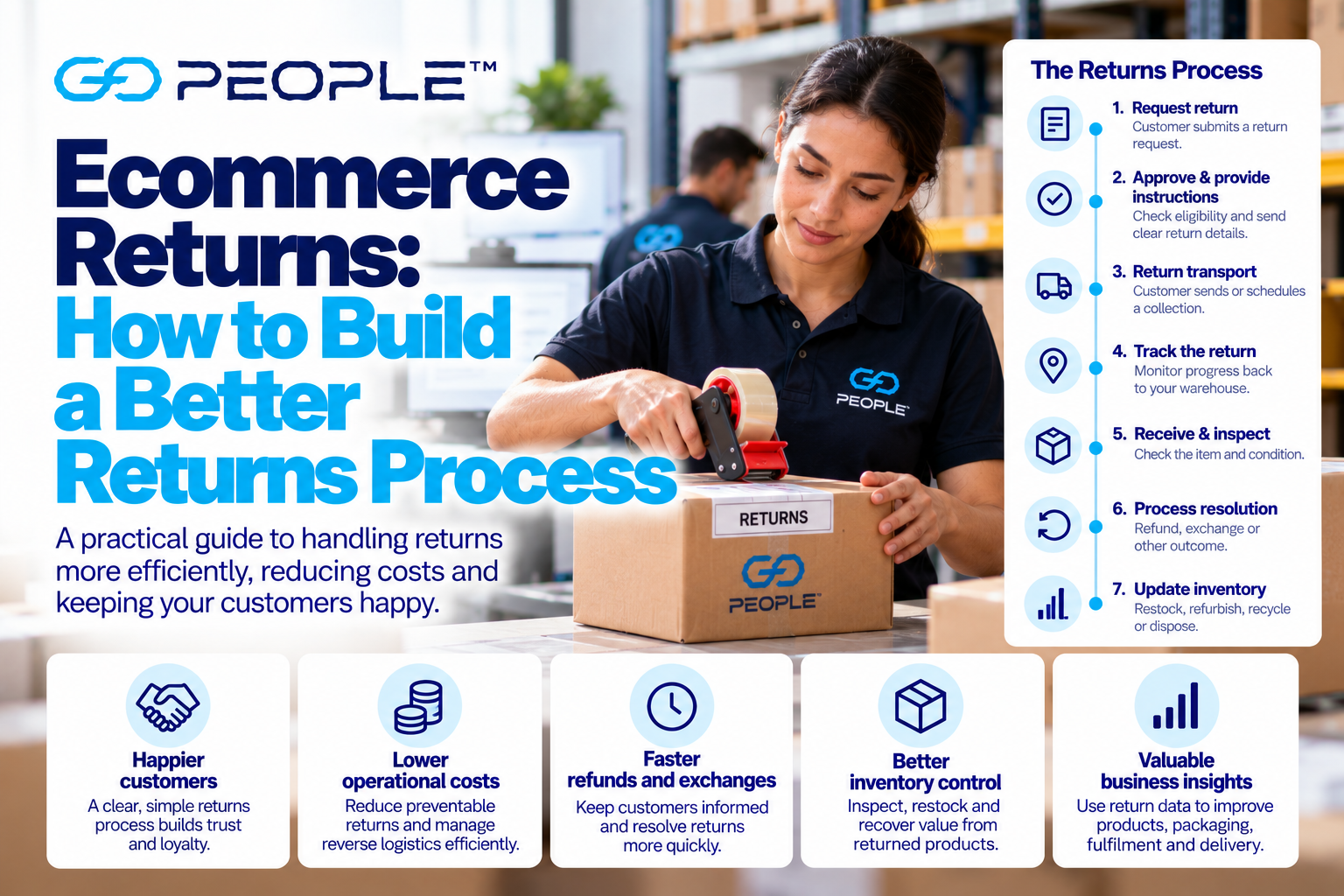
This guide explains how to build a practical ecommerce returns process from the initial customer request through to transport, warehouse receiving, inspection, refund or exchange, and inventory recovery.
What Is an Ecommerce Returns Process?
An ecommerce returns process is the workflow used when a customer needs to send a purchased product back to the retailer.
A typical process may involve:
Customer requests return
↓
Eligibility checked
↓
Return approved
↓
Return instructions provided
↓
Product transported back
↓
Warehouse receives return
↓
Product inspected
↓
Refund, exchange or other resolution
↓
Inventory updated
The exact process varies depending on:
- product type;
- reason for return;
- business policy;
- customer location;
- product value;
- fulfilment model; and
- applicable consumer obligations.
The important thing is that the process is deliberate rather than improvised each time a customer contacts support.
Returns Are Part of the Customer Experience
Businesses sometimes treat delivery as part of the customer journey but returns as an internal administrative problem.
Customers do not see that distinction.
From their perspective, the experience includes:
Shopping → Checkout → Delivery → Product → Support → Return if necessary
A difficult return can influence how the customer remembers the entire transaction.
That does not mean businesses need to accept every return without conditions.
It means the process should be:
- understandable;
- consistent;
- easy to access;
- operationally manageable; and
- aligned with the business’s obligations.
Start With a Clear Returns Policy
The operational process should begin with the policy.
Customers should be able to understand important information such as:
- what types of returns are accepted;
- relevant return timeframes;
- product-condition requirements;
- how to request a return;
- whether proof of purchase is required;
- available refund or exchange options;
- how products should be returned; and
- who pays relevant return-delivery costs where applicable.
The policy should also distinguish appropriately between change-of-mind arrangements and rights or remedies that may apply under Australian Consumer Law.
Businesses should obtain appropriate legal advice when establishing their return terms rather than relying on generic online templates.
Make the Policy Easy to Find Before Purchase
Hiding return conditions may reduce questions before checkout, but it can create much larger problems later.
Customers may want to understand the returns process before purchasing products such as:
- clothing;
- footwear;
- electronics;
- furniture;
- beauty products;
- gifts; or
- higher-value goods.
Useful locations for return information can include:
- website footer;
- product pages;
- FAQ;
- checkout;
- order confirmation; and
- customer account.
The goal is not to overwhelm customers with legal text.
It is to make the important information accessible.
Separate Return Reasons
Not all returns are the same.
A useful returns process categorises why the product is coming back.
Common categories might include:
Change of Mind
The customer no longer wants the product.
Wrong Size or Fit
Common in fashion and footwear.
Wrong Item Ordered
The customer selected the wrong product.
Wrong Item Sent
A fulfilment error.
Damaged in Transit
The product may require investigation of packaging or delivery.
Product Fault
May require a different assessment process.
Product Not as Expected
Could indicate issues with product descriptions, photography or customer expectations.
Duplicate Order
Could result from customer or system error.
The reason matters because the correct resolution may differ.
Why Return Reasons Should Be Structured Data
Suppose a business receives 1,000 returns.
If every return is simply recorded as:
Returned
the business learns very little.
Now imagine the returns are categorised:
- 320 wrong size;
- 210 changed mind;
- 170 product not as expected;
- 120 damaged;
- 90 wrong item sent;
- 60 duplicate orders;
- 30 other.
That information can guide action.
The business may discover that the biggest opportunity is not improving reverse logistics.
It may be improving its sizing information.
Returns data should therefore feed back into the business.
Make Starting a Return Simple
Customers should not need to send multiple emails simply to find out how to begin.
A clear return initiation process might ask for:
- order number;
- customer details;
- product;
- quantity;
- return reason;
- requested resolution; and
- photographs or other information where relevant.
Depending on the business, this could happen through:
- customer account;
- online return form;
- support team;
- email; or
- another defined process.
Consistency matters more than the particular interface.
Don’t Make Customers Repeat Information You Already Have
If a customer is logged into an account and the business already knows:
- order number;
- products purchased;
- purchase date;
- customer address; and
- payment method,
avoid requiring unnecessary re-entry.
Every additional step creates friction and another opportunity for error.
A good returns workflow should connect the return request to the original order wherever possible.
Give Every Return a Reference
Once a return is approved or initiated, assign a clear reference.
This could be linked to:
- original order;
- customer;
- returned product;
- reason;
- return transport;
- warehouse receipt;
- inspection; and
- final resolution.
Without a return reference, support conversations can become confusing.
For example:
“I’m calling about the blue shirt I sent back last week.”
A structured return reference makes it easier to identify exactly which return the customer means.
Explain Exactly What the Customer Needs to Do
After a return is approved, provide clear instructions.
Depending on the process, instructions might cover:
- which product should be returned;
- packaging requirements;
- return reference;
- where the parcel should go;
- whether a label is required;
- collection or drop-off process;
- what information should be included; and
- what happens after the return arrives.
Avoid vague instructions such as:
“Send the product back to us.”
Customers need to understand the actual process.
Return Packaging Matters
A product may be perfectly functional when the customer requests a return but become damaged on the way back.
Return instructions should therefore explain appropriate packaging.
Consider:
- suitable outer packaging;
- protecting fragile products;
- preventing movement;
- protecting original product packaging where relevant;
- securely sealing the parcel; and
- attaching return information clearly.
For fragile goods, the principles in How to Pack and Deliver Fragile Items Safely may also be useful.
Don’t Assume the Original Packaging Still Exists
Customers may discard shipping packaging after opening an order.
If your returns process requires original shipping packaging, consider whether that expectation is realistic and appropriate.
Where alternative packaging is acceptable, explain what the customer should use.
The objective is to protect the product and ensure the return can be identified when it reaches the warehouse.
What Is Reverse Logistics?
Reverse logistics is the movement of products in the opposite direction to normal fulfilment.
Normal ecommerce flow is:
Warehouse → Customer
Reverse logistics is:
Customer → Business / Warehouse / Other Return Location
But reverse logistics involves more than transport.
It may include:
- return authorisation;
- collection or drop-off;
- tracking;
- warehouse receiving;
- inspection;
- refurbishment;
- repackaging;
- restocking;
- recycling;
- disposal; and
- refund or exchange processing.
This is why returns should be treated as an operational system rather than merely a shipping task.
Choose the Right Return Transport Method
Businesses can offer different return methods depending on their products and operating model.
Potential options may include:
Customer Drop-Off
The customer takes the parcel to an approved return location.
Return by Parcel Service
The customer sends the product back using an appropriate parcel-delivery service.
Courier Collection
A courier collects the return from the customer.
Store Return
Omnichannel retailers may allow online purchases to be returned to a physical store.
Scheduled Business Collection
For certain B2B or higher-volume arrangements, returns may be collected as part of another logistics process.
The right model depends on cost, customer convenience, product type and geography.
Collection vs Drop-Off
Neither approach is universally better.
Collection Can Be More Convenient
The customer does not need to travel somewhere to return the parcel.
This may be particularly useful for:
- larger products;
- busy customers;
- business customers; or
- higher-value orders.
Drop-Off Can Be Operationally Efficient
The customer can return the parcel when convenient within the available network.
Businesses should consider both the customer experience and the cost of the return.
Tracking Matters on the Return Journey Too
Customers want visibility when sending something back.
After handing over a return, they may wonder:
- Has it been collected?
- Has it arrived?
- Has the warehouse received it?
- When will my refund be processed?
Tracking can help answer the transport-related part of that journey.
But transport tracking alone is not enough.
The customer also needs visibility into what happens after the parcel arrives.
Delivery Tracking and Return Status Are Different
Suppose tracking says:
Delivered to warehouse Monday
The customer may expect an immediate refund.
But the warehouse may still need to:
- identify the return;
- match it to the order;
- inspect the product;
- determine its condition; and
- process the resolution.
Businesses should distinguish:
Return parcel delivered
from:
Return processed
Clear communication prevents customers from assuming the two events are the same.
Build a Return Status Journey
A useful internal workflow might include:
Return requested
↓
Approved
↓
Awaiting customer handover
↓
In return transit
↓
Received by warehouse
↓
Inspection pending
↓
Inspection completed
↓
Refund / exchange approved
↓
Resolution completed
The customer does not necessarily need every internal status.
But the business should know where each return is in the process.
Warehouse Receiving Is a Critical Step
Returns can become operationally messy when they arrive without a clear receiving process.
A parcel arrives at the warehouse.
Someone opens it.
Nobody knows:
- which order it belongs to;
- why it was returned;
- whether the customer expects a refund;
- whether the item needs inspection; or
- where it should go next.
The warehouse needs a defined returns-receiving process.
Create a Dedicated Returns Area
Where volume justifies it, separate returned goods from normal outbound inventory.
A return may be:
- unopened;
- opened;
- damaged;
- faulty;
- incomplete;
- awaiting inspection; or
- ready to restock.
Placing returned products directly into normal inventory before assessment can create stock accuracy and quality problems.
A dedicated returns area creates a controlled workflow.
Match the Physical Product to the Digital Return
When the parcel arrives, staff should identify:
- return reference;
- original order;
- customer;
- product;
- quantity; and
- stated return reason.
This links the physical item to the return record.
Without this connection, warehouses can accumulate unidentified returned products.
Record the Date the Return Arrived
Customers often measure the return process from the moment tracking says the parcel reached the business.
Businesses should therefore record warehouse receipt accurately.
Useful timestamps might include:
- return requested;
- customer handed over parcel;
- parcel delivered to warehouse;
- warehouse processed return;
- refund approved; and
- refund initiated.
This makes it possible to measure where delays occur.
Inspect Returned Products Consistently
Inspection requirements depend on the product and return reason.
A process may need to determine:
- Is this the correct product?
- Is the quantity correct?
- Is it unopened?
- Has it been used?
- Is it damaged?
- Are components missing?
- Is the reported fault present?
- Is the original packaging included where relevant?
- Can the product be resold?
- Does it require another assessment?
The business should define inspection standards rather than leaving every decision to individual staff members.
Different Return Reasons Need Different Workflows
A wrong-size garment and a damaged electronic product should not necessarily follow identical processes.
For example:
Wrong Size
May be suitable for straightforward inspection and restocking.
Wrong Item Sent
May indicate a fulfilment error requiring operational review.
Transit Damage
May require packaging and delivery investigation.
Product Fault
May require product assessment under the appropriate consumer process.
Change of Mind
May follow the business’s applicable policy.
Categorisation allows the workflow to adapt.
Decide the Product’s Next Destination
A returned item does not automatically go back into inventory.
Possible outcomes include:
Restock
Product is suitable for resale.
Repackage
Product is fine but packaging needs replacement.
Refurbish
Product requires work before resale.
Return to Supplier
Applicable in some supply arrangements.
Quarantine
Product requires further investigation.
Recycle
Product cannot be resold but materials may be recoverable.
Dispose
Product cannot safely or economically be recovered.
The objective is to recover as much value as reasonably possible while maintaining appropriate product standards.
Restocking Speed Matters
Every sellable product sitting in the returns area is inventory that cannot currently generate revenue.
Suppose a returned product is worth $300 and can be resold.
If it sits unprocessed for three weeks, the business has effectively removed that unit from available inventory for three weeks.
For high-volume ecommerce businesses, slow return processing can create substantial hidden inventory.
Update Inventory Accurately
A common mistake is updating stock too early.
If a return is marked as available inventory before physical inspection, the website may sell a product that:
- is damaged;
- is incomplete;
- has not actually arrived; or
- cannot be resold.
Inventory should reflect the product’s real status.
Possible states might include:
- return in transit;
- received;
- inspection pending;
- restock approved;
- unavailable;
- returned to inventory.
The exact structure depends on the business’s systems.
Refund Speed Is Part of the Experience
Once the business determines that a refund should be processed, unnecessary delays can frustrate customers.
Customers may already have:
- requested the return;
- packed the product;
- handed it over;
- waited for transport; and
- waited for warehouse inspection.
Another unexplained delay after approval can make the experience feel much worse.
Businesses should define a clear internal process for moving approved returns to refund processing.
Explain Refund Timing Carefully
There can be a difference between:
Business initiates refund
and:
Customer sees funds in their account
Payment providers and financial institutions may affect the final timing.
Customer communication should distinguish between the two rather than promising an exact banking timeframe the business cannot control.
Exchanges Add Operational Complexity
An exchange is effectively two logistics processes:
Return incoming
Replacement order outgoing
Businesses need to decide whether the replacement is dispatched:
- immediately after approval;
- when the original item enters return transit;
- after warehouse receipt; or
- after inspection.
The right approach depends on product value, fraud risk, inventory and customer-service policy.
Reserve Exchange Inventory Where Appropriate
Imagine a customer wants to exchange:
Size M → Size L
Size L is currently available.
But by the time the return reaches the warehouse, Size L has sold out.
The customer now has a second problem.
Depending on the business model, reserving replacement stock after an exchange is approved may improve the experience.
However, this also temporarily removes inventory from sale, so businesses need appropriate rules.
Returns Can Create Significant Hidden Costs
The cost of a return may include much more than return shipping.
Potential costs include:
- customer support;
- return transport;
- warehouse receiving;
- inspection;
- repackaging;
- payment processing;
- outbound replacement delivery;
- inventory holding;
- markdowns;
- damaged stock;
- administration; and
- disposal.
Businesses should understand the total cost per return.
Calculate Return Cost by Category
Different return reasons create different costs.
For example:
Wrong Size
Return transport + inspection + restocking.
Wrong Item Sent
Return transport + replacement product handling + replacement delivery + support.
Damaged in Transit
Replacement + delivery + support + potential write-off.
Product Fault
Assessment + resolution + logistics + support.
This helps identify which return categories deserve the most attention.
Measure Return Rate
A basic return-rate calculation is:
Returned items ÷ items sold × 100
For example:
500 returned items ÷ 10,000 items sold = 5% return rate
But the overall number is only the beginning.
Segment it by:
- product;
- category;
- SKU;
- size;
- supplier;
- return reason;
- customer segment; and
- sales channel.
Patterns often reveal the real problem.
Track Return Rate by Product
Suppose your average return rate is 6%.
One product has:
28% returns
That deserves investigation.
Possible causes include:
- inaccurate sizing;
- misleading photography;
- unclear description;
- inconsistent manufacturing;
- product quality;
- incorrect specifications; or
- customer expectations.
Returns data can therefore improve merchandising and product decisions.
Track Return Rate by Reason
Consider:
| Return Reason | Share of Returns | Possible Action |
|---|---|---|
| Wrong size | 35% | Improve sizing guidance |
| Not as expected | 20% | Improve descriptions/images |
| Damaged | 15% | Review packaging/handling |
| Wrong item sent | 12% | Improve fulfilment accuracy |
| Changed mind | 10% | Review customer behaviour |
| Fault | 8% | Review product/supplier quality |
This transforms returns from a cost centre into a source of business intelligence.
Measure Return Processing Time
Measure the time between important stages.
For example:
Warehouse receipt → inspection
Inspection → resolution approval
Resolution approval → refund initiation
If the average return takes ten days to process, identify where those ten days are being spent.
The transport leg may not be the bottleneck.
The warehouse could be.
Measure Refund-Related Support Contacts
If customers repeatedly contact support asking:
“Where is my refund?”
the return process may lack visibility.
Track the number of enquiries relating to:
- return status;
- warehouse receipt;
- inspection;
- exchange;
- refund approval; and
- refund processing.
These questions reveal where customers lack information.
Reduce Preventable Returns
The cheapest return is often the one that never needs to happen.
Businesses should use return data to reduce avoidable causes.
Improve Product Descriptions
Customers should understand what they are buying.
Include accurate information about:
- dimensions;
- materials;
- features;
- compatibility;
- colour;
- contents;
- specifications; and
- limitations.
Avoid descriptions that create expectations the product cannot meet.
Improve Product Photography
Images should help customers understand:
- scale;
- colour;
- texture;
- shape;
- product details; and
- how the item looks in realistic use.
For some products, multiple angles or contextual images can reduce uncertainty.
Improve Sizing Information
Fashion businesses often face high return rates because of fit.
Useful information may include:
- detailed size charts;
- garment measurements;
- fit notes;
- model measurements where appropriate; and
- guidance about whether the item runs small, large or true to size.
If a particular product has unusually high size-related returns, investigate it.
Improve Fulfilment Accuracy
Some returns are entirely avoidable.
If the customer orders Product A and receives Product B, the return was created by an internal error.
Businesses can reduce picking and packing mistakes through:
- barcode verification;
- clear warehouse locations;
- order checking;
- better labels;
- appropriate automation; and
- consistent packing procedures.
The objective should be to prevent incorrect orders before they leave the warehouse.
Improve Packaging
Products damaged in transit create expensive returns.
The business may incur:
- lost product value;
- return cost;
- replacement delivery;
- support cost; and
- customer dissatisfaction.
Review whether packaging is appropriate for:
- product weight;
- fragility;
- dimensions;
- movement;
- moisture exposure; and
- normal transport handling.
For fragile products, see How to Pack and Deliver Fragile Items Safely.
Reduce Delivery Problems
Sometimes the return itself is caused by delivery.
Examples might include:
- damage;
- prolonged delay;
- incorrect delivery;
- failed delivery; or
- the order arriving after the customer needed it.
Monitor delivery-related return reasons separately.
They may indicate that improving the outbound delivery process could also reduce return volume.
Returns Fraud Needs a Balanced Approach
Returns processes can be abused.
Potential issues can include:
- returning a different product;
- returning used goods as unused;
- false damage claims;
- repeated suspicious return behaviour; or
- attempting to return products not purchased from the business.
Businesses may need appropriate controls.
But excessive fraud prevention can make legitimate customers feel like suspects.
The objective is to balance:
customer convenience + commercial protection
Controls should be proportionate to the risk.
Higher-Value Products May Need Additional Verification
A $20 product and a $2,000 product may justify different return controls.
Depending on the business, higher-value returns may require:
- serial-number verification;
- photographs;
- more detailed inspection;
- secure transport arrangements;
- signature or handover controls; or
- additional authorisation.
The process should reflect the product’s value and risk.
Return Transport Should Match the Product
Not every item belongs in a standard parcel network.
Products may have:
- unusual dimensions;
- special handling requirements;
- dangerous-goods classifications;
- temperature requirements;
- high value; or
- other transport constraints.
Businesses should confirm that the selected return method is suitable for the goods being transported.
Do not assume that because an item arrived using one method, every return arrangement is automatically appropriate.
Failed Return Collections Need a Process
If a return is being collected from the customer, the collection itself can fail.
Possible reasons include:
- customer unavailable;
- wrong address;
- parcel not ready;
- access issue;
- incorrect contact details; or
- booking error.
The returns workflow should define what happens after an unsuccessful collection rather than leaving the customer and support team to improvise.
Business Returns Can Be Different From Consumer Returns
B2B ecommerce may involve:
- larger quantities;
- recurring customers;
- account managers;
- scheduled collections;
- pallet or carton returns;
- replacement stock;
- contractual arrangements; and
- different approval workflows.
Businesses serving both consumers and commercial customers may need separate return processes.
Trying to force both into one workflow can create unnecessary complexity.
Consider a Hybrid Reverse-Logistics Model
Not every return needs to use the same transport method.
A business might use:
- customer drop-off for routine small returns;
- parcel return services for standard ecommerce orders;
- courier collection for higher-value or urgent returns;
- scheduled collection for business customers; and
- specialist transport for goods with specific requirements.
Segmenting return methods can improve the balance between convenience and cost.
Delivery Services Can Support Parts of the Returns Journey
Depending on the location, goods and delivery requirements, businesses may use different delivery models to move returns.
For example, GoVIP can suit eligible urgent or time-sensitive individual courier requirements.
GoSAMEDAY provides same-day delivery for eligible business pickups, while GoBUNDLE can support eligible multi-drop business delivery requirements.
The appropriate service depends on the actual return flow. Businesses should confirm service eligibility and suitability rather than assuming every return should use the same delivery method.
Integrate Returns With Customer Service
Support teams should be able to determine:
- whether a return was requested;
- whether it was approved;
- whether it is in transit;
- whether it arrived;
- whether it was inspected;
- what resolution was approved; and
- whether the resolution was completed.
Without this information, support agents become investigators.
They may need to contact:
- warehouse;
- finance;
- operations; and
- logistics
for every customer question.
Shared visibility can dramatically simplify support.
Integrate Returns With Warehouse Operations
The warehouse needs to know what is coming back.
Where practical, return information should reach the warehouse before the parcel does.
That may include:
- return reference;
- expected product;
- quantity;
- reason;
- customer;
- original order; and
- expected resolution.
Then when the parcel arrives, staff can match the physical item to an existing return record.
Integrate Returns With Inventory
When a returned product is approved for resale, inventory needs to reflect that.
When it cannot be resold, the system should avoid accidentally making it available.
Returns therefore connect:
customer service + logistics + warehouse + inventory + finance
Treating returns as a standalone support function can create data gaps between these teams.
Integrate Returns With Finance
A refund is a financial transaction.
The returns process should establish when finance or the payment system receives the instruction to act.
Businesses should avoid situations where:
warehouse thinks refund was processed
but:
finance is still waiting for approval
A clear status and ownership model prevents returns from falling between departments.
Assign Ownership at Every Stage
Each stage should have an owner.
For example:
| Stage | Possible Owner |
|---|---|
| Return request | Customer service |
| Eligibility review | Customer service |
| Return transport | Logistics |
| Warehouse receipt | Warehouse |
| Inspection | Returns/warehouse team |
| Refund approval | Relevant authorised team |
| Refund processing | Finance/payment system |
| Restocking | Inventory/warehouse |
The exact responsibilities vary.
What matters is that everyone knows who owns the next step.
Set Internal Service Targets
Businesses can define internal targets for stages such as:
- return-request response;
- warehouse receiving;
- inspection;
- resolution decision;
- restocking; and
- refund initiation.
These are operational targets rather than necessarily customer promises.
Tracking them helps identify bottlenecks.
Create a Returns Dashboard
A useful returns dashboard might include:
- total returns;
- return rate;
- return reasons;
- returns by product;
- return processing time;
- refund processing time;
- return transport cost;
- value recovered through restocking;
- damaged-return rate;
- return-related support contacts; and
- repeat return behaviour.
This allows management to see whether returns are improving or deteriorating.
Calculate Value Recovery
Returns are not only about cost.
Businesses should also measure how much value is recovered.
For example:
Returned inventory value: $100,000
Of that:
- $70,000 restocked;
- $10,000 refurbished;
- $5,000 returned to supplier;
- $15,000 written off.
This gives a clearer picture of the financial impact.
A faster returns process may increase recovery by getting sellable inventory back into circulation sooner.
Use Returns Data to Improve Purchasing
If particular products repeatedly come back, buying teams should know.
A high return rate can affect the true profitability of a product.
Consider:
Sales revenue
minus:
- cost of goods;
- outbound fulfilment;
- outbound delivery;
- return transport;
- return processing;
- write-offs;
- support; and
- refunds.
A product with strong gross sales can become much less attractive after return costs are included.
Use Returns Data to Improve Suppliers
If a supplier’s products repeatedly generate:
- faults;
- inconsistent sizing;
- missing components; or
- quality complaints,
returns data can provide evidence for supplier discussions.
Without structured return reasons, these patterns can remain hidden.
Use Returns Data to Improve Delivery
If return reasons repeatedly mention:
- damaged parcel;
- late arrival;
- wrong-address delivery; or
- unsuccessful delivery,
review the logistics process.
The return may be a symptom of an outbound delivery problem.
See How to Deal With Common Delivery Problems Effectively for a broader delivery-problem framework.
Create a Returns Root-Cause Loop
A mature returns process does not end when the refund is issued.
It asks:
Why did this return happen, and can we prevent similar returns?
A useful cycle is:
Return occurs
↓
Reason captured
↓
Product inspected
↓
Root cause identified
↓
Data aggregated
↓
Process/product improvement
↓
Future returns reduced
That turns returns into an improvement system.
Don’t Optimise Only for a Low Return Rate
A low return rate is not automatically good.
A business could reduce returns by making the process extremely difficult.
Customers might then:
- abandon the return;
- complain;
- dispute the transaction;
- leave negative reviews; or
- never purchase again.
The objective should be:
reduce preventable returns while handling legitimate returns efficiently
not:
make returns difficult enough that customers give up.
Balance Customer Convenience and Operational Cost
Extremely generous returns can be expensive.
Extremely restrictive returns can damage customer confidence.
Businesses need a sustainable balance.
Consider:
- product margins;
- average order value;
- customer lifetime value;
- return rate;
- product recoverability;
- transport costs;
- fraud risk; and
- customer expectations.
The correct balance will vary by business.
A Practical Ecommerce Returns Workflow
A strong returns process might look like this:
Step 1 — Customer Requests a Return
Capture order, product and return reason.
Step 2 — Determine the Appropriate Process
Check relevant policy and obligations.
Step 3 — Create a Return Reference
Link the return to the original order.
Step 4 — Provide Clear Instructions
Tell the customer what to return and how.
Step 5 — Arrange the Return Journey
Use an appropriate drop-off, parcel or collection method.
Step 6 — Track the Return
Maintain visibility where available.
Step 7 — Receive It Into a Controlled Warehouse Process
Match the physical product to the return record.
Step 8 — Inspect the Product
Assess condition and confirm the return reason.
Step 9 — Determine the Resolution
Refund, exchange, replacement or other appropriate outcome.
Step 10 — Update Inventory
Restock, quarantine, refurbish or otherwise classify the product.
Step 11 — Complete the Customer Resolution
Process the approved outcome and communicate it clearly.
Step 12 — Record the Root Cause
Use the data to reduce future returns.
Ecommerce Returns Checklist
Before considering your returns process complete, ask:
Policy
- Is the return policy clear?
- Can customers find it easily?
- Does it distinguish different return scenarios appropriately?
Customer Experience
- Can customers start a return easily?
- Are instructions clear?
- Can they understand what happens next?
Logistics
- Is the return method suitable?
- Can the return be identified and tracked?
- Are failed collections handled?
Warehouse
- Is there a defined receiving process?
- Are returns separated from normal inventory?
- Are inspection standards consistent?
Inventory
- Is stock updated only after appropriate assessment?
- Are sellable products returned to inventory quickly?
Finance
- Is refund ownership clear?
- Can refund status be identified?
Data
- Are return reasons recorded?
- Are return rates measured by product?
- Are recurring causes investigated?
Improvement
- Are returns insights shared with product, fulfilment and logistics teams?
- Are preventable return causes being reduced?
If several answers are “no”, the returns process probably has opportunities for improvement.
Returns Should Be Designed, Not Improvised
As an ecommerce business grows, informal return processes become increasingly difficult to manage.
What works at:
10 orders per day
may fail at:
1,000 orders per day.
Email threads, spreadsheets and ad-hoc warehouse decisions can eventually create:
- lost returns;
- duplicate refunds;
- unidentified stock;
- slow processing;
- support escalations; and
- inaccurate inventory.
Returns need the same operational thinking as outbound fulfilment.
The Best Returns Process Starts Before the Return
A strong returns operation begins long before a customer sends something back.
It starts with:
- accurate product information;
- good photography;
- useful sizing;
- correct fulfilment;
- suitable packaging;
- reliable delivery; and
- realistic customer expectations.
Then, when a return is genuinely necessary, the business needs:
clear policy
simple initiation
appropriate reverse logistics
tracking and visibility
controlled warehouse receiving
consistent inspection
fast resolution
accurate inventory
root-cause analysis
Returns will never disappear completely.
But businesses can make them easier for customers, less expensive to manage and far more useful as a source of operational insight.
Frequently Asked Questions
What is an ecommerce returns process?
An ecommerce returns process is the workflow used to manage products customers send back, including the return request, transport, warehouse receiving, inspection, refund or exchange, inventory updates and final resolution.
What is reverse logistics?
Reverse logistics is the movement and management of products travelling back from the customer toward the retailer, warehouse, supplier or another return destination. It can include transport, inspection, restocking, refurbishment, recycling and disposal.
How can ecommerce businesses reduce returns?
Analyse return reasons and address preventable causes. Common opportunities include better product descriptions, clearer sizing, improved photography, more accurate fulfilment, better packaging and more reliable delivery.
Should customers be able to track returns?
Where tracking is available, it can help customers and businesses understand the transport stage of a return. Businesses should also communicate what happens after the returned parcel reaches the warehouse.
What should businesses measure about returns?
Useful metrics include return rate, reasons for return, returns by product, processing time, refund-related enquiries, transport cost, value recovered through restocking and product write-offs.
How quickly should ecommerce returns be processed?
There is no single operational timeframe appropriate for every return. The business should process returns efficiently while allowing for the required receiving, inspection and resolution steps and complying with applicable consumer obligations.
Are ecommerce businesses required to accept every return?
Return obligations depend on the circumstances, including whether there is a problem with the product and applicable Australian Consumer Law. Change-of-mind policies can differ between businesses. Businesses should ensure their policies comply with applicable law and obtain professional advice where necessary.